Most Jazz musicians have a dual, connected complaint: the lack of gigs and the lack of places where they can play their kind of music. This is not new. In fact, it was already being chronicled in the 1920s, when Eddie Condon and his crowd complained about having to play “sweet” music in order to eat while “hot” music got relegated to rent parties and after-hours sessions. Things got worse when extended gigs at a single venue came to an end. Long gone are the days when Dizzy Gillespie played a seven-week stint at the Downbeat club in Philadelphia.
Every so often, a jazz musician will take the reins at a nightspot—Eddie Condon opening his place in the 1930s, Harry Minton taking over Harlem’s famous spot in the 1940s, or more recently, Spike Wilner at Small’s. There’s Wynton Marsalis running Jazz at Lincoln Center and Boston’s George Wein’s Storyville jazz club and the Newport Jazz Festival.
Apart from these capital-intensive undertakings, the need for places to gig has given rise to a network of grassroots venues for jazz performance across the country, some of them started by the musicians themselves. At one time in my home town Boston, there was Reid Jorgensen’s Studio 203 and the Friends of Great Black Music loft, which accommodated the first John Coltrane Memorial concert in 1977. Today we have Wally’s, Outpost 186 and the Lilypad (The reason we have those in Boston’s overheated real estate market is that the proprietors own the buildings).
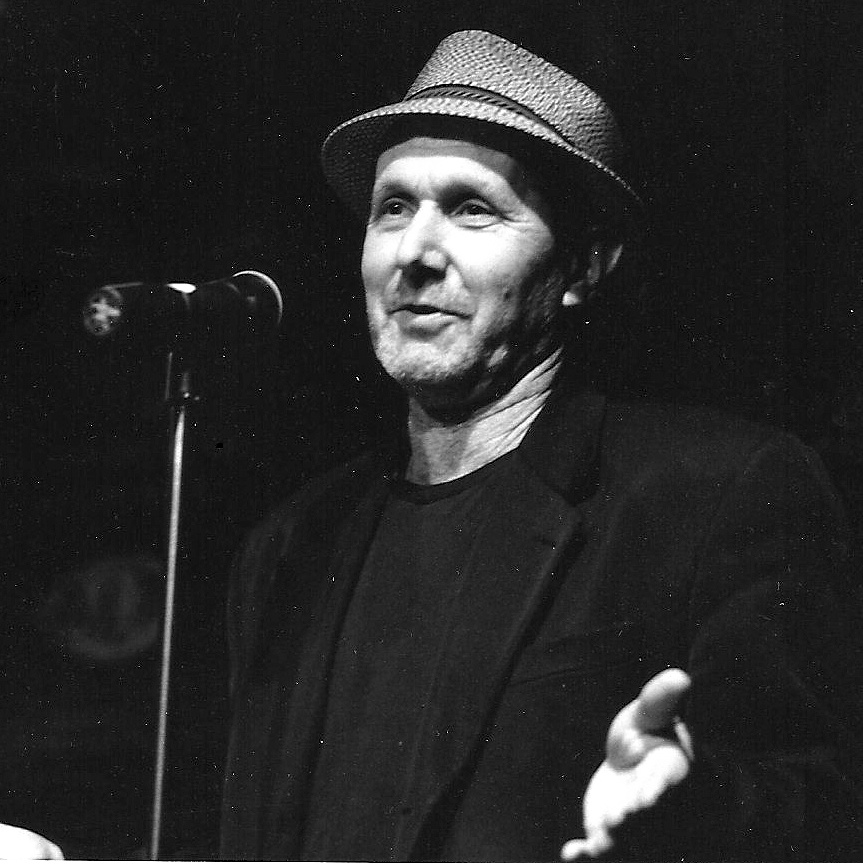
One of the most successful, longest-lived grassroots effort is the Outpost Performance Space in Albuquerque, New Mexico, founded 38 years ago by saxophonist Tom Guralnick. I recently zoomed with Tom and we dug into what it takes to make such a project come to pass and to survive.
Tom Guralnick comes from Brookline, MA (we were in the same year in the same grammar and high schools), a near-Boston suburb that punches above its weight musically, producing people like Aaron Goldberg, Mary Halvorson, Bob Margolin, Tony Levin and Peter Malick. Tom Guralnick’s brother is the well-known writer Peter Guralnick author of biographies of Elvis Presley, Sam Cooke and Sam Phillips. Peter was seven years older than Tom and gave him a thorough immersion in blues, soul and jazz.

Tom played some guitar in high school and then took up the saxophone in college. He started at Harvard but transferred to Bennington College to study with trumpeter/composer Bill Dixon. It was there that he met vocalist and percussionist David Moss and Baird Hersey whose band, Hersey’s “Year of the Ear,” he joined soon after.
After graduating from Bennington, he had the idea of learning how to repair saxophones and got a job working at Powell Flutes, although he never made the transition to saxophone repair. After his first trip to New Mexico, which we’ll talk about, Guralnick graduated in World Music studies at Wesleyan and created the infrastructure for his own solo saxophone concerts.
Guralnick had met his first wife at Bennington and they went out to New Mexico in 1976 so she could pursue her MFA. Guralnick got into trying to create a scene that was, he says: “…informed by the avant-garde…There were great players out there—just like there are everywhere.” He hooked up with New Mexico Jazz Workshop, which had formed in 1976 and held jam sessions at Madrid ballpark. In 1978 Guralnick took over that project and brought out Baird Hersey, David Moss, Fred Frith, Bob Ostertag and Steve Feld to play. He received a grant from the NEA and over the next two years, brought in the Art Ensemble of Chicago, Sam Rivers, Anthony Braxton and Sun Ra. Then, he developed a mainstream series featuring Art Pepper, Dexter Gordon and Woody Shaw.
A Cecil Taylor concert he produced was recorded and is finally being released on October 16. That album, a two-LP set on Black Editions Archives called Live at the KiMo Theater, Albuquerque 1979, includes work by the Cecil Taylor unit at the time, Ramsey Ameen, violin, Jerome Cooper, drum kit, balafon, shehnai, whistle, Jimmy Lyons, alto sax, Alan Silva, bass and cello and Cecil Taylor on piano.
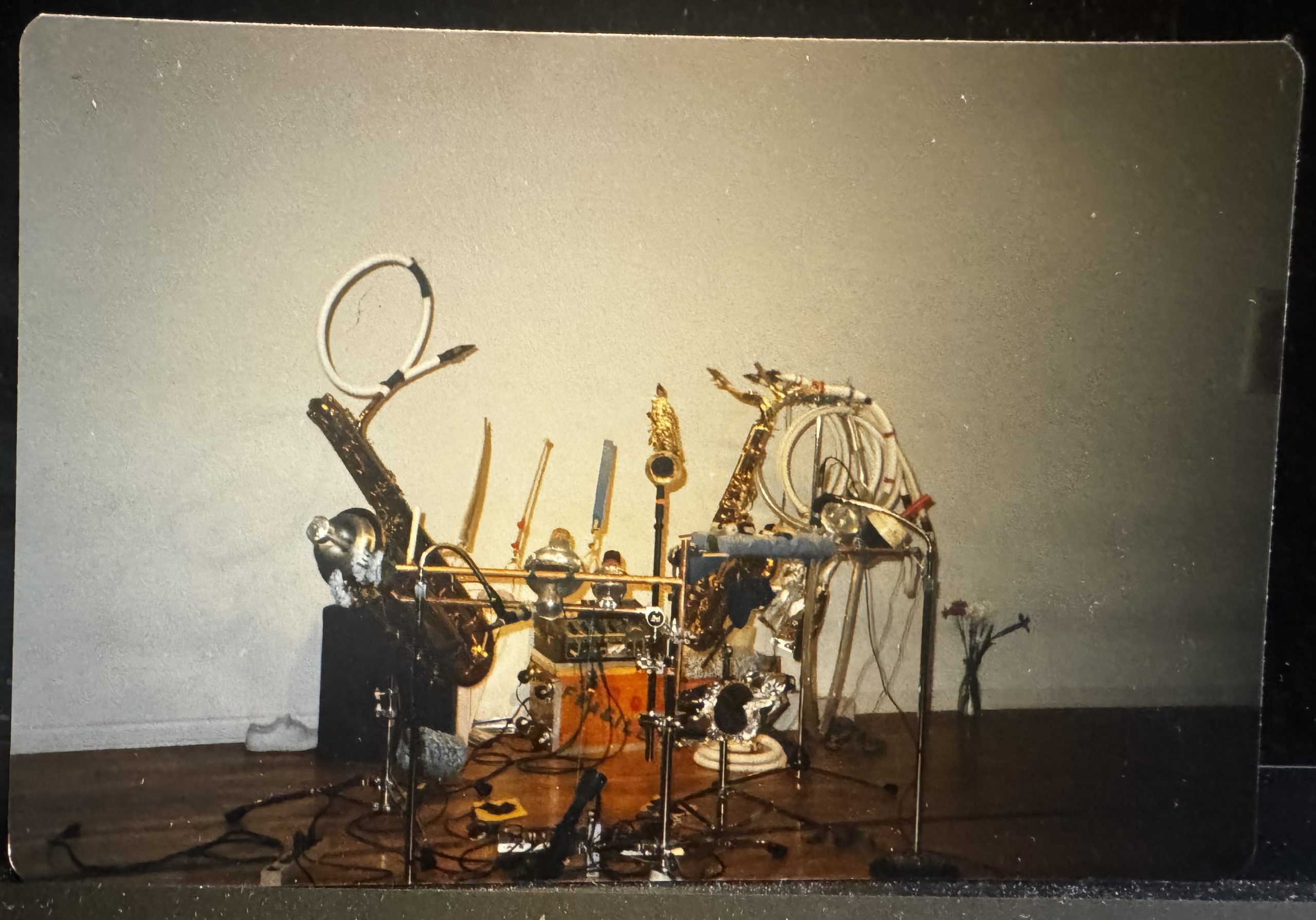
In 1981, he returned to Boston, studied with pianist/educator Charlie Banacas and started to develop his solo sax setup. Guralnick says: “I like to build things. I did plumbing and maintenance at my family’s summer camp and in my parents’ basement I started building a setup to play solo saxophone…The set-up I developed I came to call, in a somewhat tongue-in-cheek way, the ‘Mobile Saxophone and Mute Unit’— far from easily mobile as I toured…with 2 large wooden cases and a 60 pound carry-on bag filled with instruments, tubing, drum stands, electronics…Movement became an intrinsic part of the performance as I kicked electronic triggers, jumped from one instrument preparation to the next, swung tubes with mouthpieces (vacuuphone) over my head…The physical movement defined and shaped the sound and the performance.”
Guralnick had always listened to World Music and in 1983 said: “I figured this is cool, maybe I should just do my own music and get a Master’s degree and that’s when I applied to Wesleyan.” At that university’s World Music program, he studied the Indian Mridangam and African drums and had a chance to hear virtuoso artists from around the world. He did his thesis on solo saxophone playing, analyzing the form and its history and holding extensive conversations with some of its foremost practitioners, including Evan Parker, Roscoe Mitchell and John Zorn.
During the mid-1980s, Guralnick toured in New York, Europe and Australia as a solo act and also with his trio TG3, with Guralnick on multiple saxes, Steve Feld, low brass, and Jefferson Voorhees, drums.
Guralnick had previously bought a house in Albuquerque, and decided to move back to New Mexico in 1986. He finished his solo album entitled Albuquerque and started a quartet that played his compositions. They were playing house concerts and in bigger venues when, in 1988, he decided to create a performance space. “I think it probably came out of the touring in Europe where if twenty people were there it was like a huge crowd for me and it felt good. And there were all kinds of performance spaces like that…From the beginning, we had a non alcohol, non smoking space, cause people still smoked in venues.” Guralnick’s present wife warned him about the name “Outpost,” as it could be seen to carry colonialist or military connotations and might get him “canceled.” His reply: “The idea of the name ‘Outpost’ wasn’t like this bastion of civilization among the uncivilized people. The idea is that these kinds of places should exist all over the country,” a sentiment that Michael Brecker echoed from the Outpost stage in 2004.

So, the Outpost Performance Space began: “The great thing about Albuquerque,” Guralnick says, “is it just doesn’t cost too much to do a performance space. Real estate is pretty rough in Boston. I bought the Outpost building and there was an apartment upstairs where I lived for several years.” “For a minute,” Guralnick says, “the focus was on World Music and quote unquote New Music. We did Indian as well as other world music and jazz and blues. One of the first ones was Johnny Shines, Pops Staples and John Hammond.” More experimental music was presented in The Living Batch, a local bookstore.
The Outpost had a $10,000 budget, then Guralnick got a $30,000 grant and became a part of the Lila Wallace Reader’s Digest National Jazz Network. “With the grant, we had $40,000,” he says, “and I almost went broke right away because I thought I had a lot of money.” As Executive Director Guralnick, no longer negotiated with performers, but paid them what they asked for. It just didn’t work: “It was a tricky thing to get into that grant world and realize how quickly it went…I presented all these acts that didn’t make any money.” Years before, in 1980, Sun Ra had brought out 700 people and 450 came for the Art Ensemble. Ten years later, Thomas Mapfumo from Zimbabwe drew well, but in general the audiences for the avant-garde players didn’t.
However, the Outpost was doing active outreach and involved in more than just concerts: “In 1996 we started to do classes. Three classes a week for youth and adults—ensembles and instruments. We’d bring in kids from schools for concerts. I work with a local youth rock academy, who are great. We have teen performances.”

Guralnick says the city of Albuquerque has always been very supportive: “For the last 10 years we get a chunk of money through the City Council…We do a couple of big free concerts that are in conjunction with the city. Last night, we did a blues night on Civic Plaza and we had two local groups plus headliner Judith Hill…We have 1,000 members, so we’re very strongly supported by the community. Our budget now is $800,000. $300,000 is from donations.”
“The board was always strongly supportive of me as the founder. What happens after the founder goes is another story. I’m doing everything I can to make it work beyond me, as I’m gonna retire in a couple of years.” There’s no obvious successor and Guralnick says they’ll do a search and then he’ll spend 6 months showing him or her the ropes. He’ll retire, but “I will help out as long as I’m wanted.”
“I feel confident [about the future],” Guralnick says. “I also have a lot of self-doubt. I mean that’s part of my personality so I don’t ever see things in the totally rosy way. I mean I’m scared but you know we’ve done amazing things for 40 years and I have a belief, a kind of underlying belief that things will work out…I guess I’m confident enough to be doing this renovation, right when I’m leaving, a $2 million renovation. We have a five million dollar capital campaign which includes facility renovation, a 1 million dollar endowment and more. We’ve raised two and a half million dollars and the renovation is 2.3 million of that, so we still need to raise another million to get going with it but I somehow believe it will happen.”
So, what has Guralnick had to do in order to make the Outpost survive and prosper? “I did everything,” he told me. “I wrote grants, raised money, fixed the space up, helped build the stage…I have worked 60-80 hours a week for the last 40 years.”
Guralnick casts a long shadow. In 2018 he was named a “Jazz Hero” by the Jazz Journalists Association and was also a recipient of the “Platinum Music Award” from the New Mexico Music Association. Whoever follows Guralnick will have their work cut out for him or herself, but for anyone who would consider taking on the job, there does exist a support system for would-be jazz entrepreneurs, at least in the West—The Western Jazz Presenters Jazz Network which was founded in 1998. Other members include Randall Kline of the San Francisco Jazz Center (a bass player), Tim Jackson of the Kuwumba jazz center in Santa Cruz (sax player) and John Galbreath of Earshot Jazz, among others.
Notice that many of the other entrepreneurs are also musicians, trying to solve the old problem of finding places to gig. “We did it because it was the only way to do it,” Guralnick says. “It came out of do-it-yourself and the loft scene. All that generation did it because we loved the music—and were crazy.”
Guralnick may say: “I do things in weird ways,” but there’s certainly a method to his madness. I say, if weirdness and craziness—plus a lot of steely resolve—are what it takes to create more venues where jazz musicians can blow, then let them flourish across the land.
Steve Provizer is a brass player, arranger and writer. He has written about jazz for a number of print and online publications and has blogged for a number of years at: brilliantcornersabostonjazzblog.blogspot.com. He is also a proud member of the Screen Actors Guild.