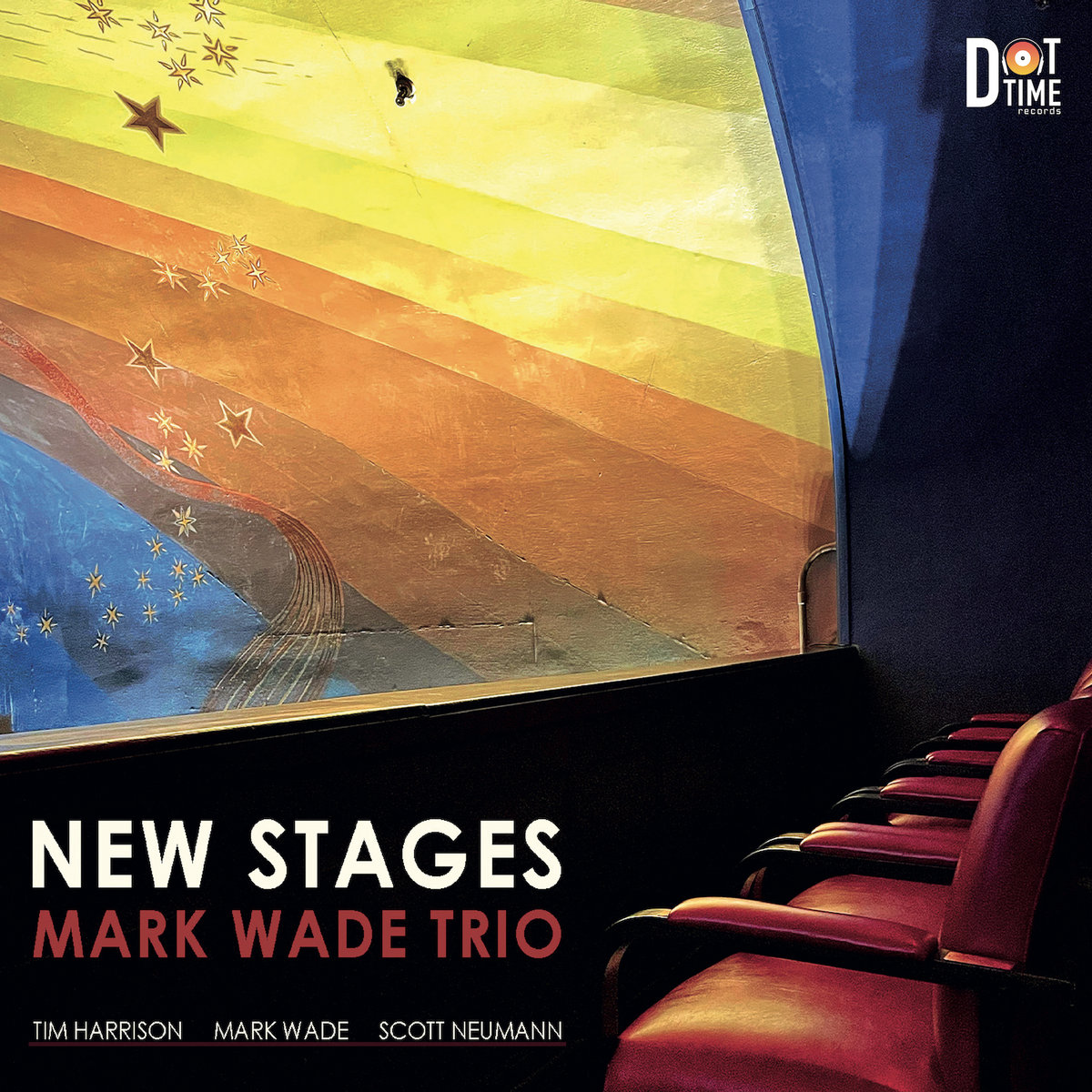
 For a few decades during the last century, when classical music was a familiar part of the musical landscape, many jazz bands borrowed tunes with pleasing results. John Kirby’s sextet recorded several such examples (his Schubert Serenade is a knockout), and Freddy Martin set lyrics to those strains. Harry James played the Bumblebee; Woody Herman did the Sabre Dance. The practice has fallen off a great deal since then, but two recent recordings remind us that, as bassist Mark Wade puts it, “A good tune is a good tune.”
Wade’s trio performs on New Stages (Dot Time), a fifteen-track collection that takes some unusual turns through the classical repertory, while pianist Ted Rosenthal’s trio (and guests) explore eleven songs on Impromp2 (TMR), so-named because it’s a follow-up to his 2010 collection of classical-informed pieces.
Both collections share rhythmically compelling, harmonically inventive approaches to the music under consideration and, remarkably, given the breadth of source material out there, they also share a single piece: Chopin’s Waltz in A-Flat Major, Op. 69 No. 1, known to many as the “Farewell.”
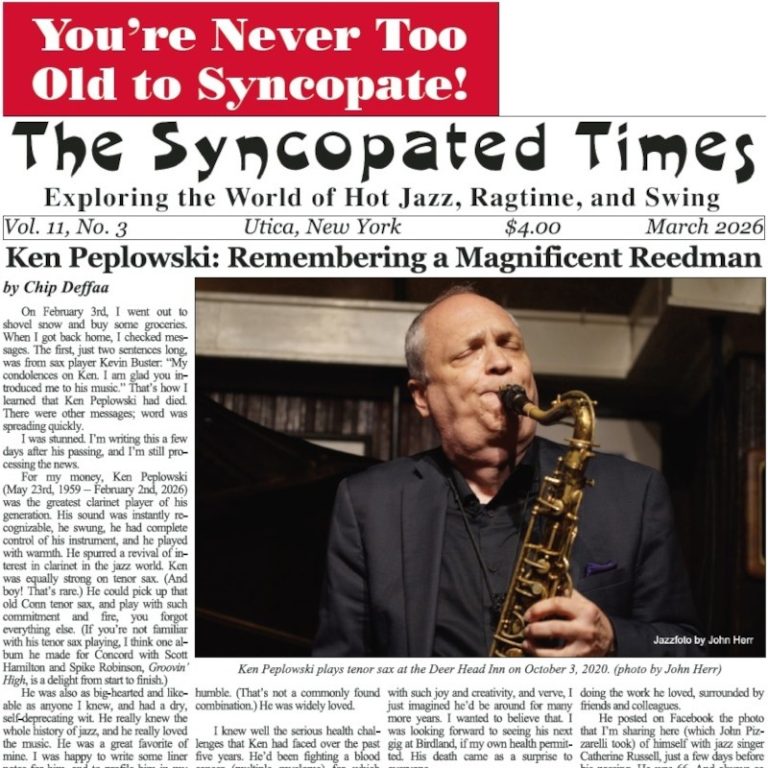
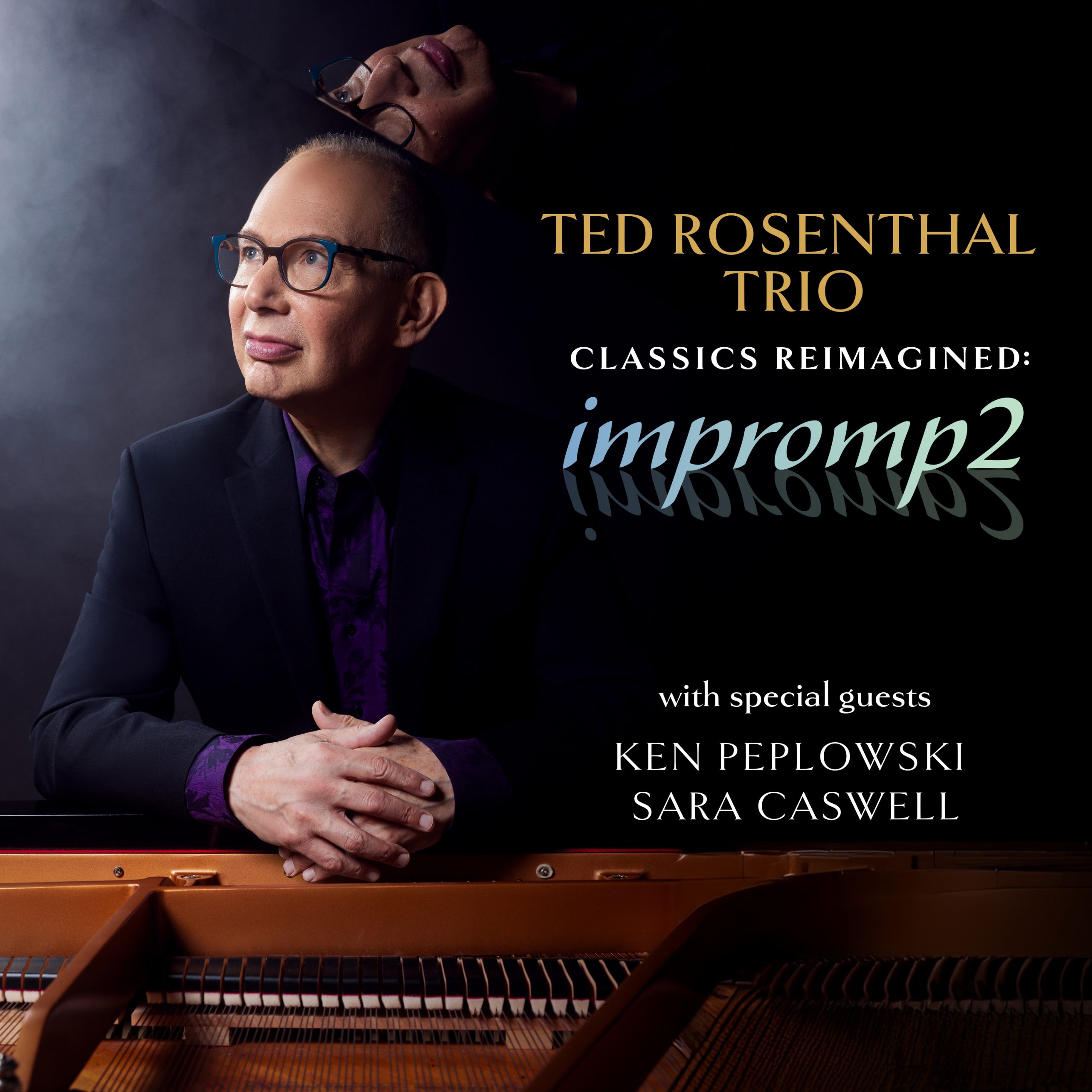 Rosenthal’s version was fashioned as a vehicle for Ken Peplowski, in one of the clarinetist’s final sessions (see Chip Deffaa’s tribute to Peplowski in the March issue of TST). It opens with a straightforward reading of the tune by Peplowski in duet with Rosenthal, who gives a light swing to his first solo passage; without deviating very much from the structure of the piece, Peplowski and Rosenthal alternate 16-bar passages, diving behind its innocent sweetness to embellish the melody with increasing urgency before Peplowski calms it again and brings it home.
On Wade’s recording, pianist Tim Harrison starts off in the salon, his approach for the first minute of the piece coming right from the original page, but with embellishments. Then bass (Wade) and drummer Scott Neumann kick in, the tempo picks up, and we burrow into the harmonic structure of the piece, isolating fragments of the melody and further exploring what they can build from those fragments. We’re treated to bass solos and drum breaks before piano takes a broader sweep through the flavor of the original, again heightening the energy by exploring the short phrases they discovered.
Both leaders toil in the trenches of both classical and jazz, which is how a freelancer survives in the city, alongside writing and teaching, and straddling those genres (probably with some Broadway thrown in) enriches one’s work in each.
A coin-toss determined the order in which I’m considering these albums; thus, we begin with Rosenthal. “Classical music has been a part of my musical life for quite some time,” says he. “I was a classical piano major at the Manhattan School of Music back in the day when you couldn’t be a jazz major because they didn’t have a jazz program. In fact, the jazz program started the year I graduated, and now, of course, I’m on the faculty at MSM.” But even before he began studying classical piano, he explains, “I grew to really love and enjoy and pursue classical music, both in its own right and also as a means to find new ways of approaching jazz.”
Which includes the borrowing of melodic material, which, he notes, is like approaching a standard. “After my earlier album came out, there was a reviewer in Boston who said something like, ‘I stepped away from the CD player and thought, “That sounds like a Cole Porter tune, but I don’t really know what it is.”’ And it turned out to be a Chopin Nocturne.
Another Chopin waltz opens the record, this one in C-Sharp Minor, Op. 64 No. 2. You well may know the tune, but you probably haven’t heard it cast as a samba, as happens here. Yet it sounds right at home in this setting. “That seems to be a real crowd-pleaser,” says Rosenthal. “I’ve been playing it for a few years, and I’ve also made an arrangement of it for chamber orchestra or strings. Last summer I enjoyed seeing the violinists playing the swing melody, all doing it with smiles on their faces.”
Yet one more Chopin piece is here, this one the Mazurka in A Minor, Op. 17 No. 4. It’s marked Lento, and the players luxuriate in that Lento, with the jazz impulses propelling it in much the same way as a traditional mazurka’s dotted-note rhythms. And watch out for the false ending! Chopin’s original almost sounds like a jazz tune on its own after listening to Rosenthal’s version, a tribute to the persistence of jazz once it gets into your ears.

Burrowing solidly into the repertory, Rosenthal found Brahms’s Third Symphony, specifically the third movement, marked Poco allegretto but always performed at an easy pace. There’s a rocking feel to the melody, which becomes grist for over seven minutes of introspection and improvisation. “That one has been sitting in my stack of music for close to 20 years,” he explains, “and I was never quite comfortable with the form. When you’re playing the theme in jazz, you’re improvising, and if you’re not comfortable with how the form is spinning out, then it’s just not going to work. I finally had to make some decisions about it because the phrase lengths that Brahms uses are not all regular. It took a period of living with it as a jazz tune.”
Two movements from Beethoven’s “Pathetique” Sonata are featured. The slow movement is a piano solo every bit as affecting in its way as is the original, culminating in a back-and-forth between two contrasting themes, in keeping with the character of the original. The brisk third movement brings in the trio to cavort in an Ellingtonian manner.
Peplowski gets another soulful showcase, this one “The Old Castle” from Mussorgsky’s “Pictures at an Exhibition.” Originally written for piano, orchestrated by Ravel (also by many others), played out of those contexts by artists as different as Andrés Segovia and Tomita, it lends itself nicely to clarinet, especially in such able hands.
Peplowski died in February at the age of 66, “and that was pretty shocking,” says Rosenthal. “Ken and I have done many things over the years, and one of the ways we’ve connected musically is this connection with the classical world, because he’s such a beautiful clarinetist and has such a beautiful tone that people always think of Benny Goodman.”
Also guesting on three numbers is violinist Sarah Caswell, playing Elgar’s “Salut d’amour,” written as a violin feature and given feather-light touches of jazz, as is “Je te veux,” a neglected song by Erik Satie. But it’s on Rachmaninoff’s “Vocalise” that Caswell really shines, summoning the mournful Russian-ness of the piece. “There’s such richness in there,” notes Rosenthal, “especially harmonically, and a beautiful melody, that we just can make a few alterations and kind of loosen it up in a way that seems to fit really nicely. Sarah was a student of mine at Manhattan School Music in a jazz combo, so I’ve known her a long time, and
I’m very happy to see how successful she’s been since.”
Appearing on the recording as well are Noriko Ueda on bass and Quincy Davis or Tim Horner on drums, musicians who also have worked with Rosenthal for many years. Although the album might seem an unlikely fusion of genres, “I love them both,” says Rosenthal, “and I love finding the commonalities and appreciating the differences.”
Mark Wade’s “New Stages” is the work of a bass player who started out on only one side of the aisle. “I went to school for jazz,” he says, “and classical music was something I came to late in life. I didn’t start listening to it till I was in college. It was almost like a hobby at first, but it eventually became part of my career. So I do both.”
A five-time finalist for Bassist of the Year in the DownBeat Magazine Readers’ Poll, he appears venues such as Jazz at Lincoln Center, The Blue Note, The Iridium, and Birdland, and he’s a longtime member of the Pete McGuinness Jazz Orchestra. On the classical stage, he has worked with the Key West Symphony as well as the Orchestra of the S.E.M./Janáček Philharmonic (Czech Republic) at both Lincoln Center and Carnegie Hall. But, he points out, “My band is a jazz ensemble, so from all those years of playing and listening to classical music this seemed like a project that would fit.”
He drew from an eclectic list of sources. Four movements from Debussy’s “Children’s Corner Suite” start off the album, including the most famous number from that set, “Golliwog’s Cakewalk.” Debussy used the middle of the piece to poke fun at Wagner’s “Tristan Chord”; in keeping with the boppish nature of his trio, Wade veers into Thelonious Monk’s “Bye-Ya.” It’s seamless, and works beautifully.
But you hear this right from the start of the CD, when the fast, rolling scalar passages that open “Doctor Gradus ad Parnassum” become buoyant bop phrases with insistent drum accents in “The Good Doctor Gradus.” Pianist Tim Harrison and bassist Scott Neumann round out the ensemble with consummate skill.
Following the Debussy suite, Wade turns to Sibelius, exploring sweeping themes from the first movement of his Violin Concerto—and the trio here is in top-notch form, deftly supporting one another as those themes are spun out, re-harmonized, and questioned in a compelling bass solo before being propelled into a surprisingly pointillistic finish.
I confessed that it took me a while to recognize Sibelius’s melodies (and I know the piece well), but Wade says, “For me, that’s mission accomplished. This was not about taking the Sibelius Concerto and adding a swing beat to it. It’s not meant as a cover album. It’s taking this music, which I really loved, and trying to distill it down to its musical essence. I’m asking, ‘What makes the Sibelius violin concerto the Sibelius violin concerto? What are the elements about it that are most important to me? And then, how do I take those and translate it through my lens as a jazz composer and a bass player and the leader of a piano trio?’”
You may think you’re about to get Rachmaninoff’s Piano Concerto No. 2, but those opening chords give way to the last of Chopin’s Preludes, proving the piece to be just as nervous as Rachmaninoff’s. After which Wade’s take on Wagner’s “Siegfried Idyll” offers seven minutes of a wistful journey from Wagner to blue-note-trimmed gospel, which probably would have driven Wagner nuts, but serves the old bigot right.
A two-selection section titled “Iberia” borrows back from Miles the lovely second movement of Rodrigo’s “Concierto de Aranjuez,” which becomes a terrific showcase for Wade, then moving into a theme from Rimsky-Korsakoff’s “Capriccio espanole”—and if a Russian speaking Spanish isn’t unusual enough already, Wade eases it into Chick Corea’s “La Fiesta.”
“I tried not to have it be like a classical greatest hits album,” says Wade, “but I also didn’t want it to seem like I went out of my way to come up with something obscure that people wouldn’t know. Everything I picked was music that I love, so whether people will know it or not wasn’t a consideration.” He credits his time playing with symphony orchestras for offering exposure to a variety of appealing works. “We’d play this thing, and I’d be so knocked out about it that I thought, ‘One day I’ve got to do something with that.’ Or I heard it on the radio, or heard a performance of it, and just thought, ‘I don’t know how or what I’m going to do with this, but I have to find out.’”
Thus his choice of three selections drawn from the Requiem by Maurice Duruflé. “This is not something everyone would know,” Wade explains, “but it’s a piece I’ve played maybe two or three times. It’s a piece that a freelance classical musician would be hired to play with a church choir, perhaps for their big piece at Easter.” The third section, titled “At Rest,” comes from the Requiem’s “Pie Jesu,” normally an alto solo. “It was one of those things where I felt like, you know, I need to do it. But how? Obviously, it’s not jazz on the original, so I took a lot of creative liberties.”
Writing the charts becomes its own challenge in a project like this, and Wade explains that it’s a long process. “For a lot of these, I start by hearing something that I think would work for my trio, and then I get the score out and start diving into it. And I might say, ‘This isn’t going to really work. I don’t want this to sound like, if you remember from the ’70s, “A Fifth of Beethoven,” because I think it’d be pretty easy to tip over into something that sounds cheesy or contrived. So the first process is just weeding out what I think could work and what doesn’t. And then I’m going to the piano, working out ideas, writing other material around it, then coming up with charts that I can hand to my band.”
“Lament,” drawn from Henryk Górecki’s Third Symphony, distilling what may be the most dolorous piece ever written into six minutes of powerful parallel. The symphony became extremely popular in the 1990s but has fallen away since then, so this is a worthy reminder.
“I feel like the final piece on the disc, Bach’s ‘Jesu, Joy of Man’s Desiring,’ is the outlier,” says Wade, “because even if you don’t know anything about classical music, that’s the one you’ll recognize. It’s the dessert at the end of 70 minutes of listening through all this stuff.”
Also hearking back to the ’90s, Wade has an old-fashioned philosophy about making recordings. “These days, you know, people listen to music so differently. You don’t buy a record and listen all the way through the way an artist may have intended. You can buy a track. You can listen to it however you want. People choose how to consume it. And it’s up to them, right? But I still create an album as if you were going to sit down and listen to it from beginning to end.”
Which I’d recommend as an approach to both albums reviewed here, because each has a satisfying arc to its programming and satisfactory finality to its finish.
Impromp2
Ted Rosenthal Trio
TMR Music
New Stages
Mark Wade Trio
Dot Time Records