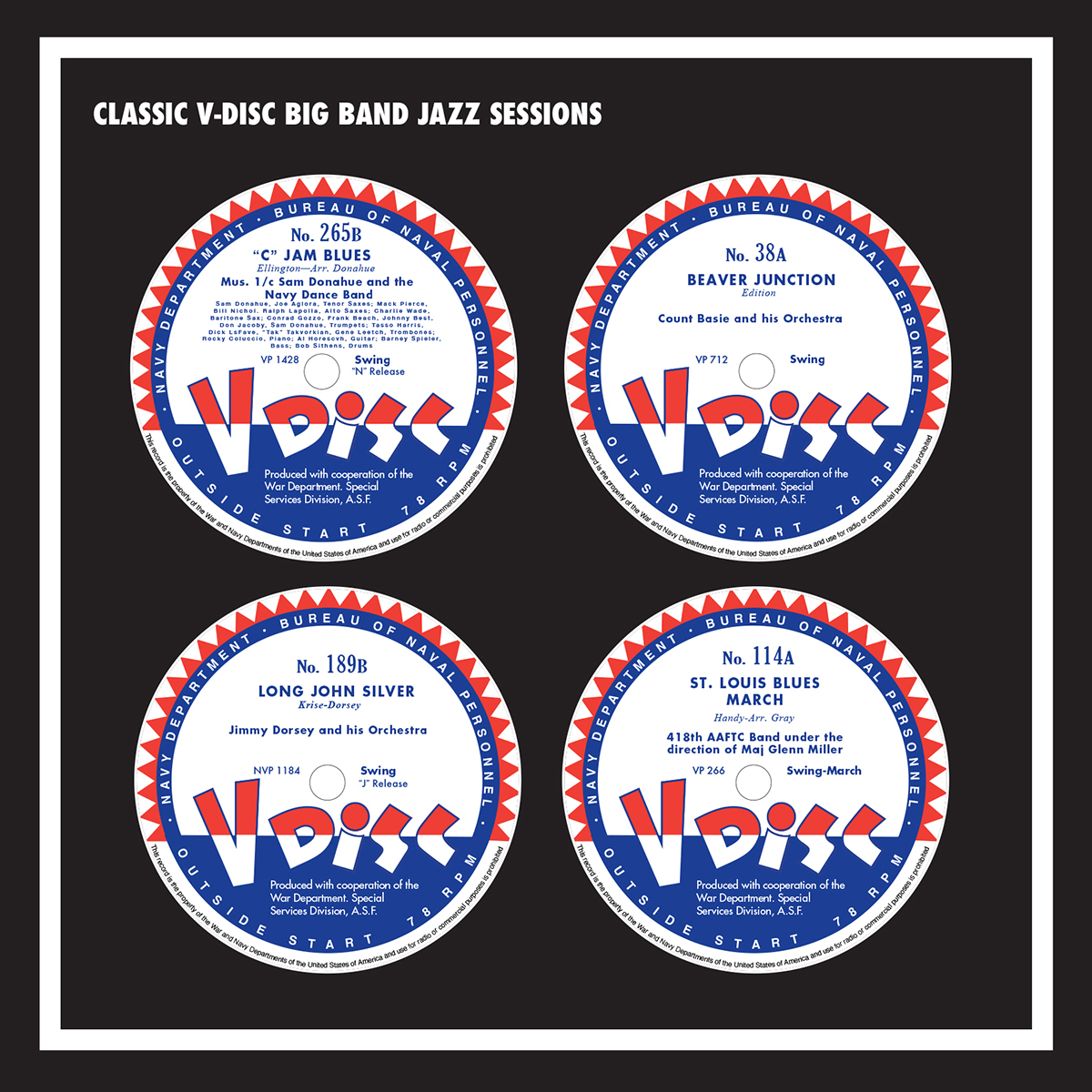
 The first batch of V-Discs shipped to military fighters overseas on Oct. 1, 1943. Less than two years later, we won the war. Many other elements contributed to this victory, of course, but let’s not short-change the power those records must have had.
Mosaic Records celebrated this unique catalogue category with the release in 2024 of a massive set of V-Disc small-group sessions and the promise that a big-band set would follow. It’s here. It’s ten CDs of excellent-sounding music by top-flight bands and a few who never gained that category but should have.
Right off the bat what invites celebration is the restoration quality. Those discs were meant to be played beside bunk and rack and even out in the field using the spring-wound phonographs that were shipped with the discs (along with packets of extra steel needles). And you got a lot of music: These discs were cut with more grooves per inch than usual to allow for up to six minutes of music on a 12-inch side.
The program continued until May, 1949, at which time the companies producing them destroyed all of their discs and masters. Service men and women were forbidden to bring them home, but with over eight million of those platters circulating overseas, many were bound to find their way back. There are stories of scofflaws having their collections confiscated, and at least one offender did jail time.
Now we can thank those rebels. The record companies and musicians’ union decided to waive copyright on V-Discs on the 50th anniversary of the war’s end, prompting a flurry of CD issues. I bought a bunch of them. They sounded mediocre to terrible, obviously sourced from whatever discs the issuing producer had at hand, and with varying success at audio restoration. Mosaic’s sets have been subjected both to scrupulous programming choices—no sappy vocals or Mickey-Mouse bands here!—and a search for the best-sounding originals which then were audio-restored by the best in the business.
To underscore the shrewdness of choice in the presented selections, let me begin by celebrating the three selections from Kay Kyser’s outfit. Being as Ish Kabibble-phobic as I am, I would have passed this band by, but it turns out that by 1943, Kyser was fronting a gang that could swing, with personnel that included clarinetist Rosy McHargue and Noni Bernardi on alto. Mind you, what we have here are three selections culled from a session of 14.
Then there’s the discovery of Musician First Class Sam Donahue and the Navy Dance Band (or, in 1948, Sam Donahue and His Orchestra), who recorded on two consecutive days in 1945 and waxed a single session three years later. When tenor sax-man Donahue was drafted in 1942, he joined Artie Shaw’s aggregation and was tapped to take over when the exhausted Shaw got invalided out in 1944. Donahue changed some charts and personnel and successfully toured throughout Europe before returning stateside for his first V-Disc sessions.
These recordings are beauties, in excellent sound, and include two takes of Donahue’s arrangement of “C-Jam Blues,” two of “Dinah,” two “Bugle Call Rag”s, a Benny Carter arrangement of “My Melancholy Baby”—and those are just from the first session. “Sax-o-Boogie” is the single cut chosen from the 1948 session, by which time Doc Severinson was in the band. The 20 Donahue tracks included here take up the entirety of Disc Nine, and well deserve the showcase.
Count Basie gets more real estate in this collection than anyone else, because he was an enthusiastic supporter of the V-Disc program, recording frequently and not lousing up his selections with sappy vocals. He and his band held four sessions between 1943 and 1945, with 24 cuts deemed Mosaic-worthy.
The two songs from the 1943 session (Basie originals “Yeah Man” and “Rhythm Man”) are a last aural glimpse of the famous rhythm section trio of Freddie Green, Walter Page, and Jo Jones. But the following session, in May 1944, which took place between sets at the nearby Hotel Lincoln, features the brief return to the band of Lester Young. You’ll hear him briefly in two takes of Dicky Wells’s “Kansas City Stride,” and at greater length in the “I Got Rhythm” inspired “Playhouse Stomp No. 2,” unissued until a 1991 CD release on the Vintage Jazz Classics label.

Jimmy Rushing is in excellent form, not only in Don Redman’s arrangement of “Gee Baby, Ain’t I Good to You,” but also revisiting “Sent for You Yesterday” and “Jimmy’s Boogie Woogie,” again summoning memories of the ‘30s Basie band. And there’s an inadvertent Easter egg as well, as Thelma Carpenter’s vocal on “Call Me Darling” is noted in the big booklet but not in the CD’s discography or label. And then there’s a vocal that may give you nightmares—“Aunt Hagar’s Country Home,” sung with sincerity by alto sax-man Earle Warren but with lyrics almost as cringeworthy as “Old Folks.”
Woody Herman and His Orchestra are represented by four sessions, beginning with a powerhouse band of 18 players and enjoying its way through arrangements by the likes of Neal Hefti and Eddie Sauter and a couple of vocals by Frances Wayne when Woody himself wasn’t showing his vaudeville roots by singing some novelty refrains. A generous eighteen selections and two alternate takes include Herman originals like “Apple Honey” and “Your Father’s Mustache,” standards like “I’ve Got the World on a String” and “Lover Man,” and penned-for-the-occasion songs like “Jones Beachhead” and Irving Berlin’s “There Are No Wings on a Foxhole.”
We even get an unexpectedly straight vocal from Martha Raye on “He’s Funny That Way,” recorded during Herman’s August 22, 1945, session after Woody took off for the night and turned the band over to his bass player, the irrepressible Chubby Jackson. Trumpeter Pete Candoli takes songwriter credit for another Jackson number, “Meshugah (They Went That-a-Way).” They sure knew how to give crazy titles to songs back then.
Ever want to hear Glenn Miller cuss? Now’s your chance. Okay, few of us would think of it as cussing, even in 1943, but Miller’s first session begins with a breakdown during his initial intro. If you’re new to the V-Disc world, performers were encouraged to add a brief personal message at the top of each set, and they range from the cursory to the endearing, with Miller decidedly among the former.
In any event, he’s here with his Army Air Forces Training Command Orchestra, which we know as the Army Air Force Band. Three years ago, I confessed in these pages my secret affection for the Miller band even as the hardcore jazz lovers I knew tore him to pieces for the sin of sounding sweet. There was a lot of Miller issued under those V-Disc labels, but most of it was drawn from commercial recordings and broadcasts. In this set is the result of the band’s three actual V-Disc sessions, to which no jazz-lover should object.
The first session produced the recording most associated with wartime Miller and the V-Disc program: “The St. Louis Blues March.” With a 32-piece band under his baton and a high-stepping arrangement by Jerry Gray, this piece swings right from the top, as a big brass fanfare introduces two drummers (Ray McKinley, who helped with the arrangement, and Frank Ippolito) to lead us into a familiar tune that never sounded like this before. The idea was to give soldiers something more exciting to march to. Some of the brass hated it, but the open-minded ones saw the sense.
Sousa’s “El Capitan” gets a similar treatment, and the service itself is celebrated in the quotes-laden “The Squadron Song” as well as Johnny Mercer’s witty “G.I. Jive,” sung by Ray McKinley sounding very Mercer-esque. Some twenty strings were added for the ballads, as you’ll hear in “Stardust” and “Stormy Weather.”
Wartime can be a time of strange bedfellows, and two who probably shared a boyhood room reunited for a V-Disc session in 1945, prompting Sy Oliver to pen “Brotherly Jump” for the occasion. Jimmy Dorsey brought 19 players to the session; so did Tommy. The combined forces certainly raise the roof on Liederkranz Hall, but it’s the quiet finish, with the brothers trading fours and playing together in easygoing harmony, that makes the piece.
Several Jimmy Dorsey selections (from an earlier session) follow, highlights being a revamped “John Silver” and Dizzy Gillespie’s “Grand Central Getaway,” showing Jimmy’s versatile, somewhat up-to-date chops. Tommy and his band had nearly 80 V-Discs out there, but most were drawn from existing recordings. Two unreleased numbers are in this set, both Sy Oliver originals, both of them giving Charlie Shavers impressive solo time.
Should this be enough to keep your ears busy for quite some time? Sure. But let’s be greedy, especially with so many more bands on tap. Charlie Barnet’s seven selections include “Skyliner” and a blazing “Blue Skies.” Several Goodman alumni are on tap, including Harry James with eleven tunes, Lee Castle with two, Lionel Hampton with nine minutes of “Flying Home,” alongside four more killer-dillers. Gene Krupa’s band bulges with strings at one of his sessions; his second boasts the more-than-welcome return of Anita O’Day, who, saddled with a pair of dumb songs (“Jose Gonzales” and “Ooh, Hot Dawg”), nevertheless dignifies the material in her trademark fashion.
Krupa shares a CD with Buddy Rich, and Rich really goes to town on his twelve numbers, especially a pair of arrangements by Neal Hefti. One of them, a George Auld tune titled “Daily Double,” clocks in at nearly six minutes, which was the maximum time a V-Disc could hold. Usually more than one song was put on a side, but Rich takes over another one with over five minutes of “Nellie’s Nightmare.”
Among Yank Lawson’s four sides is Bix Beiderbecke’s “Davenport Blues,” and another fine trumpeter, Charlie Spivak, fronts an underrated band on three songs, putting his horn to good use on Jimmy Mundy’s “The General Jumped at Dawn.” Both Jimmie Lunceford and Don Redman had new bands when they entered the recording studio in 1945 and 1943 respectively, but the first strains of “For Dancers Only” proves that Lunceford was in excellent shape—ditto Redman, who leads his band both in playing and singing the effervescent annoyance “Pistol Packin’ Mama.”
You’ve got the idea, so I’m just going to list the remaining bands included in this set, with the number of numbers you’ll find for each. Thus we have Glen Gray (3), Tony Pastor (2), Les Brown (6), Stan Kenton (6), Randy Brooks (2), Hal McIntyre (10), Mal Hallett (2), Clyde Lucas (3), and Ted Fiorito with one nutty Sy Oliver tune, “Don’t Get Stuff in Your Cuff.” Boyd Raeburn has five, including a sinuous “Begin the Beguine” with an English horn intro, four years before Sauter-Finegan would do such things. And Bill Heathcock ably represents the west coast with four numbers.
And there are some military bands, such as the U.S. Maritime Service Training Station Band under the direction of Warrant Officer Si Waronker (who would go on to found Liberty Records), USMC (3), the Army Service Forces Dance Band, directed by Sgt. Johnny Messner (1), the 344th Army Service Forces Orchestra (2), and the completely unknown Majors & the Minors, their personnel a mystery but their work on “Whispering” and “Sometimes I’m Happy” deserving of praise.
I’ve saved Claude Thornhill for last only because he was the last, recording “Easy Does It” (by Trummy Young and Sy Oliver) in November 1948 and sent out, as V-Disc 900, in the last package of discs. David J. Weiner speculates that the alto soloist is Lee Konitz, which lets me segue into praise for Weiner’s program notes for this set. It must have been exhausting pursuing personnel and analyzing recording sessions before distilling it all into a beautifully written essay that adds tremendously to the listening enjoyment this set provides. It’s been playing fairly continuously in my house for the past couple of weeks, yet I’m only being asked for more.
Classic V-Disc Big Band Jazz Sessions
Limited Edition Box Set (#284 – 10 CDs)
Various Artists
mosaicrecords.com