Alexander Van Vliet Feldman was born in 1915 and he lived until 2015, mostly using the name Van Alexander. He had a long and successful musical career, mostly in Hollywood, but he was best known for co-writing “A-Tisket, A-Tasket” with Ella Fitzgerald while both worked in the Chick Webb Orchestra in 1938.
He grew up in Harlem when it was ethnically diverse. His mother, a classical pianist, started him on lessons early, but playing outside with friends was more attractive than sitting at the piano. He did, however, find it interesting that the same tune played by one band sounded so different when played by another. That led him into arranging for his own high school band. He even took some orchestration classes at Columbia University.

As he wrote in his autobiography From Harlem to Hollywood, My Life in Music, “A lot of us teenagers and young adults all loved to dance. And the place to dance was the Savoy Ballroom, located on Lenox Avenue between 140th and 141st Streets, right in the heart of Harlem. The Savoy … was one of the first racially-integrated public places in the country. It occupied the second floor of a building that extended along the whole block and featured a large dance floor (200 feet by 50 feet), two bandstands, and a retractable stage. The ground floor of the building housed various stores and the entrance to the ballroom at the center of the block signified by the marquee that extended out over the sidewalk. The Savoy was appropriately nicknamed, ‘The Home of Happy Feet,’ and it was also known among the regular patrons as ‘The Track’ for the elongated shape of the dance floor.”

Alexander was at the Savoy often enough to have a nodding acquaintanceship with the great band leader Chick Webb. He asked Webb if he’d consider some of Alexander’s arrangements. “When Chick said, ‘Bring me the arrangements after rehearsal Friday night,’ I got there at 8 o’clock in the evening. I didn’t know they started to rehearse after the job finished at 1:00. Then they took an hour off and started to rehearse at 2:00. But there were other arrangers before me, like Edgar Sampson and Charlie Dixon. By the time they got to my work it was about 4:00 in the morning. They rehearsed it for about 45 minutes so I didn’t get home until about 5 o’clock. My mother had called the police wanting to know what her son could be doing in Harlem at 5 o’clock in the morning.”
Webb liked Alexander’s efforts, so the teen went home with a smile on his face, and cash for his efforts. Naturally his parents were impressed, but “…they frowned on me spending so much time with the black musicians. They didn’t see much of a future in it. Why couldn’t I write for white bands?” The teenager, however, recognized his opportunity and submitted more arrangements until, as Alexander wrote, “Chick hired me to write three arrangements a week … at a whopping salary of $75 per week. … I was doing what I wanted to do while working for my favorite band. Life couldn’t get any better.”

Life soon got much better in the person of Ella Fitgerald.
Fitzgerald’s early years read like a path to nowhere. Her parents were unmarried and parted soon after her birth. Her mother was killed in an accident when Ella was fifteen. Some stories whisper about an abusive stepfather, and she did spend time in a state orphanage and reformatory as well as with the wrong crowd on New York’s streets.
Then she won an Amateur Nights contest at the Apollo Theater. Contradictory stories exist as to how that brought her to Webb’s attention, but they agree that when he saw her looking so “unkempt” he rejected her without hearing her. Persuaded to give her a working audition at the Savoy, she won over the crowd and his musicians so about six months after her Apollo victory, Webb made her his female vocalist.
Webb assigned Alexander to focus on arranging for Ella, and that soon produced her first hit – Hoagy Carmichael’s “Sing Me a Swing Song (And Let Me Dance)”. Alexander remembered her as humble and shy, but with an infallible ear, impeccable intonation and marvelous phrasing, characteristics that always stayed with her. Webb realized that Ella was not just an average talent, and he used her more and more on recordings and performances to increase the band’s popularity.
Ella eventually approached Alexander to do something with the nursery rhyme “A-Tisket A-Tasket” for her. He agreed, but prioritized Webb’s new arrangements. After a week or so she asked him again, and he again promised, but with no results. After he failed to produce for a third time, she threatened to ask another arranger. That produced a promise to have it at their next meeting.

Alexander wrote that what he had to work with was just, “an old nursery rhyme that’s been in the public domain since 1879. There was never really a song: it was just a little rhythm thing that the kids used to sing. I put the piece into a 32-bar frame. I added the release (middle section), the bridge and wrote all the novelty lyrics…” Fitzgerald made some changes, and Webb’s organization performed it on a radio broadcast the first evening they had it and recorded it two weeks later.
It became one of the best sellers of the 1930s, and the band enjoyed some time of national popularity, performing in major venues usually closed to black musicians. Then Webb’s spinal tuberculosis and other health conditions reached their terminal stages, and he died at age 34. By then, Ella was on her way to super-stardom and Alexander said, “I got to write for many white bands, Paul Whiteman, Benny Goodman, Les Brown and so forth.” He also was lured into starting his own band.
Alexander said, “I spent three wonderful years with Chick, and I’ll always be grateful to him for being my first ‘boss’ and for giving me my start in the business.” When Alexander told Webb that he was leaving Webb’s employ the drummer was very gracious and wished him well. “To me he was very likable. We spent a lot of time together at his home and had dinners together. I loved that little man tremendously. He was a good friend.”
Fitzgerald and Alexander also were and remained friends, but, “through the years I did some arranging for Ella’s nightclub act, but I was always a little chagrined that I was never asked to do any of her songbook albums, which I wanted to do. For some reason or other her manager Norman Granz, didn’t dig me. I never found out why.”
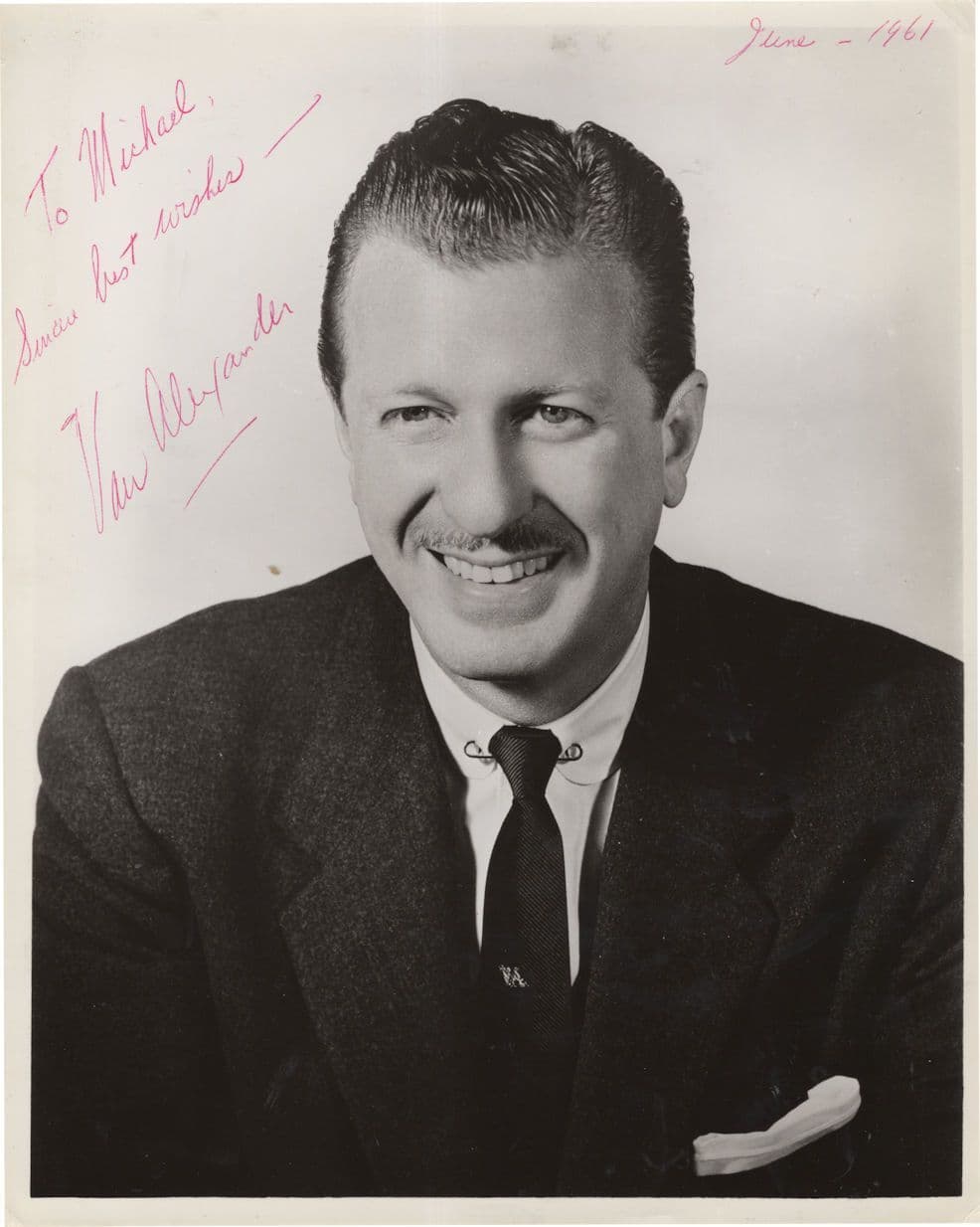
Largely forgotten today, the Van Alexander band had some excellent players such as Billy May, Johnny Best, Bob Bain, Matty Matlock and bassist Bob Haggart. It endured for several years, and Alexander’s evaluation was, “As a road band, we were doing all right— not great, but all right. To be honest, my heart was actually more into arranging than it was at being a bandleader.” He also began teaching arranging and one student, who also became a friend, was the great Johnny Mandel.
Soon after WWII, Bob Crosby talked Alexander into joining him in California. Shortly after bringing his entire family out, he said, “Bob fired me. It was a disaster but also a blessing in disguise.”
“Little by little I got into television and pictures and established a good reputation. I did everything. I was living by the old adage, ‘Friend or foe, get the dough.’ I did a series with Jonathan Winters and one with the Gold Diggers and before that with Guy Mitchell. I was also the staff arranger at Capitol where I got to do so many different types of things, country/western with Tex Ritter and Molly Bee and kiddy albums with Mel Blanc and Eddie Cantor. Somebody once called me ‘A journeyman’s arranger.’ Whatever the job called for I was able to do.”
He wrote that he worked with Gordon MacRae, who became “a dear friend and one of the great voices of all time. I went on the road with Gordon as his arranger and conductor. Gordon was an excellent golfer. He got me interested in it and got me my first set of clubs. I played with Bob Hope, Guy Mitchell, Les Brown, Paul Weston, and Vin Scully. Some of the musicians I played with are Sweets Edison, Les Brown, and Ray Brown. Of course, the most fun was Bob Hope. He had a nine-hole golf course behind his house. His wife Dolores was a great golfer too.”
As the decades passed, Alexander worked successfully largely behind the scene in both movies and television. When he died, he was the last living member of Chick Webb’s great organization.