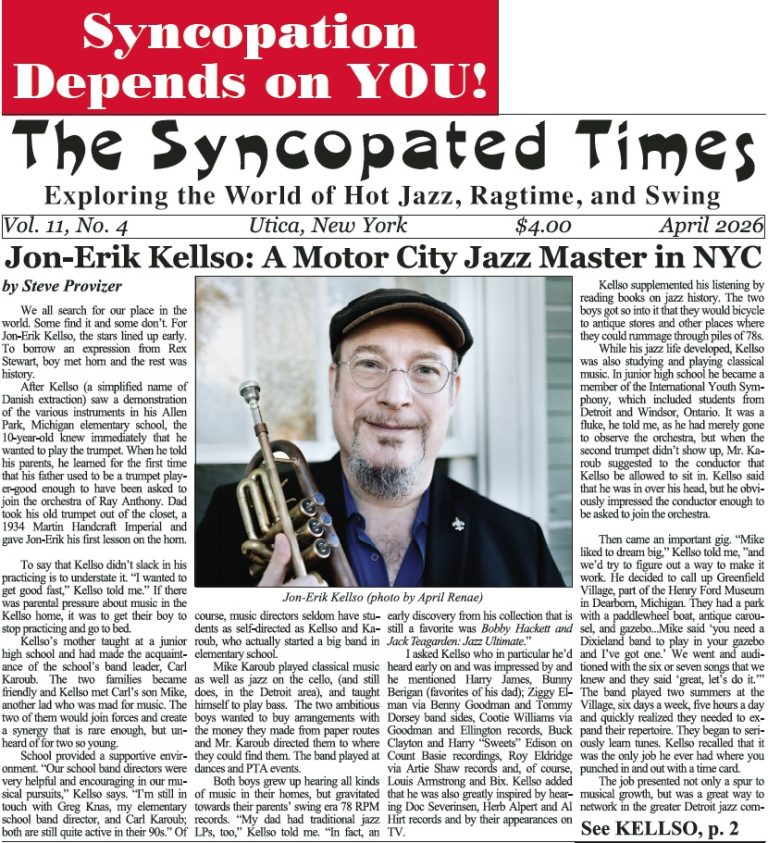
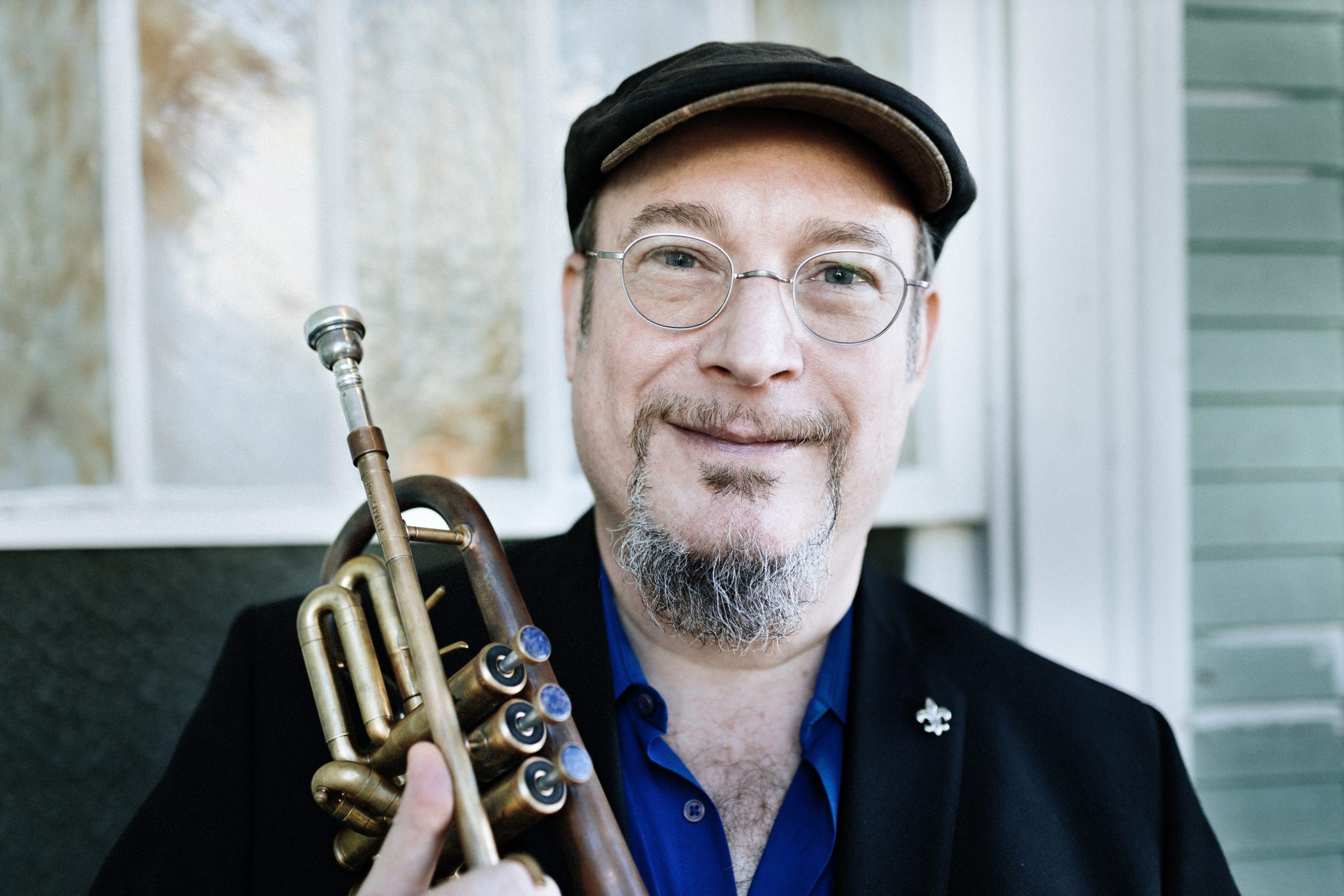
We all search for our place in the world. Some find it and some don’t. For Jon-Erik Kellso, the stars lined up early. To borrow an expression from Rex Stewart, boy met horn and the rest was history.
After Kellso (a simplified name of Danish extraction) saw a demonstration of the various instruments in his Allen Park, Michigan elementary school, the 10-year-old knew immediately that he wanted to play the trumpet. When he told his parents, he learned for the first time that his father used to be a trumpet player-good enough to have been asked to join the orchestra of Ray Anthony. Dad took his old trumpet out of the closet, a 1934 Martin Handcraft Imperial and gave Jon-Erik his first lesson on the horn.

To say that Kellso didn’t slack in his practicing is to understate it. “I wanted to get good fast,” Kellso told me.” If there was parental pressure about music in the Kellso home, it was to get their boy to stop practicing and go to bed.
Kellso’s mother taught at a junior high school and had made the acquaintance of the school’s band leader, Carl Karoub. The two families became friendly and Kellso met Carl’s son Mike, another lad who was mad for music. The two of them would join forces and create a synergy that is rare enough, but unheard of for two so young.
School provided a supportive environment. “Our school band directors were very helpful and encouraging in our musical pursuits,” Kellso says. “I’m still in touch with Greg Knas, my elementary school band director, and Carl Karoub; both are still quite active in their 90s.” Of course, music directors seldom have students as self-directed as Kellso and Karoub, who actually started a big band in elementary school.
Mike Karoub played classical music as well as jazz on the cello, (and still does, in the Detroit area), and taught himself to play bass. The two ambitious boys wanted to buy arrangements with the money they made from paper routes and Mr. Karoub directed them to where they could find them. The band played at dances and PTA events.
Both boys grew up hearing all kinds of music in their homes, but gravitated towards their parents’ swing era 78 RPM records. “My dad had traditional jazz LPs, too,” Kellso told me. “In fact, an early discovery from his collection that is still a favorite was Bobby Hackett and Jack Teagarden: Jazz Ultimate.”
I asked Kellso who in particular he’d heard early on and was impressed by and he mentioned Harry James, Bunny Berigan (favorites of his dad); Ziggy Elman via Benny Goodman and Tommy Dorsey band sides, Cootie Williams via Goodman and Ellington records, Buck Clayton and Harry “Sweets” Edison on Count Basie recordings, Roy Eldridge via Artie Shaw records and, of course, Louis Armstrong and Bix. Kellso added that he was also greatly inspired by hearing Doc Severinsen, Herb Alpert and Al Hirt records and by their appearances on TV.
Kellso supplemented his listening by reading books on jazz history. The two boys got so into it that they would bicycle to antique stores and other places where they could rummage through piles of 78s.
While his jazz life developed, Kellso was also studying and playing classical music. In junior high school he became a member of the International Youth Symphony, which included students from Detroit and Windsor, Ontario. It was a fluke, he told me, as he had merely gone to observe the orchestra, but when the second trumpet didn’t show up, Mr. Karoub suggested to the conductor that Kellso be allowed to sit in. Kellso said that he was in over his head, but he obviously impressed the conductor enough to be asked to join the orchestra.

Then came an important gig. “Mike liked to dream big,” Kellso told me, ”and we’d try to figure out a way to make it work. He decided to call up Greenfield Village, part of the Henry Ford Museum in Dearborn, Michigan. They had a park with a paddlewheel boat, antique carousel, and gazebo…Mike said ‘you need a Dixieland band to play in your gazebo and I’ve got one.’ We went and auditioned with the six or seven songs that we knew and they said ‘great, let’s do it.’” The band played two summers at the Village, six days a week, five hours a day and quickly realized they needed to expand their repertoire. They began to seriously learn tunes. Kellso recalled that it was the only job he ever had where you punched in and out with a time card.
The job presented not only a spur to musical growth, but was a great way to network in the greater Detroit jazz community. They supplemented the band with ringers they knew from high school or college. Pro bands would come to play at the park, giving them the chance to meet older players. Kellso recalled that Carl Karoub introduced him to Chuck Peterson, the other featured trumpeter with Ziggy Elman on the famous recording “Well, Git it.” Carl and Chuck were playing an outdoor concert in a concert band, doing Sousa marches and the like, when Kellso asked him to autograph an Artie Shaw album he was on, Peterson thought someone was playing a joke on him. When he realized these young kids were really fans, he was deeply moved that anyone still recognized and appreciated his contribution to jazz.
At the same time, their parents were taking them around to jazz clubs and concerts, including Benny Goodman, Harry James, Maynard Ferguson, Woody Herman and Buddy Rich. Well-known local bandleader Tom Saunders had a traditional jazz and swing combo called “The Surfside Six” that had a gig six nights a week at the Presidential Inn that they often went to and cornetist Saunders eventually gave the boys a chance to sit in with the group. Kellso also mentions meeting the Gabriel Brothers Jazz Band (originally from New Orleans) who in turn took them to hear and meet The Preservation Hall Jazz Band.
Clarinetist Bill Roper starting getting them on gigs when they were 14-15 years old and persuaded the Musicians Union to make an exception to allow Kellso and Karoub to become union members at a young age. “We were welcomed into the scene,” Kellso told me. “They were glad to have competent subs…And I also got a lot of good tough love.”
Kellso continued playing classical music and while in high school also played in the Michigan Youth Symphony at the University of Michigan in Ann Arbor, and the Detroit Honors Concert Band at Wayne State University.
After high school, Kellso decided to go to Wayne State University. There were two main reasons. First, he had a lot of friends in the school’s well-respected jazz program. Second, he was already doing a lot of gigging around Detroit and didn’t want to move away and give up that work. In addition to lots of trad jazz gigs, Kellso was playing with Motown groups when they’d come through town, subbing in a Latin jazz group, playing in a Salsa band, community symphonies, rock and soul bands, various big bands including drum legend J.C. Heard’s orchestra and fusion groups.
Wayne State was a mixed experience for Kellso. He was getting good instruction in arranging, theory and history, but says “I kept dropping classes because of my busy gigging schedule, and eventually realized that getting a Jazz Studies degree was not really necessary in the professional world, so I just went to Wayne State on and off for 6 years, taking the classes I wanted and playing in various ensembles.” He had a couple of excellent teachers, including Billy Horner, who had been selected in 1940 by conductor Leopold Stokowski to play in The All-American Youth Orchestra in Philadelphia, breaking through the race barrier in classical music. Horner went on to be a world class orchestral player, playing in the Navy during WWII with Clark Terry, Snooky Young, Gerald Wilson, and Sy Oliver and with the Jimmy Lunceford Band after the war. Kellso credits Gordon Stump, another teacher, with helping him extend his upper range on the trumpet. Stump was well-known as a disciple of NYC trumpet guru/method book author Carmine Caruso.
In 1989 tubaist/bassist/bass saxophonist Tom Saunders (nephew of the aforementioned cornettist by the same name) recommended that the Dukes of Dixieland audition Kellso to replace their trumpet player, Frank Trapani, who had unexpectedly passed away. Kellso went down and played with them for a week and they offered him the job. He told them he was going to do another audition and would let them know. That band was Vince Giordano’s Nighthawks.
Giordano knew of Kellso from his work in James Dapogny’s Chicago Jazz Band, so when they connected, he offered him an audition. Kellso told me he would have been happy to be either in New York or New Orleans, two of his favorite cities. However, the Giordano band offered Kellso a wide variety of challenges that the Dukes did not. On one tune, he’d have a sweet lead solo for dancing, on another, have to sight read a Red Allen solo, on another tune play like Bix. He did well enough and Giordano realized his potential and how much he loved the music and offered him the gig. He’s been with them ever since. Giordano graciously introduced him to other bandleaders and helped usher him into the scene and Kellso was able to spend time with other bands, a situation that he’s maintained since.
There was a big traditional jazz scene in New York that delighted Kellso. He was able to meet a cohort that included Dan Barrett, Howard Alden, and Harry Allen, and through them and Giordano he met heroes like Ruby Braff, Kenny Davern, Bob Wilber, Dick Hyman, Ken Peplowski, Scott Hamilton, Warren Vache, Buck Clayton, Jake Hanna, Michael Moore, Bob Haggart, and Ralph Sutton. They recommended him to the jazz parties that were popular and he was stepping into the roles that musicians could no longer fill because of age or infirmity.
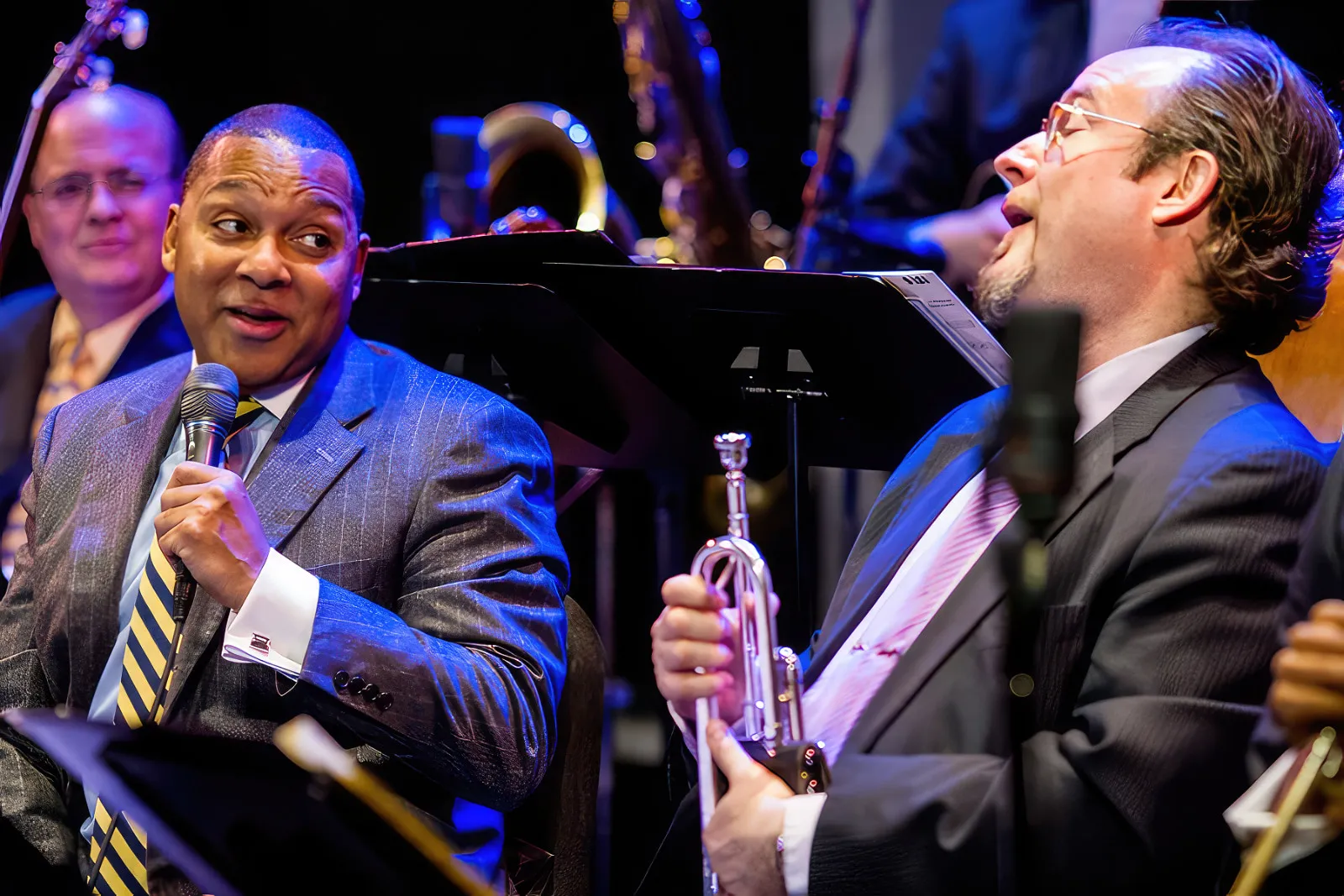
Recording opportunities started to come up. He recorded with James Dapogny’s Chicago Jazz Band, the Nighthawks, and became a stalwart for Arbors Records, playing with Rick Fay, Marty Grosz, Johnny Varro and others. The first recording with Kellso as leader was 1993’s “Chapter One,” which featured Milt Hinton. Kellso also had some gigs in the pop world, including playing on one of Linda Ronstadt’s last albums and with Elvis Costello on Garrison Keiler’s “Prairie Home Companion.” Later on Costello joined the Nighthawks for a few songs on the Boardwalk Empire soundtrack. That leads us to Kellso’s work in TV and film.
Most of this work has been on soundtracks, although sometimes Kellso also appeared onscreen, as with Boardwalk Empire, an HBO TV series for which the Nighthawks did soundtrack material for all five seasons. Others projects include Bessie, Ghost World, Revolutionary Road, The Aviator, The Joker and the second Joker movie, Folie A Deux. Most recently he played for Scorsese’s “Killers of the Flower Moon” with Giordano and the Nighthawks, “The Marvelous Mrs. Maisel,” on which he also appeared on screen in several episodes and “Vinyl,” in which actor David Proval mimed to a Kellso improvised solo (he’s best known for his role as Richie Aprile on “The Sopranos”).
We have both been in films miming on trumpet (which I play) and we talked about it. “Sometimes they have you miming to things,” Kellso said, “but you don’t even hear the music you’re supposed to be synching your movements to because they give you no in-ear monitoring and no playback to listen to…In the first ‘Joker’ movie, they hired me to give lessons to a couple of the actors playing trumpeters in Robert DeNiro’s talk show big band, including the band leader. They wanted me to make sure they were holding and fingering the instruments realistically. That was a cool gig.”
Most of the film work happens in New York, but Kellso was flown out to the West Coast to play for the second Joker movie Folie a Deux. “I gotta hand it to the West Coast guys. They were cool with us being there, didn’t resent us for encroaching on their gig, even though they have their own pool of musicians, like Wayne Bergeron, who was the lead trumpet player. They were all top players and great guys.”
Kellso went on to talk about one recording situation he handled alone. “For one 3-hour session it was me alone in the studio. There was no written music. They told me there was a guy in the asylum in the film who sometimes gets his horn out and responds to what he sees around him. They told me to play “When Saints Go Marching In” like I was watching people breaking out into a fight and mayhem is happening and I’m accompanying what I see. That would be one take, then they’d say, ‘same thing, but play much crazier.’ Then on another take they said to play it mournfully like there’s no one else around and you’re depressed.”
Kellso is called upon to do a lot of different kinds of playing and his equipment reflects that. This is how he describes it: “I’ve been playing a 1920s Conn 22B for Vince Giordano and the Nighthawks gigs. I’ve been mostly using a Stork 3E*28T mouthpiece in recent years, on all my gigs. I also have a bunch of other Conn trumpets, including a 1941 22B Symphony Special that is a beast, a great 1940 12B, which is mostly the same, aside from its “Coprion” one piece copper bell. Bunny Berigan was known to have played those models quite a bit. I also dig my 1920s Conn Victor 80A, known for being the model Bix played on primarily. Also, a Benge cornet, and a couple of Olds Super trumpets. But I’ve played Pujé trumpets for most of my other gigs. I’ve been playing them since the mid-nineties. They suit me very well. I even used my first one on Nighthawks gigs for years.”
There is a long tradition of musicians endorsing instruments and a somewhat shorter history of musicians actually working with instrument companies on design. I mentioned Maynard Ferguson and Doc Severinson to Kellso, who reminded me that Rafael Mendez had done it before anyone else. Kellso himself has a relationship with the people who make the Pujé (pronounced ‘pudgy’) trumpets. “Bob DeNicola originated the Pujé in the early ’90s,” Kellso said. “His brother, the great drummer Tony DeNicola, introduced me to him, suggesting I might dig the horns he was making, and he was right. The Pujé is a trumpet/cornet hybrid and looks like a shepherds’ crook stylecornet, or compact short trumpet. One of the unusual features is that the thumb hook tunes all notes, as that crook is part of the bell, rather than a typical first valve slide adjuster.”
“About a dozen years ago,” Kellso continued, “Brent Peters acquired the rights to the Pujé brand name and took up where Bobby left off…Both of them worked as one man operations, with home workshops, kind of mad scientists, experimenting with different components and designs. And both chose me to test out their various models and prototypes, and I gave them my input. I got to keep the ones I especially liked. I just received the second “Kellso Signature model” prototype last Friday, and have been having a ball breaking it in.”
Kellso says the number of young people interested in traditional jazz is growing, and aspiring cornet/trumpet players will want to know that he teaches, sometimes via Zoom or FaceTime, as well as in person. He’s also taught master classes here and abroad, for all ages, including universities.
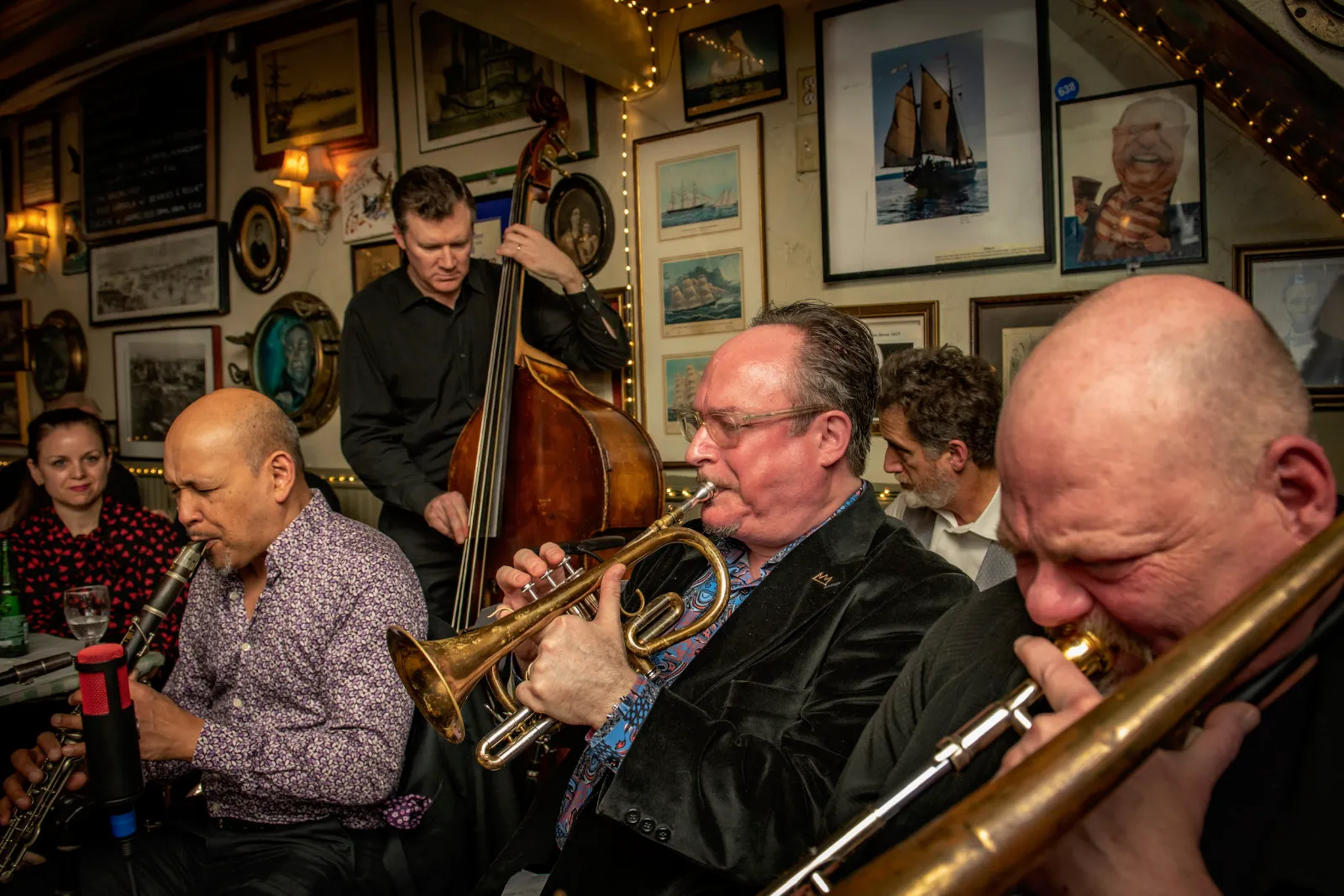
Whether Jon-Erik Kellso is playing traditional, swing or more modern jazz, you can hear that he is steeped in the history of the music. At age 61, Kellso is one of the bright flames whose confidence and experience help ensure the continuity of the jazz legacy.
Kellso’s a busy guy. Here are some of his projects and associations: Vince Giordano and the Nighthawks plays every Monday and Tuesday at “Birdland”, downstairs in the theater, shows at 5:30 and 8:30. The Tuesday 5:30-6:45 shows are live-streamed on YouTube by “Radio Free Birdland.”
He’s played with singer Catherine Russell’s band for several years whenever she uses horns and done many arrangements for her recordings.
He’s led The EarRegulars since 2007, when they started their Sunday night residency at the Ear Inn, 326 Spring St., SoHo. Co-founder Matt Munisteri gets first dibs on the guitar chair, and they use a rotating cast on bass and other horns. There’s no piano there, and not really room for drums.
The second Thursday of each month Kellso leads varying trios at Cafe Ornithology in the Bushwick neighborhood of Brooklyn, 7:30-10:30. He says: “They have a nice piano and house drum kit so I often use pianists with strong left hands such as Mark Shane and Rossano Sportiello, and varying drummers including Paul Wells.”
Occasionally Wynton Marsalis includes Kellso on special concerts and gigs where the theme is Louis Armstrong or New Orleans music.
Upcoming: Saturday, April 4th from 5:30-6:45 Kellso will be leading a combo at Birdland (upstairs) featuring pianist Ehud Asherie, reeds player Jay Rattman, and drummer Kevin Dorn.
May 8 and 9 he’ll be leading a quartet at Mezzrow (also in NYC) at 9:00 and 10:30, with Scott Robinson, Chicagoan pianist Jeremy Kahn, and bassist Neal Miner.
Kellso will be at the West Texas Jazz Party in Odessa, TX, June 4-6. July 24-26 (tentatively)
July 24-26 The EarRegulars will play at the Evergreen Jazz Fest in Colorado.
Visit Jon-Erik Kellso online at www.kellsomusic.com.
Steve Provizer is a brass player, arranger and writer. He has written about jazz for a number of print and online publications and has blogged for a number of years at: brilliantcornersabostonjazzblog.blogspot.com. He is also a proud member of the Screen Actors Guild.