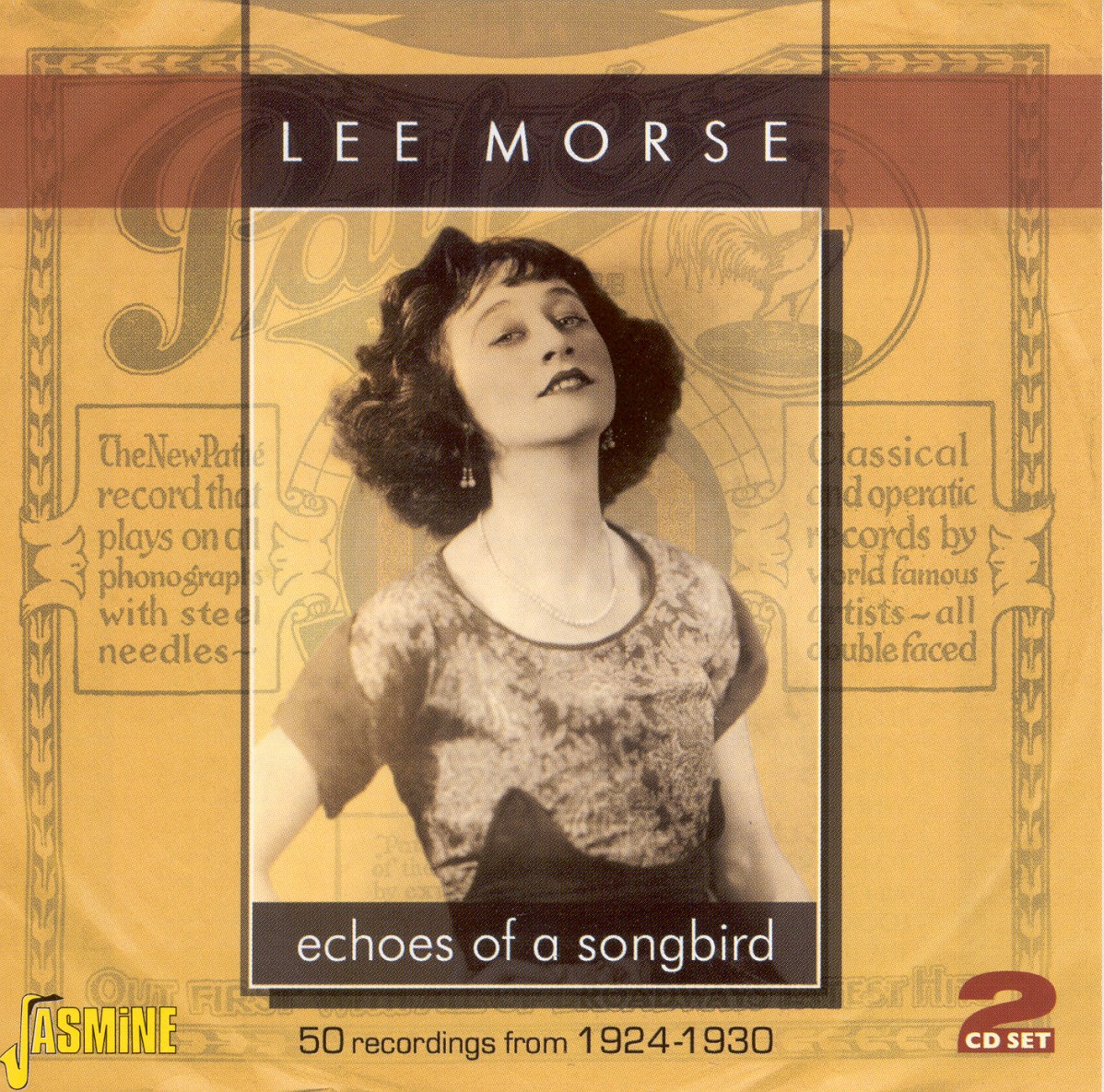
 I had never heard of Miss Morse until recently when a few “soundies” came up in my YT feed one day. I was quite impressed by her professionalism and charm, but wasn’t quite sure what to make of her. She seemed to be doing quite a lot of yodeling which didn’t think really became “a thing” in commercial music until Jimmy Rodgers started recording in the late 1920s. So I did a little research and happened upon this double album recording and bought it.
I have a couple of caveats about this release. First of all, there are no citations in the notes (written by the late Ian House), so we don’t know from where the information in the liner notes is derived. Ipso Facto (while I’d like to presume that all the statements are correct), unless we know the sources, we can’t really know what is true and what is hearsay. Secondly, there is no real discographical information provided. What we are told is that the first compact disc is comprised of records released on the Pathé and Perfect labels during the acoustic era, and that the second disc is made up of electrically recorded Columbia releases. However, no matrix or other numbers are provided. (As an aside, my 25-year-old self would probably choke at my making that criticism). So while this is not an archival-level release, your average Jane or Joe Consumer is probably not going to care.
However, what really matters, the sound quality, is excellent. Kudos to Tall Order Mastering who did a nice job of removing much of the surface noise without removing the music as well. (Discogs.com says that Tall Order Mastering is a “mastering studio in East Sussex, England owned by Peter Rynston since 2002.”) Playing this on my cheap stereo, there is quite a bit of nice bass and presence audible. Occasionally we hear a bit of distortion, but until we find a way to repair worn grooves on the original 78s, I’m not sure that much can be done about that.
I’m going to talk a little about each disc. On the first disc, track 10, “Sweet Man” (made famous for its various versions by the California Ramblers), is for those listeners who wish to hear a more traditional rendition. It has great solos on trumpet as well as a lovely singing as well. That is, until the end where we hear high-pitched scat singing until she returns to singing the words again.
However, track 12, “Oh Boy! What a Girl!” is, like all the tracks I’ve heard, extremely tight and well-rehearsed. For a second chorus, Miss Morse does a scat singing chorus with call and response patterns with her band. The band, in its responses, often starts quiet and crescendos to a loud accent. The third chorus consists of Miss Morse of “talking” and “sliding” around the words and notes.

The next track, “I Love You So” is sung more “straight” without so many vocal effects, and she shows that she has exceptional control over the pitches as she occasionally slides with glissandi and portamenti up to notes, and she rests on the notes for a longer period of time, and displays a delightful vibrato that is not excessive. She also sings in what is, for her, the upper registers of her voice. It is a little sad, but never sentimental. Her accompanying instrumentalists also play with great thought, sensitivity and subtlety.
In track 14, “I Love My Baby (and My Baby Loves Me)” Miss Morse accentuates the ends of phrases by using “blue notes.” Although this number is more “up tempo” than some of the others, much of it is sung and played plaintively and quietly with call and response patterns with both Morse’s scat singing interspersed with either a quietly played trumpet or trombone. There is also a really great trombone solo. It is really rare to hear such subtlety in 1920s popular recordings, and when everyone cadences with a loud dynamic, it has considerably more impact than if the entire song was played loud and fast.
There is no shame in Miss Morse recording for the Perfect label. Many other great artists (e.g. Lou Gold, Cliff “Ukulele Ike” Edwards, and Chick Bullock) also recorded for them as well. However, to hear Miss Morse sing on the Columbia electrically recorded 78s is an absolute revelation.
The opening number on the second CD (“What Do I Care What Somebody Said?”) bursts forth with a great amount of energy and pizzazz. You can definitely hear more nuance in both her singing and that of the instrumentalists. She “talks” most of the song and slides up to notes most of the time. But when she ends a phrase, you realize she can really sing, and the effect is remarkable. The clarinetist imitates her glissandos followed by Miss Morse doing her famous yodeling. This is a relatively lesser-known song, and the only other rendition I’ve heard was by Jeff Barnhart on his album, I Wish We Were Twins. One wonders if this version had any influence how Jeff sang it (?)…
What I haven’t discussed up to this point is that a fair number of the tunes on this set were actually penned by Miss Morse as well. The third track on the second CD, “Mollie Make up Your Mind,” is a somewhat slower tune, but not at all lugubrious. Both the lyrics and the harmonies are very clever. While she slides around a little, she sings this one relatively “straight.” And the arrangement is lovely with the instrumental chorus with the brass doing quick crescendi over the percussion instrumentalists playing on the “off-beat,” after which Miss Morse sings a very plaintive vocalise over the instrumentalists, followed by straight singing again. This number proves her ability at composing, lyric writing, and doing outstanding arrangements. She was incredibly talented!

The fourteenth track, “Old Man Sunshine, Little Boy Bluebird,” once again starts with straight singing, and she proves herself to possess a delightful and controlled vibrato when she wants to, and sings very quietly most of the way through. The pianist takes a break after the first chorus, then Miss Morse breaks loose and improvises by going up and down an octave, followed by her yodeling. The second chorus consists of her singing mostly only two notes and she does more with two notes than most singers do with a whole lot more.
There is so much great material here, that it is almost impossible to pick favourites. But I’ve described some of her extraordinary range, and this should hopefully pique the interest of the reader at least a little bit.
It’s too bad the instrumentalists are left as anonymous in the liner notes, because clearly Miss Morse was so talented that she could attract some of the greatest jazz players of the day. I distinctly heard banjoist Harry Reser in the 15th track, and Brian Rust (in his discography, Jazz and Ragtime Records, 1897-1942 Sixth Edition, Mainspring Press, 2001) lists some of the instrumentalists which may be playing on any of these sides: Larry Abbot (clarinet), Miff Mole (trombone), Tommy Dorsey (trombone), Jimmy Dorsey (clarinet), Frank Signorelli (piano), Adrian Rollini (bass sax), and possibly Red Nichols (trumpet) and possibly the extraordinary Arthur Schutt playing harmonium on “’T’ain’t No Sin” (!!!). None of these extraordinary instrumentalists are mentioned in the liner notes, but there are some really nice photographs and biographical information.

Morse’s singing style was actually very experimental, and I can’t think of even any modern “popular” singers (with the exception of perhaps Eva Cassidy) who could even approach creating so many different sounds and timbres with just their vocal cords. The question remains, how did she manage to do this so successfully, so often and with such consistently fine results? Photographs of her in the accompanying booklet and online show her almost constantly keeping her neck long and undistorted (not quite “straight” as that is anatomically impossible) so that a minimum amount pressure is placed on both her neck muscles and vocal cords while singing. The less pressure, the greater the resilience.
In addition, she often uses what, in “classical” singing technique, might be described as the “plumb in the back of the throat” tone, which also reduces pressure on the voice. Listen to the German baritone Dietrich Fischer-Dieskau to hear the perfect classical approach to this type of sound. But to hear this type of sound in a “popular” singer is rare. So why did she develop this singing technique? Was it because she sang in a choir with her family for so many years? Was it because she obtained some classical singing lessons somewhere down the line? Was it because she was unconsciously imitating the singing style of her brothers? We’ll probably never know.
But what we can state for certain is that Miss Morse was arguably one of the finest female singers of all time, and that like Ukulele Ike (Cliff Edwards), she was completely unique and unduplicatable in both style, subtlety, and substance. Furthermore, in almost every one of her recordings, she sang with accompanying musicians who were as equally talented as she was, and played with equal subtlety. And what is also certain is that this is a fabulous collection of exceptional performances and great material by one of the greatest singers of all time—even though time has not been kind to her memory.

In spite of all the caveats, because of the historical value, the excellent transfers, the extraordinary performances and arrangements, I recommend this double CD album without reservation. Every music lover of any genre should have this in their collection.
Echoes of a Songbird
Lee Morse
© 2005 Jasmine Records
jasmine-records.co.uk
Matthew de Lacey Davidson is a pianist and composer currently resident in Nova Scotia, Canada. His first CD,Space Shuffle and Other Futuristic Rags(Stomp Off Records), contained the first commercial recordings of the rags of Robin Frost. Hisnew Rivermont 2-CDset,The Graceful Ghost:Contemporary Piano Rags 1960-2021,is available atrivermontrecords.com.A 3-CD set of Matthew’s compositions,Stolen Music: Acoustic and Electronic Works,isavailable through The Sousa Archives and Center for American Music University of Illinois (Champaign/Urbana),sousa@illinois.edu.