 Archeophone, the top label in reissuing pre-1920 music, has 23 CDs in their very valuable series of Phonographic Yearbooks. The program consists of two volumes of music from the 1890s along with a CD apiece dedicated to some of the most popular and listenable recordings of 1903-23. Each of these various artists sets includes a comprehensive booklet that not only discusses each selection but events of that particular year.
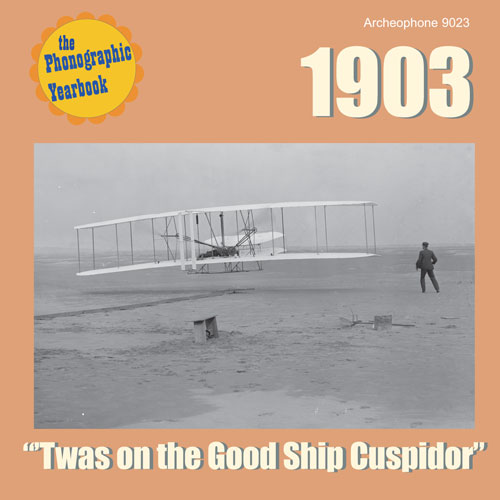
The most recent release in the series is titled 1903: ’Twas On The Good Ship Cuspidor with the liner notes celebrating the Wright Brothers. Its 26 selections were mostly released that year (some were recorded in 1902) and they give one a good idea as to the recorded music scene of the time. It is fair to say that the world was a very different place 123 years ago. Jazz was an unnamed and regional Southern music that was largely unknown in most of the world. It would be 14 years before it began to be documented. It is a great pity that no record label took recording equipment to New Orleans to record Buddy Bolden, Papa Jack Laine and the other early jazz bands, or to the Midwest to capture a Scott Joplin piano solo.
Many recordings from that time period are not of much interest and some are quite unlistenable due to racist comedy, erratic operatic singers, and technically inferior recording quality. Fortunately that is not true of the performances selected for 1903. The concise recordings (many under two minutes long with the 26 songs totaling 63 minutes) do not overstay their welcome, the singers are generally fine, and there is a fair amount of variety.
With the exception of two versions of “In The Good Old Summertime” (sung by the Haydn Quartet and heard in an episodic reworking by Sousa’s Band), and “Hiawatha,” all of these songs are long forgotten. The well-written liner notes inform readers that many of the tunes were part of successful stage shows and were hits for the performers, showing how fame could be quite fleeting.
Most of the selections feature singers. “Down Where The Wurzburger Flows,” an old drinking song, was the first recording by the duo of Collins and Harlan, and the soon-to-be prolific Billy Murray is featured on two songs including his debut “Up In A Cocoanut Tree.” Among the other vocalists are the soprano Mina Hickman (whose singing has not dated well), baritonist J.W. Myers, Byron, G. Harlan (on the overly sentimental “Always In The Way”), W.H. Thompson, Henry Burr, J.W. Myers (the waltz ballad “The Message Of The Violet”), Arthur Collins (a later version of “Any Rags” from 1905), and Henry Burr.

Among the other highlights are Harry Macdonough singing “Hiawatha” (a song well worth reviving), a snappy version of “Good-Bye, Eliza Jane” by Arthur Collins, Dan W. Quinn’s moderately humorous “The Beer That Made Milwaukee Famous,” a song (“Hurrah for Baffin’s Bay”) from the original stage version of The Wizard Of Oz, and several numbers that have excellent accompaniment by unidentified pianists who were probably familiar with ragtime. There are also three instrumentals in addition to the Sousa number: the Columbia Orchestra’s “Laughing Water,” the Peerless Orchestra playing a spirited barn dance (“In Old Alabama”), and a rare piano solo (semi-classical with a sweet melody) by Frank P. Banta (“Violets”) which was advertised as “probably the first really successful piano record ever made.”
Historians and those who enjoy very early recordings are advised to pick up 1903 and to explore Archeophone’s rich catalog.
1903
Archeophone 9023
www.archeophone.com

Since 1975 Scott Yanow has been a regular reviewer of albums in many jazz styles. He has written for many jazz and arts magazines, including JazzTimes, Jazziz, Down Beat, Cadence, CODA, and the Los Angeles Jazz Scene, and was the jazz editor for Record Review. He has written an in-depth biography on Dizzy Gillespie for AllMusic.com. He has authored 11 books on jazz, over 900 liner notes for CDs and over 20,000 reviews of jazz recordings. Yanow was a contributor to and co-editor of the third edition of the All Music Guide to Jazz. He continues to write for Downbeat, Jazziz, the Los Angeles Jazz Scene, the Jazz Rag, the New York City Jazz Record and other publications.