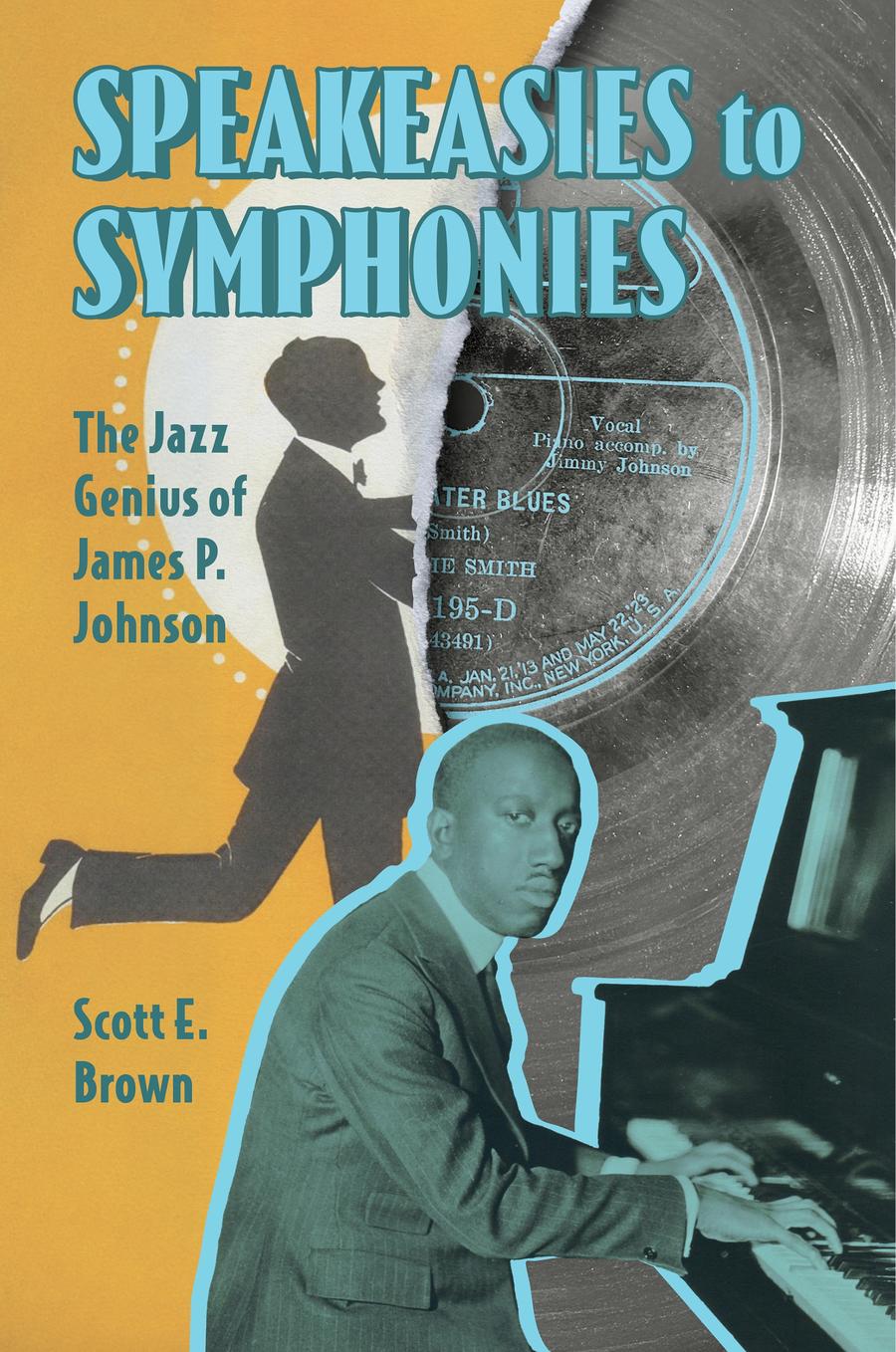
 When most jazz fans think of James P. Johnson (1894-1955), it is of a brilliant and pioneering stride pianist who also wrote some notable songs. While that is certainly true, Scott E. Brown’s very definitive book on Johnson, Speakeasies to Symphonies, shows in great detail that there was much more to him than that.
To say that Brown’s work in uncovering the James P. Johnson story is a labor of love is a major understatement. While attending Yale University, he spent his entire senior year in an independent study program researching and writing about Johnson. In 1987 his thesis was greatly expanded and became the first full-length biography ever written about the pianist-composer, James P. Johnson: A Case of Mistaken Identity. Now after nearly an additional four decades of research and discoveries, his Speakeasies To Symphonies has been published.
The remarkable amount of research is obvious. While aspects of James P. Johnson’s life and career were previously quite obscure, this book tells as much of his story as is likely to ever be known.
One learns about Johnson’s childhood in New Brunswick and Jersey City, New Jersey, his experiences playing in a variety of settings in New York starting when he was 14 in 1908, and his early (and mostly unrecorded) role models on piano. Brown’s book is filled with mini biographies of the many musicians and associates who Johnson encountered throughout his life. His lifelong friendship with Willie “The Lion” Smith and mentorship of Fats Waller are well-known and their musical adventures at rent parties in the 1920s are legendary. But less known is James P. Johnson’s parallel and very prolific career as a songwriter and musical director for a large number of theater productions including in black vaudeville and concert halls. Racism and his own quiet nature worked against him becoming the household name he should have been in the 1920s. He wrote “The Charleston” but never officially recorded it and, when it was at the height of its popularity, few knew that he was its composer. Unfortunately, many of the songs that he wrote for shows were also not recorded and have been largely lost ever since the productions closed.
In this book one learns about the importance of his early piano rolls (Duke Ellington and Art Tatum both learned from them) and the fact that making piano rolls usually paid quite a bit more than being on recordings. While Scott Brown discusses Johnson’s key recordings, there is actually much more detail about the nearly countless number of shows that Johnson wrote for including Plantation Days, Runnin’ Wild, and Keep Shufflin’, his work on two operas, and the many productions and dreams that for one reason or another did not succeed. Like Scott Joplin, Johnson’s goal was to be known as a composer of “serious music” and, while he did have much more success than Joplin, he still fell short of his goals.
Unlike Joplin, James P. Johnson was always able to find work as a pianist and had periods when he was remarkably busy. Among the more memorable aspects of this book is hearing about Johnson’s admiration for Jelly Roll Morton and their few encounters, the full story of the cutting session in 1932 in which the newly arrived Art Tatum dethroned Johnson, and details about the legendary if short-lived Pied Piper club. In addition to his best-known songs (“If I Could Be With You,” “Old Fashioned Love,” “A Porter’s Love Song to a Chambermaid,” “Carolina Shout” and of course “The Charleston”), some of Johnson’s songs found favor later in the 1940s including “Don’t Cry, Baby.”
Because so many details are included, it does take some time to fully read this book and there are slow moments when the narrative is about plays and shows that are long lost. Also, Speakeasies to Symphonies would have benefited from a full discography and a list of James P. Johnson’s compositions although those can be compiled by others elsewhere.
The James P. Johnson story ends sadly with him being bedridden for his final five years. However, his place in history is stronger now than it was when the earlier biography was written. In addition to the reissuance of nearly all of his recordings (the Mosaic seven-CD box set is priceless), many of Johnson’s papers and symphonic scores, which were feared to be permanently lost, were discovered in 1987 as were the scores for his two operas in the late 1990s.
The publication of Speakeasies to Symphonies will be a major step in reassessing James P. Johnson’s musical importance. While he deserved to be ranked as being among the most significant of all early jazz pianists (I would say the very best of the 1920s) and a skilled songwriter, his work as a composer puts him in the top level of several overlapping fields. Scott E. Brown is to be congratulated for completing his essential book and doing justice to the life and career of James P. Johnson.
Speakeasies to Symphonies:
The Genius of James P. Johnson
by Scott E. Brown
University Press of Mississippi
upress.state.ms.us
Hardcover: 480 pages, 52 b&w illustrations; $110
ISBN: 9781496857521
Paperback: 480 pages, 52 b&w illustrations; $35
ISBN: 9781496857538


Since 1975 Scott Yanow has been a regular reviewer of albums in many jazz styles. He has written for many jazz and arts magazines, including JazzTimes, Jazziz, Down Beat, Cadence, CODA, and the Los Angeles Jazz Scene, and was the jazz editor for Record Review. He has written an in-depth biography on Dizzy Gillespie for AllMusic.com. He has authored 11 books on jazz, over 900 liner notes for CDs and over 20,000 reviews of jazz recordings. Yanow was a contributor to and co-editor of the third edition of the All Music Guide to Jazz. He continues to write for Downbeat, Jazziz, the Los Angeles Jazz Scene, the Jazz Rag, the New York City Jazz Record and other publications.