The recent production of Scott Joplin’s opera Treemonisha took place at the Lisner Auditorium on the campus of George Washington University in Washington D.C. on March 7, 8 and 15, 2026. It was historic in its presentation for a number of reasons: one being that it was the first production in the Washington National Opera’s season after its departure from the Kennedy Center. The second is that this “new version” was fully staged; newly adapted (additional text, lyrics and music) and orchestrated.
As Executive Director of the Washington National Opera, Timothy O’Leary, welcomed the audience and spoke of “creative freedom” and “believing in American civil society” powered by “We the People”, he was greeted with a standing ovation. Along with Artistic Director Francesco Zambello, they spoke of the upcoming season at the National Opera which focused on American works that celebrate 250 years of America. While those around me listened to their welcoming words, my mind couldn’t help but drift into imagination to the time when Eubie Blake claimed to have met the “King of Ragtime” himself, Scott Joplin, in Washington DC sometime between 1907 and 1909. I wondered what these two men would have thought about Joplin’s opera opening the 70th Anniversary season here in our nation’s capital.
Director Denyce Graves and Musical Adaptor and Orchestrator Damien Sneed gave an informative pre-show lecture about the production; with Sneed telling of how the “mystery” of this Treemonisha came to be during his freshman year at Howard University while serving as accompanist to the late Carmen Balthrop (who was Treemonisha in the 1975 Houston Grand Opera production). According to Sneed, a graduate student unexpectedly walked up to him, placed a brown paper bag in his hands, and said: “It’s yours … you will finish it.” He would later find out it was the score to Treemonisha. Sneed wrote in his Composer’s Notes: “I pursued opportunities to conduct and perform Treemonisha on four separate occasions … we are here because Scott Joplin never stopped believing in his opera. And neither did I.”
As I sat among the sold-out audience, taking in the exquisite set design by Lawrence E. Motel III, with its vibrant fabric pattern colors and picture framed arch featuring a majestic tree that was reminiscent of a fantastical children’s book come to life, I was eager with anticipation to hear the familiar sounds of Joplin and the new and exciting additions that the Washington National Opera was about to present.
As Graves spoke about earlier, she opted to stage the Overture. This concept worked quite well. The Overture, however, did not open with the traditional steady eighth-note pattern which sets the rhythm for the familiar syncopated Joplin melody to play off; but instead, a solo banjo player entered strumming casually while birds sang. A piano player joined him onstage and began to play in an improvised-style manner similar to the opening of A Prairie Home Companion, before segueing into the Overture accompanied by an impending storm. The piano player and banjo player remained on stage for the entire production; providing short musical interludes that spanned the genres from improvised jazz to blues and even a touch of early be-bop.
During the Overture, a choreographed mini-ballet enacted the discovery of Treemonisha by a tree. She is schooled, learning to read and write, before being reunited with her adoptive parents, Monisha and Ned, as a young woman. We are also introduced to Zodzetrick selling his bags of tricks to workers who are returning home from the fields. The Overture unexpectedly segued directly into “Aunt Dinah Has Blowed De Horn”; a number that originally closed out Act Two in the original Joplin opera. In past productions, this brought the house down and caused audience participation with rowdy hand clapping. However, with this redirected placement, the number came and went without much notice.
Knowing the score well, the newly orchestrated sound directed me to the program. Aside from the on-stage banjo and piano, it was difficult to decipher the instrumentation for this production. I was surprised to discover a 29-member string section, 14 reeds, 11 brass, 2 timpani, 1 harp and 2 percussion: a well represented orchestra. However, on first hearing, I thought the production team had made the artistic decision to go with a small ensemble with respects to what Joplin might have had available to him in the 1910s. Perhaps it was the amplification of the new space, but the sound never quite equaled that of the listed 59 member orchestra.
Vocally, the ensemble was well represented within their roles. Viviana Goodwin not only led the story heroically and with great determination as Treemonisha; but the cast, as well, with her beautiful soaring soprano voice. In her Washington National Opera debut, Tichina Vaughn gave a grand performance as Monisha; tugging at the heart strings of the audience during her solo, “The Sacred Tree.” Kevin Short as Ned received an enthusiastically collective outbreak of applause upon reaching the final D2 note at the end of “When Villains Ramble Far and Near.” But it was Jonathan Pierce Rhodes in his role as Zodzetrick who stole the show—mischievously bounding on and off the stage with his “bag of tricks.”
This production was not in keeping with the “grand opera” style that Joplin had originally intended (wherein the entire libretto, including dialogue, is sung). Additional dialogue, unsung, was added by Kyle Bass; along with new lyrics. For those seeing the opera for the first time, it provided an additional thread of storyline not found within the Joplin text.
Act Two and Act Three were combined, so the Prelude to Act Three was cut. “The Frolic of the Bears” was cleverly transformed into a ballet sequence that took place in the conjurer’s camp. The number “I Want To See My Child,” normally sung by Monisha and Ned at the beginning of Act III, was cut and the music was repurposed as a solo for Treemonisha, with new words that expressed her want to show gratitude, faith, and “honor her name with grace.”

The number “Good Advice,” sung by Parson Alltalk (portrayed by Nicholas R. Lagesse) was staged and musically presented as a southern-style church meeting, punctuated with shouts of “Amen!” and accentuations of preacher chords emphasizing spirited moments of faith. Willing participants were called forth by the Parson, before the call-and-response: “Does ya feel like ya been redeemed?”—“Oh, yes! I feel like I been redeemed!” Gospel chords and even Billy Preston-type licks reinforced the sermon; while the congregation clapped on two-and-four.
The program did not list Musical Numbers so it was unclear as to who wrote a new solo for Treemonisha; but given that the notes provided by Damien Sneed were titled: Composer’s Notes, it is my assumption that this number was written by Sneed himself. Treemonisha sings in a lovely, period waltz: “I can read, I can write … I can teach! Please let me live,” while she is held captive by the conjurers.
An added feature that was interwoven through the production was Treemonisha and Remus humming the tune to “A Real Slow Drag” when they were together. When Remus rescues Treemonisha, she asks him: “How did you find me?” He replies: “I followed my heart”—they exit humming. This little touch made the opera feel more like a modern day musical with musical threads linking the storylines together.
There was something to say, however, for Joplin’s original music and text. When left alone, the audience reacted accordingly; both musically and textually. The quartet “We Will Rest a While” was received with great warmth and affection; while lines such as: “Just give them a severe lecture, and let them freely go,” was greeted with delightful humorous appreciation, yet with a bit of tongue-in-cheek, sarcastic connection.
In her director’s notes, Denyce Graves writes: “Treemonisha is not only historically significance, it is emotionally and politically alive today.” The audience agreed. When Treemonisha asked: “Who will lead the men?” in the number “We Want You To Be Our Leader,” and the chorus answered with a resounding: “You!”, the audience broke out in overwhelming applause. In similar measure, the audience erupted upon hearing the line: “for ignorance is criminal”. Obviously, this struck a chord with the D.C. audience.
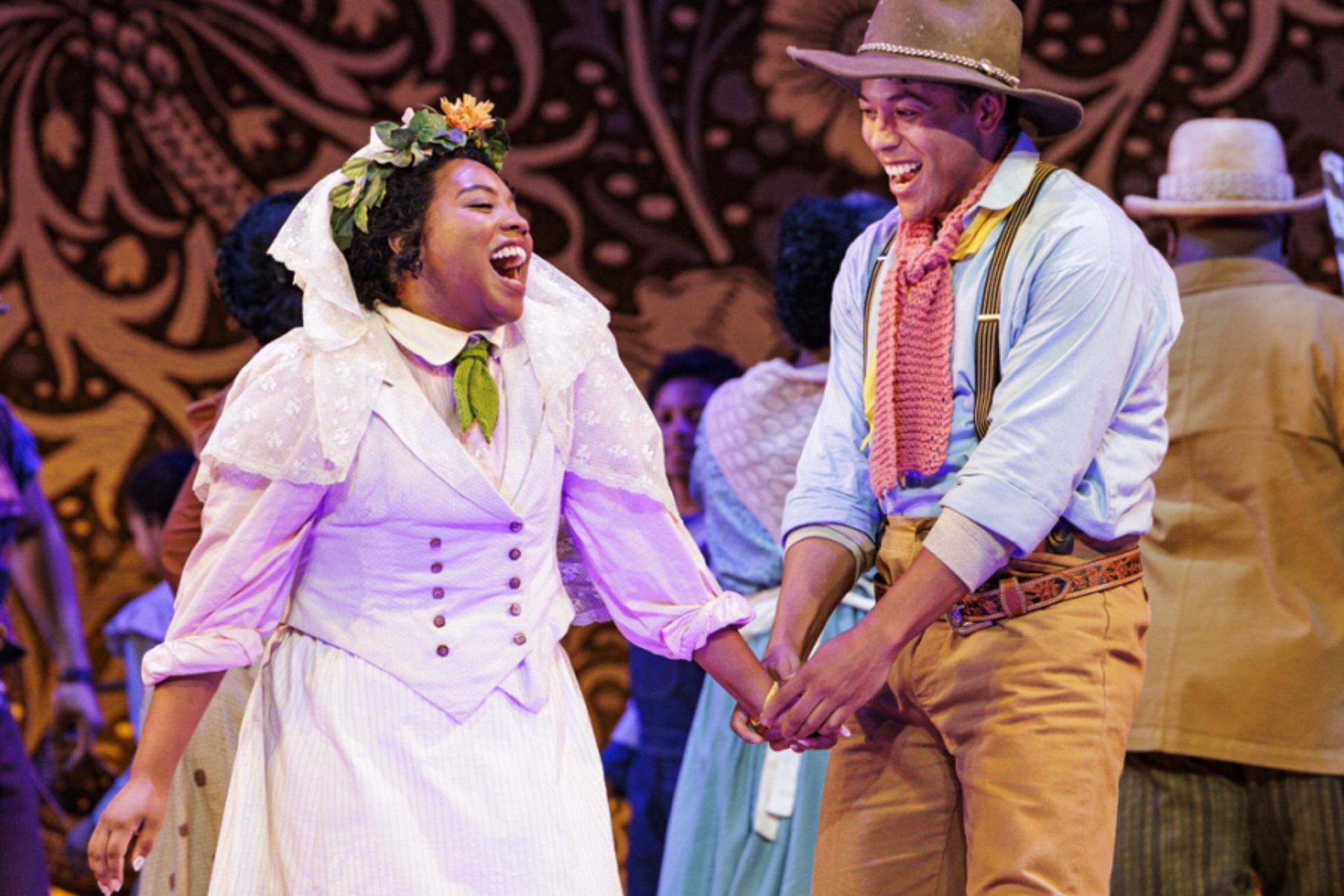
The famous finale “A Real Slow Drag” was sung by Treemonisha and Remus (originally sung by Treemonisha and Lucy); during which, they were married—symbolically stepping over a placed broom on the stage. Musically, it was not as grand a performance as traditionally presented by previous productions and recordings. The rhythmic drive seemed to be absent. Many of the more upbeat numbers lacked the foot stomping energy found in Joplin’s music because there was not (as historians David A. Jasen and Trebor Tichenor so aptly wrote in their 1978 book Rags and Ragtime: A Musical History) a syncopated melody accompanied by an “even steady, duple rhythm.”
Although Treemonisha isnot a “ragtime opera”; there are elements of ragtime to be found within the music. “We’re Goin’ Around (A Ring Play),” normally a rousing, highly syncopated, circle dance driven by a strong down-beat on 1 and 2, evoked images more of a turning calliope. Perhaps it was the amplification in the auditorium, but the lack of time-keeping percussion (snare drum) and lower brass was noticeable. This caused, on occasion, a disconnect between the onstage piano, the singers and the orchestra; who fell out of time with each other at various moments. Despite this, the final chords of the finale, in true Joplin style, prompted thunderous applause and an immediate standing ovation from the appreciative audience.
The lighting design by Jason Lynch was both stunning and visually impressive as each concept transformed the fixed set into spectacular scenes of imagery and historic design. The costume choice by Lynly A. Saunders for Treemonisha to be all dressed all in white set against the period dress for the rest of the cast was bold and pronounced. Visually, the production was a feast that left the eye dazzled and delighted.
Over all, the production was a triumphant for the Washington National Opera. The production’s expanding librettist said it best: “WNO’s brave new production of Treemonisha honors Joplin’s original intentions and introduces his opera to many who may only know him as a composer of ragtime music. Additionally, this new version may also introduce Joplin to audiences for the first time as an important, influential, original, and uniquely American composer.”
Aaron Robinson is an award-winning, Emmy nominated composer, conductor and best-selling author. He is the Artistic Director and founder ofThe Glenn Jenks Ragtime Revueand musical scholarship held annually in Midcoast Maine. Visit him online atwww.aaronrobinson.info.