Every other year, the annual conference of the Jazz Education Network (JEN) is held in New Orleans. This past January was such an occasion, and I was there, rubbing shoulders with thousands of fellow educators, students, professionals, and industry reps. I’m happy to report that trad jazz was appropriately represented in the proceedings; in fact, the theme of the conference was “The Spanish Tinge,” referencing Jelly Roll Morton’s famous nod to the Afro-Latin rhythmic influences in early jazz, and this year’s conference logo was a portrait of him.
I had already missed a couple sessions of interest by the time my plane touched down on the first day: a presentation comparing Jelly Roll Morton’s sheet music and autograph manuscripts by Kris Monson of Gettysburg College, and another exploring the functions of Creole identity in the development of jazz in New Orleans by Brian Casey of the University of Northern Colorado. But I was in time to hear the New Orleans All Star Youth Jazz Orchestra performing Duke Ellington repertoire as well as “What a Wonderful World” and a trad rendition of “Just a Little While to Stay Here” with guest clarinetist Roderick Paulin; and the evening concert included the Preservation Hall Jazz Band playing some of the repertoire they played on a memorable 2015 trip to Cuba.
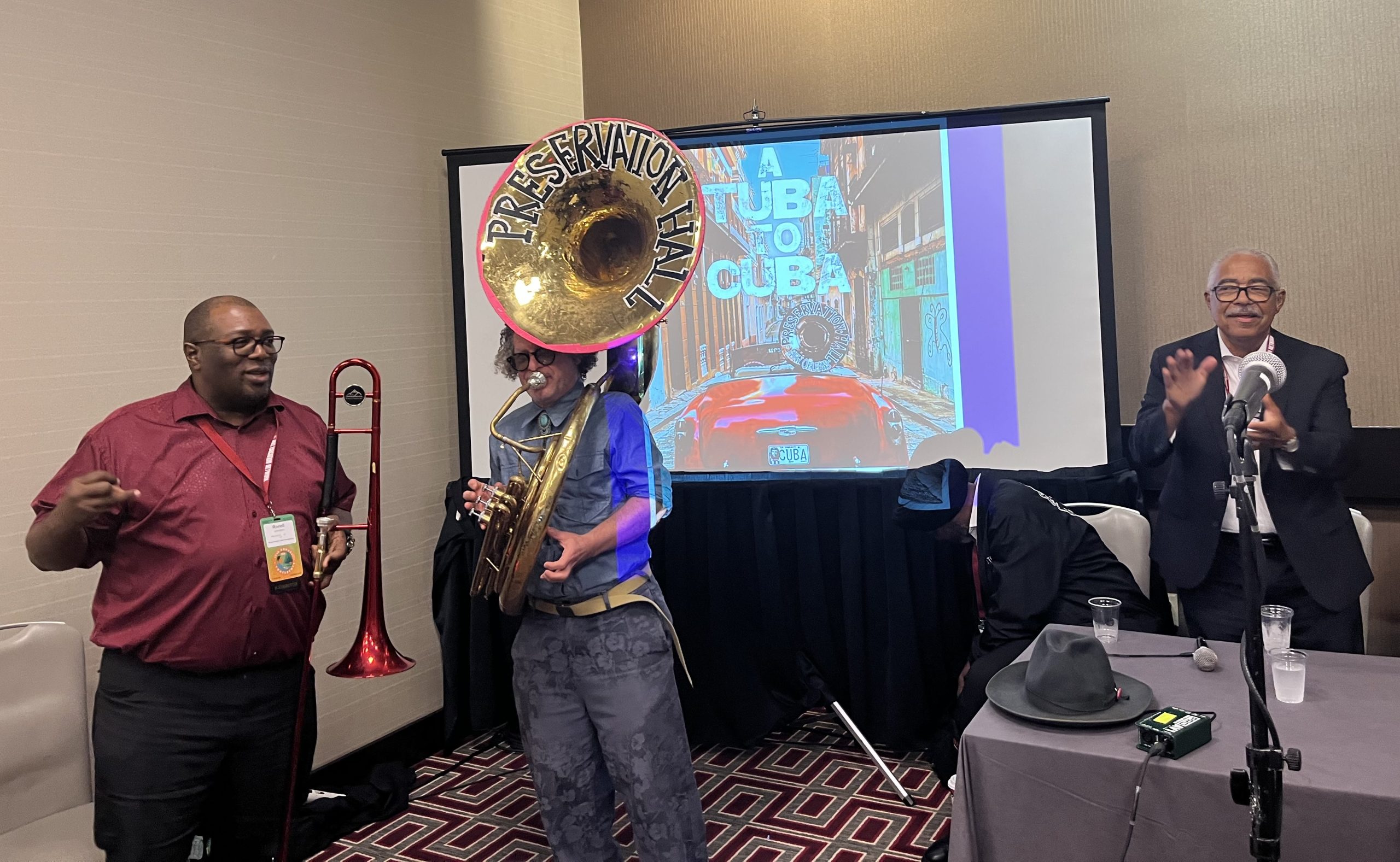
Preservation Hall, in fact, was a major sponsor of the conference, and had a strong presence throughout the four-day event. Another day, an assemblage of Hall old-timers did an evening performance of traditional repertoire, and various musicians from the Hall’s roster did two other sessions as well. One of these consisted of a panel of the Cuba trip participants very movingly describing that life-changing experience, now documented in the film A Tuba to Cuba. Another found a group of Hall players demonstrating and discussing modern brass band repertoire, joined by a bevy of student musicians (quite to the delight of the audience).
I caught as many sessions across the four days as I could. The Alabama Jazz Hall of Fame did a session about preserving jazz history (which they do partly via their own jazz radio station). The Little Stompers Family Band performed a show they do for school kids—vocalist, tenor sax and rhythm highlighting mostly the funky aspect of New Orleans music, but the saxophonist switched to clarinet for renditions of “The Saints” and “Basin Street Blues.” A band including Mark Braud, Steve Pistorius, Freddie Lonzo and Lars Edegran leaned into the conference theme, demonstrating and discussing examples of the “Spanish tinge” in New Orleans jazz. The Next Generation Jazz Band of New Orleans, a large student ensemble, played “Hot Sausage Rag” as well as Ellington and Basie repertoire. Natalie Boeyink of Indiana University gave an interesting presentation making a case for the teaching of jazz history structured around thematic blocks rather than the usual chronological approach. My friend and colleague John Edward Hasse, founder of Jazz Appreciation Month held internationally every April, gave a presentation recounting the 25-year history of that annual celebration.
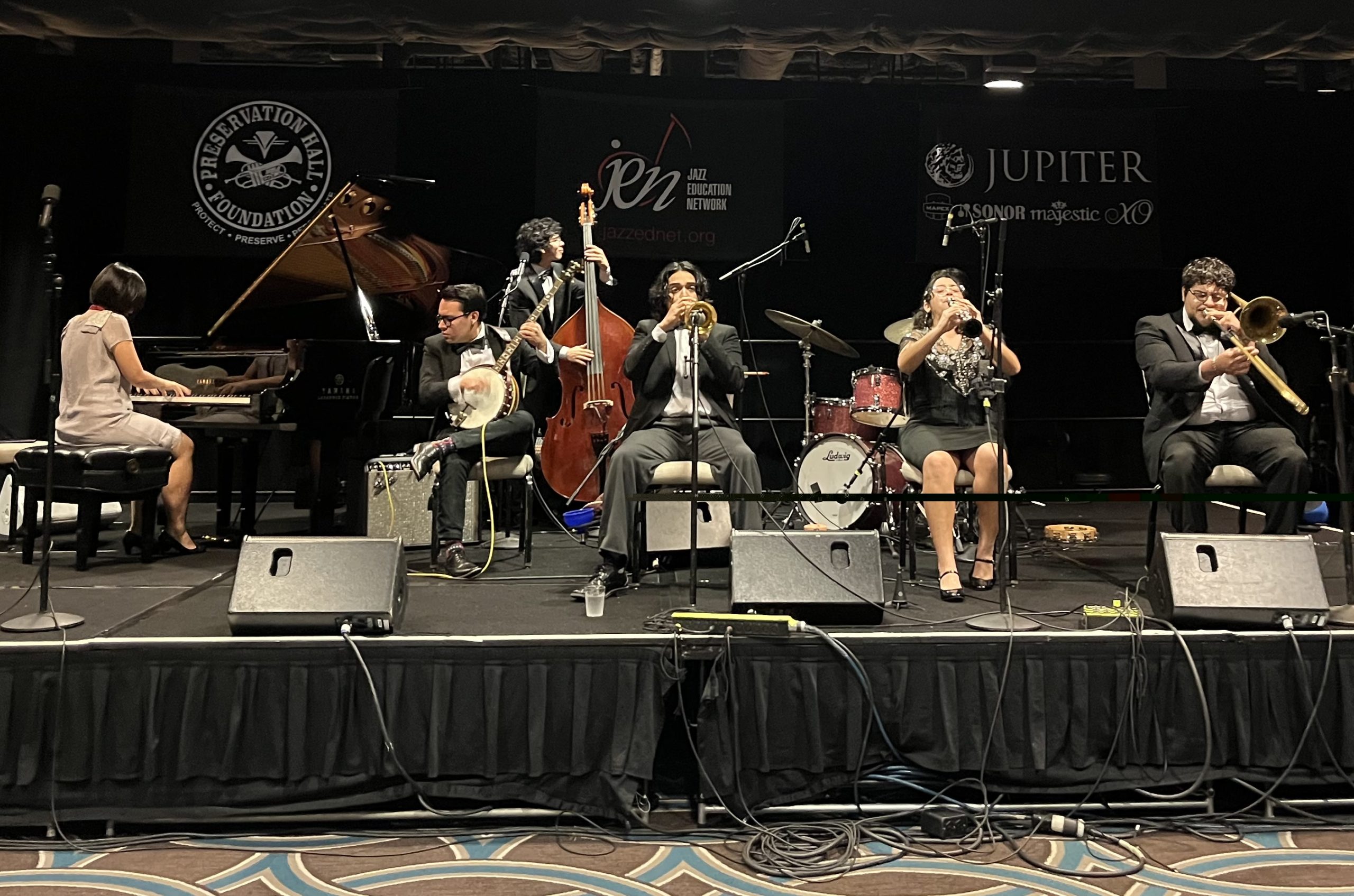
The morning of the third day presented a tough choice. Scheduled opposite each other were trumpeter Catie Rodger’s session exploring trad jazz in New Orleans today, and a concert by a student trad group from Texas A&M University-Kingsville. I decided to hear the student group, and I was not disappointed. Calling themselves the Javelina Jaht 7 (pronounced “Havelina Hot 7”) and directed by the animated Dr. Theresa Chen, this group gave a performance that was tight, swinging, and inventive, featuring some of their original compositions in the trad style.
Research presentations during the conference included such topics as early New Orleans jazz education, by Jonathan Bumpus of the University of Northern Colorado; the compositional approach to improvisation from Morton and Armstrong through the 21st century, by Keegan Marshall-House of New England Conservatory; and 100 years of the Charleston, by James P. Johnson biographer Scott Brown (whose Johnson bio Speakeasies to Symphonies is hot off the press).
I, too, had a role in the festivities: I served as a clinician for two of the student bands performing at the conference, and I gave a well-received audiovisual presentation on such historical New Orleans trumpeters as Wingy Manone, Kid Howard, Red Allen, Sharkey Bonano, Kid Thomas, and Buglin’ Sam DeKemel (who could wail the blues on a beat-up Army bugle!). I also found time to go catch Don Vappie in a trio setting at Mahogany Jazz Hall, and made my obligatory stops at the Acme Oyster Bar and the Louisiana Music Factory record store. (Striking up a conversation with my server at the Acme, it surfaced that she was Roderick Paulin’s niece!) Another night while I awaited my blackened salmon and bread pudding in a French Quarter bistro, the PA system pumped out a rap selection, followed by a Professor Longhair tune, followed by a Cajun tune, followed by some Trombone Shorty funk, followed by Sweet Emma Barrett singing “I Ain’t Gonna Give Nobody None of My Jelly Roll.” It’s all just music in New Orleans!
The 18th annual Jazz Education Network Conference will be held January 6-9, 2027 in Louisville, KY; then back to the Big Easy in ’28. I lead an interest group for trad jazz within JEN, called the JEN Traditional Jazz Society, which I encourage you, dear reader, to join. I can be reached at jazzteacher@wap.org.
Dave Robinson has directed the Capital Focus Jazz Band since its formation in 1988. He is an active jazz performer, historian, and educator. Visit the Capital Focus Jazz Band atcapitalfocusjazzband.com andFest Jazz atwww.fest-jazz.com/welcome.