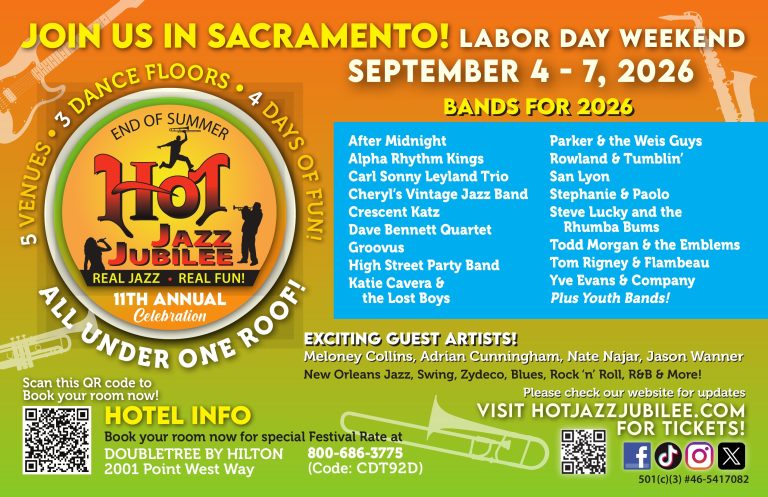
I’m aware that the Traditional Jazz festival circuit has been around a long time. One of the earliest festivals was the Sacramento Jazz Jubilee in California which began in 1974. According to past festival officials, at one time the event was considered the second largest music festival in the US and drew attendance numbers of more than 100,000 people from around the world.
Indeed, when I first appeared at the Sacto Jubilee (it was with the CT-based ensemble The Hot Cat Jazz Band in 1993) there were still scores of thousands of fans in attendance. We did OK because we were young, brash, and wore a livery of dark slacks, suspenders, white shirts and colorful ties, shamelessly copying the get-up (and admittedly quite a bit of the music) of the better-known Black Dogs.

This edition of my occasional “To___ or Not To___” series focuses on a rule that emerged during the salad days of the festival circuit (1970s-1990s or thenabouts). A band couldn’t be considered a band unless everyone was in a uniform. To me, this stance was a throwback to the early “musicianer” ensembles of New Orleans, such as The John Robichaux Orchestra, Peter Bocage’s Superior Orchestra, or Piron’s New Orleans Orchestra. [Note: none of these was referred to as “bands.”] But I soon realized that visual synchronization mattered as much as musical synchronization (and in some cases I experienced, and sometimes still endure, even more!).
A few years before my inaugural appearance at the SJJ, my good friend (also in the Hot Cats) Jim Fryer had appeared there as trombonist and co-leader of the Massachusetts-based Paradise City Jazz Band. This group mirrored a very popular band, The High Sierra Jazz Band, in instrumentation only. Both bands (at that time) had no reeds in the front line—so only trumpet and trombone supported by a full rhythm section—but while the HSJB specialized in stomping two-beat jazz a la Lu Watters and Turk Murphy, the PCJB’s motto was “From Morton to Monk.” They’d expertly assay an ebullient “Black Bottom Stomp” and then slide into a brooding “‘Round Midnight.” The director of the festival said he and the audience loved their music and variety but that they’d better get in uniform or they would never be invited to return.
Fryer’s co-leader, Dave Pinardi, was furious and started scouring thrift stores in the area. He found six powder blue bowling shirts with frills and names embroidered in the upper left hand corner. He handed them out to the band and demanded they wear them for the rest of the festival (so, Saturday through Monday as this was Memorial Day Weekend). Jim told me from then on he was “Ernie” while Pinardi chose “Biff” and the others got stuck with “Casper,” “Finch,” “Melvyn,” and “Royston.” Imagine the surveys…
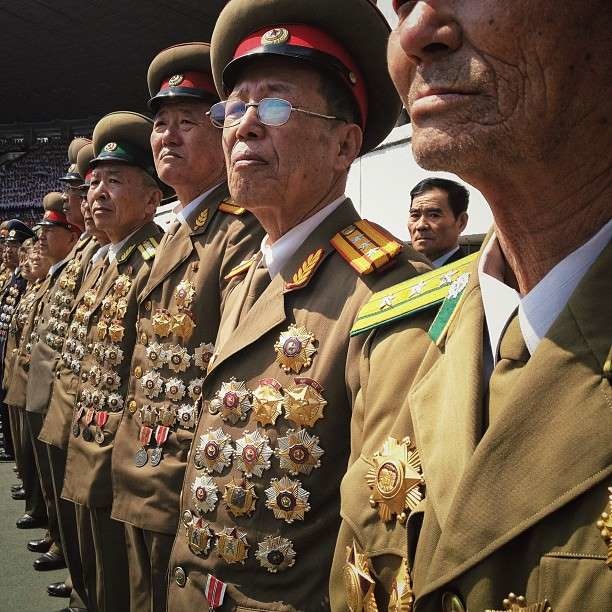
Tight and mismatched
During my stint with the Titan Hot 7, we all wore suits or jackets with button-down shirts and ties or silk pullovers. We caught hell for not having matching ties, or the same color suits or shirts. One incensed audience member spat out “What do you think this is, a jazz party?”
[N.B. For any uninitiated among my readers, a “jazz party” differs primarily from a “jazz festival” in that the former mostly features “high profile” (whoa…can I even use that descriptor with the subject of jazz?) individual musicians—rather than organized bands—who convene at the behest of event organizers to “mix it up” over the weekend playing jazz primarily in a “mainstream” (I’m going down a rabbit-hole here with so many labels…HELP!) style but with a hearty dose of “good old good ones” in the repertoire…succinctly, put Eddie Condon on 52nd Street and you get the—if I’m permitted to indulge in synesthesia, aural—picture. The point here is that being individuals rather than part of a band, the invited musicians can don any get-up they like.]
We Titan Hot 7ers were unmoved. (We were rebellious to the verge of being anarchic, but that’s a subject for several future articles). We thought we were honoring the music and the audience by putting on our best performance gear and playing hot. For some in attendance that was true, but for the “garment gendarmes” it was another story.
Insisting on a uniform can sometimes cause quite a kerfuffle. My good friend cornetist Fred Vigorito, leader of the celebrated CT-based Galvanized Jazz Band, once told me an amusing story about uniforms. When the band does an outside function, they put on what every trad jazz musician in Connecticut, Massachusetts, and New York refers to as the “Jersey Tux” (I can’t honestly say what the musicians from New Jersey call it), to wit: grey slacks, light blue collared-shirts, red tie and dark blue blazers. So far so good. If every musician arrives adorned in the aforementioned sartorial splendor, voilà, instant band!

The problem is everyone’s blue blazer might display a definition of “dark” that somewhat differs. Likewise the style and era of the garment could be dissociative. This, however, is a minuscule issue compared with the slacks. “Grey” can mean anything from “iron” to “storm,”“warm” to “cool,” “ashen” to “achromatic.” Indeed, as far as a band uniform is concerned, there are WAAYYY more shades of grey than fifty! The GJB would engage in endless arguments, and infrequent fisticuffs, over what actually constituted “Grey.”
Will that be Dijon or honey?
I witnessed, and was peripherally involved in, perhaps the ultimate uniform “faux pas.” During the 2000’s-2010’s I was an annual international Guest Artist at the Keswick Jazz Festival, a five-day event in the Lake District of the UK. English Trad bands, from Chris Barber on, often eschewed pianos as part of their line-up (mainly out of self-defense, as the pianos offered in pubs in the UK were commonly referred to as a “box of matches,” indicating the only fitting thing to do was to burn them). So the Festival Director would often saddle piano-less English trad sextets with me as a guest for their sessions (in contrast with US festivals where bands typically play between 45-75 minutes sets, a session in the UK is typically three 50-minute sets with twenty-minute breaks—or intervals as they call them).
Often these sessions would go remarkably well. I remember shows with the Zenith Hot Stompers and Gerry Brown Mission Hall Band that were memorable for all concerned.
In contrast, some bands were sniffy about my “encroachment” upon their sound. One in particular really didn’t want me there at all. The venue was the Alhambra Cinema. This was a proper movie theater with a stage ten feet above the audience (or, as the English refer to them, “punters”). I arrived 45 minutes early to confer with the leader as to how I would be involved. The leader rather dismissed me with the notion that the band would play the first six tunes of each set of the session and have me up for the final one or two. When I pressed them for what tunes they would likely include me, they were much more interested in crowing about their new band uniforms, trotted out to be debuted at this very session!
The band were wearing black trousers (safe), and mustard yellow shirts with open neck collars and poofy sleeves (because these were all procured by the band leader who handed them out to the band members, they were also safe: they actually matched). Every time I tried to pry a program out of them, they were preening like peacocks.
“Fine,” I said, “I’ll be out there listening to you, call me up when you like.” I always make a point to respect any ensemble that has agreed to host me (however reluctantly in some cases) and listen to what they have to offer in their unaugmented state. I plopped myself in the tenth row of the theater and waited.
Now, the theater personnel were keen in keeping the theatrical atmosphere intact, so they insisted the band be onstage before they closed the curtains to cover up the set for their upcoming show Moose Murders which was being presented at the Alhambra by the Keswick Kast of Kharacters Kommunity Ktheatre. Unbeknownst to the band who had been touting their new duds, the theater folk presenting the following weekend’s soon-to-be dud were bragging about the new stage curtain! They told me I’d see it when they pulled it closed behind the band as they started their session.
The band started, the curtain closed, and it was the EXACT same mustard-yellow hue as the band’s new shirts, so they disappeared from the waist up except for disembodied heads and hands. The punters roared, and that day I had a triple shot of Schadenfreude for which I shall never be ashamed!
I’m not saying I’m anti-uniform. I’m certainly no fan of the sartorial message implied by the current influx of young bands whose shambling mismatched outfits cry “I’m homeless, so tip me so I can buy a decent shirt” or “I fell out of bed and into this washboard”—honestly…respect the music, the audience, and yourselves! I simply hope there’s some middle ground. If a band looks sharp and sounds good, enjoy them and leave it at that. Don’t judge a band by its coverings.

Jeff Barnhart is an internationally renowned pianist, vocalist, arranger, bandleader, recording artist, ASCAP composer, educator and entertainer. Visit him online atwww.jeffbarnhart.com. Email: Mysticrag@aol.com