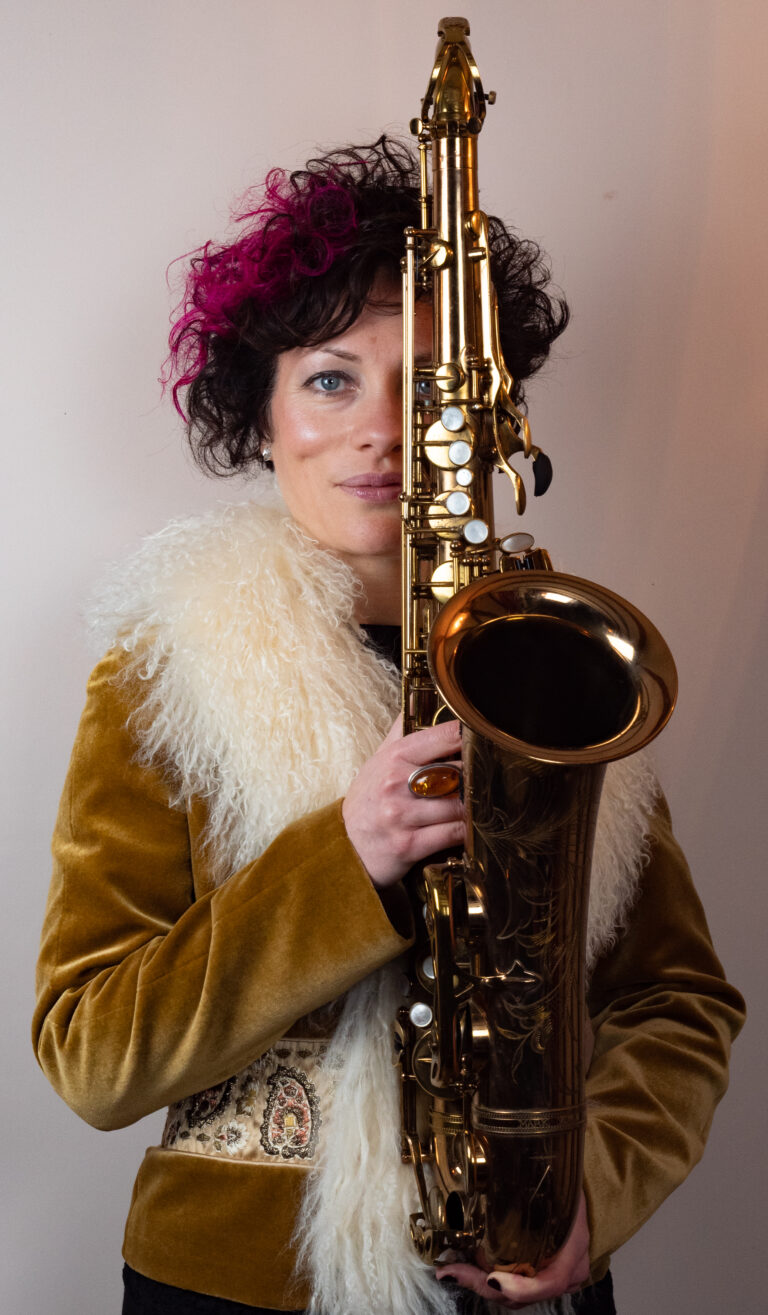
Hannah Horton is an award winning saxophonist, composer, bandleader and successful recording artist. She has played alongside Amy Winehouse. She won a Parliamentary Jazz award in 2023 and has played at Ronnie Scott’s, the 606 Club, and the Royal Festival Hall. BBC Music Magazine said: “Rising star Hannah Horton is turning heads.”
I had the opportunity to sit down with Hannah and ask her about all things jazz.
How did you get into jazz?
I really connected deeply with jazz in my twenties, but my relationship with it before then was quite complicated. I loved playing in the jazz bands at Junior Guildhall (a British school of music and drama) and other ensembles as a teenager, but I was made to feel that my improvisations weren’t good enough and that really knocked my confidence. I stopped improvising for a long time after that and focused instead on classical saxophone, playing in orchestras and big bands where everything was written out for me.
It wasn’t until I got to music college—where I studied joint jazz and classical saxophone at postgraduate and advanced postgraduate level—that I started to rebuild that connection with jazz. The improvisational side slowly came back, and I began exploring writing my own tunes too, especially around the Covid-19 lockdown when there was finally time and headspace to experiment without pressure. That’s when jazz really became mine.

Why the sax? And why the baritone?
I actually started out on clarinet, but when I was about ten my teacher suggested I try the saxophone—and I instantly fell in love with its sound and timbre. I began on alto, then moved to tenor, and eventually saved up to buy my first baritone.
The baritone has a special place in my heart. I love those rich, lower registers and showing people just how versatile the instrument can be—it’s not just about honking out bass lines. It can be lyrical, powerful, soulful and nimble too. There’s something magical about its depth and the way it anchors the music while still being able to sing over the top.
So you’ve done alto, tenor and baritone…what’s next? The contrabass? Just keep getting bigger and bigger…?
No, I think that’s it for the moment!

Did you ever veer away from jazz and go a little bit wild?
I actually started firmly in the classical world and still play clarinet and flute as well. I also played bassoon for many years—though during lockdown, when I decided to give being a jazz saxophonist my full energy and attention, the bassoon went back into its case and hasn’t come out since!
I’ve dipped into other genres over the years too, which has been great for my development, but jazz is where I feel most at home. It’s where I can express myself most honestly.
What’s your typical week like? Gigging, teaching?
No two weeks are ever quite the same, which is part of what I love about this life. It’s usually a mix of gigging—both my own projects and collaborations—composing, recording, and teaching. I also run J Steps, a collective for young female and non-binary jazz musicians, so I spend time mentoring the next generation too. And then there’s all the behind-the-scenes stuff like planning tours, creating content, working on new ideas and running my Patreon too.
You recently shared “100 Days of Practice” on your social media. Can you tell me what that is and why you did it? Don’t you practice everyday anyway?
I do practice every day—that’s part of being a professional musician—but the 100 Days of Practice was about something else entirely. My followers often ask me for tips and insights into what goes on off stage, and I wanted to share that more openly.
It was also a way for me to hold myself accountable, to commit publicly to showing up every single day and share the reality—the messy, imperfect bits as well as the breakthroughs. I hoped it might even grow my following a little (it didn’t, as it turns out!) but I loved how it pushed me and inspired others. The only real extra effort was filming the sessions, writing the copy and posting—but it gave people a genuine window into the daily graft that sits behind the music.
What’s it like to be a woman in the jazz world? Is it as hard as being a woman in any other profession or does it have special challenges?
It’s hard—and often lonely. In jazz, as in many creative careers, you have to wear every hat: publicist, content creator, booking agent, administrator, tour manager… the list goes on. And yes, there are definitely still moments where gender assumptions are very much alive. I’ve turned up at venues and been shown straight to the green room and told to wait—because they assume I’m a girlfriend of someone in the band.
There’s also a pressure to be absolutely on my game all the time, because I know I’m being judged differently. That said, things are changing. There’s a growing community of brilliant women and non-binary musicians, and a real awareness that diversity matters. That’s a huge part of why I founded J Steps, a collective that supports young female and non-binary jazz musicians—because representation and visibility really do shift the culture.
What’s the state of British jazz at the moment?
It’s a really exciting time. There’s so much creativity and diversity bubbling away—new voices coming through, established artists pushing boundaries, and audiences that are more open than ever. British jazz feels less tied to definitions now; it’s drawing from so many influences while still honouring the tradition. That makes for a scene that’s vibrant, adventurous and full of possibility.
When is the next album out?
Spring 2026. The album is called Stories on the Wind, and it’s by far my most personal and ambitious work yet. It’s a sonic exploration of memory, belonging and the invisible threads that tie us to people and places—a soundscape that’s spacious and open but always rooted in rhythm and melody.
We recorded it during a week-long retreat at Red Kite Studio (in Wales) with producer Martin Levan, whose work I’ve admired for years. I deliberately stepped away from the rush of daily life and immersed myself completely in the process with my band. That time and focus really allowed the music to unfold naturally, and I can’t wait to share it with the world.
Visit Hannah Horton online at hannahhorton.com.
Gavin Milnthorpe is a published author, with three books published to date. He has also had some modest success in the theatre, including two professionally produced plays, and also featured on the BBC Radio Norfolk New Comedy Show. He lives in Bury St. Edmund, UK.