 Jazz and comedy have always been intertwined. No surprise. Both are rooted in a sense of timing, creating a personal voice, living a life on the road and skewering pomposity. Duke Ellington said: “You have to have a good sense of humor before you’re a really great jazz musician.” Bix Beiderbecke was asked in 1929 to define jazz and said: “Jazz is musical humor.”
One of the set of first jazz recordings by the ODJB called “Livery Stable Blues,” was full of “off” instrumental sounds meant to be funny—whinnying, smears and growls. King Oliver’s use of mutes is often meant to evoke a smile, if not a laugh. Jazz musicians often danced, sang and did comedy routines in the course of an evening’s performance.
And, of course, comedians were often on the bill. At the Cotton Club, the likes of Moms Mabley and Butterbeans & Susie opened for the Duke Ellington Orchestra. In the 1930s, Pigmeat Markham and Dusty Fletcher opened for Count Basie and others at the Apollo theater. Then, there was Spike Jones, Slim and Slam, and Harry the Hipster Gibson.
Lord Buckley, almost a pure fusion of comedy and jazz, emerged in the early 1940s, at about the time Bebop began to take hold. This marked the time when the perceptionthat jazz was entertainment began to change to the ideathat it was an art form. Ironically, one of the people most responsible for bebop was one of the funniest people in jazz: Dizzy Gillespie. Diz, along with some other Jazz musicians who remained in the mainstream of Jazz continued to use humor on stage—James Moody, Dexter Gordon, Roy Eldridge, Illinois Jacquet.
Beginning in the 1950s, a whole gang of stand-up comics arose who were moving away from broad, ethnic, or slapstick humor and taking on some of the “hip” and “infra” modes of jazz musicians. Among them were Lenny Bruce, Mort Sahl, Shelley Berman, Bill Cosby, Dick Gregory, and George Kirby.
Then, comedy became big business and jazz became smaller business. Las Vegas, Playboy clubs, and some other nightclubs kept it going for a while—Jay Leno opened for the Miles Davis Quintet at Lennie’s On The Turnpike. But it became increasingly rare for comedians and jazz musicians to share a stage.
Of course, humor never left jazz. For one thing, musicians continued to use humor in their solos and compositions. Then, you had people like Steve Allen, Pete Barbuti, Annie Ross, Jon Hendricks, Jack Sheldon, George Shearing, Dave Frishberg, Bob Dorough, Mose Allison, Matt Wilson, Larry Goldings, the group “Mostly Other People Do The Killing,” and Willem Breuker’s Kollectief.
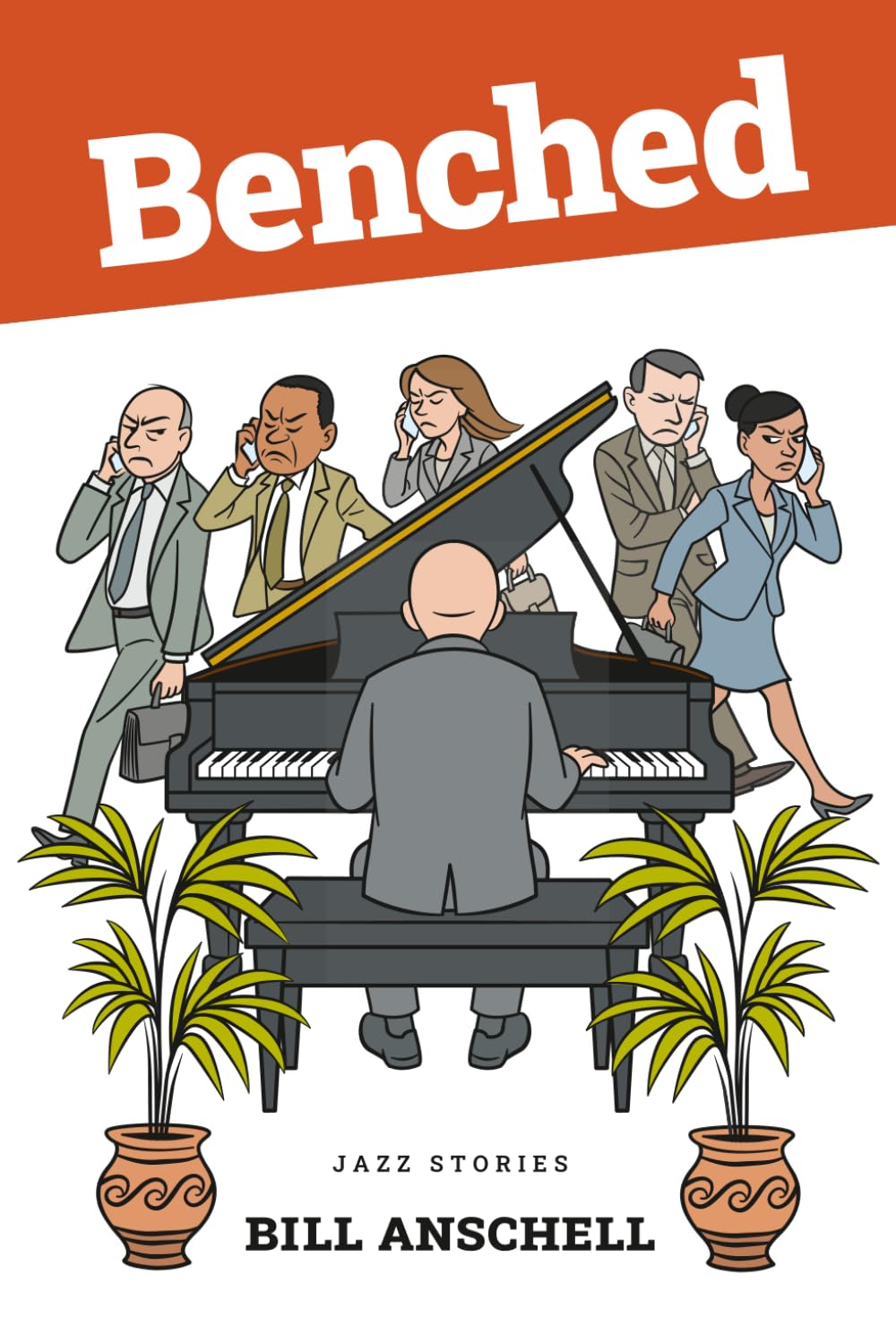
Pianist Bill Anschell is often spoken of as being in this group and he has just released a book called Benched: Jazz Stories, which falls on the dark and absurdist end of the humor spectrum.
Anschell seems to love jazz music, but he’s not that happy about the world of jazz. The cover illustration says it all. It shows a pianist, apparently Anschell, seated at a piano with his back to us. Meanwhile, executive types with pissed off expressions pass by, ears glued to cell phones, several shooting angry looks at the pianist.
Anschell’s “jazz advice column,” Mr. P.C.’s Guide to Jazz Etiquette and Bandstand Decorumis in its 16th year on Allaboutjazz.com. There are a number of those columns collected in this book. I was not a reader of the columns, but I have a feeling they work better as separate items than they do here. There’s a certain amount of repetition in themes and motifs that undermines their collective effectiveness.

The author knows how to write and there are some outright laughs and riffs that come off well. As a trumpet player, I especially liked his bit about what happens to horn player’s spit. His occasionally picaresque adventures sometimes amuse. But there are things working against the success of the book as a whole.
It’s one thing to look askance at the denizens of the jazz world, but there’s a bitterness that underlies the book’s tone. The only group that escapes Anschell’s dark pen are the best, most dedicated jazz players, which he dubs “the Chosen Ones.” Everyone else earns the author’s scorn. To Anschell, jazz audiences seem almost universally naive at best and often, idiotic. Owners, bookers, producers, record industry people, to a man or woman, are only in it for the money and will screw over a musician at the drop of a rimshot. Critics? Don’t even ask.
Drummers and vocalists come in for a lot of abuse. My response to this is—really? I know good drummers and vocalists exist. I know you do too, so I feel like you’re just playing to the cheap seats.
I get it, the author feels that he and the jazz he cares for are embattled—engaged in a war against a horde of Philistines. That in itself would not preclude a humorous approach, although few people apart from Jonathan Swift have carried that off. As I said, there are some things that amuse, but there’s just too much personal insecurity, even a sense of despair in the tone and that left this reader not in that much of a mood for a good laugh.
Benched: Jazz Stories
by Bill Anschell
Paperback: 168 pages; $15.99
ISBN: 9798270830021
Blow Hard Music
Available on Amazon.com
Steve Provizer is a brass player, arranger and writer. He has written about jazz for a number of print and online publications and has blogged for a number of years at: brilliantcornersabostonjazzblog.blogspot.com. He is also a proud member of the Screen Actors Guild.