Teddy Wilson looms over early jazz piano, just as Bill Charlap does today. It is unsurprising that Mr. Charlap, who in addition to his performing career also teaches jazz at William Paterson University, had a decades-long interest in finding a forgotten, or perhaps legendary, tome by his great predecessor. He said, “I don’t remember how I first heard of it. It seemed basically a myth. Now there are many books on how to play jazz piano, but the idea that there was a pedagogical book by the premier jazz pianist in the world pre-Bud Powell, was of very high interest to me.
“Everybody I talked to who might know something about this, people like Loren Schoenberg, Ken Peplowski, and Kenny Washington, they had heard of it, but no one had ever seen it. I know I didn’t hear about it from Dick Hyman, because of all people who would have everything like this it would be Dick Hyman who was also a student and friend of Teddy Wilson and ultimately one of his greatest progenies, and my mentor for that matter. Dick was always my go-to for any such thing. Anytime I was looking for anything like Willie the Lion’s ‘Morning Air’ or ‘Echoes of Spring,’ I could ask him and they would come in the mail a day or two later, beautifully copied.”
Decades of looking for Wilson’s tome yielded nothing. Then in June, 2023, the people in charge of our Library of Congress held an extended celebration of Billy Strayhorn. As part of that Charlap explained, “I did a concert of all Billy Strayhorn’s music; with Kenny Washington, Peter Washington, and Jon Faddis the guest artist. There were a lot of people there from Billy Strayhorn’s family which was very meaningful.”
Prior to that, Charlap and his wife, pianist Renee Rosnes, were invited to see some of the library’s special treasures. By law, everything that has ever been copyrighted, plus much more, is there. Charlap said, “They set up a very lovely afternoon for us. They said, ‘What would you like to see?’ I said, ‘There are so many things here, why don’t you just pick some things you think are special and bring them out to us.’
Then Charlap said, “In the actual theater where we did the concert, there was a small gallery devoted to George Gershwin. It is very moving. I saw the opening bars of the fanfare that opens Porgy and Bess and it reduced me to a puddle of tears just to be in front of that and to think how important that was. So, we spent a whole afternoon with a library cart filled with a whole bunch of George Gershwin’s music, music by Dexter Gordon, music by Thelonious Monk, all kinds of unbelievable things.
“The people who work at the Library of Congress know the value of where they are. I said to the young man helping me, ‘I’ve heard about this book by Teddy Wilson that nobody has ever seen. He had a half smile and kind of nodded his head like he understood and that was it. I thought, ‘Well you never know where that would go.’”
The next day, when time came for the concert. “My plan was to walk out on stage, bow, and sit down and immediately play ‘Lush Life.’ That didn’t happen. Rather, it began with a shock to the pianist which you can see at the Library of Congress website (tinyurl.com/billcharlaploc) or on YouTube. It’s entitled “Bill Charlap Trio with Jon Faddis.” Eight minutes into the introduction, Susan H. Vita, the Chief of the Music Division of the library, calls Charlap to the stage and explains to all about his Teddy Wilson quest. As he realizes what is happening, Charlap’s mouth falls open in shock. “I can’t believe you,” he says. Then, as she shows it to him, “Oh my God. This is the Bible and the Torah and the Quran all in one for jazz piano. Unbelievable. I am just knocked out.”
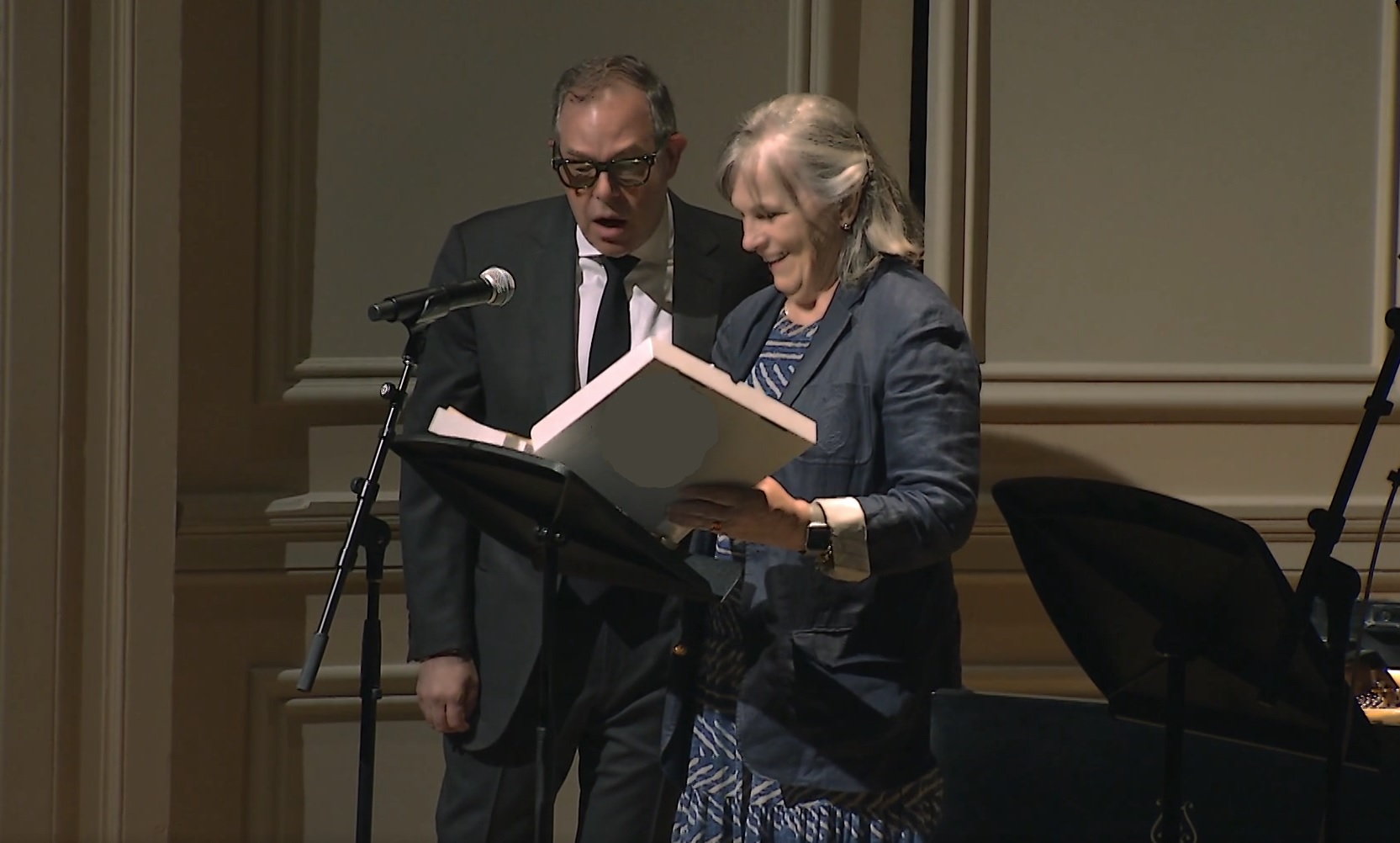
Ms. Vita explains that the 250 fragile pages were not bound, “So we can’t give it to him to take home.” Charlap told me, “They were kind enough to put it on a flash drive for me, and they did a very nice job of that. What’s cool about it is all the examples are written by hand, and it’s likely Teddy’s hand. It looks like a professional copyist”. It’s entitled Teddy Wilson’s Advanced Course in Modern Piano Playing and is dated 1939.
“The very first thing in there is Teddy talks about all these rhythmic statements. That tells you that the key element in the music from his point of view, and that means from the center of the music coming straight out of Louis Armstrong, through Earl Hines to Teddy Wilson is the rhythm that we call ‘Swing,’ that inevitable forward motion that exists only in jazz.
“He doesn’t speak of other pianists or any other musicians. It is much more nuts and bolts. There are assignments with empty pages for answer sheets. I believe this was a mail order course. It consists of lessons with titles such as ‘Lesson Number 2 Fixed Rhythmic Patterns, The Inherent Rhythmic Influence, Embellishment of Simple Patterns.’ ‘Lesson Number 3 The three Basic Feelings in Music Tendency of Tones, Passing Notes, Enabling Tones.’ Its technical. He doesn’t sugar coat it.

“This is why the book is so fascinating. Now we have the Juilliard Jazz Program at the Juilliard School, The New School, North Texas State, William Paterson University, Manhattan School of Music all these fantastic places, but those didn’t exist at the time and explaining jazz wasn’t like today. When Teddy wrote his book, the Merriam-Webster dictionary from the 1930s has for ‘Jazz’: ‘Noisy, loud dance music sometimes played at parties.’ If that isn’t dismissive and racist, I don’t know what is.”
Charlap still hasn’t studied it thoroughly, but he did make sure to make proper use of it. “I shared it with Dick Hyman. It was the first time I was able to give him something, and it was such a great feeling to hear him say, ‘I’ve never seen that before and it’s sensational. I can’t thank you enough.’ I wanted to say, ‘Yeah, you can and you did, just about 10,000 times.’”
Our Library of Congress is well worth a pilgrimage. In addition to the original copies of our Declaration of Independence and the Constitution, there are vast treasures to see in so many fields. Many years ago, I was dumbfounded to see a reel-to-reel tape containing a command performance that the Duke Ellington Orchestra gave for the king of Jordan in the 1950s. Perhaps now you can not only see it but hear it there as well.