Hal Smith: Jeff, last month we agreed to talk about some of our favorite recordings by the great traditional jazz vocalist Clancy Hayes. In your excellent review of Chris Reid’s Clancy Hayes: The Swingin’ Minstrel (The Syncopated Times, February, 2026) you mentioned that “Oh, By Jingo!”—the 1964 recording session by Clancy with the Original Salty Dogs—was your introduction to Mr. Hayes’ music. What was it about his vocal style that caught your ear?
Jeff Barnhart: Hal, Clancy was unlike anyone I’d heard up to that point. First, the overall recording quality on that session still sounds terrific to me, and his voice was beautifully captured. His singing was so honey-warm and rich, with a phrasing that sounded natural and effortless at the same time it compelled you to tap your feet and wiggle your seat. As well, every word he sang added to the unfolding story. He was a troubadour who infectious good humor and clear delivery of often very complicated lyrics will forever leave smiles on listener’s faces and pep in their steps! Sometime during this exploration, I’d like to delve more deeply into this remarkable matchup of Clancy and the Salty Dogs, but I suggest we go back in time to some of his earliest commercial recordings. You mentioned some sessions from the early 1940s so it would be great to start with them!
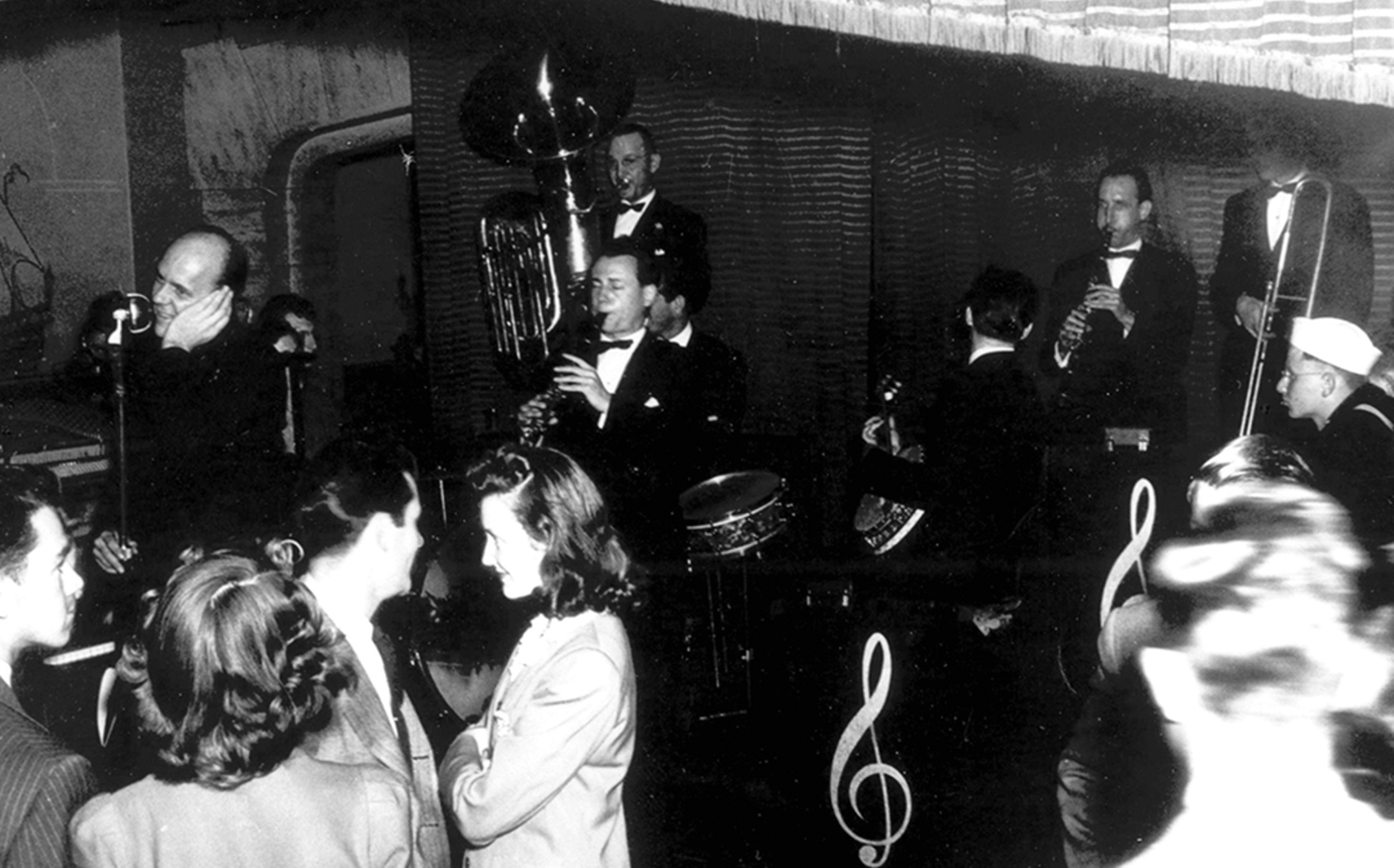
HS: There are some acetates that feature Clancy singing with the Yerba Buena Jazz Band at the Dawn Club in 1941-1942, but let’s talk about what appears to be the first recorded version of Mr. Hayes singing “Ace In The Hole”—with Benny Strickler and the Wartime Yerba Buena Band. This is from a station KYA airshot, dating from August, 1942. The band includes Benny Strickler, trumpet; Bill Bardin, trombone; Bob Helm and Ellis Horne, clarinets; Burt Bales, piano; Russ Bennett, banjo; and Clancy on drums and vocal. When he sang “Ace In The Hole” later on with the Watters Band, Clancy sang the verse in tempo. However, with Bob Scobey (and even later, when performing the intermissions at Earthquake McGoon’s), Clancy once again sang a rubato verse—as heard here.
Clancy didn’t get called to serve during WWII, so he was able to stay active in the Bay Area music scene. One of his most significant wartime activities during this time was his association with New Orleans trumpeter Bunk Johnson, who led a band comprised of ex-Yerba Buena sidemen on sessions that took place at C.I.O. Hall in San Francisco. Clancy was in the rotation of drummers who played on these sessions and was called on to play and sing when Bunk was recorded by David Rosenbaum in 1944. One of the numbers recorded was “Ace In The Hole” and apparently, Bunk had never played the song before the recording was made! It’s a spirited performance, as is “219 Blues” a/k/a “Mamie’s Blues.” Clancy sounds wonderful on both tracks. His drumming is similar to Bill Dart’s playing with the Watters band and fits the ensemble very well. His vocals sound just as relaxed and confident as on his later recordings. Turk Murphy, Ellis Horne, Burt Bales, Pat Patton, Squire Girsback and of course Bunk sound stellar.
Jeff, what do you hear in these early recordings that include the “Swingin’ Minstrel” on drums and vocals?
JB: I’ve always loved “Ace in the Hole.” I first heard it as the first track on the 1959 Turk Murphy album Music For Wise Guys And Boosters, Card Sharps & Crap Shooters (Roulette R25008)—the title comprising lyrics from the tune itself (an album that we should cover sometime for all of the heroes who are on it!) and fell in love with the lyrics, the melody, and the stomping two-beat feel. That album lists the tune as being written by one W.F. Stevenson, but I can’t find any reference to its provenance beyond that.
Anyhow, to come to the first Clancy rendering of “Ace in the Hole,” while it’s unfortunate that the crackling on this transfer is so loud and the band is so far back in the mix, Clancy’s storytelling prowess is at the forefront. The rubato verse sounds almost conversational—and what precision in vocal pitch!—and the chorus swings mightily, though a tad faster than I’d have expected. The ensemble is hot with all parties giving it a go, and I don’t mind the missing bass as pianist Burt Bales has such a strong left hand. Interesting that you mention Bill Dart as I heard a lot of “Dartisims” here and in the Bunk sides. I wonder what Clancy’s drumming sounded like in the 1920’s-30’s before he was infused with the Watters/Dart “sound.”
Moving on to the “Bunk” sides, although the rubato verse is evocative, I don’t mind the in-tempo verse on “Ace in the Hole,” and I LOVE Bunk playing that diminished chord on bars 2 and 4. Hard to believe that he’d never played the tune until this recording. Hal, Clancy’s vocal return at the bridge of the chorus seamlessly blends with everything going on around him. I should really say melds! Clancy is rare in that his instrumental background so deeply informs his singing: he sings like a horn saying words, with an attack, phrasing, and rhythm that can only be possible from a true musician. What a joy to hear this!
Clancy’s vocal on “2:19 Blues” (or “Mamie’s Blues”) is perfect. The two ensembles leading in seem to have a different blues melody to me but is beautiful nonetheless. Clancy’s drumming behind his own first vocal chorus is terrific (what do you call that, Hal?). Was Bunk reading an accompaniment part behind the three vocal choruses, I wonder? Only his phrases are identical on all three…
HS: It sounds to me like Clancy may have been playing on the shell of the bass drum behind his vocal on “219 Blues.” As for his drumming…everything I have heard him play sounds “old style,” like he didn’t move beyond the way drummers played in the 1920s. And that’s fine with me!!!

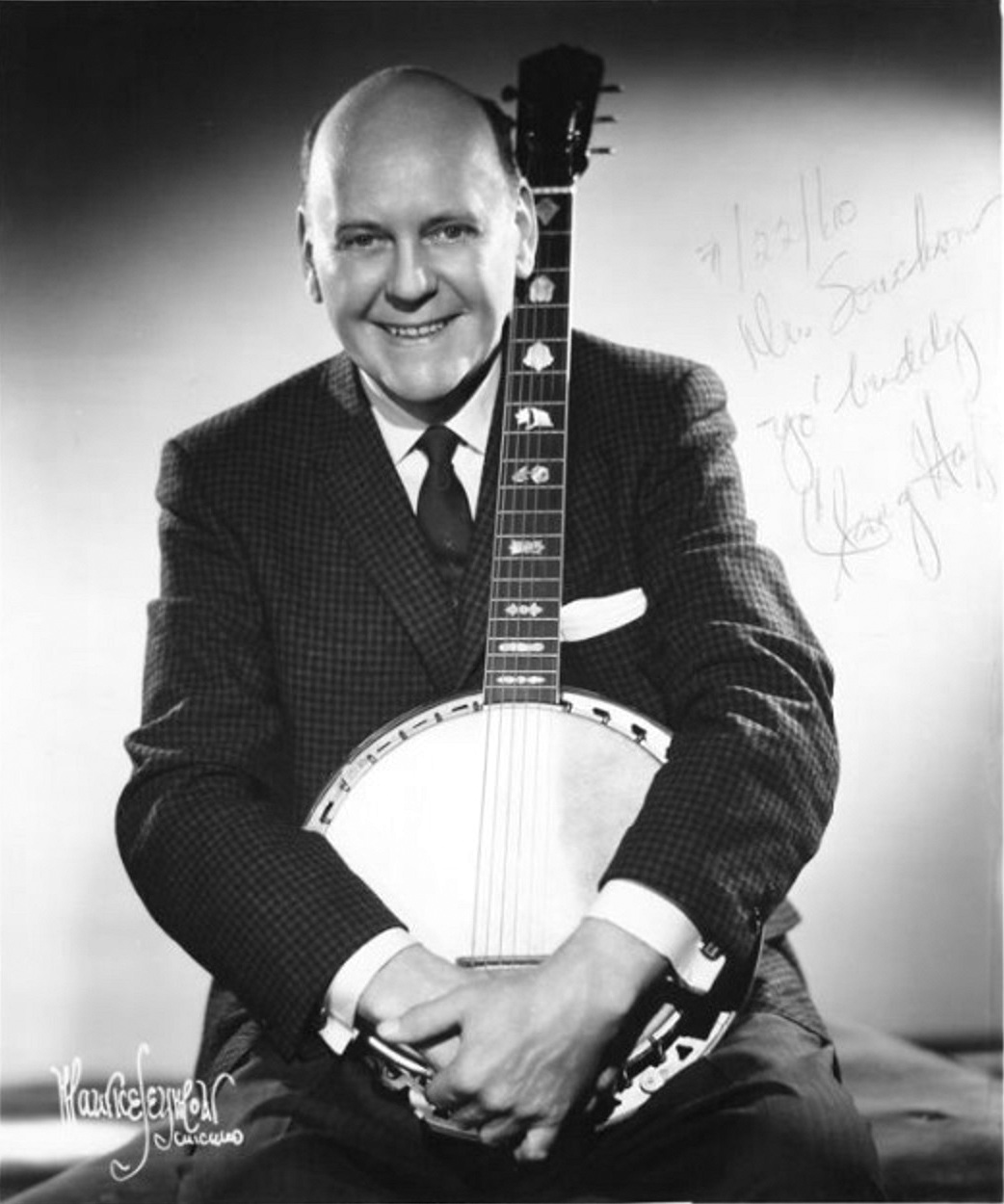
None of the musicians I talked to who played on these recordings ever mentioned reading music. I would guess that Bunk played something he liked behind the first vocal chorus and just decided to stick with it on the subsequent choruses. By the way, this song is sometimes called “Mamie’s Blues.” The lyrics are the same in both songs, but Bunk’s melody and Jelly Roll Morton’s are slightly different. This particular version of “219” is based on Bunk’s own “New Iberia Blues.”
I know there is a recording from a few years later that includes Clancy in a very unusual setting. Would you like to describe it?
JB: Absolutely! Let’s spring forward to 1948 and listen to the very surprising pairing of Clancy and the virtuosic guitarist Les Paul. They made four sides for the Mercury label and there was no hot jazz here at all. One could call it smooth swing, although Clancy’s singing on the waltz “Now is the Hour” is balladic, with an almost Hawaiian backing provided by Paul and Co. The other three selections are “My Extraordinary Gal,” “Nobody But You,” and “Street of Regret.”
What standouts for me is how authoritative and lilting Clancy vocals are—and him standing there crooning with no banjo, piano or drums (as we’ll see, he played all three) in sight! Les Paul takes a backseat during these sides, never overplaying behind Clancy’s warbling, an occasional habit he developed as the years progressed. The format on each side is simple. After an instrumental intro and a full vocal chorus, either Paul on guitar or his (quite good) pianist takes a solo, and Clancy returns to take it out from the bridge (excepting “Now is the Hour” where we hear him sing it through again).
While these sides fascinate me—and all but “Street of Regret” can be listened to on YouTube, I know far more interesting material for our readers came from some live recordings made by Lu Watter’s Yerba Buena Jazz Band at Hambone Kelly’s in 1949-1950. Hal, would you like to take us through a selection of your favorite Clancy moments from those sessions?
HS: One of my favorites is the number that became the title of the session by Clancy with the Salty Dogs: “Oh, By Jingo.” This was recorded for Lu Watters’ Down Home label in late 1949 at Hambone Kelly’s (portable equipment was brought to the club). Clancy’s vocal sounds joyful (who wouldn’t, with that fantastic accompaniment by Lu)???
“Doctor Jazz” is a live recording made a few months later, in February 1950. Just listen to Clancy’s entrance! And dig Bill Dart and Dick Lammi laying it down behind Lu’s half-chorus all the way to the end. The band was still operating with seven (and sometimes eight) pieces when “Doctor Jazz” was recorded, but as the financial situation at Hambone’s continued to deteriorate through 1950, the working band was eventually reduced to a quintet—without Clancy. Thankfully we have the recordings of the full band with Clancy’s vocals on Down Home and Mercury, plus live recordings by Bob Helm and numerous airshots from KLX.
What strikes you about these two sides, Jeff?
JB: One thing that knocks me out is that this version of YBJB is still an eight-piece band but with two banjos rather than two trumpets! Lu plays much freer in this line-up. The tempo is perfect for the tongue-twister lyrics of “Oh By Jingo”—although Clancy flawlessly executes them at a much sprightlier speed on the 1964 album with the Salty Dogs. In addition to Watter’s exemplary backing of Clancy’s vocal on the chorus, Dick Lammi’s splatting tuba (LOVE those leading tones on the 4th beat into the downbeat of the next bar!) lifts you out of your seat! The final half-chorus has terrific breaks for Watters as well! The YBJB was strong enough to give Clancy the backing he needed and deserved.
When I was just getting into this music, “Doctor Jazz” became an early favorite and remains so to this day. And that vocal entrance is beyond hot; it’s abandoned and “get-out-of-the-way” raucous! As a (whiskey tenor) vocalist, I’m interested that he concludes the vocal with a low Eb rather than going up for the high one, even though he’d just hit a high G above it. I also think his lyric variation is an improvement on the original, but I wonder how he came to sing them, as he always sings the original lyrics to the most obscure songs and this one was even then quite familiar. Lastly, Clancy is also playing banjo, so the YBJB continues to be an octet with two banjos!!
From these live recordings, I’ll point out “Alcoholic Blues” from March 3, 1950. The first chorus features the plaintive melody played by Don Noakes on a bucket-muted trombone with Bob Helm playing beautiful harmony in the warm chalumeau register, and Wally Rose playing right-hand filigrees unlike any I’ve ever heard coming out of his fingers. The second chorus has Rose playing a bluesy solo (again with voicings and stylings I’d never associate with him). The entire band comes in (with once again, Rose’s backing sounding a bit like Teddy Wilson..?!?). All of this leads up to Clancy’s belting vocal, with perfect pitch and phrasing that show just what a fantastic interpreter he was of old songs from every style! After Lu’s strutting solo, Noakes and Helm return to take out the song. Hal, this my favorite version of this song, although the label lists “Hayes” as composer when this 1919 lament about Prohibition was penned by Albert Von Tilzer and Edward Laska. No matter, it’s absolutely gorgeous from start to finish.
Finally, I’ll mention a song I had to grow into: “Roll, Jordan, Roll.” When I heard it on a Turk Murphy album I’d bought as a teenager, it didn’t do anything for me. I’ve since come to realize what a terrific song this is, and THIS is the ultimate version, with Rev. Hayes belting it out with all the fervor needed to start a revival! The band plays hot, but it’s Clancy’s vocal that sends this up into the skies! One question, Hal, who does that terrific plantation-style single-string banjo solo, Pat Patton or Clancy Hayes?
HS: That’s definitely Clancy on the six-string banjo solo. I remember that sound when I heard Clancy on the intermissions at Earthquake McGoon’s in the 1960s.
As the Lu Watters Jazz Band finished their run at Hambone Kelly’s, former Yerba Buena trumpeter Bob Scobey was launching his own group, originally called “Alexander’s Jazz Band.” That group recorded for the Jazz Man label in 1950, with Clancy on guitar, though strangely there were no vocals. The following year, with a slightly different lineup, Scobey recorded four sides for Good Time Jazz and this time Clancy was featured on “Beale Street Mama.” This is a very short, juke box – length performance, but the band really packed a lot into those two minutes and 56 seconds! Burt Bales’ wonderful piano sets the mood for an ensemble, with guest clarinetist Albert Nicholas playing some fantastic figures alongside Scobey and trombonist Jack Buck. Bales, bassist Squire Girsback and drummer Fred Higuera play discreetly in the background as Clancy croons the vocal. Notice Clancy was playing guitar on this one, rather than his usual banjo. Clancy was back on banjo and sang in a vocal trio on “Coney Island Washboard”—which he also sang with the Watters Band, but the remaining two sides in this session were instrumentals. Other than some live recordings from 1950-51, these recordings mark the official start of the Scobey-Clancy alliance, where he was the primary featured artist with Scobey’s Frisco Jazz Band.
JB: With headphones on, I can hear some righteous single-string work by Clancy in the first ensemble of “Beale Street Mama.” What a laid-back tempo and feel. Nicholas beautifully backs Clancy’s vocal, which is indeed bluesy! Yes the short length of this side allows for only two times through the tune, but it’s a great feel—almost sounds Chicago-style rather than Frisco-style.
While I enjoyed the vocal trio on “Coney Island Washboard,” what really turned me on was Nicholas’ searing clarinet solo and Fred Higuera’s drumming throughout, especially on the final outchorus!
Clancy is featured much more on both “Melancholy” and “South.” On both, he’s the troubadour singing a story, sharing sorrow in the first and joy in the second! The Scobey band seamlessly backs him, and he gets some great solo-string phrases in behind his vocal on “Melancholy!” “South” is taken at a real Motenesque tempo (this was originally a tune recorded by Bennie Moten and his Orchestra, as anyone who’s kept up with our column will hopefully recall) and Clancy’s vocals take up a full half of the 2:55 length of the take. Hal, I especially enjoyed hearing the diversity Fred Higuera displays on the drums on these two contrasting sides. What do you think of his drumming?
HS: Well, you’re talking about one of my all-time drumming heroes! I love hearing everything that Fred recorded…especially the early-1950s sides with Bob Scobey. Last year, our pal Kevin Dorn and I wrote a column for TST where we discussed some of Fred’s best records. “South” was one that both of us really like. Those Ben Pollack rhythms on the big cymbal are a nod to the 2/4 that the Watters band played, but Fred managed to work in some wonderful ride cymbal, snare accents fills and backbeats, “4-1” on the tom-tom as well as tap-dance style rhythms on the snare drum rims. Everyone is in top form here: Scobey, Jack Buck, Probert, Wally, Lammi, Fred…and of course Clancy! There are so many adjectives that work to describe Clancy’s vocal, but “sunny” is how I always think of it. When Clancy sings, the sun shines brightly!
JB: Hal, that’s a wonderful image. I agree! Even on a sad song—like “Melancholy”—Clancy’s vocal is a smiling one; no brooding self-conscious growling for him…he is pure sunlight. In fact, this might be a good place to wrap up Part I of our exploration of “The Swingin’ Minstrel” and his timeless contribution to traditional jazz! EXCEPT I’ve got just one more ’cause I can’t wait until next time!
With Bob Scobey’s Frisco Band in 1952-1953, Clancy recorded a tune (among many others, some of which I hope to include in Part II) called “Everything is Peaches Down in Georgia” and when I heard it I just about went mad. Written by Grant Clarke, Milton Ager and George Meyer in 1918, it’s such a great ragtime-era tune! Pianist/historian Dick Zimmerman turned me onto it back in the mid-1990’s and I performed it for several years. Although the band changes some of the harmonies from the original sheet, the spirit is spot on with a jaunty, swinging ensemble leading into Clancy’s vocal. As always, his diction and phrasing are perfect, but I’d also like to point out the incredible support Scobey gives him—expertly inserting hot bits in between the vocal phrases—as well as Clancy’s ragtime-style-strumming banjo playing as he accompanies himself! On the ensuing ensemble chorus, listen to Probert’s quirky, herky-jerky clarinet. It gives me goose-bumps! Clancy returns with an even stronger vocal and the whole thing swings out joyously! So, I’ll add one word to our “sunshine” imagery: JOY!
Hal, we’re blessed in that we’ll both be quite busy in the first half of March (including, among other engagements, our upcoming appearances at the Jazz Bash by the Bay in Monterey, CA—shameless plug!), so how about we take a break for the April issue and return to Clancy Hayes for the May one? I want to be sure we’ve the time to do this great musician and entertainer justice.
HS: “Joy” is definitely an appropriate description of Clancy’s singing. It radiates through the grooves of every record he made!
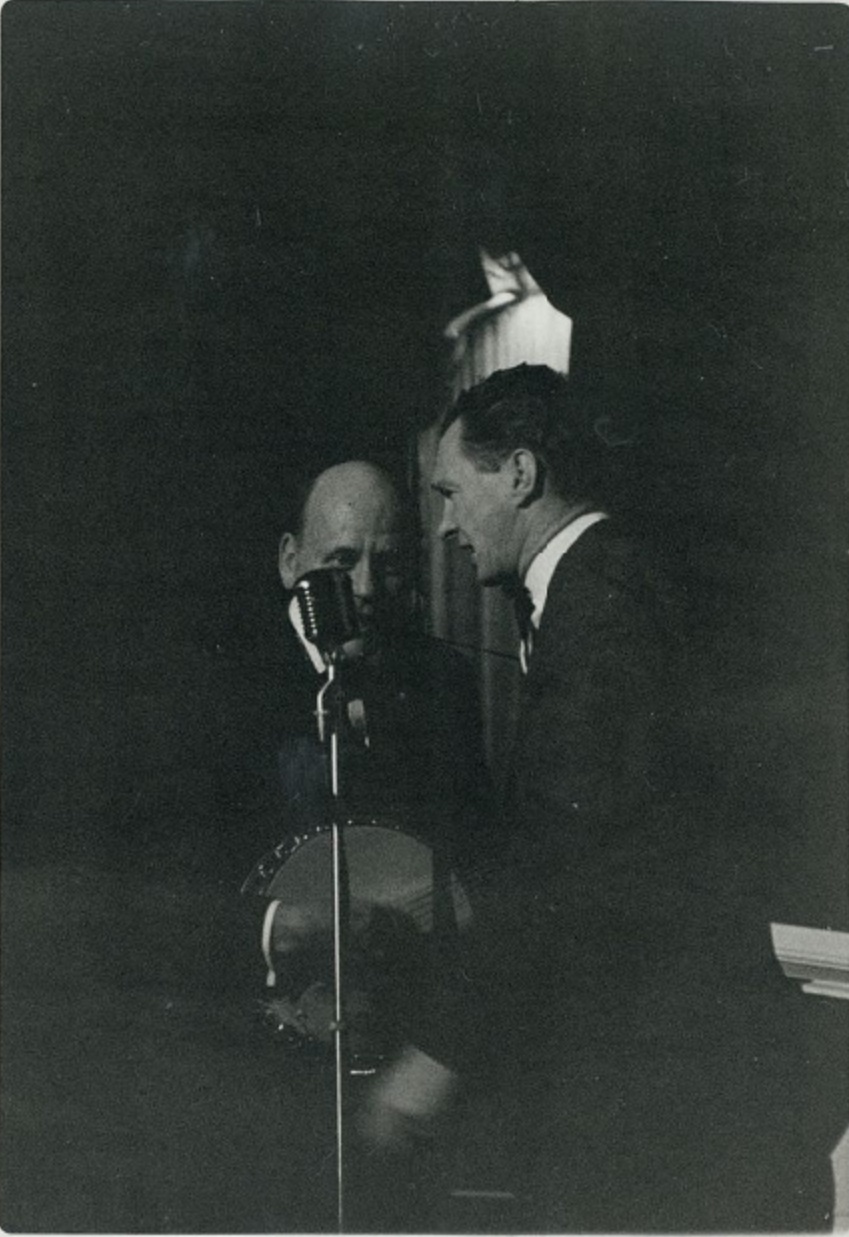
I agree that we should concentrate on the Jazz Bash By The Bay next month and return to a discussion of Clancy Hayes’ vocals in April, prepping for inclusion in the May issue. There are several more great sides by Clancy with the Scobey band—Buck, Probert, Wally, Lammi, Higuera—plus some outstanding guests—and I look forward to talking about those before we move forward chronologically. Meanwhile, I’ll see you in Monterey!
JB: Yes, you will, as well as thousands of friends who will be there to celebrate YOU being this year’s Musician of the Year! In the meantime, for those who’ve listened to the titles we discussed herein and can’t wait until May to learn about more songs by Clancy they can check out (and that really should be ALL of you!), you can visit the YouTube channel “Clancy Hayes Jazz.” It’s curated—and assiduously expanded—by Chris Reid, the author of the biography/discography Clancy Hayes: The Swinging Minstrel, so frequent visits are encouraged!
Clancy Hayes: The Swinging Minstrelby Chris Reid is published by Hardinge Simpole Limited, and is available in the US through barnesandnoble.com and amazon.com.
Visit Jeff Barnhart’s Website (www.jeffbarnhart.com) and Hal Smith’s (www.halsmithmusic.com) for information regarding recordings and upcoming engagements.
Jeff Barnhart is an internationally renowned pianist, vocalist, arranger, bandleader, recording artist, ASCAP composer, educator and entertainer. Visit him online atwww.jeffbarnhart.com. Email: Mysticrag@aol.com
Hal Smith is an Arkansas-based drummer and writer. He leads the El Dorado Jazz Band and the
Mortonia Seven and works with a variety of jazz and swing bands. Visit him online at
halsmithmusic.com