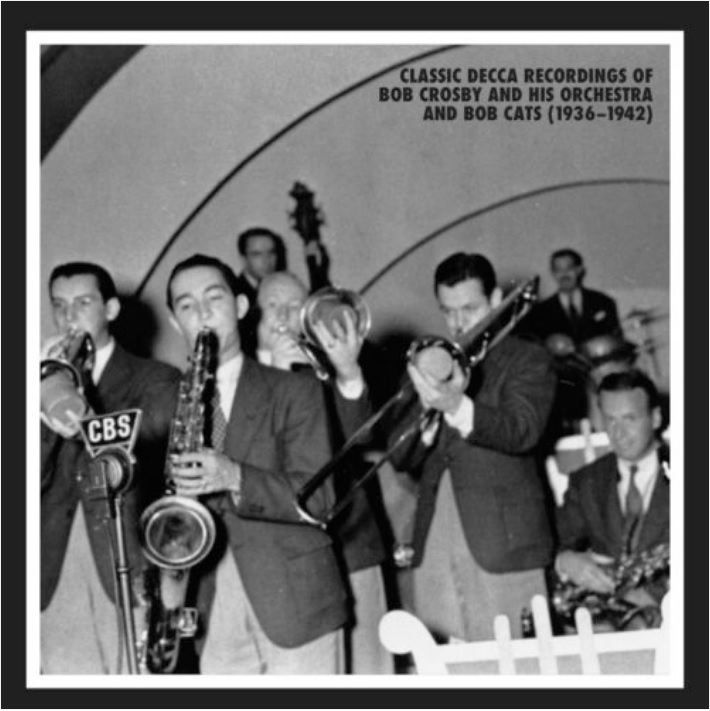
 Bob Crosby (1913-93) was a unique bandleader. When asked what he did for a living, he often replied, “I’m Bing Crosby’s brother.” He had a decent voice, a reasonable feeling for jazz, and a genial personality. But being the sibling of the most famous and beloved singer of the 1930s meant that, while some doors were open, others would be very difficult to get through. During his period as the vocalist with the Dorsey Brothers Orchestra (1934-35), he was sometimes referred to as “the wrong Crosby.”
He might have gone through the swing era as a mid-level band singer but for one event. In 1935 the members of the Ben Pollack Orchestra, frustrated with Pollack’s focus on trying to make his modestly talented girlfriend into a singing star and actress, had a mutiny and decided to go out on their own. They tried to get Jack Teagarden to be their new leader but Mr. T. was tied up with a five-year contract with Paul Whiteman.
Bob Crosby was their second choice since he could serve as an appealing front man and he had that magical last name. Altoist Gil Rodin became the band’s musical director, bassist Bob Haggart, tenor-saxophonist Deane Kincaide, and clarinetist Matty Matlock (who sometimes quotes early Louis Armstrong solos in his charts) provided most of the arrangements and Crosby, who did not play an instrument or write music, was hired to take occasional vocals and essentially be the band’s emcee.
While most of the Bob Crosby Orchestra’s early recordings were dance music featuring its leader’s singing, beginning on Mar. 19, 1936 with “Christopher Columbus,” it would be the instrumentals that made the band into a hit. While much of the swing world seemed to think that 1920s music (which was only a few years in the past) was old-fashioned and passé, Haggart and Matlock’s arrangements and the band’s hot soloists showed that it was possible to have a Dixieland-oriented big band that sounded fresh and exciting. And starting with their recording session of Nov. 13, 1937, Bob Crosby’s Bob Cats, an octet taken out of the orchestra, helped to bring in the Dixieland revival.
Ironically, none of the hits of the Bob Crosby Orchestra had singing by its leader; he is invisible on all of their most popular records. Classic Decca Recordings Of Bob Crosby & His Orchestra/Bob Cats (1936-1942) is a limited-edition six-CD set that is a must for anyone who loves hot jazz. Its 144 selections (including eight previously unreleased alternate takes) features such classic soloists as trumpeters/cornetists Yank Lawson, Billy Butterfield, and Muggsy Spanier, trombonists Warren Smith and Floyd O’Brien, clarinetists Matty Matlock and Irving Fazola, tenor-saxophonist Eddie Miller (who also occasionally soloed on clarinet), and pianists Bob Zurke, Joe Sullivan, and Jess Stacy with Ray Bauduc on drums.
All of the famous numbers are here including “Gin Mill Blues,” “Little Rock Getaway,” “South Rampart Street Parade,” “March Of The Bob Cats,” “The Big Noise From Winnetka,” “I’m Free” (soon renamed “What’s New”), “Honky Tonk Train Blues,” “Spain,” and the haunting “Chain Gang” plus much more including hot versions of “The Caissons Go Rolling Along,” “Anchors Aweigh,” and “The Marine’s Hymn” from 1942. There are two vocals apiece by Connie Boswell and Marion Mann, one from Teddy Grace, six by a surprisingly effective Eddie Miller, and eight from rhythm guitarist Nappy Lamare but just five from the largely absent bandleader.
Bob Crosby’s Classic Decca Recordings, which has one hot number after another and particularly exciting solos from Yank Lawson and Eddie Miller, is essential for any vintage jazz collection.
Classic Decca Recordings Of Bob Crosby And His Orchestra and Bob Cats
Mosaic MD6-283
www.mosaicrecords.com

Since 1975 Scott Yanow has been a regular reviewer of albums in many jazz styles. He has written for many jazz and arts magazines, including JazzTimes, Jazziz, Down Beat, Cadence, CODA, and the Los Angeles Jazz Scene, and was the jazz editor for Record Review. He has written an in-depth biography on Dizzy Gillespie for AllMusic.com. He has authored 11 books on jazz, over 900 liner notes for CDs and over 20,000 reviews of jazz recordings. Yanow was a contributor to and co-editor of the third edition of the All Music Guide to Jazz. He continues to write for Downbeat, Jazziz, the Los Angeles Jazz Scene, the Jazz Rag, the New York City Jazz Record and other publications.