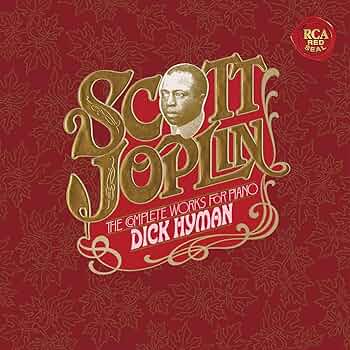
 This review of Dick Hyman’s Scott Joplin: The Complete Works for Piano is personally meaningful for me. The very first CD I ever bought, and the one which initiated my lifelong love for Ragtime music, was Scott Joplin: Greatest Hits, containing sixteen tracks gleaned from the aforementioned complete collection. That collection, originally recorded in 1975, has recently been re-released as both a CD box set and digital download.
Included in the set (72 tracks in all) are the piano rags, marches, waltzes, School of Ragtime with Joplin’s didactic remarks narrated by the venerable Eubie Blake, and twelve short Hyman improvisations on Joplin themes; absent are any excerpts from Treemonisha. Tempi are generally fast and energetic; reference the impish upbeatness of Original Rags and the brisk pace of The Chrysanthemum and The Sycamore. Melodies are cleanly articulated and somewhat angular, and octaves are ringing and declarative (e.g. in The Strenuous Life and The Nonpareil). Pregnant pauses in the A section of Lily Queen are very affecting; the grace notes in the D section are played on the beat. Hyman’s legendary technical command is well-illustrated in The Cascades, where the emergence of the C section—an etude in left hand octaves—is volcanic.
I was initially concerned that the improvisations—influenced by jazz, bebob, and boogie woogie—would sound misplaced in a playlist of Classic Ragtime. However, they struck me as refreshing interludes. Hyman’s improvisation on The Chrysanthemum adheres relatively closely to the source material and can be thought of as a “humoreske on Joplin’s intermezzo.” Great Crush Collision [March] features narration of Joplin’s programmatic footnotes by Maestro Blake; at “whistle before the collision,” Hyman wisely plays the chords tenuto instead of staccato, imitating the sustained sound of a train whistle quite well. Wall Street Rag does not have narration. Here Hyman lets the music speak for itself, and he clearly conveys the changing moods of the piece. Bethena is played at a moderately upbeat, matter-of-fact tempo, which I enjoyed.
Recording fidelity is not uniformly rock-solid, with pitch being shaky in places (e.g. at the beginning of Antionette). The album cover is fine but too monochromatic for my personal taste (perhaps a nod to the RCA “Red Seal”); I prefer those of the Dowling, Dyson, and Parker sets. As could be predicted, Dick Hyman’s long-awaited recording is one of the notable recommendations among complete Scott Joplin cycles. For me, it was worth the wait. As Joplin himself said in preface to School of Ragtime, “What is scurrilously called Ragtime is an invention that is here to stay!”
Dick Hyman
Scott Joplin: The Complete Works for Piano
SONY Classical


Brandon Byrne is a ragtime composer, performer, and scholar. Max Morath said of Byrne, “Brandon’s unique compositions display unparalleled gifts and hidden virtuosity. His music reflects the past and challenges the future. His playing will touch your soul.” For a full list of his compositions, please visit his website.