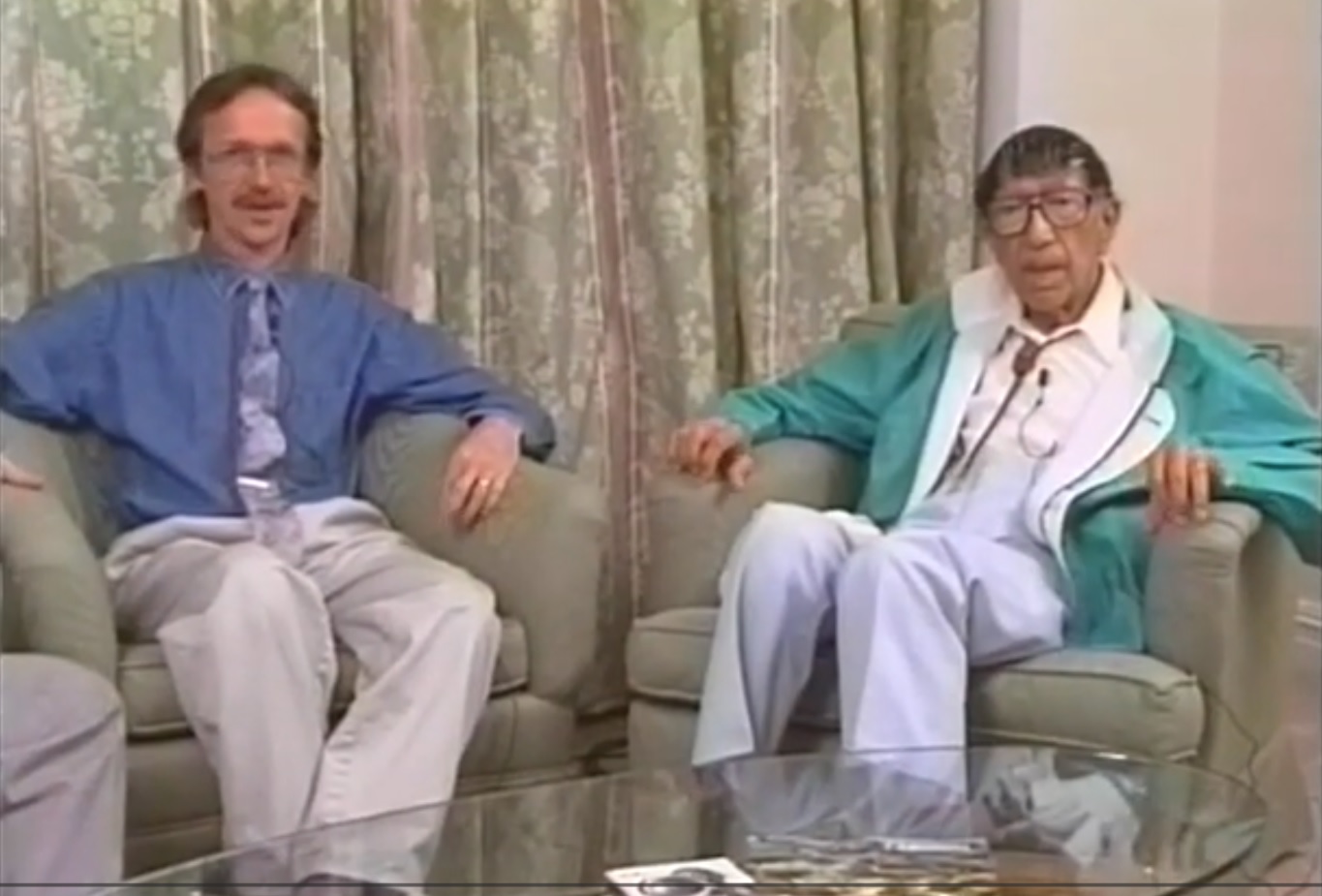
Following are excerpts from the Fillius Jazz Archive interview with Doc (Adolphus Anthony) Cheatham (1905-1997) New York City, July 28,1995:
First recordings
Monk Rowe: Can you tell us about your first recording date?
Doc Cheatham: I was with Albert Wynn’s Creole Jazz Band when we made that recording. I knew Ma Rainey because I sat in the Bijou Theater playing shows with the pit band. I wasn’t getting paid, I did it because they let me do it. And I just did it to try to learn as much as I could. And Ma Rainey, she came, she was the ugliest blues singer on earth when she got old, but when she was young she was pretty. You see her picture, she was the prettiest, nice looking girl. But she is so ugly, that that’s what they call the ugliest blues singer, and they billed her as that.

MR: Oh my God.
DC: And she taught Bessie Smith. She was Bessie Smith’s teacher. And in Chicago she used Albert Wynn’s Creole Jazz Band and I was in the band. So that’s how I recorded with her. She was very nice, a very, very, very nice woman. And we played all of her songs, and that was it. That was about 1926.
MR: What was it like at that time to make a record?

DC: Well after, this place where we played and recorded with Ma Rainey was just a room. They didn’t have any speakers. We had a big megaphone we put out in front of the band, but no speakers. And everything was done by wax. You know we didn’t have all that stuff. My next recording I did in Spain, in Barcelona, with Sam Wooding’s band.
Sam Wooding was a band in New York and he turned down the Cotton Club, to go to Europe with his band. That’s how Duke got in there. So Sam took the band to Europe in the latter part of ’27. And I joined Sam Wooding and went to Europe with that band. And that’s the second recording I ever made was with Sam Wooding in Barcelona. The band was so great that no other band in Europe could compare with it.
Now they were there in 1923. They were all through Russia and all down in Argentina with that band. I joined the band the first part of ’28. And we just went over there and we played all the big casinos and hotels, because they had a very big name, and we recorded up in Barcelona. It was hot as it is now. And the wax kept melting. And they put ice cubes on the wax to keep it from melting. But they came out wonderful. And I stayed in Europe three years and I recorded with Sam Wooding in Paris. And I wrote one of the arrangements. I studied that too but it was too much for me, too much headaches on the eyes to write it. I think I only made one arrangement in my life, and that was in Paris for Sam Wooding. And that’s on there.
Playing with Benny Goodman
DC: I was with Benny Goodman. I played two years with him. We went to Las Vegas and other places. And he was very good to me. He fired everybody in the band at one time but myself. Because you know people don’t understand the man’s a genius, and he expected his men to play as well as he played. And if you can’t satisfy him, you have to leave that’s all there is to it. I made an audition with him, he and Hank Jones had a place and I just played and he played. He liked what I played. I didn’t know everything he knew. But he was very easy on me, because I was an easy-going guy, you know.

One day we were in Las Vegas and I was standing out in front of the band and he had a habit of starting out on one tune. And he would switch to another tune without telling anyone. He did that all the time. He’d pick up and start playing “Body and Soul” and after a chorus, “I Surrender Dear” and not tell anyone. That’s hard and it’s not right. But that’s the way he was. So one day we were standing out front and I says, “Benny I don’t know.” He said, “listen. Just watch my eye. Just look at my eye. My eye will tell you when I’m going to change to another tune.” I said, “okay, but” I said, “I can’t see out of this eye.” So he fell down laughing. We had a lot of fun together.
I’m the only one that stayed in that band with his group. Right away I knew how to treat him. Don’t try to be a big shot around him, you know. That’s all you had to do, just let him have his, it’s his job. And what he asks you to do, you do, that’s all.
We had a rehearsal up in Skitch Henderson’s studio. And we were playing beautiful “Stardust.” And he played so beautiful. He just took out his clarinet and started, he don’t—let’s rehearse this, or what do you want to do fellas, you didn’t do that. He just took his clarinet and played the [hums] played the melody and everything, and then he stopped all of a sudden, and started taking the clarinet apart and walking out. We said what’s wrong with this man? He walked out. And he stayed out. So his valet came and I said, “Is this all?” He says, “Yes, this is all.” He said, “Don’t call me, we’ll call you” one of those things. So everybody started going out, packing up and leaving. I was the last one to leave. I don’t know why, but I was. He opened the door and said, “Where are you going?” I said, “Well the valet said everybody’s fired.” He said, “Not you.” So he kept me.
In Las Vegas there was a lot of segregation, I couldn’t go in the hotels, but he went across from this big casino, there was a woman there that had a nice house. And he took me over there and stood for me, and she said why sure, and she gave me a room. And I sat on the porch, because I love porches. And Benny came out from, he was staying at this big casino. He came out with his golf things and he crossed the street and he saw me sitting and he came all the way back on the porch and says, “Doc?” I said, “what.” “Does anything ever worry you?” I said, “No, Benny, I don’t think so,” I said “but there’s only one thing that will worry me, is if you don’t give me my check at the end of the week.” He fell down laughing.
A short-lived experience with teaching
DC: I taught once, the beginners, and I got to the place where I said the heck, let them handle it, let them do it. I can’t do it. A woman brought her son down to 48th Street where I had a studio with another fellow. And she brought her son and came and introduced him and on her way she bought a trumpet on 48th Street because he wanted to play trumpet. They came up there and the first thing she says to me, “This is my son, I have a horn, now how long will it take him to play his horn?” I said, “What do you mean?” She said, “How long will it take you to teach him to play?” I said, “Lady, he may never learn to play that horn. How on earth can you ask me a question like that?” She said, “Well I bought a book for him to look at that maybe you can teach him with.” And she opened the book and you know what she had? A Dizzy Gillespie book. He hadn’t opened the case yet. I said, “Lady, I’m sorry, you go down the street and you may see somebody there that can help you out. I can’t do it.”
His career late in life
DC: I used to hold back and let somebody else do it. I still do that. If I’m playing in a big band I don’t try to hog anything. But I have more confidence in myself now than I’ve ever had in my life. And all these harmonies that I taught myself are coming back to my brain. And all the cycles of fifths, from all those years, are coming back to me. And I read, I read a lot about things you know. And now I feel like I’ve never felt before in my life. I don’t fear getting up to play. I used to fear that. I told this girl, she wrote about me in a magazine, she called me the “late bloomer.” So she came out with this and I said, “Listen. I’m not a late bloomer.” I says, “I’m an electric light bulb.” She said, “What are you talking about?” I said, “When it’s getting ready to blow out, it gets brighter.” I could just give up anytime. Because being 90 years old is not easy. I don’t worry about that. But a lot of people look at me like I’m nuts or something.
MR: I think you’re just creative.
DC: It’s something. It’s something that has changed overnight. I know someone in New Orleans—you know people in New Orleans are very superstitious people. She said, “Louis Armstrong is looking out after you.” I called her last night she says, “How you doing?” She says, “Louis Armstrong is looking out after you.” And I said, “I’m glad somebody’s looking after me.” And I keep a little silver engraving, a little metal thing on my horn for Louis Armstrong. And everybody says, “Oh boy, that’s Pop.”
And his sense of humor remained intact
DC: I’ve never had a schedule like this ever before. And it’s still going on, people calling me every day, and I don’t understand it because it’s just new. It’s a new thing to me.
MR: Do you remember what you told me on the phone when I said, “Wow you’re pretty busy.”
DC: I don’t think I do.
MR: You said, “All the other trumpet players must be sick.”
As Director of the Fillius Jazz Archive at Hamilton College, Monk Rowe has interviewed over 500 jazz artists since 1995. The videos can be viewed on the Fillius Jazz YouTube channel, audio excerpts can be heard on his podcast Jazz Backstory and read in print in the book Jazz Tales from Jazz Legends, authored by Monk and Romy Britell. Monk is a board member of Syncopated Media, Inc. Interview transcriptions by Romy’s Creative Services.
As Director of the Fillius Jazz Archive at Hamilton College, Monk Rowe has interviewed over 500 jazz artists since 1995. The videos can be viewed on the Fillius JazzYouTube channel, audio excerpts can be heard on his podcast Jazz Backstory and read in print in the book Jazz Tales from Jazz Legends, authored by Monk and Romy Britell. Monk is a board member of SyncopatedMedia, Inc. Interview transcriptions by Romy’s Creative Services.