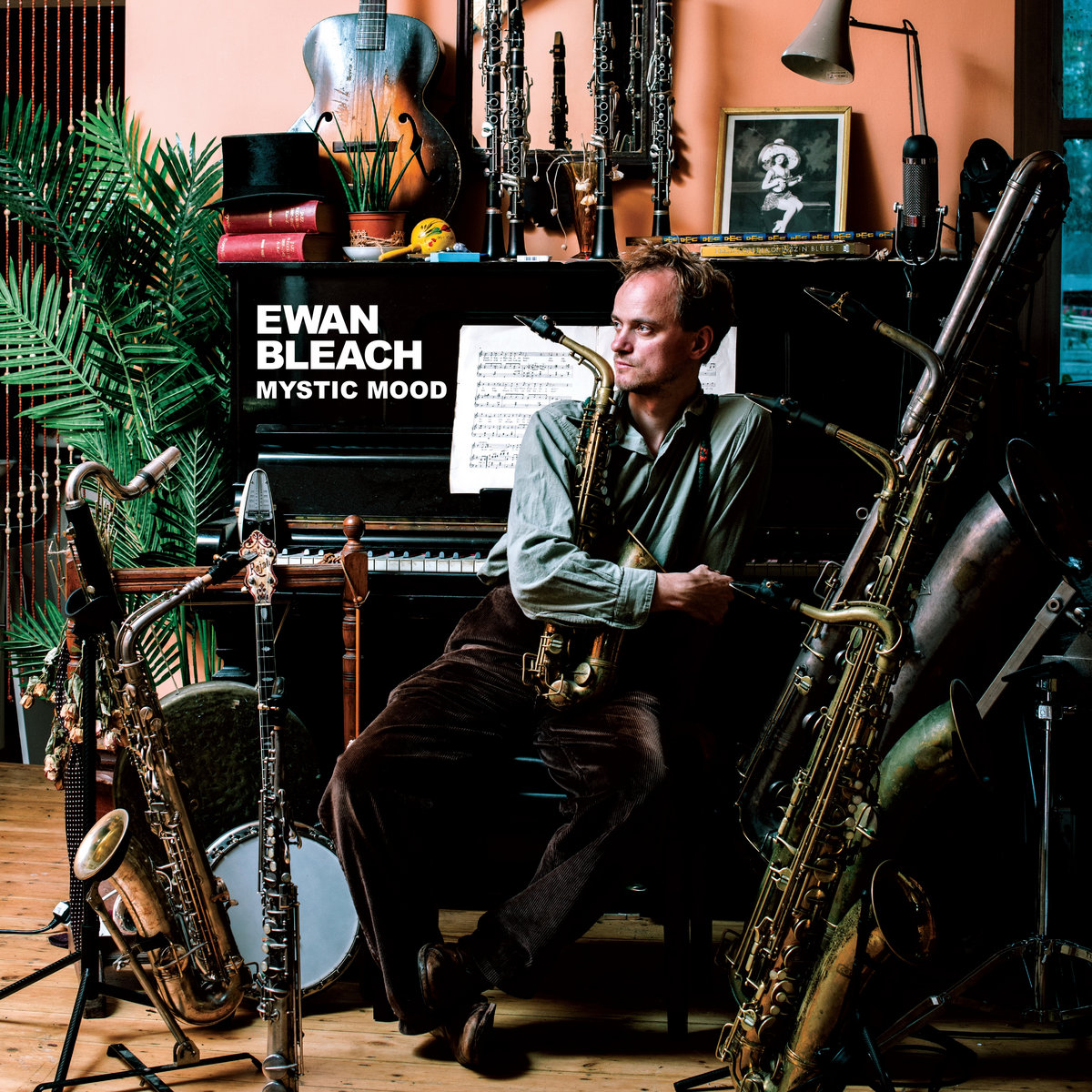
 It can be oddly difficult to pinpoint when a musician becomes essential to your listening life. With Ewan Bleach, that realization crept up gradually. His clarinet and other reeds kept appearing on records I loved and returned to, albums from Frog and Henry, Cable Street Rag Band, Whiskey Moon Face, Tuba Skinny, Man Overboard Quintet, and others, until it became clear that he wasn’t simply a welcome presence but a shaping force on those records. Mystic Mood, brings that long familiarity into focus. It doesn’t introduce a new voice so much as gather one that has been developing in plain sight.
For listeners who know Bleach primarily from painstakingly true to the source early jazz sets at Whitley Bay, or from his work on several Tuba Skinny albums, this album may initially register as a departure. There is less overt bustle here, little emphasis on collective propulsion for dancers. But for anyone who has followed his broader orbit, or even deeply listened to his playing, the record feels like a culmination rather than a change of direction. The traits that have made his sideman work so distinctive; melodic imagination, tonal warmth, a sense of distance or yearning, even romantic danger just beneath the surface, are fully revealed and clarified.
It is striking that Mystic Mood is only Bleach’s second album as a named leader, following 2022’s Ewan the Night’n the Music. That earlier release was a deliberately restrained set of familiar jazz standards he referred to as ballads and focused on atmosphere rather than storytelling. It revealed Bleach as a sensitive interpreter, but it stopped short of staking compositional territory. Here, in nine original pieces, he does exactly that. This is not a tentative first step into writing, Bleach is a composer who has been quietly developing material across years and projects, and now chooses to present it as a unified statement.
Some of these compositions have appeared before. “St Petersburg Gelatery Blues,” for instance, was recorded with Frog and Henry in 2018, credited to Bleach. Heard here, however, it gains new weight and definition. The presence of Enrico Tomasso, given a genuinely prominent role rather than a cameo, pushes the piece toward a brighter, more extroverted register, while still fitting comfortably within the album’s overall mood. It remains a standout, not because it is flashy, but because it reveals how Bleach’s writing can accommodate strong individual voices without losing its center.
“September Rag,” which immediately follows, carries the faint memory of a tune that has lived a prior life somewhere in Bleach’s musical ecosystem, though its origins remain elusive despite my searches. Whether newly written or long-refined, it reinforces the impression that these pieces have been inhabited over time. The music moves at the pace of something known well and trusted.

One of the album’s most revealing stretches comes with “Sipihr Song” and its transition into “Spring Schottische/The Colour of the Sky.” “Sipihr Song” feels like a distillation of a particular strand of Bleach’s playing: it begins sparely, as a solitary utterance, before gradually admitting additional voices. There is a melancholy and a sense of estrangement that recalls songs from Whiskey Moon Face. It creates a cinematic, old-European atmosphere that sits adjacent to jazz rather than within it. The appeal lies in that foreignness; it draws the listener in without explaining itself.
“Spring Schottische/The Colour of the Sky” carries that mood forward while shifting decisively toward folk idioms. Its rhythm is forward-driving and physical, unmistakably rooted in dance, yet its emotional core reaches back to something older than jazz or ragtime. There is sadness or nostalgia here, but it never becomes heavy-handed. You can close your eyes and see the pastoral dancers, and that vision feels natural rather than imposed.
The scale of Mystic Mood speaks to the respect Bleach commands within the jazz community. Seventeen musicians appear across the nine tracks, though never more than a carefully chosen few at any one time. Readers will recognize names such as Colin Good and Enrico Tomasso among the participants, but the emphasis isn’t on assembling a roster. The arrangements are disciplined, with each piece shaped by a specific instrumental palette. Variety comes through rotation and contrast.
Despite that breadth, the album’s focus remains firmly on Bleach’s compositions and playing. His reeds are the primary voice throughout, but Colin Good’s piano, present on all but two tracks, feels central to the sound in several key moments. Bleach does play piano, though he rarely features his own playing on record.
Bleach reveals another facet of his musicianship on “Fleet River,” where his voice comes quietly to the fore. It is an underrated aspect of his work in many of my favorite bands, a natural complement to his smooth, lightly sentimental reed playing. The pairing feels organic, reinforcing the sense that this album reflects a unified musical personality rather than a collection of separate skills.

Over the past decade of reviewing records, Bleach’s name appears with unusual frequency among my personal standouts, not only from a critical standpoint, or projects I feel advance traditional jazz in the 21st century, but also among the albums I return to simply for pleasure. His playing is consistently evocative and unmistakably his own. Mystic Mood shows that the same is true of his writing. It is the sound of a musician who has spent years lifting other projects, absorbing traditions from many directions, and who now knows exactly what he wants to say under his own name. I’m not the first to say it, but Ewan Bleach is easily among the most distinctive reed players in traditional jazz today and deserves to be followed and supported by the jazz community as the standouts of recent generations were.
Ewan Bleach
Mystic Mood
oldstylerecords.bandcamp.com
Joe Bebco is the Associate Editor of The Syncopated Times and Webmaster of SyncopatedTimes.com