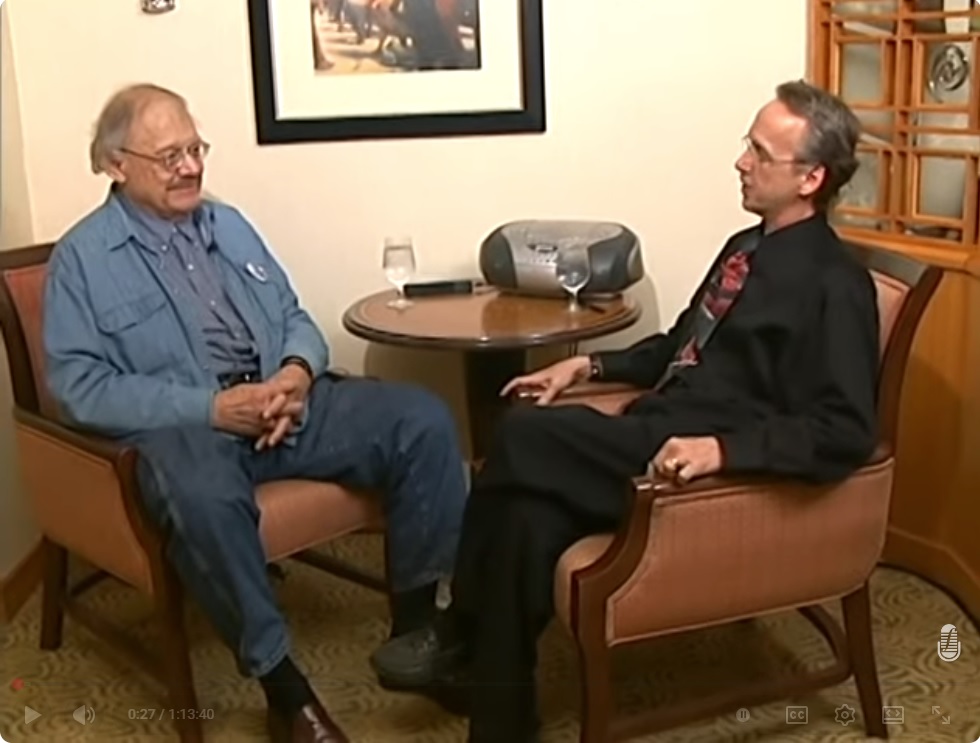
Clarinetist Joe Muranyi was born in Martin’s Ferry, Ohio on January 14, 1928. He worked as a record producer for major labels and played alongside Roy Eldridge, Jimmy McPartland and Max Kaminsky. Joe was a member of the Louis Armstrong All-Stars from 1967-1971. He passed away on April 20, 2012.
Joe was interviewed in New York City on January 11, 2007, by Monk Rowe.

Music entered his life
JM: My parents were musical. Hungarians had a natural affinity for music like Italians, Irish, something like that. It’s very similar. And I’m an emotional being. Of course we all are. But the other night, there was something about “Pennies From Heaven.” The song came up. I had this recall. And I’m thinking about myself, at what age did I start thinking about the music and whatever. So I remembered that I learned “Pennies From Heaven” [sings] every time it rains, it rains—to this day I know the words very well—directly connected back to when I was six or seven.
I used to go to the movies on Saturday morning for a nickel in those days, you know, in Bellaire, Ohio. Steel mines and coal mines and a lot of the immigrant bohunks you know and all that kind of stuff. Polacks and Italians. So I used to go to the movies. I might have seen it there, and maybe I heard it on the radio. My parents at that time didn’t have a gramophone, so I learned “Pennies From Heaven” because I liked it in my ear. And the words and all. And they used to stand me up on a chair, like seven years old, and I would perform.
First paying gig, learning jazz speak
JM: So my first dollar with the clarinet, would you believe, was a gig in Trenton, New Jersey and the bass player was Pops Foster. It was a bowling alley in Trenton, New Jersey. I think it paid a lot of money, like 35 bucks or something, which was a lot of money.
MR: Apiece?
JM: Yeah.
MR: That’s a lot of money at that time.
JM: Yeah, well when was it, late ’40s, ’50s? Well late ’40s, I guess. And it was a very funny one because we were in this place and we go down, there’s a restaurant in the place, in the bowling alley, and we’re going to have something to eat. And it was Pops Foster. And I knew who he was, I loved him and I respected him you know. And he looks at the menu and he said, “is this every tub?” I said, “Pops, what’s every tub?” “Oh,” he says, “don’t you know what that means?” I said, “no.” He said, “every tub on its own bottom, do we pay or does the boss pay?” And then you know there’s a King Oliver record called “Every Tub.”
MR: And a Basie record too.

JM: Yeah, And I think I heard Louis Armstrong say a couple of times, you know when an ensemble starts playing? “Every Tub.” It’d be every guy on his own, improvising.
MR: So Pops meant everybody was paying for their own food?
JM: Everybody on his own.
MR: That’s cool.
JM: And that could apply to paying or it could apply to improvising. You know we’re not going to read music or don’t play the melody. Improvise, yeah.
Originality, What is Jazz, Louis Armstrong
JM: Kenny Davern was, very early on, a wonderful clarinet player. It was just, he was God given natural you know. I think that Bob Wilber is a great reed man too but I think Kenny is more creative.
MR: Very creative.
JM: More of a fire in him you know. And one of the reasons I like Kenny was you know Kenny didn’t particularly care for bebop. He made something out of traditional jazz. It became an individual thing, which I like, which I try to do, I’ve tried to do all my life. And strangely enough I think I’m coming into, I think I’m getting better and better as I get older. It’s not an illusion, I always am a strong critic of myself. And now I have moments that I feel good, I feel happy about what I played. You know I hear it back and I say yeah, that ain’t bad. It still ain’t where I want it to be but it’s hard. You see, improvising, playing jazz is a very difficult thing. It’s very difficult to be original and then you have to be your own person. You can copy choruses and do all kinds of things but that doesn’t count. A clarinet player and I learn all the Benny Goodman things like Sol Yaged. So what?
It’s a fool’s errand because somebody does it perfectly already. You can only suffer by the comparison you know. Not that I’m putting Sol down, I admire Sol. I remember Sol from when I was a kid seeing him play. He’s lasted. He’s a New York legend in his own way, not a giant but you know I mean in his own way.
MR: How do you explain to someone who is only familiar with jazz in the large sense. For instance, what’s traditional jazz as opposed to modern jazz?
JM: Okay Monk, you hit the nail—I’ve been working for years, I’ve got about 30 chapters in the computers about Louis Armstrong. And it’s very rarely discussed. It’s a very big problem of the music and it doesn’t get discussed much—what is jazz? And it’s a very difficult subject, and how do you define what is jazz. I’ve tried, well it’s swing, but a lot of music swings. It’s got soul. A lot of music has got soul. It’s got to have—I think it’s got to be a strong touch of the blues, some of the bended notes. Most stuff that passes for jazz today I do not care for. I don’t like it. So it boils down to what is jazz? It’s got to have some blue notes, it’s got to swing, it helps if it’s original. It’s sort of life, generally it’s got to be in a certain bag, you know what I mean? A certain form, bebop or whatever, however. But it’s very hard to define. And I thought about it and thought about it and for me jazz is the music that Louis Armstrong plays.
MR: But Louis Armstrong played a lot of music after the 20s and 30s that may not have been really jazz but he jazzed it up.
JM: Well his music, jazzing it up, what is jazz? Jazz is a feeling. You can play the straight—now Louis Armstrong, he was the same man when he died as he was when he was young. That flame in him never died. And he could play the straight melody and melt your heart and that’s jazz.
“Louis Lightbulb”
MR: What is “Louis’ Lightbulb?”Does this mean something?
JM: Yeah, yes…I took my kids, my second wife and the two kids, Adrienne and Paul, Paul was the little one. We took them down to Atlantic City. We were playing there, to have them meet Louis Armstrong. So I took them back stage, and my daughter said, “it’s nice to meet you Mr. Armstrong.” She’s the older one, she was very cute and darling. My son Paulie must have been five or something like that. And Paul puts out his left hand because he was ambidextrous, he puts out his left hand. And Pops breaks up laughing and he puts out his left hand too.
He liked the kids you know. And they met him later on in Reno. We had made some records with Pops and he had a little phonograph. He always traveled with a phonograph, and enjoyed demos of the records. And he called me on the phone and he says, we’re in the same motel, and he says, “you want to hear the record we made?” I said, “yeah, yeah.” I said, “I’ll send up Paul, my son.” So I sent Paul up, and God 45 minutes, what happened to him, did he get lost? I’m starting to get nervous. And in walks Paul with the phonograph record. “Paul, where were you?” “Oh,” he says, “I went up and the door was a little open and I knocked on the door and he let me in and he was sitting on the bed with his trumpet,” tooting you know. So he called me in and he says, “you like the trumpet?” And Paul says, “yeah.” Well a conversation ensued and then he said, “I sat on the bed next to him and he says ‘you want to blow it?’”
The old man fell in love with my son. He never had any kids you know what I mean? It was darling. So anyhow he impressed Paul. And for years Paul drew a head with teeth, a big smile. It was obviously Pops, at the time I didn’t pick up on it. It’s this big smile and he called it “Louie Lightbulb.” I mean it’s like when Pops is around a light goes on. But it was so darling you know. That’s the “Louie Lightbulb” story.
As Director of the Fillius Jazz Archive at Hamilton College, Monk Rowe has interviewed over 500 jazz artists since 1995. The videos can be viewed on the Fillius JazzYouTube channel, audio excerpts can be heard on his podcast Jazz Backstory and read in print in the book Jazz Tales from Jazz Legends, authored by Monk and Romy Britell. Monk is a board member of SyncopatedMedia, Inc. Interview transcriptions by Romy’s Creative Services.