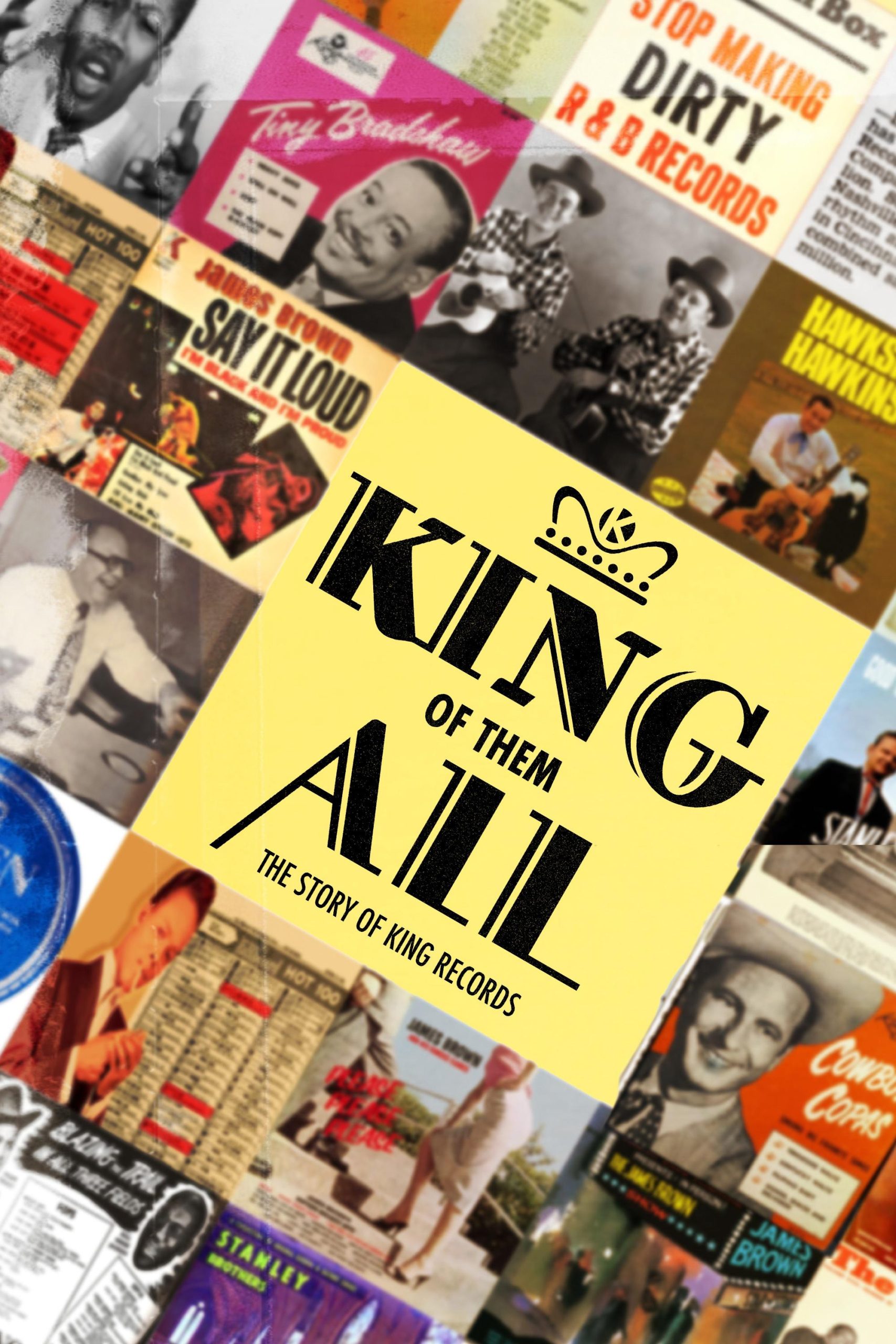
People interested in popular music always welcome films that dig into the history of the music they love. A recent documentary about King Records, King of Them All, misses a couple of opportunities, but overall makes a good contribution to the genre.
Cincinnati native Syd Nathan was the founder of the label, and the film tells the back story well. Nathan was an overweight high school dropout with bad eyesight who spent 15-20 years moving through various jobs, at least one of which got him in trouble with the law.

Nathan opened a store with a man named Saul Halper, selling appliances, and doing photography. They got used records in barter from a jukebox owner who owed them money. The records sold quickly and they decided to open a used record shop.
At that time, Cincinnati was home to the most powerful radio station in North America, WLW, 500,000 watts. Nathan became aware of the live music acts that were featured on the station; mostly country artists in shows like Midwestern Hayride. Singers would come to his store looking for tunes to do and Nathan began to see that the market wasn’t covering niche musical interests.
In 1943, he got fairly significant financial backing and started King Records. He got Grandpa Jones and Merle Travis (who were under contract and not supposed to record) and they cut the first King records, in a genre which at that time was called “Hillbilly.”

I was surprised and disappointed that the film did not set the broader context for the start of an indie label in that era; namely, the musicians strike that shut down almost all major label activity from 1942-1944. It was that American Federation of Musicians action that allowed independent labels to get a foothold. Aside from King, you had Savoy, Capitol, Apollo, and others which goes unmentioned in the film.
During the war, rationing meant lack of shellac and in order to get his records made, Nathan had to pay bribes to providers, inspiring him to say “I’ll make my own damn records.”
He started on a process of vertical integration, creating his own studio, making the record covers, and establishing a national distribution network.
 At this point, the film discusses the demographics of Cincinnati, making the point that because of wartime industry the city was a locus of immigration by blacks from the South and whites from the South and Appalachia. There are two themes here that are developed during the rest of the film. First is that, in large part because of Personnel Director Ben Siegel, hiring at King was done without racial bias, creating a rare integrated working environment in that segregated city. The second theme is that because of King records and Cincinnati’s unique racial mix, the city can conceivably be recognized as where rock and roll was created. More on that later.
King began its recordings of R&B in 1945 with Bullmoose Jackson’s “I Know who Threw the Whiskey in the Well.” As the 1940s proceeded, R&B, also known as Race or sepia music, began to supplant Hillbilly/Country and by 1949, King was the largest of the indies.

In 1951, Wynonie Harris recorded “Good Rockin’ Tonight,” and the film makes a case it may be the first Rock and Roll song. “Firsts,” of course, are tricky things.
We’re introduced to the man described as being only second in importance in the company to Nathan, a black man named Henry Glover. He was initially a songwriter, then a producer, arranger and A&R. Unusually, artists on the country side and the R&B side often recorded the same tunes—antecedents to Ray Charles’ great Modern Sounds in Country and Western. Under Glover’s direction, Roy Brown, Albert King, Little Willie John, Hank Ballard, and many others recorded. On the jazz or jazzy side, you eventually had Cleanhead Vinson, Earl Bostic, Bill Doggett and others, but unfortunately for jazz fans none of the jazz material makes it into the film.
Hank Ballard was a star for the label, and Hank Ballard and the Midnighters had three hits on the top 10 at one time. His double entendre song “Work with Me Annie” was banned by some stations, inspiring some coverage in the film of the moral crusade against Rock and Roll, partially because of its integrated aspect. The film gives a lot of space to the saga of Ballard’s song “The Twist.” One commentator in the film gets down on Dick Clark for finding Chubby Checker, a more “acceptable” black singer. For his part, Ballard was happy about Clark recognizing the song’s appeal. The wider exposure helped him sell three million copies of his own record.
Speaking of commentators—the film has a great many, including Tammy Kernoodle, a musicologist, musician Vince Gill, bass player Christian McBride, music historian Brian Powers, and John Morris Russell, conductor of the Cincinnati Pops orchestra. Russell and Gill are the two most staunch supporters of the notion that Cincinnati should get credit as the place where Rock and Roll was created.
The next part of the story belongs to James Brown, whose entry into the King fold is well covered. Producer Ralph Bass signed him and his first King recording was “Please, Please, Please,” which Nathan hated—yelling such when he burst into the studio during the recording. It was enough of a hit to launch JB’s career.
There is lots of great footage of JB, showing his skyrocketing career. Clearly, three minute studio recordings didn’t show JB’s true impact on an audience. Brown wanted King to record him live at the Apollo and Nathan said no, so JB paid for it himself—$5,700. The engineers under-miked the audience, which defeated the whole purpose of recording live. The film says they had to go to a white sock hop and record that audience and dub it in. If you’ve heard the screaming on the Apollo recording, it would have to seem odd that those audience sounds came from a white sock hop. It does to me. In any case, it was the best selling record King ever had.
Apparently Brown and Nathan had a love hate relationship. They fought constantly but each respected the other as a self-made man. Eventually, King couldn’t afford him. Brown knew he needed a company with international clout and left the King label for Polydor in 1968. I assume it was a blow to Nathan, although its not mentioned in the movie, which chronicles his declining health and death in 1968. He had not groomed anyone to take over for him and the company declined and closed two years later.
The film bemoans the fact that Cincinnati didn’t recognize the importance of King Records and never touted it as a tourist attraction in the way that Stax and Sun Records have been. It makes the case that the large catalog of King recordings has influenced current music, citing various examples like the many times JB drum licks have been sampled in rap songs.
I can’t say whether Cincinnati and King Records deserve top billing in Rock and Roll, but through this film I learned they have played a much larger role in American popular musical history than I realized.
King of Them All: The Story of King Records (2025)
Documentary directed by Yemi Oyediran; 1h 15m
Steve Provizer is a brass player, arranger and writer. He has written about jazz for a number of print and online publications and has blogged for a number of years at: brilliantcornersabostonjazzblog.blogspot.com. He is also a proud member of the Screen Actors Guild.