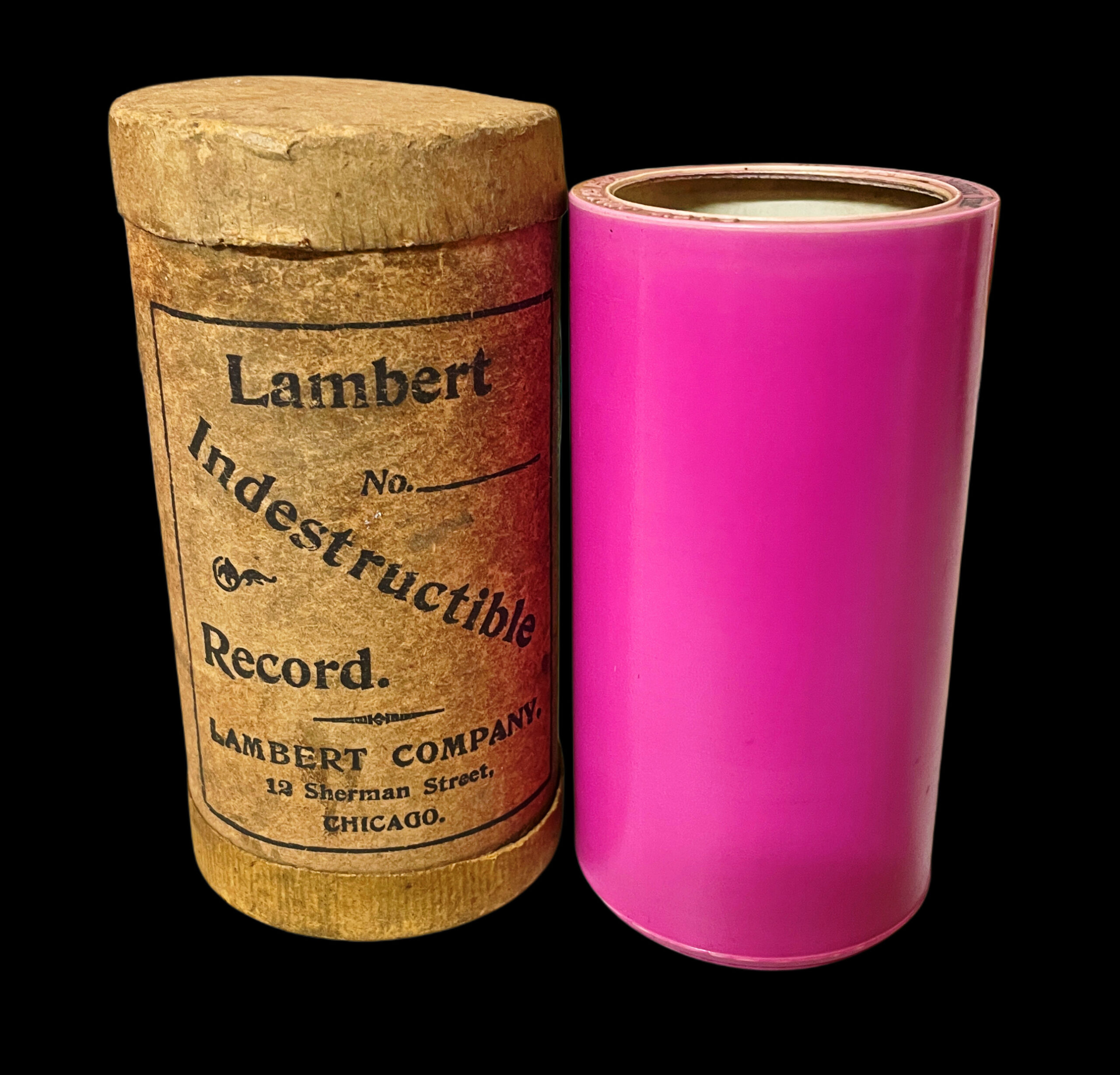
Most recording companies of the acoustic era can be relatively well tracked in terms of their locations and employees, but there is one that still puzzles collectors today. This is Lambert. We know where they were located, but much of what they recorded, in terms of artists and content, doesn’t seem to line up with the company being based in Chicago. While we know some things about them, there is still a lot to learn.
Collectors know this company for their incredibly striking and innovative celluloid cylinders. They were so genius at the time that Edison and his crew later sued the heck out of them to gain the patent rights to this type of record. Their records were not only made of this seemingly indestructible material, Lambert decided to use vibrant colors for their records, something that in 1900 was still seen as a rare novelty for both cylinders and discs. They recorded onto copper masters and molded the copies onto the celluloid. Because of this, the records(when in good condition) can sometimes sound electric, and are free from blasting. They are sometimes some of the loudest records of their era. From personal experience, I can tell you that when played on an appropriate machine, you might have to stand several feet away while they play. They started out in white celluloid, but then branched out into various shades of pink, orange, and black. These were easy to market. Initially they started in Chicago but later on they opened an office in London and also made some over in the UK as well. Artists like Russell Hunting and Olly Oakley often recorded for them over there.
While we do know who invented the records, Thomas Lambert, and who managed the company, we know little else about how it operated. The company was founded in Chicago, and on most of the records the beginning announcement will say “…for the Lambert company of Chicago.” One would think that because of this announcement the records would have been recorded in Chicago. This is however most likely not the case.
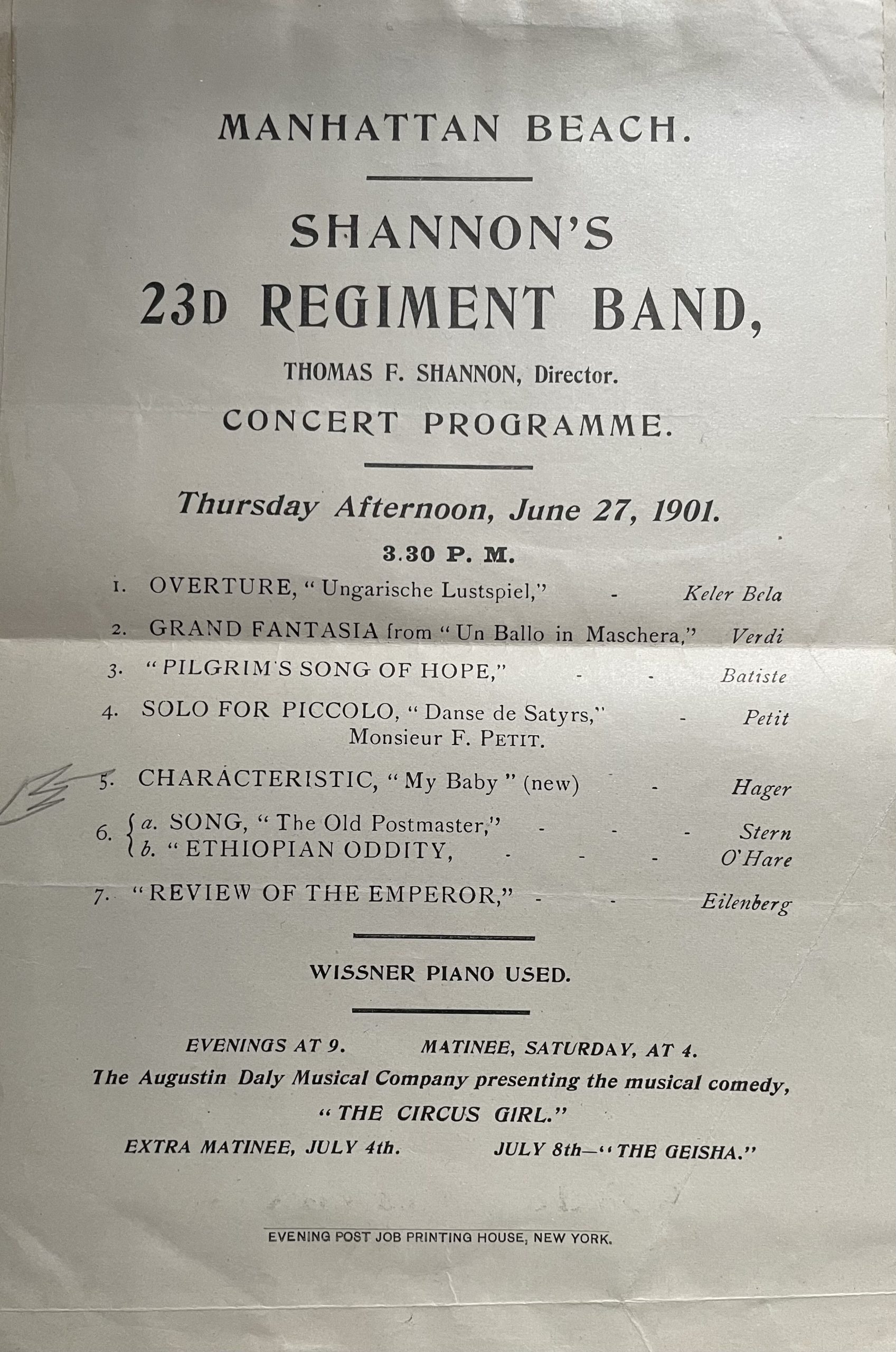
Based on the roster of talent Lambert had, it seemed the same as any other New York based company at the time. In fact, the label actually had more in common in terms of artists with Zon-O-Phone. It’s quite strange. There were the more common artists like Arthur Collins, Vess Ossman, American Quartet, Steve Porter, Len Spencer, but there were other artists that pretty much only worked for one other label like Billy Heins. There were also folks who only recorded for Lambert like Shannon’s 23rd Regiment band. It would have been too much for regular East Coast artists to go back and forth to Chicago to make a few records. Not everyone had that luxury like Silas Leachman.
By 1900 most of the major recording studios in the US were in New York, specifically around 23rd street. Zon-O-Phone was at 18th and Broadway, Columbia was at 27th street, and later on, Leeds and the American Record Company (the guys with the blue discs) was on 23rd street. While we do not know where the Lambert New York studio was, it was most likely somewhere near the other major ones.
Another way to tell that Lambert’s records were certainly made in New York is by the accompaniments. Like many things about the label, we know nothing about who their accompanists were, but by listening to many of them you can notice commonalities when compared with records of the same selection and performer on other labels. What the accompanist does on many selections is nearly identical to other versions of the same selection.
For example, there is an unlabeled Lambert of Billy Heins singing “Mister Johnson Turn me Loose.” It is an exceptional recording, partially because of the accompaniment. The accompaniment is almost exactly the same as the Victor by Silas Leachman. Much of the same motifs are present on both, though the Lambert is a little more scattered and disjointed. It was likely the same pianist on both. Who is the pianist? Well it is hard to know, but based on my extensive study on this topic I would say Frank P. Banta. It is slightly disturbing to think that considering the dates of many of these Lamberts, Banta likely not only made Edisons until the day before his death, but also Lamberts. On some you can also clearly distinguish the Indiana rag-time style of Fred Hylands as well, same with the style of Justin Ring—yes, Justin Ring. Lambert is a fascinating study for piano accompaniments, because it was just all over the place.
R. S. Baker has appeared at several Ragtime festivals as a pianist and lecturer. Her particular interest lies in the brown wax cylinder era of the recording industry, and in the study of the earliest studio pianists, such as Fred Hylands, Frank P. Banta, and Frederick W. Hager.