There’s a new face on the New York-area trad jazz scene that I think is worth your attention. But you may not have to travel to New York to see him, as he is already making the scene at important trad jazz events. Gavin Rice is a recent graduate of the Eastman School of Music in Rochester, NY.
He is originally from Brewster, Mass., on Cape Cod. I first encountered him at the Bix Beiderbecke festival in August, and by the time you read this he will have played several times with Miss Maybell and the Ragtime Romeos and with Dan Levinson’s Roof Garden Jass Band at the Symposium on Historic American Music at Susquehanna University in Selinsgrove, PA.
He plans to move to New York early in the new year. Another tidbit about him: you might sometimes see him tooling around in a 1923 Model T owned by a friend. I hope he didn’t take it out on snowy days in Rochester, where the amount of salt spread on the roads seems like it equals the amount of snow that fell.
He not only plays banjo and guitar, but I’ve already seen him on drums and trumpet. But there are even more instruments in his portfolio, as you’ll read below. Andy Schumm and Colin Hancock, watch out!
BH: How did you develop your interest in early jazz?
GR: Since I was a baby, I’ve always been very sensitive to sound and developed an interest in music at a young age. I started playing instruments at eight years old and every year it seemed like I wanted to learn a new instrument. I was always interested in jazz, but When I was a sophomore in high school, an older gentleman who was a mentor to me gave me an Edison Diamond Disc phonograph with a crate full of acoustic-era 78s from the 1910s and ’20s. I spent a lot of time fine tuning it and getting a 78rpm adaptor arm (as Edison Diamond Disc phonographs only play Edison discs as standard). I played those 78s every day absorbing the music and the rhythm.
One of those records in the crate was a record by Edwin J. McEnelly and his Orchestra, a New England territory band. I really enjoyed that one in particular and started to do more research on the artists behind the music. From there, not only the history of the music not only attracted me, but it was the lifestyle, the clothing, the art, the cars, and pretty much everything else about the jazz age. The music is very exciting to listen to and play. Coming from a modern jazz background where the audience is mainly seated and listening to the music, the danceable quick tempos of the early jazz tunes hooked me immediately.
BH: Who are your music idols, and why?
GR: My number one musical hero is Harry F. Reser, because he is in my opinion the best banjo player to ever live. He re-defined how musicians played the four-string banjo and gave the instrument more front-line spotlight rather than just being a rhythm section team member. His licks, his compositions, his personality and his recordings will always be something I look up to every day. I have visited his house in Buffalo and his house in Forest Hills, Queens.
Besides Harry Reser, Bix Beiderbecke has always been a long time hero of mine. In fact, I moved to Sunnyside, Queens, partly because of Bix. He lived two streets over from where my building is. Not only is Bix’s playing and compositions something that inspires me to this day, but his life story will always have a place in my mind and heart. His story motivates me and helps me through the toughest of times.
Noble Sissle and Eubie Blake are another example of a major inspiration to me. The showmanship in their performances help shape me how I am as a player. One of the biggest things about playing early jazz is the enthusiasm and showmanship that every musician had. It is fun music to play, so let the audience know that you’re having fun!
Going beyond jazz, my classical heroes would be Debussy, Ravel, and Stravinsky. I am a huge fan of the Impressionistic era of music because of the beautiful, flowing harmony, as well as the Modernistic era of music because of the complex harmony and advanced rhythms. These composers inspired the musicians of the 1920s, which you can hear on many records made across the globe during that time.
BH: Please describe your educational background, beyond what I’ve written above.
GR: I graduated from the Eastman School of Music in 2025, double majoring in Jazz Bass performance and Music Education. I have just finished my student teaching semester here in Rochester and have passed my licensing exams to become a fully licensed music teacher in New York State.
When I was a student at Eastman, I was the unofficial TA to the Jazz History professor, and I helped organize the first early jazz concert at Eastman in 2022. In the same year when I was still a student, I gave a lecture at Syracuse University about Early Jazz and early recorded sound. I gave a Powerpoint presentation as well as making cylinder recording demonstrations with the students.
Now that I am moving to New York City, I plan on getting a masters degree in Musicology, school to be determined. My ultimate goal would be to not only play but to also teach jazz history at the college level.
BH: What instruments do you play?
GR: My very first instrument was the violin starting at age eight. Not long after, for Christmas I asked for a mandolin, which I found under the tree! From there I also decided I wanted to play the banjo because I absolutely loved the percussive, rhythmic sound of it. My childhood music teacher also played the banjo, so I was able to get lessons from him as well as violin and mandolin (This was before I started playing Jazz Banjo, as I primarily learned Celtic music as a child. Celtic tenor banjo is more single note melodic playing rather than strumming).
In middle school, I picked up the double bass and played in the jazz band and orchestra. While studying with my bass teacher, he also taught me jazz piano. In high school jazz band, the band director needed a baritone saxophone player, So I thought I’d give it a shot. I then started playing alto, tenor, and baritone saxophone. The concert band at my high school also needed a tuba player, So I started playing that as well. After this, I taught myself trumpet, trombone, drums, guitar, clarinet, oboe, flute, accordion, harmonica, bassoon, and many others. Most of my instruments are 100 plus years old.
Most importantly, I am one of very few people in the world who are proficient in tenor banjo, Plectrum banjo, classic Five-String banjo, and guitar. Banjo is the most important instrument to me, and I play it extensively. I taught myself how to play jazz banjo by listening to the records of my favorite players (Harry Reser, Mike Pingitore, Bill Haid, Elmer Snowden, Howdy Quicksell, Cloyd Griswold, etc.). One of my major skills is being able to play like any of these banjo players depending on the arrangement being played, or the era of the tune that we are playing.
BH: Is there anything else in your background that you’d like TST readers to know?
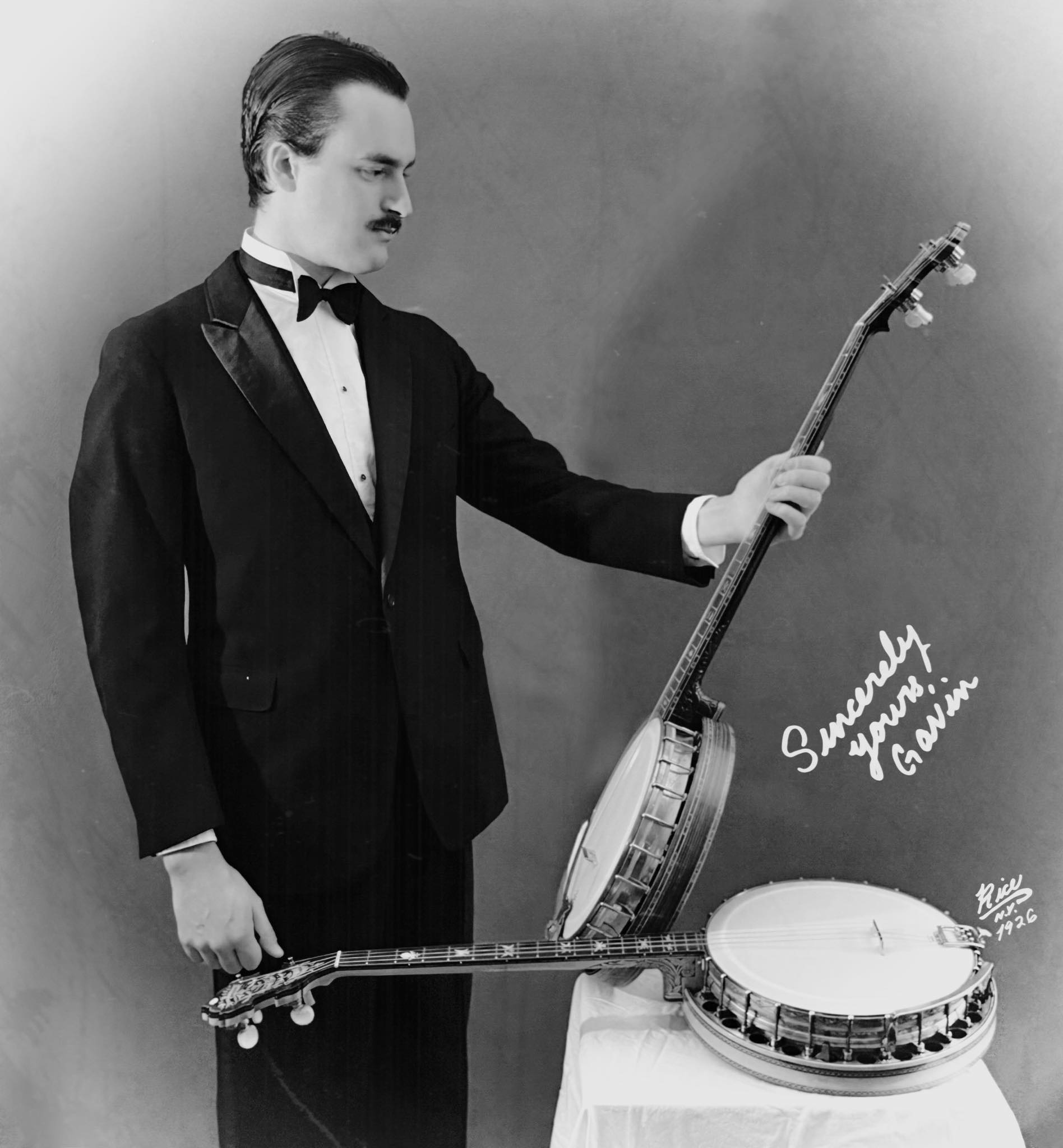
GR: One of my major hobbies is historic process photography. I specialize in Gelatino-Bromide dry plate negatives which were popular in the 1880s to the 1930s before sheet film ended up being the dominant medium. I take portraits with my 1920s Century studio camera. Not only do I develop/process all of my plates, but I have to make them from scratch, which entails creating a light sensitive emulsion from chemicals and pouring them onto thick glass plates.
Other than that, my other major hobby is setting up banjos how they were when they left the factory. I hand make wooden bridges for all of my banjos, and use special strings that are accurate to what each company would have offered back then the banjo was made. Other minor hobbies include antique car collecting/driving, vintage menswear and record collecting.
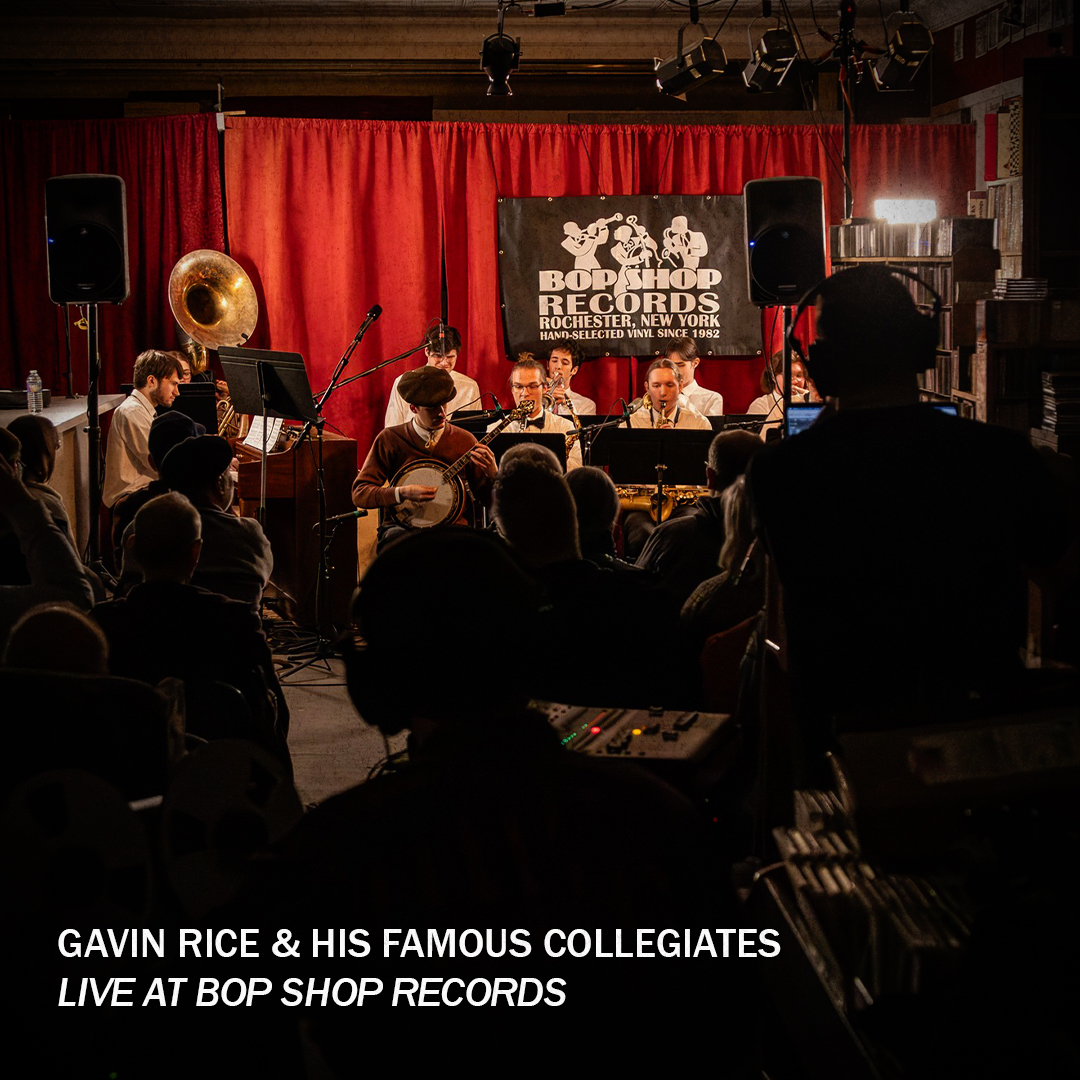 I’m featured in an upcoming Warner Brothers movie, have played with Mike Davis, Andy Schumm, Vince Giordano, Miss Maybell/Charlie Judkins, Colin Hancock, Matt Tolentino and more Trad jazz bands across the country. I was the Whitley Bay young talent award winner 2024, ran my own band in college “The Famous Collegiates,” made an album last year, have played with the Jazz at Lincoln Center Orchestra with Wynton Marsalis. I’ve made “one man band” multitracks of early jazz tunes with me playing all of the instruments. I plan on giving private lessons. I worked in Special Education for five years.
BH: Thanks, Gavin. You’re certainly a very well-rounded individual!
Find Gavin Rice’s CD online at gavinriceandhisfamouscollegiates.bandcamp.com.
Bill Hoffman is a travel writer, an avid jazz fan and a supporter of musicians keeping traditional jazz alive in performance. He is the concert booker for the Tri-State Jazz Society in greater Philadelphia. Bill lives in Lancaster, PA. He is the author of Going Dutch: A Visitors Guide to the Pennsylvania Dutch Country, Unique and Unusual Places in the Mid-Atlantic Region, and The New York Bicycle Touring Guide. Bill lives in Lancaster, PA.