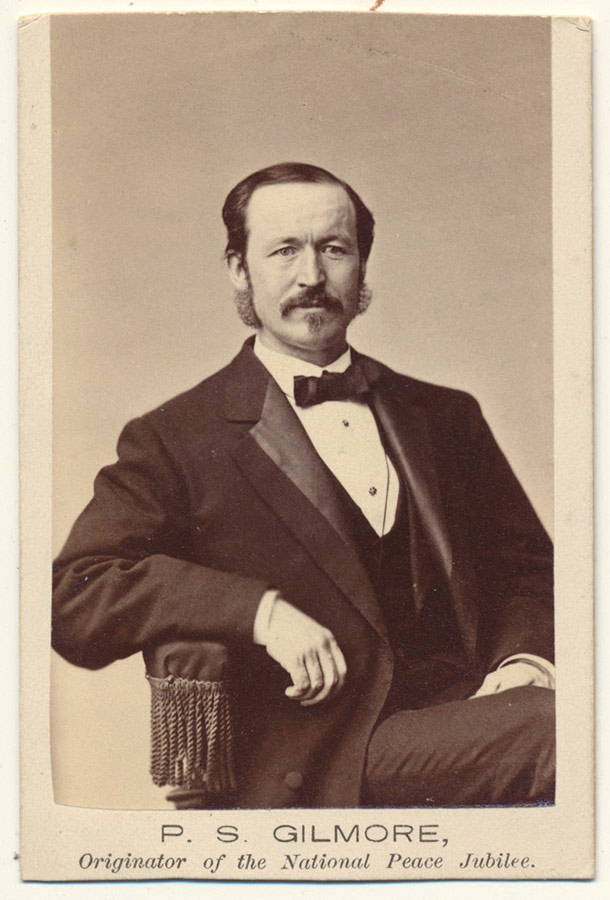
If you were a young musician in the late 19th century, you most likely would have aspirations to be in Gilmore’s band. This band was the most successful of its kind, and what formed the concept of an organized military style band in the United States. Only the best of the best in the music world could be part of it. It officially lasted from the latter 1850s until Gilmore’s death in 1892, but it did continue for a little while longer after then. The band’s story is long and fascinating.
Patrick Gilmore was born in Ireland in 1829. He did not move to the United States until 1849, but not without making a local name for himself. In his home village he has already begun his own small band. His music teacher Patrick Keating was impressed by his ambition with this band of his, and encouraged him to move to the United States. It took him a little while to make a name for himself in Massachusetts, where he settled. He started off in Salem, playing in small time local bands and making extra money playing bones and tambourine in a minstrel troupe. By 1857, he had become such a well-known figure with a good band to where his band was contracted to play for the parade of James Buchanan’s inauguration. Until the beginning of the Civil War his band continued to play for various political functions in Boston and around Massachusetts.

During the Civil War, Gilmore enlisted all of his musicians. His musicians were discharged in 1863, and his star continued to rise. By the beginning of the 1870s he was beginning to tour his band around the United States, not just performing in larger cities, but also in smaller towns. It was this fact that really sparked the craze for military bands in the United States. You can bet that pretty much every young musician in the 1870s who heard his band was inspired. These tours would have most likely inspired folks like Arthur Pryor, William Krell, Fred Hager, Henry Fillmore, and countless others. Combing through American newspapers in the 1870s, there are seemingly endless articles about Gilmore’s band coming to town. Gilmore’s band coming to small towns was just as exciting as the circus.
His band became famous for putting on incredible productions, sometimes with thousands of singers in a choir to accompany the 50-ish person band. Sometimes there would be visual spectacles to accompany the music. One of these famous acts was playing the “Anvil Chorus,” but when the famous anvil section begins, the lights would go out and dozens of firemen would filter onto the stage and slam anvils, scattering sparks amid the dark. It was this kind of showmanship and Gilmore’s good nature that allowed him to become music’s most famous American.
He moved from Boston to New York in 1873, and renamed his band the 22nd Regiment Band. This was the name (other than Gilmore’s) that most people knew them for. Not long after they moved, the famous venue later called Madison Square Garden was originally opened to host Gilmore’s band and their giant productions, like the Anvil spectacle. This move brought the band to the next level. They continued to tour around the United States, though the schedule wasn’t nearly as rigorous as it had been back in the ’70s, as Gilmore himself was aging, as was most of his band.
Throughout his band’s history, he did rotate in new musicians as the old guys aged out, or started their own bands. Gilmore didn’t realize that by creating the most famous band in the world, he also created a musical dynasty. The lineage of his band filtered into all corners of the United States. For example, Justin Ring later married one of the daughters of Gilmore’s early cornetists, Gustav Patz. Hard to believe there was something of a musical nobility in the United States, if there was, Gilmore’s band created it. Everyone starting a band wanted one of Gilmore’s musicians. The tradition and musicianship was passed down through many off-shoot bands.
By the last iteration of his band, it was now the 1890s. Just before his death in 1892, Gilmore and the band made some recordings, and these ended up being of great historic importance. On December 17, 1891, 12 musicians of Gilmore’s band recorded an astounding 19 selections for the North American Phonograph company. 19 selections is a lot of recording to do in a single day. Thankfully for us, several of the recordings survive, and in good condition. Most of them are ensemble pieces, but a few are cornet solos by Thomas Clark, someone who would later have his own band, and would take on the mantle of handling the recordings the band would do later.
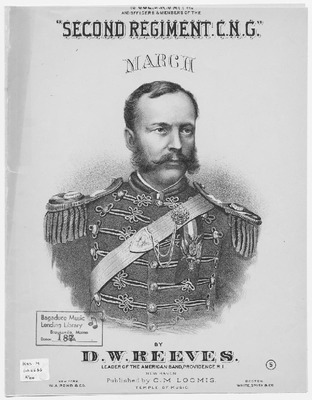 After Gilmore died, there was a moment when people were worried the band would fall apart, but thankfully the band had a few more leaders after Gilmore himself. Right after his death David Wallis Reeves (another very important figure in the band history world) ran the group for only another year, he then handed it to someone completely different. In 1894, Victor Herbert was given the baton for Gilmore’s band. Herbert was already widely known in the US and Europe. While he did bring many new faces into the band, people still came out to see them, and the band continued to tour under Herbert. He remained with the band until 1900.
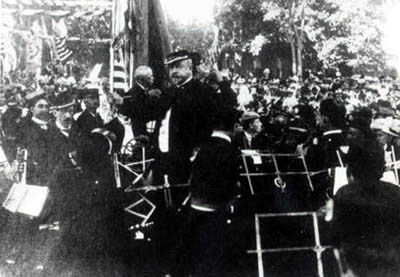
After that point it is a bit difficult to track the lineage of the band, but it is likely that Thomas Clark continued to have an important role. The band was making records all through the time between 1891 and 1900. Some of the best recordings the band ever made were actually done in the late brown wax era (1897-1902). They recorded a surprising amount of ragtime, something that Herbert would famously sue over. There are accounts of the band still doing shows as late as 1912, but it is likely that they weren’t doing near as much as even when Herbert ran the band. The band stopped showing up in record catalogs by 1906, and they didn’t seem to survive the cylinder era.
Though the band itself seemed to fade away, nobody forgot the prestige and skill of the band, and its musicians continued this tradition for generations to come. It is difficult even to describe to modern readers how influential this band was, and how much of a privilege it is that we have so many great recordings of them left. Every kid who joins band class in school continues to be taught some methods and musicianship that can be traced back to Patrick Gilmore and his band.

R. S. Baker has appeared at several Ragtime festivals as a pianist and lecturer. Her particular interest lies in the brown wax cylinder era of the recording industry, and in the study of the earliest studio pianists, such as Fred Hylands, Frank P. Banta, and Frederick W. Hager.