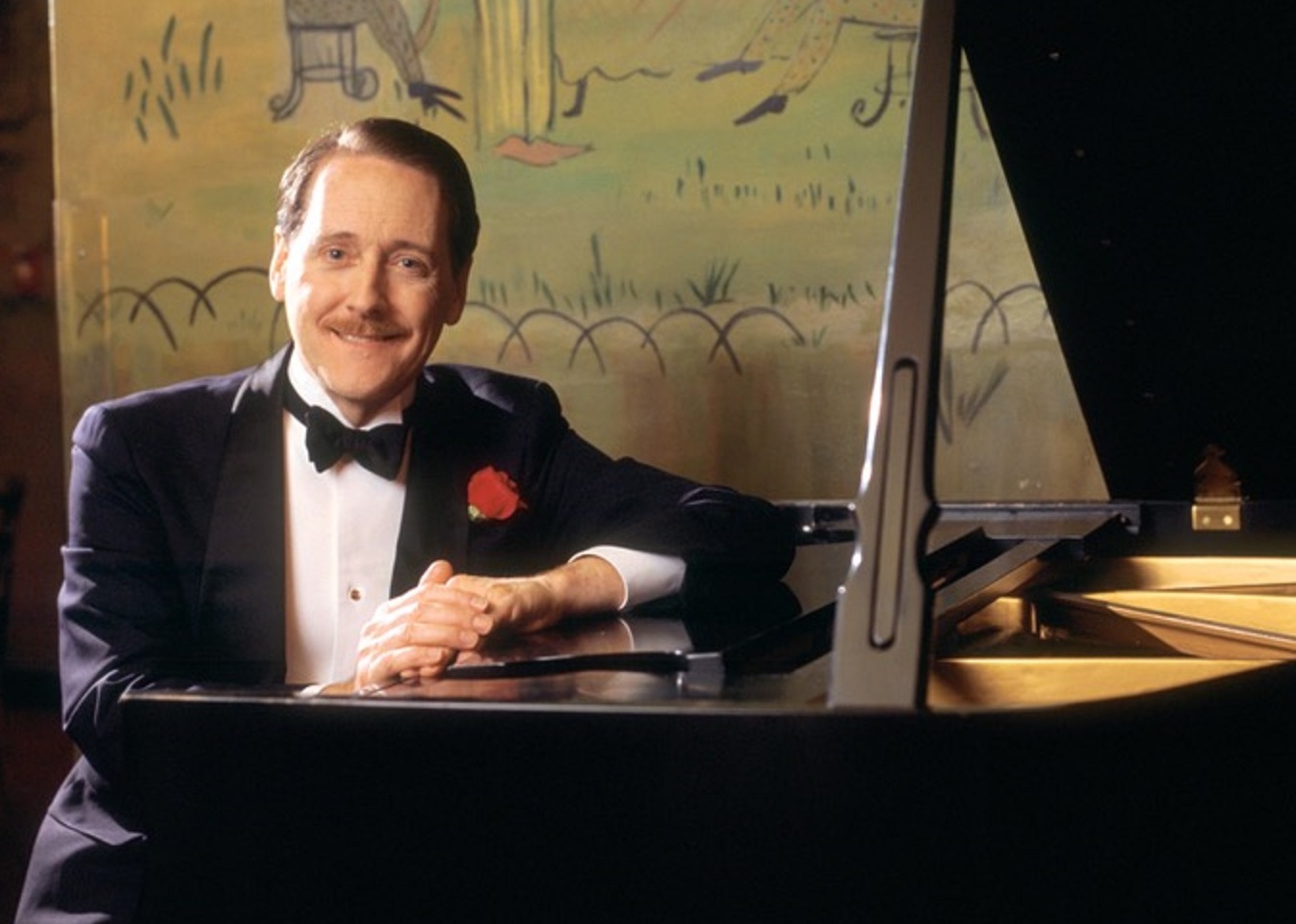
Long before anyone used the word “retro,” pianist Peter Mintun fell in love with music from the decades before he was born. And he has made a successful career of playing songs from the 1920s, ’30s and ’40s in the high-tone cocktail lounges and hotel restaurants of San Francisco and New York.
The sophisticated “lounge pianist” grew up in Berkeley, Calif., in the 1950s when rock ’n’ roll was big. “Originally I liked it,” he said, “even Elvis. But my parents were playing older music on LPs and 78s. My mother was a pianist who played songs from those days, and I just gravitated toward those sounds. My father would listen to Fats Waller and Glenn Miller. Fats Waller’s style, especially, gave me great joy. He was a big influence on me.”
Peter’s mother started him on piano, guiding his fingers toward the right notes, so they could play duets on songs from her childhood, like “Ain’t She Sweet.” Once he could play on his own, however, “my parents trotted me out to perform for company. I didn’t like it. I was terribly shy. Self-conscious. When I was in the homes of my schoolmatesI could play the “12th Street Rag,” but only if I was hiding under a blanket!”
What brought him out of his shell was the opportunity to play for dancers. In the Bay Area in the early ’60s (as in many places around the country, then) dance classes for kids also taught social skills. Girls wore gloves; boys wore jackets and ties and learned how to politely ask a young lady to dance.
“I was taking one of those classes at age twelve. When the pianist retired,” said Peter, “the teacher, a Berkeley legend named Dart Tinkham, asked me to play, and paid me $5 an hour for her class lessons; and $7.50 an hour for her dance parties. I did waltzes, cha-chas, ‘swing step’ and fox-trots, and she gave me good feedback, saying things like ‘That’s too busy,’ or ‘Make it simple.’ And I learned to play in a strict meter, to hold the tempo. She would also have me demonstrate dance steps with her. I enjoyed that. The mothers, who were the chaperones, always complimented me. I was playing songs from their past. Unlike their children, they knew the old tunes.”
Emboldened, Peter was recruited for talent shows. “I was always playing rags as fast as I could. I thought velocity was the test of a good pianist. People said, ‘Slow down!’ But it impressed my classmates.”
By age 14 he’d been taking lessons for seven years, from a teacher in his neighborhood; but he admits. “I hated lessons. I didn’t read notation well, and I never really learned to do it well. If I had to play from sheet music, especially in an unusual key, I couldn’t be in a group that relied on notation.”
His ear, however, more than compensated. “I was good at mimicking,” he said. “I could listen to something and play it right back. I’m still good at that. As a soloist, I could play rings around other people.” Still, he was frustrated, because most piano teachers didn’t teach the “old” popular music that he adored. But he finally connected with one who did.
Practical Piano-Playing
Lee Green had been a pianist in San Francisco with Tom Coakley and His Palace Hotel Orchestra, which made Victor and Brunswick records in the ’30s. (Tony Martin sang in the Coakley orchestra, and Lee later became his accompanist.)

“He was a very good teacher for practical piano playing,” said Peter. “He guided me to play in different keys, make special runs and arpeggios. And since I had the finger-span to do it, he showed me how to play stride-style with the left hand, from the Fats Waller era that predated World War II. And of course, I loved Fats Waller.
“Every week we would choose a song, like ‘The Shadow of Your Smile’ or ‘Sweet Lorraine.’ He’d sketch an arrangement for me to learn. After about a year—this would be 1966 or so—I could make my own arrangements of songs, on a whim. And Lee told my mother there was no more he could teach me.”
After high school, Peter spent one semester at Sonoma State College; but he was a poor student, frustrated in classes. “All I wanted to do was perform.” And at age 18 he joined the Musicians’ Union: AFM Local 6.
Peter started getting work in San Francisco, playing for parties and amateur shows. For a whole year, he was the pianist for the gender-fluid, glitter-spangled Cockettes, at their midnight shows in North Beach. “I had to hide that gig from my school chums and my family, because it was so outrageous. But I was getting a paycheck: a hundred bucks every few months!”
The Time Warp
It wasn’t only the old music that Peter delighted in. From 1968-70 he lived down the Peninsula in what he calls “a commune—not the usual, meaning hippies,” he said, “but we had the same save-the-planet values. We collected things from the past: vintage cars and clothes, appliances, records, sheet music, piano rolls, telephones, lightbulbs. Everything worked, including a monitor-top refrigerator.
“We’d have picnics in public parks and drive there in a 1925 Chrysler, wearing 1920s clothes, bringing 1920s picnic baskets and table settings, and listening to records on suitcase phonographs. We’d pretend we were back in the ’20s. What we were doing, we called it a ‘time warp.’ It was a lifestyle, trying to live in our parents’ or grandparents’ age, with old-fashioned norms too. It’s where I learned the rule for men’s hats: Outdoors on / Indoors off.”
High-Tone Places
“I yearned for a gig in a fancy restaurant where the old kind of musical culture still existed,” said Peter, “places where, like in the old movies, people ate, drank, smoked, and listened to a pianist. In December 1969 I had played a New Year’s Eve party at L’Étoile, a classic French restaurant in the Huntington Hotel on Nob Hill. The owners liked me, and in 1973, after I’d moved to San Francisco, they offered me a job at L’Étoile, five nights a week.
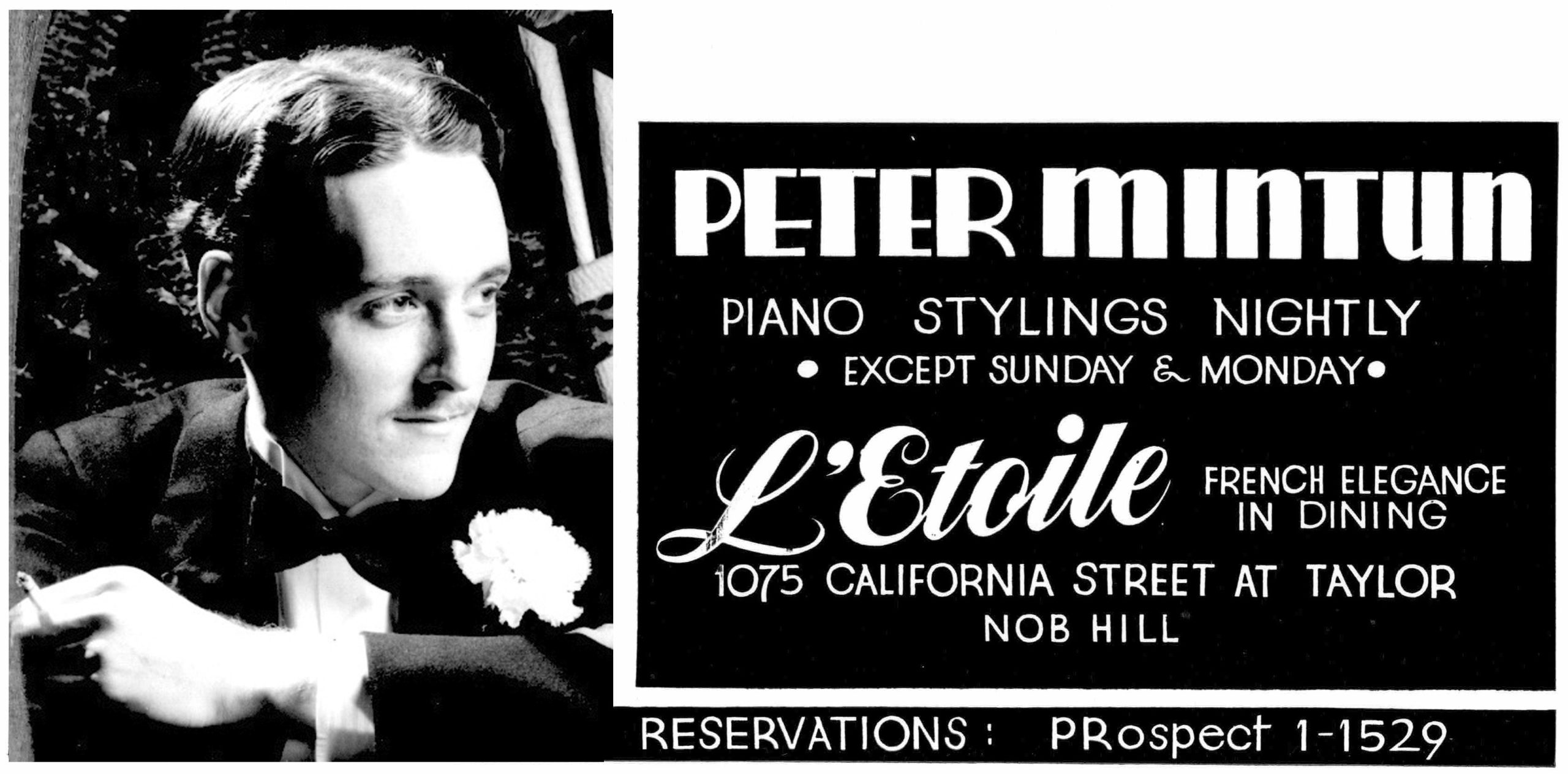
“In those days, men could not come in without a tie and jacket, and women could not wear pants-suits. I wore vintage tuxedos with detached shirt collars. The clientele was old enough to recognize the hit parade from their past.”
It was steady work for union scale: $129 a week. “They offered me an alternative: 15 percent of the income from drinks. Thinking it would be a bad thing, I turned it down. I really wanted that steady paycheck. But a few weeks later, the bartender told me what the drinks were bringing in, and encouraged me to go for the percentage. So I did. After six months, I was getting several hundred dollars every week. And by 1980 I was earning $2,000 a week.” It was enough for Peter to buy a house in the city.
Four months in, he started getting press coverage, including a full-page profile in the Sunday San Francisco Chronicle. The paper’s “three-dot” gossip columnist, Herb Caen, was already a customer who liked hearing Peter play the old songs. [See Sidebar.] “He started conversing with me, and then started quoting me in his column. His first mention camein July of 1973 when Hoagy Carmichael came in as somebody’s guest; I played for him, and then he played for us!”
Caen wrote it up; and after that, any time something funny happened there, or a celebrity was there, it got into his column. By the time Caen passed away, Peter had been a “character” in (he counted) 100 columns!
Peter’s gig at L’Étoile was so popular that the restaurant didn’t have to advertise it or put a “show-card” out on the sidewalk. Celebrities befriended him there, including Broadway legend Mary Martin, composers Johnny (“Out of Nowhere”) Green and David (“Laura”) Raksin, and pianists Michael Feinstein, Bobby Short, and Liberace. On nights when Peter couldn’t play the gig, he hiredhis former teacher Lee Green, or the legendary ragtime pianist Wally Rose, to sub.
Broadcast journalist and cultural TV host Alistair Cooke was a regular guest at the hotel every summer. “He once said ‘I bet you don’t know “In a Mist” by Bix Beiderbecke.’ I whipped it up, and he was flabbergasted. He later gave me his collection of 78s.”
The Art Deco Revival
For four afternoons in July of 1974, Peter was engaged to play solo piano in the Sheraton-Palace Hotel for an event called the San Francisco Art Deco Exhibition. During that week he met Laurie Gordon, an event producer and photographer with a keen eye for the 1930s. She would later be a founding member of the Art Deco Society of California (ADSC), create and produce its signature events—the Art Deco Preservation Ball and the Gatsby Summer Afternoon—and choreograph the movie-musical-style all-girl dance troupe Decobelles.
In 1986 Laurie asked Peter to pull together an orchestra. His friend Jack Bethards, whose day job was Executive Director of the Oakland Symphony, had an extensive library of old big-band orchestrations. Jack was also responsible for the restoration of the Oakland Paramount Theater, an Art Deco gem in whose lobby many ADSC dances were and still are held.
On Peter’s birthday the 16-piece Peter Mintun Orchestra, with Frederick Hodges on second piano, made its debut at the ADSC’s “The Captain’s Gala” in San Francisco. Peter also stepped off the stage, that evening, to do a routine with tap-dancer Rusty Frank, to “A Shine On Your Shoes.” It’s on YouTube at tinyurl.com/mintunfrank1986.
The following year, Peter’s orchestra played an ADSC dance the night before the Golden Gate Bridge celebrated its 50th anniversary with a public invitation to walk across it. Many people who’d gone to the dance stayed up all night to do that “bridge walk” at dawn, still in their vintage finery. “But I didn’t go,” said Peter. “I don’t like crowds. I went home and slept with my two dogs.”
From 1994 to 2011, the Peter Mintun Orchestra played for onstage dancing at the San Francisco Symphony’s annual New Year’s Eve Gala in Davies Symphony Hall.
East of the Sun
Peter’s L’Étoile engagement ended on Bastille Day in 1989. But he was snapped up by the owners of the nearby Fairmont Hotel, to play a restaurant called Masons. “I took the gig,” he said, “just in time for the earthquake to ruin everybody’s business in San Francisco! We struggled to get back on our feet, and Masons never became as popular as L’Étoile.” But celebrities and San Francisco socialites followed him there.
So did famous people from the East Coast, among them BrendanGill, The New Yorker magazine’s literary and architecture critic, who told Peter that, if he ever moved to New York, he could surely play at the prestigious Carlyle Hotel.
Peter started to get gigs in New York and to (figuratively) commute coast to coast, from Masons in San Francisco to the Madison Room in the Villard Houses hotel in Manhattan—which is where the manager of The Carlyle heard him and hired him to play in the hotel’s Bemelmans Bar.
Bemelmans was a cocktail lounge with Upper East Side elegance and a seven-foot Steinway grand. Peter alternated nights there with the legendary Barbara Carroll, whose career had started in the ’40s. Under the same roof, the celebrated Bobby Short was calling himself a “saloon pianist” for patrons of the Café Carlyle.
By the end of the 1990s, though, Peter was ready to move to New York and, as he put it, “learn how to live in snow.”
He sold his San Francisco house and bought an 1897 brownstone in Manhattan, that had retained almost all of its original interior. “I felt it was my duty to buy it,” Peter said, “to keep it from being modernized.” He and his partner at the time, Eric Bernhoft, moved there in 2001 with “nine hundred” boxes of collections: records, sheet music, piano rolls, and Dana Suesse’s memorabilia [see Sidebars following article].
When Peter was playing in Bemelmans five nights a week, New York Magazine voted it the city’s “Best Piano Bar.” But soon after, the hotel was sold, and the new corporate owners gave him and Barbara Carroll notice.
Almost immediately, he took a six-month job at The Greenbrier, a historic hotel in West Virginia. It was the third hotel he’d played in, after the Fairmont and the Carlyle, where the interior décor was by Dorothy Draper. (He subsequently played a one-night stand at a fourth: the Grand Hotel on Michigan’s Mackinac Island.)
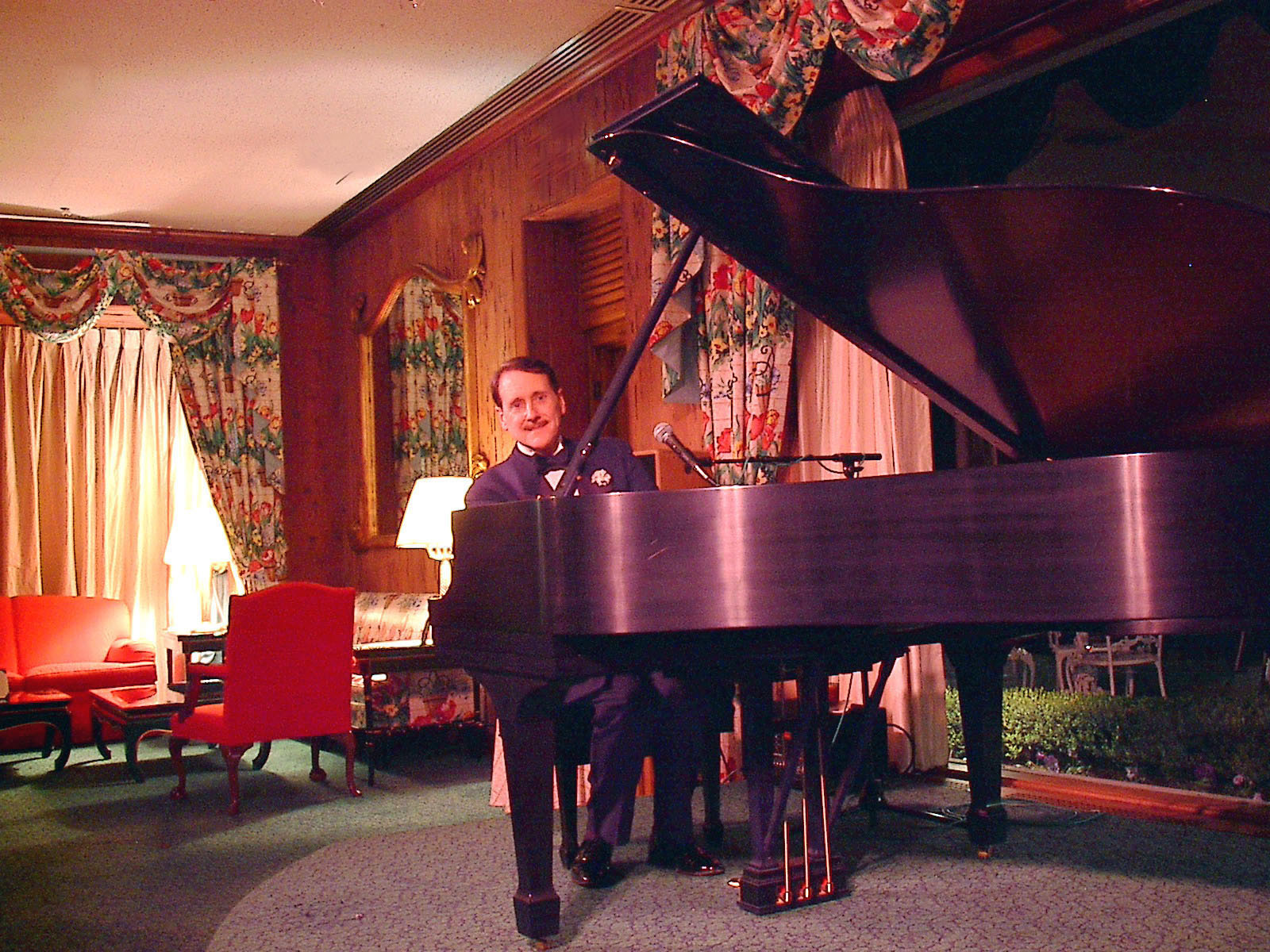
Peter freelanced for a while, but “After fourteen years, as I neared the age of retirement, I couldn’t afford to be the curator of a historic home any longer.” So he sold or gave away a lot of things, sold the house to an executive in the music business, and downsized to an apartment in Washington Heights, large enough for his two pianos, his piano rolls, his sheet music, and his dog.
“Nowadays, people hire me,” he said, “but I’m not looking for steady work. When you live in Manhattan, you can pick and choose what to see and do. I’m giving myself musical projects, like transcribing old recordings into notation. It’s making me a better sight-reader, and I’m enjoying getting better. I always encourage musicians to learn how, although most of my jobs still don’t require me to read.”
And in New York, Peter gets to see more of Vince Giordano, his friend of forty years with whom he has performed on many occasions, including the funeral for dancer Harold Nicholas at the Cathedral of St. John the Divine.
“The main reason I’m staying here in New York,” Peter declared, “is so I can go hear Vince Giordano and The Nighthawks at Birdland!”
Sidebars:
The Return of Dana Suesse
In 1972, one of Peter’s roommates collected 16mm sound films. One was a Paramount short subject featuring composer Dana Suesse (“sweese,” rhymes with “geese”) and her lyricist Edward Heyman performing their songs “Ho Hum” and “My Silent Love.”
“She played in a really nice style,” Peter recalled, “but nobody I knew, knew who she was. I found her name on sheet music and record labels, so I wrote her a fan letter and mailed it to her care-of ASCAP in New York. I said I was playing several of her songs and offered to send her a tape recording. She replied cordially, though she lied to me, saying she didn’t own a tape recorder. But she sent me her autograph. I sent her a tape anyway, of me playing several of her compositions.
“She lived in Connecticut at the time. On Thanksgiving Day she had friends over for dinner and played my tape for them. Evidently her friends said, ‘That’s you, Dana,’ and she said, ‘No, it’s this nut in San Francisco. And he plays exactly like me, clinkers and all!’”
“She phoned me, apologized for lying about the tape recorder, and calling my playing ‘remarkable.’ I said I wanted to promote her any way I could. She invited me to visit.
“I’d never been on the East Coast before. I got to Connecticut in July 1973, and she let me stay at her house for a week. I recorded hours of her talking about her career. She and her husband brought out boxes of clippings, records, albums, and conductors’ scores.”
Peter was amazed. She had written concertos and other classical pieces. She’d been friends with George Gershwin and Oscar Levant. Paul Whiteman had commissioned two of her crossover pieces for his “Experiments in Modern Music.”
“That week I spent with her,” he said, “she’d play the piano, play records she hadn’t dusted off for years. She gave me duplicate photos. I encouraged her to not be so modest about her career. She later called me the ‘catalyst’ for her concert at Carnegie Hall in 1974. Of course I went! I even brought her that old 16mm movie that I’d first seen her in, and screened it in her hotel room. She laughed at her 23-year-old self and said, ‘Oh, my god, I’m not wearing a bra!’”
The concert wasn’t well attended, but it was broadcast on the Voice of America, which gave her career a new boost. After that, she was asked, for the first time, to appear in festivals and symposiums of American composers.
In 1976, when she and her husband moved to the U.S. Virgin Islands, she sold Peter her Steinway concert grand—the instrument on which colleagues including Gershwin and Harold Arlen had played. It was the piano she had bought in 1934 with the royalties from her biggest song hit: “You Ought to Be in Pictures.”
After husband died, she moved back to New York and lived there until her death in 1987. In her will she left Peter all her papers and manuscripts which, after organizing, he donated to the Library of Congress in 2014. She also left him the royalties from her unpublished works. So Peter, as The Dana Suesse Music Co., is now a member of ASCAP.
Neglected or unknown pieces are sought-after, today; especially works by women. Symphonies are performing and recording pieces that would otherwise have been ignored. And at long last, her name appears in many accounts of women composers.
Peter is proud to say, “She is actually better known, now, than she ever was. In her lifetime none of her concert works were ever released on record. Now, though, I’ve lost track of the number of CDs.”
Last year, Peter flew to Paris to give a talk about her before a symphony performance of one of her concertos. He spoke in English; the symphony’s pianist translated. “I told the audience that, when I knew her, she would not have believed that a work she composed in the ’40s or ’50s would one day be performed in Europe.”
Making Piano Rolls
Peter still has the first piano he bought: a 1925 Hamilton with the Welte-Mignon reproducing mechanism. In the 1980s, his then-partner Eric Bernhoft had a Weber upright player-piano and hundreds of rolls. But Eric also had a vintage Leabarjan “Patent Music Roll Perforator”: a tabletop machine for making piano rolls.
It had a music desk with a note scale (from the first to last note on a keyboard) above the long roll of blank paper. Using sheet music, the user would guide a calibrated, spring-loaded punch directly below the note scale, to make one note at a time. There was also a “Time Scale Index Plate” to determine the note and rest values. With practice, the operator could create piano rolls with a “hand-played” effect.
Eric became an expert at using the machine. He started a company called Upright & Grand to sell rolls of his own compositions, such as “LeClede’s Landing Rag,” and vintage rags such as “Texas Fox Trot” by David Guion.
He also, said Peter, “outfitted my Steinway—imperceptibly, under the keyboard—with sensors that sent midi signals to his computer. He would edit those, and use the final midi file to make a piano roll. He had me record several songs that way, including a few four-hand pieces with Bay Area pianist Frederick Hodges.”
Eric’s master roll was then sent to a special roll-producing company in Texas for reproduction. He had the venerated Leslie Cabarga (who designed all of Peter’s album covers) create a label for the custom-made roll boxes. Then he would mail a fancy letterpress advertisement to his piano roll mailing list. “Those rolls were expensive, because they were expensive to make. Now they appear with high prices on eBay.”
The Old Piano Roll Blues
Peter had joined the Automatic Musical Instrument Collectors Association (AMICA) a decade after the Association was co-founded by Ed Linotti—a member, with Peter, of that that 1920s-themed Bay Area commune. “Most of us collectors, nowadays, have white hair,” said Peter who, surprisingly, at his age, does not.
“In the 1910s and ’20s, player-pianos represented a significant percentage of all piano sales,” he said. “Then came the Stock Market Crash which closed the factories, and records and radios became the source of home entertainment. A quarter-century later, as technicians retired, these pianos became white elephants. Some tuners would even get paid to throw out the mechanisms of a customer’s player piano!”
With associations such as AMICA, the player piano (and the more sophisticated reproducing pianos that played with expression) had an international revival and received newfound respect in the 1960s through the 1980s, and thousands of antique piano rolls were re-cut on longer-lasting paper stock.
“Unfortunately, like the pipe organ, these instruments need regular service,” said Peter. “And today’s young people are less interested in mechanical devices, when they can hear a piano concerto on their hand-held smartphone. So player pianos are white elephants again!”
The View from the Piano Bench
“As Times Goes By” (Herman Hupfeld, 1931) and “It Had to Be You” (Gus Kahn-Isham Jones, 1924) are the songs Peter is most often asked to play. Two songs he hopes nobody will ever ask him for again are the chestnuts “Happy Birthday to You” and (Edith Piaf’s signature number, from 1945) “La Vie En Rose.”
Celebrities who came to hear Peter had their favorite requests. Besides “In the Mist” (Bix Beiderbecke, 1928), Alistair Cooke always asked for “I Need Some Cooling Off” (Rodgers & Hart, 1927), and “Ill Wind” (Harold Arlen-Ted Koehler, 1934).
Always looking for a scoop, Chronicle columnist Herb Caen’s favorite was “What’s New?” (Bob Haggart-Johnny Burke, 1939). Hollywood director Mervyn Le Roy always requested “Chinatown, My Chinatown” (William Jerome-Jean Schwartz, 1906), because he had performed it in vaudeville.
And what are Peter’s own favorites?
“Body And Soul” by Johnny Green, Edward Heyman and Robert Sour, from 1930. “I was fortunate to have been friends with composer Johnny Green and lyricist Eddie Heyman.”
“(It Was) Sweet of You” by Richard A. Whiting and Sidney Clare. “It’s a highly melodic and sophisticated song from the 1934 film Trans-Atlantic Merry-Go-Round.”
“My Silent Love” (Edward Heyman-Dana Suesse, 1932) “Its melody is haunting.”
“Miss Lonely Heart,” is “a sophisticated ballad by Irving Berlin from the 1933 revue As Thousands Cheer.”
“Restless” (Tom Satterfield-Sam Coslow, 1935) has “one of the most tantalizing chord patterns you’ll ever hear.”
Hal Glatzer is a rhythm guitarist and vocalist who performs the Great American Songbook in New York and in Europe. He is also a journalist whose articles and profiles have run inFretsandAcoustic Guitarmagazines.Hal Glatzer has numerous published works of fiction and non-fiction. While living in San Francisco, he became an officer of the Art Deco Society of California. Visit him online at halglatzer.com.