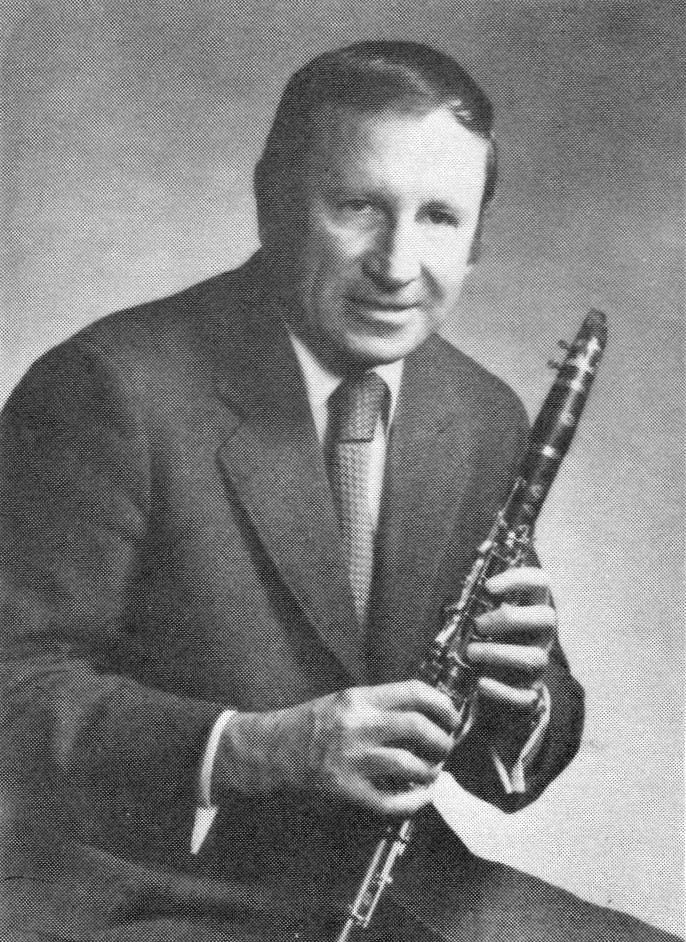
Born in Norfolk, Virginia, in 1921, Tommy Gwaltney was, by his teens, a competent reed player, working in dance bands while he was at college. Told that he might as well play music, “because you’re not doing anything with your grades”, he left college in 1941 and began playing professionally with Ted Ross and his band.
He was drafted in 1942, playing clarinet and alto in the 12th Armored Division Band, including various army groups in service clubs at Camp Campbell in Kentucky. During his service he suffered a lung problem which stopped him playing reed instruments for about six years and he switched to vibes, a change he seemed to achieve quite smoothly. After his discharge in 1945, he attended New York University, taking a three-year journalism course under the G.I. Bill, and sitting in wherever and whenever he could.
Bassist Harlow Atwood recalled a most unusual, and probably short-lived, quartet of clarinet, flute, guitar and bass: “I played with Tommy Gwaltney in 1946 with Charlie Byrd’s first New York group. Besides them and me, we had Paige Brook on flute.”.
In November and December, 1947, he was playing vibes with clarinettist Sol Yaged’s trio at the Swing Rendezvous in New York City. Charlie Byrd was also in the group, playing electric guitar at that time.
In 1948, when his father died, Gwaltney returned to Norfolk to work in the family’s feed business, while continuing to play both with local bands and with his own pick-up groups. He was also a frequent visitor to New York to hear what was happening and finding opportunities for sitting-in, which eventually drew him back into the jazz life.
Early in 1956 Bobby Hackett invited him to join a band for a month of bookings in Toronto and Chicago. This was a standard type unit. In addition to Hackett and Gwaltney there were Vic Dickenson, trombone; Johnny Varro, piano; Tony Hannan, drums and, unusually, a tuba played by multi-instrumentalist John Dengler. The band worked off and on for the remainder of the year until November 24, when it secured a two-week booking, with a two-week option, in the Voyager Room of the Henry Hudson Hotel in New York. By this time there had been changes, with Ernie Caceres replacing Ray Diehl, who had replaced Vic Dickenson. Johnny Varro was replaced by Dick Cary for this date and it was Cary’s arrangements which broadened the band’s repertoire.
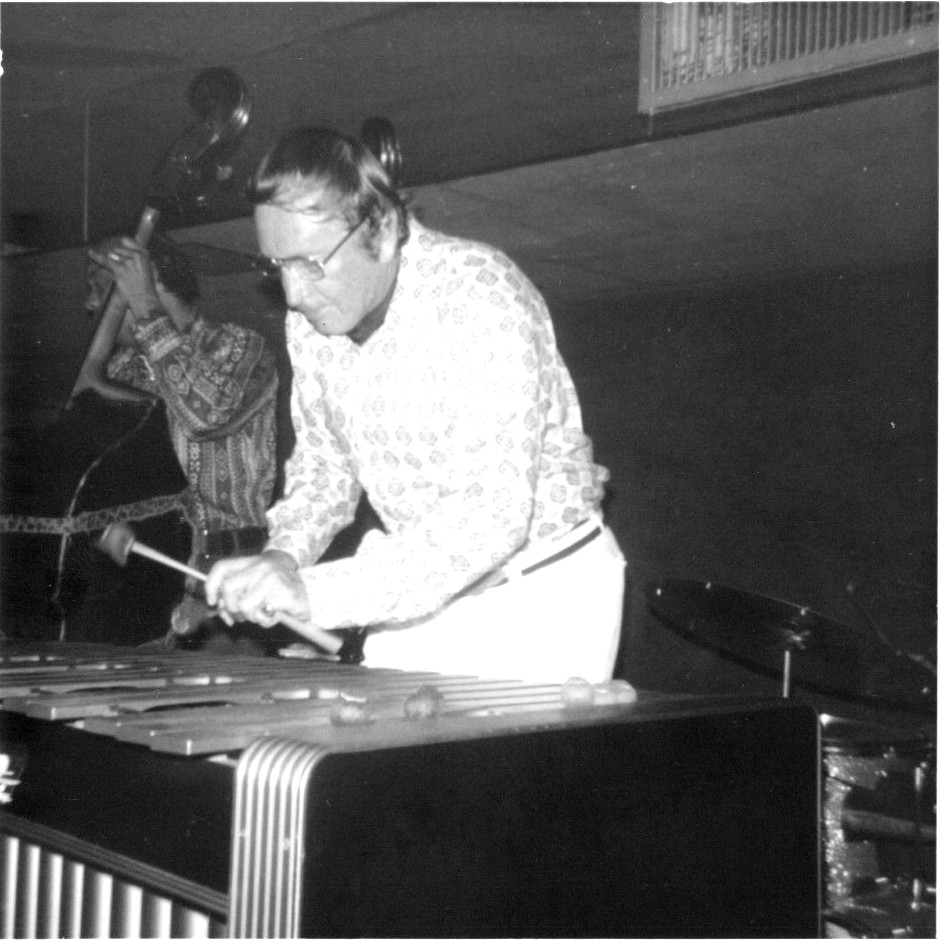
The option was taken up and the engagement then continued until June 27. The full personnel was Bobby Hackett, cornet; Ernie Caceres, clarinet, baritone; Tommy Gwaltney, clarinet, vibes; Dick Cary, piano, alto-horn, arranger; John Dengler, tuba; Nat Ray, later replaced by Buzzy Drootin, drums. There were numerous broadcasts in the Bandstand series which appeared on AFRTS transcriptions and subsequently Alamac and Lonehill Jazz. There was a highly praised album, Gotham Jazz Scene, for Capitol and an appearance at the 1957 Newport Jazz Festival. The Capitol recording sessions of March and April, 1957, and with a pianist and bassist added, were Gwaltney’s first. The album appeared on CD on Dormouse and Mosaic.
Capitol’s a&r man wanted Hackett to stick with Dixieland and ballads, but the leader wanted more variety. The unit played Dick Cary originals (“Handle With Cary,” “Henry Hudson,” and “Holiday Hop,” for example, which British bands should check on) while his arrangements of numbers such as “The Continental,” “In A Little Spanish Town,” and Willie “The Lion” Smith’s “Morning Air,” made the band stand out.
Gwaltney’s contribution to Hackett’s Henry Hudson band was important. The sextet was buoyed by the skill, versatility and experience of the musicians, and Gwaltney’s ability on clarinet and vibes made a sterling contribution.
Two months after a return engagement at the Henry Hudson Hotel began on August 30, 1957, Gwaltney had to return to Norfolk for “pressing family reasons”. His replacement was Bob Wilber.

With the family problems resolved, Gwaltney formed a trio with Steve Jordan, guitar, and John Drew, bass, for gigs around New York, until a call came from Billy Butterfield. “Billy needed a band for a tour of the Southern U.S. He contacted me about getting some men from that area.” Gwaltney organised the band while Butterfield fulfilled an engagement with Benny Goodman. The tour, which started that summer, was mainly to play at military bases, providing dance music for officer’ clubs.
On March 1 and 2, 1959, Billy Butterfield recorded a tribute to Bix Beiderbecke.
To quote Gwaltney, “The Bix thing was my idea. I selected the numbers and the players, arranged the rehearsals. Billy and I went 50-50 on financing the date. Tommy Newsom did most of the arrangements. I did a few and Billy did one, I believe.” Gwaltney chose, after Butterfield on trumpet, and himself on clarinet, Ziggy Harrell, bass-trumpet; Danny Meyers, trombone; Pat Roberts, piano; Junie Saul, guitar; Alton Smith, bass; and Bobby Test, drums. The album, whose titles were all closely associated with the Bix discography, was sold to Columbia and released on Epic (and Columbia in the UK).
Though the band and the music were not to the standard of his Kansas City tribute the following year, there are highlights. Gwaltney is featured on “Way Down Yonder In New Orleans” and Butterfield plays a worthy “I’ll Be A Friend With Pleasure.”
After the Butterfield band “I went on my own as a leader in July 1959, been on my own ever since.”
In 1959 Gwaltney organised the first Virginia Beach Jazz Festival, a one-day affair on August 30, headlined by Billy Butterfield, Ernie Caceres, Don Elliott and Charlie Byrd. The following year it became a two-day event, July 14/15, with bigger names, Dave Brubeck, Maynard Ferguson, in addition to the Gwaltney big band.
The 1961 Festival, July 15/16, starred Count Basie, Buck Clayton with Jimmy Rushing, Lambert, Hendricks and Ross, and the Sal Salvador Concert Band. From 1962 the Festival was promoted by various civic clubs, with Gwaltney assisting.
Goin’ to Kansas City was a first-class album recorded by Gwaltney and his Kansas City Nine in October 1960. The personnel was Buck Clayton, Bobby Zottola, trumpets, Dickie Wells, trombone, Gwaltney, mainly alto, plus clarinet, xylophone and vibes, Tommy Newsom, tenor, clarinet, John Bunch, piano, Charlie Byrd, guitar, Whitey Mitchell, bass, Buddy Schutz, drum, with Gwaltney and Newsom the arrangers. This was most likely another album subsidised by Gwaltney, subsequently sold to Riverside for release.
In his sleeve notes to the Riverside issue, George Hoefer commented on Gwaltney’s arrangements: “His approach includes an emphasis on some of the better tunes that have not been re-recorded or reissued. And Gwaltney determined to dress up these relatively obscure melodies in modern arrangements—but without destroying the original charm and impact”.
The following month there was a well-regarded album for the Candid label by singer Nancy Harrow. Organised by Gwaltney, it also included Buck Clayton and Dickie Wells, as well as Buddy Tate, tenor; Danny Banks, baritone; Dick Wellstood, piano; Kenny Burrell, guitar; Milt Hinton, bass; and Oliver Jackson, drums, in the line-up. One could call it a fair backing group.
Towards the end of 1960 Gwaltney led a big band and a small group on stage of the Colley Theatre in Norfolk in ten half-hour programmes on “The History of American Jazz.” Presumably these were radio shows or recordings for broadcast at a later date. In addition to his Kansas City and Bix Beiderbecke tributes, he did the same for Pee Wee Russell and Jimmy Noone, as well as a concert at the Smithsonian Institute honouring Jimmy Noone.
On June 2, 1961, Gwaltney opened at the Keyboard Lounge in Virginia Beach, with a quartet. No doubt work in such bars continued. Two years later, in August 1963, we find his trio, with John Eaton, piano, and Steve Jordan, guitar, ending a long engagement at the French Quarter in Washington. The next stop was the Showboat Lounge, opening early in September. This trio recorded for Laurel about this time. The same personnel was back at the French Quarter by February of 1964.
Late in 1964 Gwaltney found a derelict circa-1800 carriage house in an alley in the centre of the Georgetown district of Washington, D.C. To quote the Washington Post, “He gutted the building, sanded the brick walls and set up a stage along one side of the room and a bar running along the opposite wall. He has built, to his own satisfaction, a dandy club.”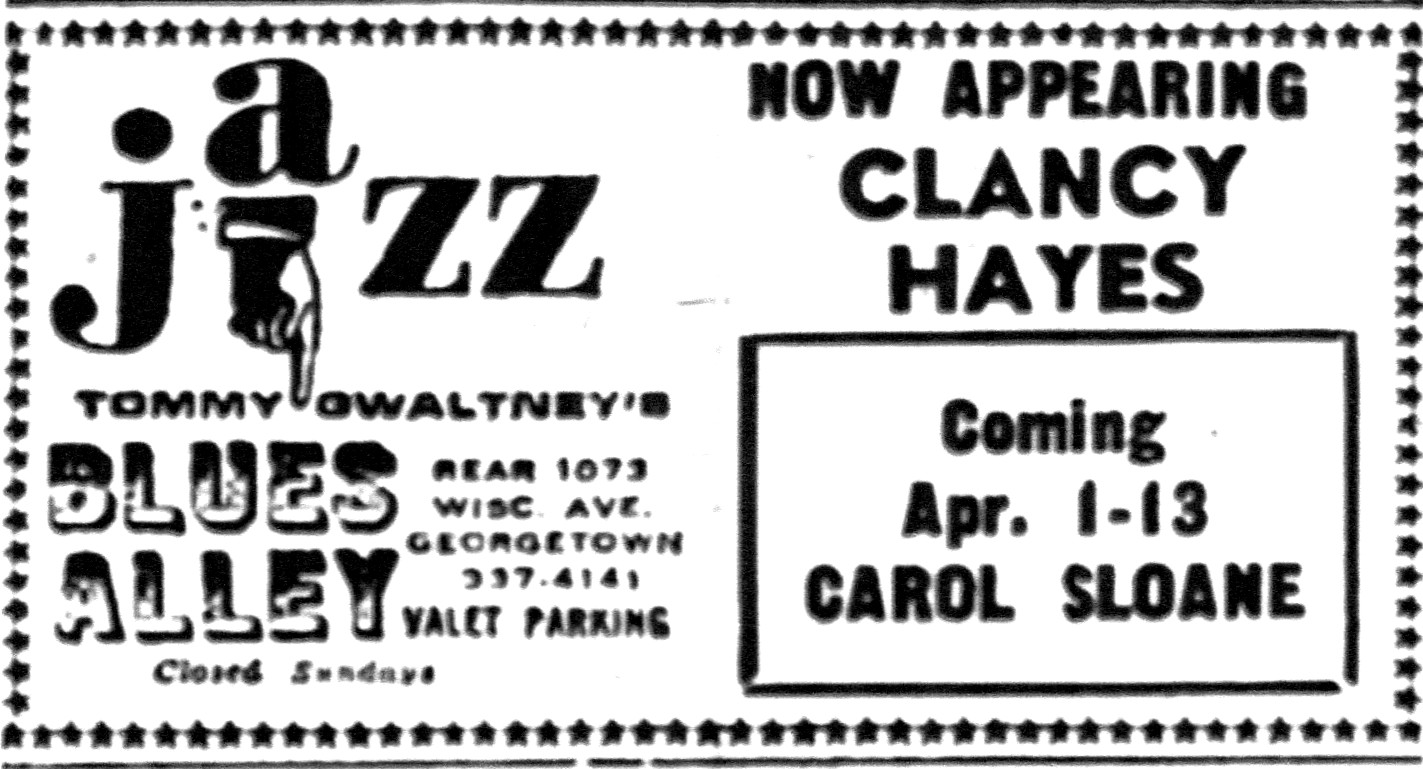
With décor by Betty Gwaltney, the club at No. 1 Blues Alley, opened early in January 1965, with music provided by Gwaltney, clarinet, vibraharp, Newton Thomas, piano, Steve Jordan, guitar, and Norman Williams, bass. Down Beat quoted Gwaltney as saying, “There is only one reason I built this club … so people could listen to what we are trying to do. And we will sink or swim on that basis.”
In a Down Beat review of a two-week engagement by Bobby Hackett at Blues Alley in November 1965 Tom Scanlon, in a piece mainly concerned with praising the cornetist, wrote, “Gwaltney, a better clarinettist than many with bigger reputations, was at his best with Hackett. He swung with gusto, assurance and grace on “Shine” and “Sugar” particularly.” The other musicians were Charlie Butler, trombone; John Philips, piano; Steve Jordan, guitar; Keter Betts, bass; and Eddie Phyfe, drums.
In March 1968 Gwaltney’s quintet at Blues Alley was John Philips, piano; Steve Jordan, guitar; Billy Taylor, Jr., bass; and Bertell Knox, drums. Guests had included Vic Dickenson, Lou McGarity, Buck Clayton, Emmett Berry, Bobby Hackett, Bud Freeman, Pee Wee Russell, Zoot Sims, Teddy Wilson, Jimmy Rushing, and Maxine Sullivan.
Maxine Sullivan was retired from music in 1965 and working in a school when Gwaltney telephoned to ask her to sing at his club. She explained about her job, which meant she would not be available until the summer. A little later Gwaltney rang to tell her, “You open July twelfth.” After that Blues Alley gig, one thing led to another and onto Maxine’s second career.
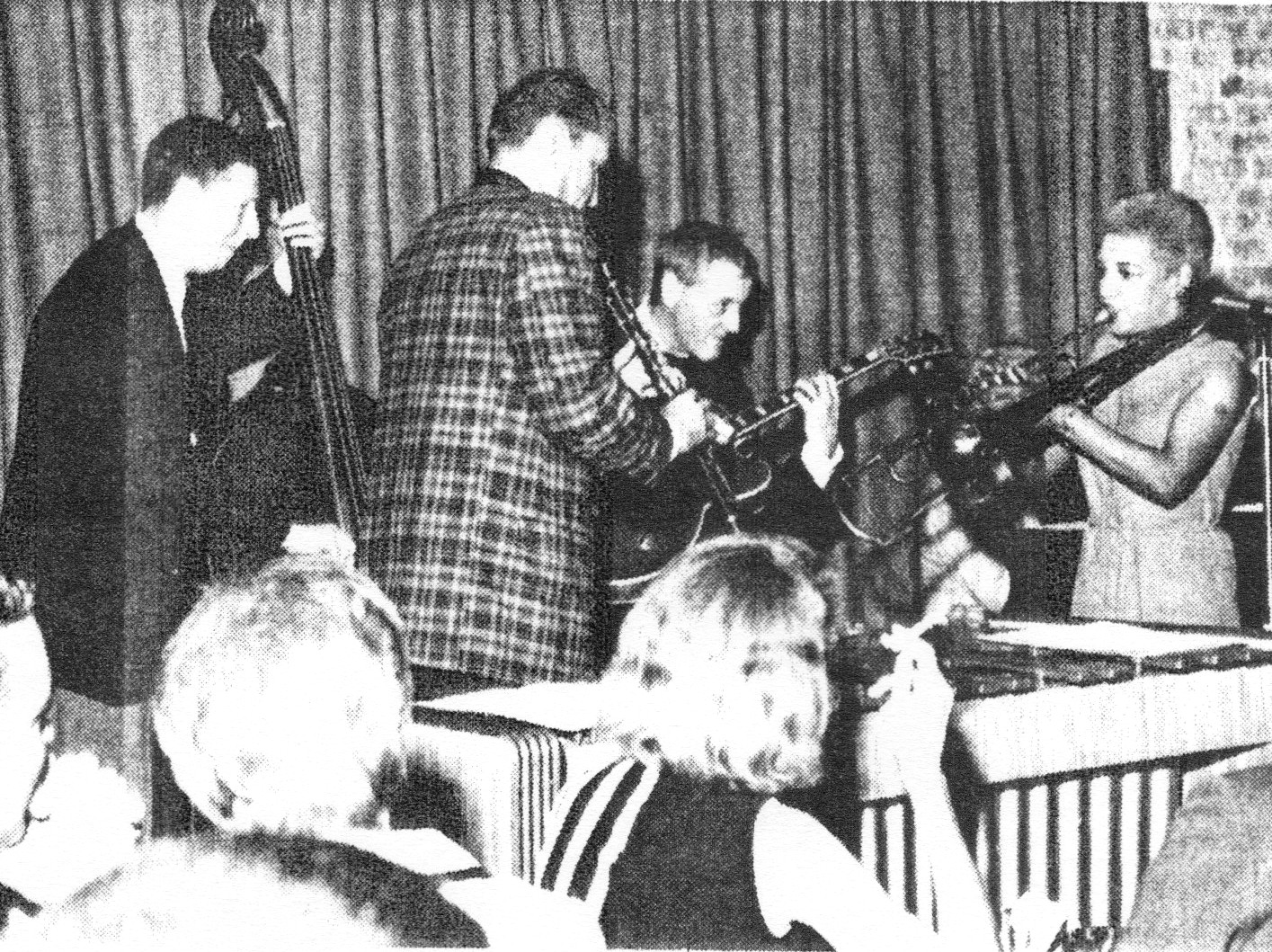
In 1969 Gwaltney sold Blues Alley, having become disenchanted with the hassle involved in running a club. He continued to play there on a regular basis until early 1973.
Blues Alley is claimed to be the oldest continuing jazz supper club in the U.S.A.
This year it celebrated its sixtieth anniversary, though the style of jazz now played there is very different from that provided by Tommy Gwaltney. Today the club is advertised as “The House That Dizzy Built!”
Recordings made at Blues Alley included Willie “The Lion” Smith on Chiaroscuro CR104 (June 24, 1969). Also recorded at the club, in 1968, was a satisfying album called Clancy Hayes with Tommy Gwaltney and the Blues Alley Cats on Clanco LRC814. The accompaniment is Tommy Gwaltney, clarinet, vibes; John Philips, piano; Steve Jordan, guitar; Billy Taylor, Jr., bass; and Bertell Knox, drums. There was even a Blues Alley album (issue 0001), probably recorded in 1970, titled This is Blues Alley, by Gwaltney, Philips, Jordan, and bassist Keter Betts.
One of the investors in Blues Alley was Johnson “Fat Cat” McRee, he and Gwaltney being close friends. In 1966 McRee promoted the first Manassas Jazz Festival and did so annually until 1989, with Gwaltney playing clarinet in various band permutations at all 24. The clarinettist also appears on innumerable Fat Cat’s Jazz LPs and cassettes, including one under his own name.
The first two 12” LPs issued on Fat Cat’s Jazz (FCJ100/FCJ101) were from a studio session recorded in Manassas in February 1967. The group was called Zutty Singleton and the Clarinet Kings, with Slide Harris, trombone; Sammy Rimington, clarinet, alto; Tommy Gwaltney, clarinet; Bob Greene, piano; Van Perry, bass; Zutty Singleton, drums. The combination of the two contrasting clarinet styles, Zutty’s drumming and Greene’s Jelly Roll Morton-influenced piano make intriguing listening. (Some titles were also issued on Doug Dobell’s 77 label.)
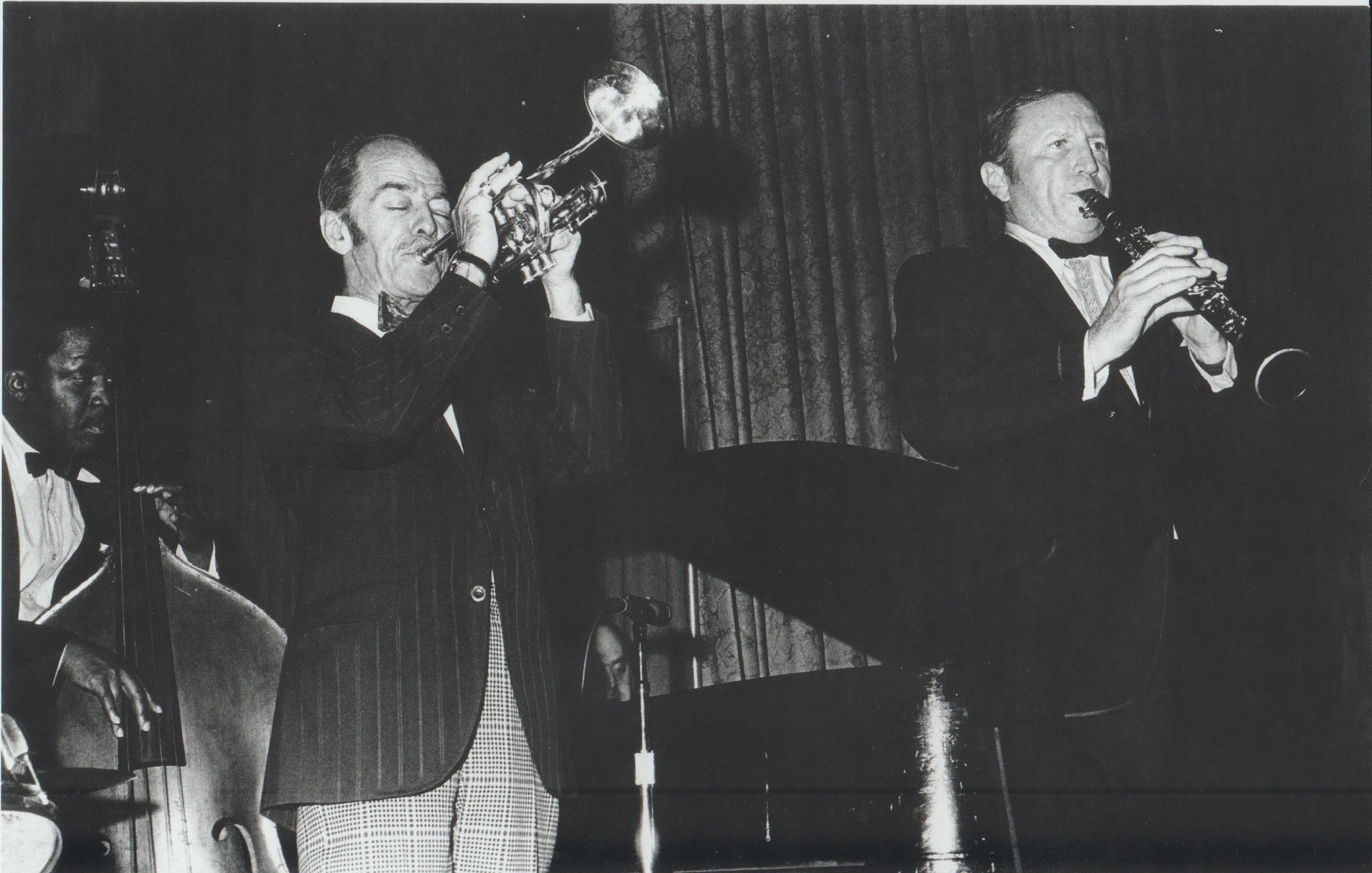
Of uncertain date was “a very nice job” playing for dinner cruises on board Le Bateau, a 100-foot vessel, seating 200 for meals, with space for dancing. The cruise on the Potomac River lasted three hours.
In All of Me, the Louis Armstrong discography by Joss Willems, there are some details of a concert at the National Press Club in Washington, DC, which took place on January 29, 1971. Louis was the guest and the host was David Frost. The five musicians who backed the star included Tyree Glenn, trombone, and Tommy Gwaltney. Five titles, plus repeats and Louis telling a naughty joke, appeared on a National Press Club LP (PRC178). Armstrong is featured as a vocalist but surprisingly, just five months before his death on July 6th, is credited with playing trumpet on two titles.
In September 1971 TG had “a good little band at the Sheraton Parks Hotel in Washington. We have been there eight months, but are going to another steady engagement on October 1 at ‘The Place Where Louie Dwells.’” This booking was not so steady. Business was poor and the group, personnel still unknown but probably the same as for 1972, had moved in Arlington, Virginia, to the Windjammer.
The following year, on May 27, Gwaltney concluded a booking at the Holiday Inn and then opened at the Moonraker Lounge in Virginia City for three weeks on June 5th. For July and August he was at The Carousel in Ocean City, Maryland, His rhythm section for these dates was John Philips, piano; Billy Taylor, Jr., bass; and Hal Ludwig, drums.
Gwaltney did not entirely waste his journalism studies. Among his efforts were “Pee Wee’s Last Days” for Down Beat (June 12, 1969 issue) and for Tailgate Ramblings there were articles on Jimmy Noone and Ernie Caceres. (The latter magazine was published by the Potomac River Jazz Club.)
The Pee Wee Russell memorial was recorded by Tommy Gwaltney’s New Yorkers and eventually issued on Tom Pletcher’s Teaspoon label in September 1981. With excellent work by Gwaltney (on clarinet), cornetist Pletcher, trombonist George Masso and pianist Dill Jones, it warrants a hearing.
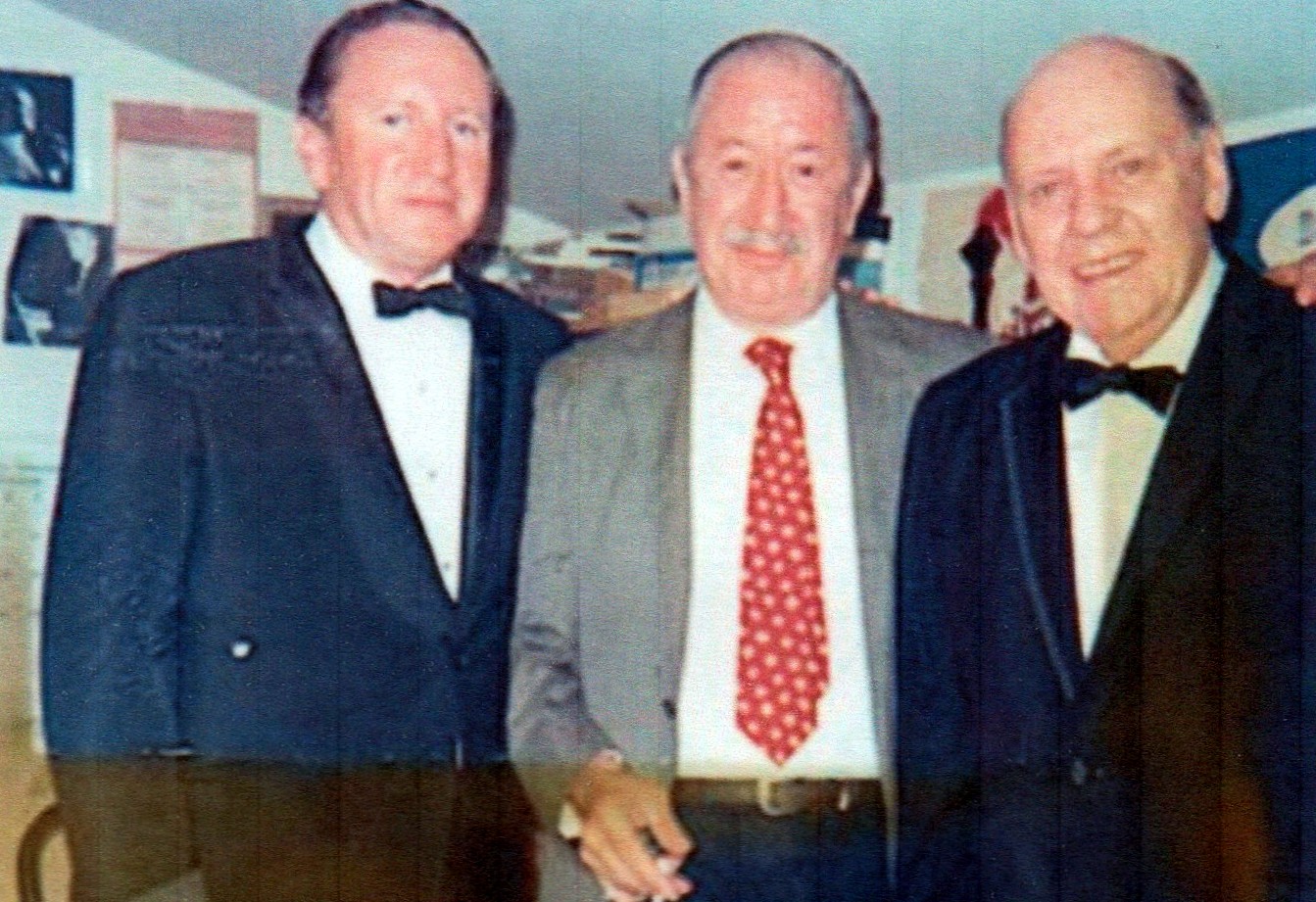
Trumpeter Don Ingle, reviewing the 4th Annual Reunion Concert by members of the 1950s Chesapeake Bay Jazz Band, in The Mississippi Rag (June 1995), said of Tommy Gwaltney, “He still has that delightful pixie quality in his playing, a touch of homage to Pee Wee in his tone, and the same deep woody sound of old. Just wonderful listening.”
Gwaltney spent his final years in a retirement community in Virgina Beach, dying there on February 11, 2003.
Sources
Bob Byler, “Tommy Gwaltney, Entrepreneurial Jazzman,” The Mississippi Rag, July 1995
George Hulme & Bert Whtyatt, Bobby Hackett: His Life In Music (Harding Simpole, 2015)
Steve Jordan, Rhythm Man: Fifty Years in Jazz (The University of Michigan Press,
1993)
George W. Kay, International Musician, September 1966
Various issues of Down Beat
Occasional correspondence with Tommy Gwaltney
Derek Coller, born in Devon, UK, in 1926, became a big band enthusiast as a teenager. His interest in jazz led to him becoming an author and jazz magazine editor. His recent biographies of Johnny Guarnieri and Big Joe Turner have been reviewed in The Syncopated Times.