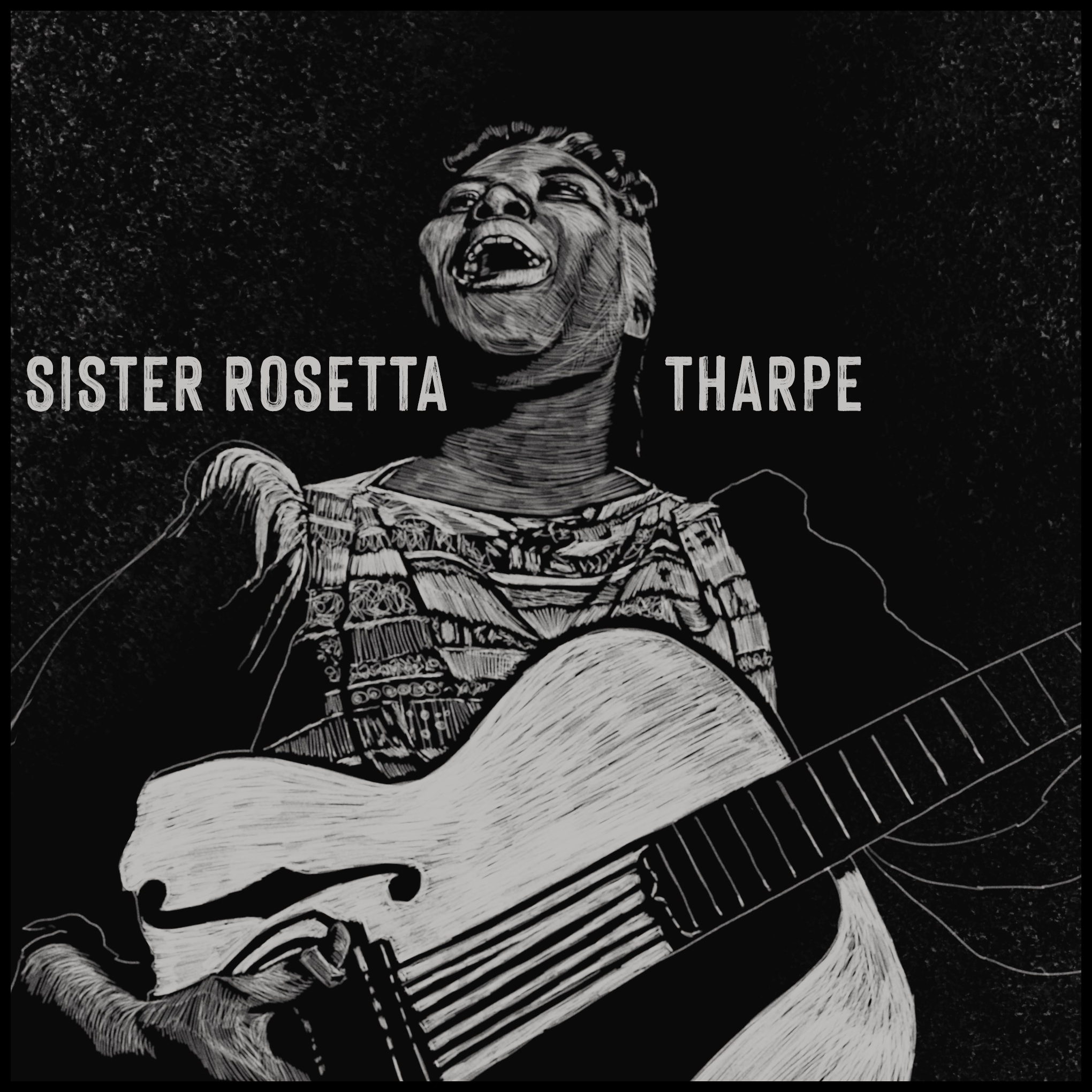
Rosetta Tharpe was born Rosetta Nubin, March 20, 1915, in Cotton Plant, Arkansas. At age six, Tharpe had joined her mother as a regular performer in a traveling evangelical troupe. Billed as a “singing and guitar playing miracle,” she accompanied her mother in performances that were part sermon and part gospel concert before audiences across the American South. Tharpe developed considerable fame as a musical prodigy, standing out in an era when prominent black female guitarists were rare.
Her stage name, Sister Rosetta Tharpe, derived from an early, brief marriage to a preacher named Thomas Thorpe.
In 1938 Tharpe made her first sides for Decca and appeared with Cab Calloway at Harlem’s Cotton Club and in John Hammond’s “Spirituals to Swing” concert at Carnegie Hall. By performing gospel music for secular nightclub audiences Tharpe fell out of favor with certain segments of the gospel community.
After Tharpe joined Lucky Millinder’s swing band in 1941, she made a recording with them on electric guitar of “That’s All,” which has been cited as an influence on Chuck Berry and Elvis Presley. In 1942, music critic Maurie Orodenker wrote, “It’s Sister Rosetta Tharpe for the rock and roll spiritual singing.”
Tharpe continued recording during World War II, one of only two gospel artists able to record V-discs for troops overseas. She toured throughout the 1940s, backed by various gospel quartets, including the Dixie Hummingbirds.
In 1957, Rosetta Tharpe was booked for a month-long tour of the UK by British trombonist Chris Barber, and in 1964, Tharpe toured Europe as part of the Blues and Gospel Caravan, under the auspices of George Wein. On May 7, 1964, she was recorded in concert in Manchester by Granada Television, a program which “influenced nearly everyone who saw it.”
When asked about her music, Tharpe is reported to have said, “Oh, these kids and rock and roll—this is just sped up rhythm and blues. I’ve been doing that forever.”
Tharpe’s live performances were curtailed by a stroke in 1970. On October 9, 1973, the eve of a scheduled recording session, Sister Rosetta Tharpe suffered another stroke and died. – adapted from Wikipedia