Jeff Barnhart: Hal, this afternoon I sat wondering if we’re being indulgent with a third installment of strolling together down our respective (but on occasion crossing) memory lanes, and then decided: NO. we’re NOT! And here’s why: Hopefully we’re providing our readers with inspiration to search out the groups and individual musicians that inspired us so much all those years ago, whether in live performance if any are still playing, or via recordings or videos. We’re doing a public service is what we’re doing! LOL! Anyhow, I’d like to hope so.
I’d also like to invite you to start us off. I’ve enjoyed everything you’ve shared so far so I’m really looking forward to this.
Hal Smith: Jeff, I am also hoping that our readers will take the time to search for the musician we mentioned in this series. To save a little space, I will skip over the music from the 1970s that I have already written about for The Syncopated Times. But one concert that deserves a little more discussion was “Clancy Hayes Day” at Earthquake McGoon’s on May 31, 1970. Turk Murphy hosted this benefit for Clancy, who was in ill health. Turk’s band played, of course, as did Wally Rose (accompanied by Smokey Stover on drums and Turk on washboard).
They all sounded great and so did a pianist I heard for the first time: Ray Skjelbred. He was amazing! And a majority of the bandleaders agreed, as Ray played with at least three bands during the benefit! “The hits kept comin’,” as they say, as it was the first time I heard Bob Helm, Burt Bales, the Bay City Jazz Band and Bob Mielke’s Bearcats live. And Hoagy Carmichael made an appearance! He sat in with Turk’s band, playing piano and singing “Up A Lazy River.” I’ll tell you—that was one incredible day of music!
You’re way ahead of me chronologically, but what was the next eye-and-ear opener for you?
JB: Yea-bo! I can’t compete with THAT line-up!! No wonder Hoagy was there to support his good friend, Clancy Hayes! Carmichael had the hit recording of Hayes’ terrific 1946 composition “A Huggin’ And A Chalkin’”—one of the many tidbits I learned from the Clancy Hayes bio I’ve reviewed this month elsewhere in this publication! Many of the other musicians and bands you mention have been long-time inspirations of mine.
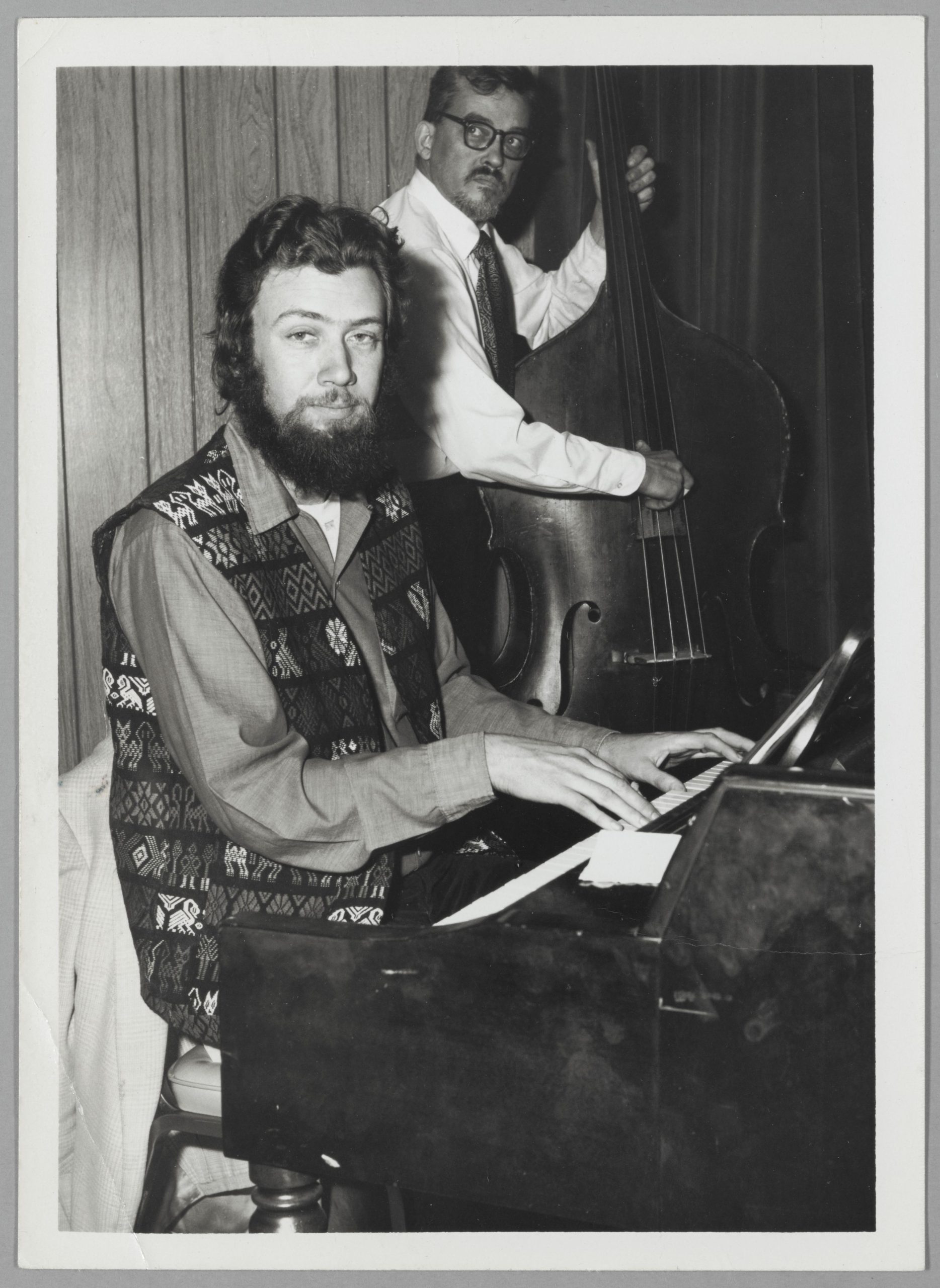
The first time I ever heard Ray Skjelbred on record was on Stomp Off LP “Hambone Kelly’s Favorites” with your Down Home Jazz Band! I was floored by his percussive style and combining barrelhouse with plenty of Jess Stacy! Watching Ray play live is even more invigorating than hearing him on record; he just can’t sit still, carried way with the excitement of the music he’s providing whether as a soloist or with a band! Bob Helm and the Bay City Jazz Band have been favorites of mine for a long time, but I really haven’t heard enough Burt Bales or Bearcats. Maybe we can discuss them in a future installment!
My next epiphany happened at my local annual festival—The Great Connecticut Traditional Jazz Festival (hitherto GCTJF)—in 1990 when a band that would change my life appeared for the first time. It was Uncle Yoke’s Black Dog Jazz Band and I’d never heard (or seen) anything like it. History has proven that this band gave the entire festival circuit a much-needed shot in the arm in the 1990s, but at that point I was not interested in their effect other than what it had on the CT festival audience that year and on me!
The line-up was: Steve Yocum (leader/trombone/vocals); Davy Jones (trumpet); Jim Buchmann (reeds); Tom Hook (piano/vocals); Bob Leary (banjo/guitar/vocals); Dave Gannett (sousaphone); Ed Metz, Jr. (drums). Their swagger and attitude were matched by their incredible musicianship. The medium stomp tempos they chose for tunes normally played as barnburners, the humorous interchange between the band members, the twists they’d take an audience down during well-known trad jazz numbers, the wild risks they’d take with time in a tune (which always worked thanks to Metz’ inhumanly accurate time-keeping), the dramatic way they’d present ballads; the fire coming out of Dave Gannett’s sousaphone: all these added up to a sound and presentation none of us had ever before heard or seen—and haven’t since. The online version of our column has some video examples, albeit of poor resolution the music is well documented.
Hal, what’s (or who’s) next from your memory box?
HS: First, I should add to your comments regarding Uncle Yoke’s Black Dogs. If any latter-day jazz group was a sensation on the festival circuit, that was it! They were a hit at every West Coast festival where they performed and offshoots of the band continue to play across the U.S. right up to and including the present time.
Returning to my “memory box”… In 1971, there was a memorable live music experience: a concert by the Preservation Hall Jazz Band at the University of California-Irvine. That was an incredible band with DeDe and Billie Pierce, Big Jim Robinson, Willie Humphrey, Narvin Kimball, Allan Jaffe and Cie’ Frazier. And as much as I have come to appreciate Cie’s playing over the years, the sounds that really caught my ear were those of DeDe on cornet and Big Jim on ’bone!
Now let’s fast forward to 1990 or beyond. What was the next encounter that influenced you as a musician?
JB: Man alive, you heard the A-1 Preservation Hall Line-up!! You’re mentioning that experience jogged my memory box, so I’d like to briefly go back in time because I remember my mom taking me to the Bushnell Theater in Hartford, CT in 1980 to see the Preservation Hall Jazz Band. I’d not heard the earthy, truly New Orleans sound made by folks who’d been there AND done that back in the early days and it was a revelation. Among the musicians were Percy and Willie Humphrey on trumpet and clarinet with Frank Demond on trombone, Marvin Kimball on banjo, AND Sweet Emma Barrett on piano. Of course, she was the star of the show!
I didn’t know at the time what legendary figures in the flesh I was listening to, but I wish I could go back again knowing what I do now. The only thing that confused me at the time was that every vocal (these duties shared by Emma, Narvin, and Percy that night) was sung twice in a row, with no difference in lyrics or delivery. I still find that odd and wonder if you could shed some light on what I later learned was a traditional NOLA way of doing things.
HS: Now that you mention it, I have heard New Orleans vocalists repeating a chorus with the same lyrics, sung the same way. I think you and I have gotten used to hearing vocalists sing a second chorus after a series of instrumental solos and before the final ensemble. We should check with our New Orleans friends to find out whether anyone can give us a definite explanation regarding the origin of the back-to-back vocals.
JB: Great idea: I’ve not heard it anywhere else. Bringing it back up to the 1990s, another live concert I heard in 1991 was up in Massachusetts. I was thrilled to be going to see the New Black Eagle Jazz Band in action! Once I arrived at the theater, I was disappointed when I discovered that cornetist/leader Tony Pringle was away. That is, until I learned who was taking his place: Peter Eckland! Yowza! What’s funny is that this might’ve been his first time playing with the band, because he seemed unaware of their proclivity to squeeze the last drop of juice out of their outgoing ensembles.
During the first half of the concert, he’d end a tune after two outchoruses. The music was fantastic, but it wasn’t boiling the temperature of the audience the way that band was used to. It must’ve been during the intermission that reedman Billy Novick chatted with Peter; during the second half of the concert, Peter kept an eye on Billy during the final ensembles: if Billy made a rolling gesture with his left hand, Peter would lead the band into another outchorus. Thus, many of the tunes would have ride-outs of three or four choruses’ length.
I think Peter really enjoyed the final tune, “Weary Blues,” where he displayed a combination of “Now I understand you” and “Oh yeah, I can do this all night,” because he led the band through nine outchoruses! It took the audience’s breath away, and I think it did that of the band members as well!!
It’s funny, when we started our conversation this month, I thought I wouldn’t have much to share this time around, but your entries are awakening some great memories, Hal. Do you remember the first time you heard the Black Eagles?
HS: The Black Eagles were a hot topic among traditional jazz fans way back in the 1970s. Wayne Jones told me about their music before I ever heard them in person. That finally happened in 1975, at the St. Louis Ragtime Festival. You better believe that the Black Eagles tore it up aboard the Goldenrod showboat! And one night, in the theater, the Eagles played an incredible massed-band set with the Salty Dogs and other festival musicians. Wild!
My all-time favorite band at the St. Louis Ragtime Festival was the eponymously titled St. Louis Ragtimers! I’d previously met and heard Bill Mason, Al Stricker, Trebor Tichenor and Don Franz at the “Where It Was” ragtime concert at the Wilshire-Ebell Theater in Los Angeles in 1972. They shared a bill with Pete Clute (playing solo piano), the Dave Bourne Trio (with yours truly on washboard)…and Eubie Blake! Eubie was in fine form. As you can imagine, his “Charleston Rag” stopped the show! Pete Clute played outstanding solo versions of rags that he performed with the Turk Murphy Band—like “Harlem Rag” and “Blame It On The Blues.”
I really liked the music on the St. Louis Ragtimers’ LP, but hearing them in person was pure joy! Cornetist Bill Mason played hot improvisations without ever losing sight of the melody. Trebor Tichenor’s manner was supremely calm as he coaxed lively, raggy music out of the keys. Al Stricker played tasteful single-string banjo counterpoint to the piano and his good-humored vocals and patter were irresistable. Don Franz’s tuba playing was authoritative, but understated. And they were such nice people! Over the years it was a great privilege and pleasure to play with them on a number of occasions. I wish it was possible to go back in time and enjoy this band again!
Next, I got to hear the World’s Greatest Jazz Band at the Century Plaza Hotel in Los Angeles. This version of the WGJB included Yank Lawson, Billy Butterfield, Vic Dickenson, Ed Hubble, Bob Wilber, Bud Freeman, Ralph Sutton, Bob Haggart and Gus Johnson, Jr. My attention was immediately drawn to Ralph Sutton, as this was the first time I heard stride piano in person! On the first intermission I got to talk with Ralph and on their next set he played “California, Here I Come” for me. That was some of the greatest piano playing I ever heard!
My memory is playing tricks on me with regards to the final memory from 1972. It may have actually taken place in early 1973. Either way, it was the first and only time I got to hear the great Bob Short with a band. He was playing cornet with Ray Skjelbred’s Great Excelsior Jazz Band for the New Orleans Jazz Club of Northern California “Showcase” at the Jack Tar Hotel. Short’s cornet playing was unbelievably good. On the final number, cornetists Jim Goodwin, Ev Farey and Bob Neighbor joined in. What a front line!
Jeff, I’m guessing that you have more musical adventures to describe from a couple decades later.
JB: I do, but first, I have to say I am SOOO jealous! I’ll now add you to the list of musician friends whose playing I greatly admire who got to meet Eubie Blake (among them Vince Giordano and Bob Milne)! I saw Eubie when I was thirteen but I was in the second balcony, so he looked smaller than a flea…however, the sound in that hall was exquisite and it’s a night I’ll never forget.
You also mention so many musicians I wish I’d heard in person. However, in a future installment of this subject, I’ll share an exciting story involving the World’s Greatest Jazz Band. By the time I encountered them, Wilbur, Hubble, Sutton, and Johnson Jr. had moved on, Freeman had retired, and Butterfield and Dickinson were either no longer walking this earth but the line-up was still magnificent!
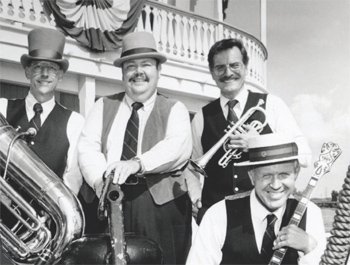
I never heard Bob Short live, but he was the first person I heard on record who was equally wonderful on trumpet AND tuba!! Sadly, I wasn’t on the scene early enough to hear many of the greats you mention live. My friend Art Hovey, tubist/bassist with the Galvanized Jazz Band, invited me to travel down with him to NYC on January 11, 1987 to see Turk’s concert at Carnegie Hall and I turned him down…stupid idiot, I was playing my local Sunday steady and was afraid to lose the $80. For shame, for shame!
By the early 1990s I was playing ten steadies a week on the CT coastline. If you add in the two or three one-offs I had weekly as well, I was averaging 45-50 hours of playing in front of audiences (and about 1,000 miles a week on my dilapidated 1982 Oldsmobile faux-wood-grain Custom Cruiser Station Wagon). All of this is to say regrettably I was too busy gigging to take in much music unless it was also occurring during some event at which I was playing. Thus, the next band that I learned quite a bit from was in 1992 when I heard The Buck Creek Jazz Band out of Virginia at—once again—the GCTJF.
To my provincial ears, Buck Creek was a kind of Galvanized Jazz Band/New Black Eagle hybrid. Yes, they were tuba/banjo, but the tubist almost always played in four-four. The band would invariably end their hot tunes with three outchoruses and the trombonist often played the melody on the second one out. Finally, the three horns had such a great blend, harmonizing with a three-note spread that sounded so polished, This band, too, enjoyed a long career on the festival circuit!
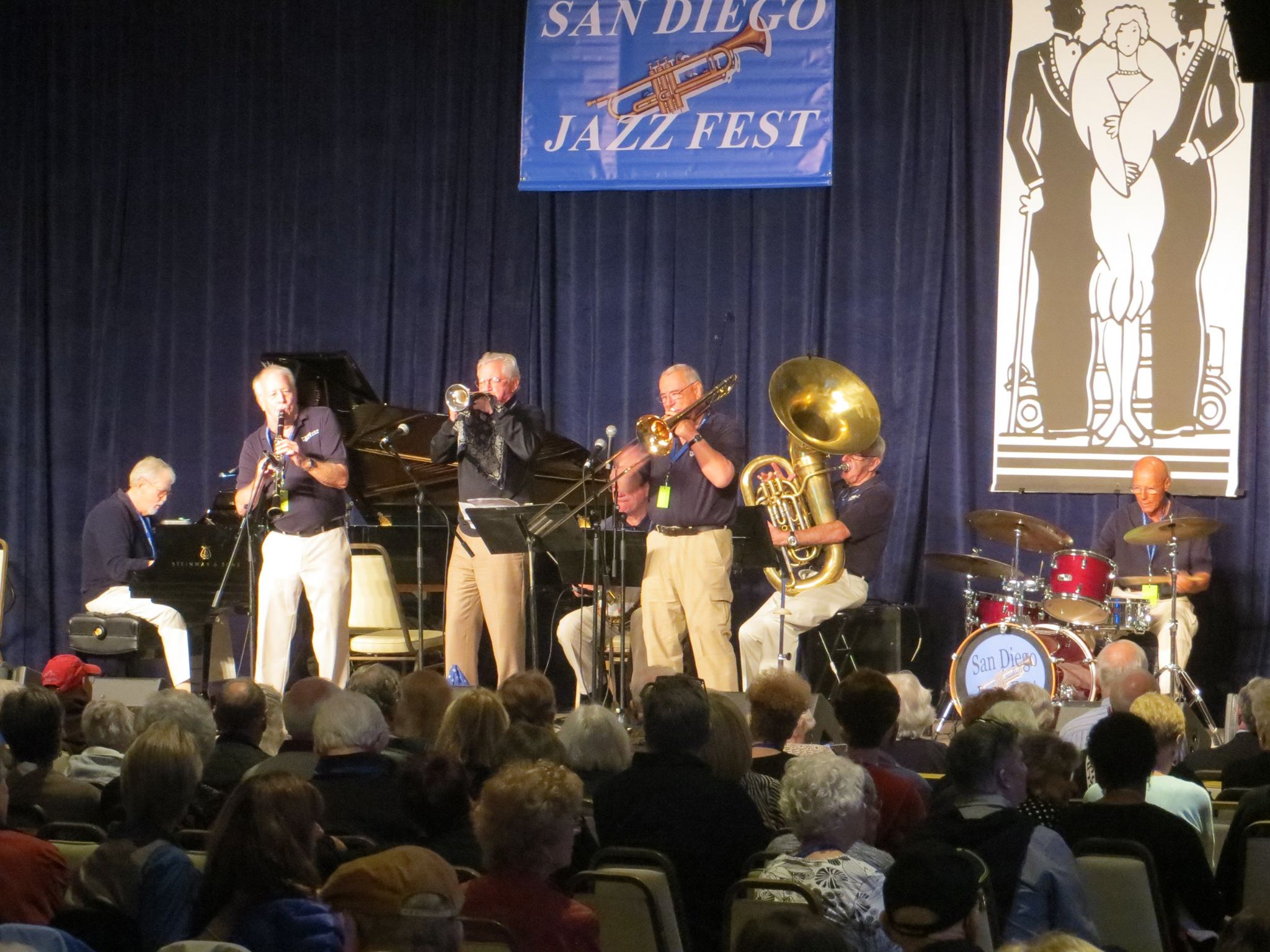
By then I was performing at the annual festival in CT. My first appearance was in 1990 with Bill’s 94 Jazz Band, a sing-along group consisting of two banjos, double bass and me on piano and vocals, so named due to the age of the leader, 94-year-old banjoist Dan Vece. We appeared as Bill’s 95, 96, 97, 98 and 99. Each year in between playing sets with either that quartet or a Black Dog-inspired septet called the Hot Cat Jazz Band, I’d run around listening to everything I could hear. Two highlights were Dejan’s Olympia Brass Band and The Young Olympians, straight out of New Orleans!
HS: The Buck Creek band was another band that was extremely popular at West Coast festivals. They were very active for a long time and even inspired a couple of Bay Area groups to play in a similar style! Besides the festival appearances, the Buck Creek band performed on a heck of a lot of jazz cruises! I was aware of the Hot Cats, but never got to hear them in person.
Meanwhile, let’s return to the 1970s. I know you enjoy the music of the Bay City Jazz Band. As I mentioned earlier, I heard a put-together version of the BCJB in 1970. In 1973, I led a band for a concert hosted by the New Orleans Jazz Club of Northern California. Opposite my group was the Bay City Jazz Band, with all but one of the original members! They opened the concert with “Yerba Buena Strut.” As soon as they came out of that intro, I was ready to jump back in the family car and return to San Diego! What an exciting band that was—with Everett Farey, Bob Neighbor (the only non-original band member), Sanford Neubauer, Roy Giomi, Don Keeler, Tito Patri, Walt Yost and Lloyd Byassee! I get goosebumps just thinking about that brassy, powerhouse sound!
JB: I’m sorry that I never had a chance the Bay City Jazz Band—or most of the the players in it—live. Our mutual friend Steve Drivon used to play with Ev Farey and has some great stories about that experience! I DID get to enjoy Lloyd Byassee on drums in the 1990s when he played at the GCTJF with the South Frisco Jazz Band! What other memories are coming back to you from the 1970s, Hal?
HS: I was playing quite a bit by 1974 and also dealing with college, so I didn’t get out to listen to music as much as I wanted to. The following year, I had an easier time at school and was able to hear some good jazz! One event that stands out was the aforementioned St. Louis Ragtime Festival. Besides hearing the Salty Dogs and Black Eagles, I got to meet and hear Butch Thompson, Frank Powers, Roy Tate, Jim Snyder and Terry Waldo. Besides the band sets, I will always remember sitting in the cabin on the top deck, hearing Butch Thompson for the first time. He started his set with Jelly Roll Morton’s “Fickle Fay Creep.” Butch was wearing a “Storyville professor” type of shirt (see the photo of the Morton record cover) and as he played, I could see the Mississippi gently rolling, just past the bow of the showboat. Listening to someone dressed like Jelly, playing a 100 percent authentic version of a Morton song on a Mississippi riverboat was an incredible experience.
JB: You’ll forgive me for being sorry I’m younger than you are: I missed out on so much terrific music. Of course, in the 1990s and up until his death, I met, played duets with, and was honored to call Butch Thompson a friend and inspiration. Such a soft-spoken gentleman and—for my money—still the most convincing purely-Mortonesque player after Don Ewell—although there are some up-and-coming practitioners of this art, most notably Andrew Oliver from the great state of Washington! I’m enjoying hearing about that great decade when I was still in knee-pants, Hal. Do you have another?
HS: I will wrap up my memories with a moment in 1975 where one of my drum heroes stole the show…It was during a concert put on by the fledgling San Diego Jazz Club. The band was an all-star group which included John Best, trumpet; Abe Most, clarinet; Johnny Guarnieri, piano; Jack Lesberg, bass; and NICK FATOOL on drums! All the musicians played fantastic, swinging stuff—but none more than Mr. Fatool.
For me, the highlight of the concert was a virtuoso duet on “Big Noise From Winnetka” with Jack Lesberg and Nick. It was completely different from the well-known Bob Haggart/Ray Bauduc version, but wonderful in its own way. As soon as Nick hit the final note on the “G” string of the bass, he wheeled around and sailed one drumstick like a paper airplane towards his drum set. With the perfect timing that you would expect from Nick Fatool, his drumstick hit the large “swish” cymbal right on the beat and at just the right spot for a spectacular CRASH!
And with that cymbal crash, I yield the word processor to you! Jeff, what other musical adventures influenced you way back in the 20th Century?
JB: Hal, I’m afraid we’ve run out of space this time around. Let’s save it for the future: I’d love to continue this sharing some time later this year, but I’ve had a hankering to listen to and discuss some of vocalist/banjoist/guitarist/drummer/bandleader/raconteur Clancy Hayes recordings next month. Are you in?
HS: That sounds good. Let’s focus on Clancy next time!
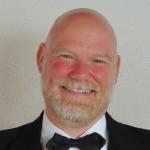
Jeff Barnhart is an internationally renowned pianist, vocalist, arranger, bandleader, recording artist, ASCAP composer, educator and entertainer. Visit him online atwww.jeffbarnhart.com. Email: Mysticrag@aol.com
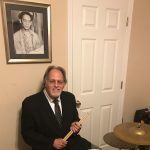
Hal Smith is an Arkansas-based drummer and writer. He leads the El Dorado Jazz Band and the
Mortonia Seven and works with a variety of jazz and swing bands. Visit him online at
halsmithmusic.com