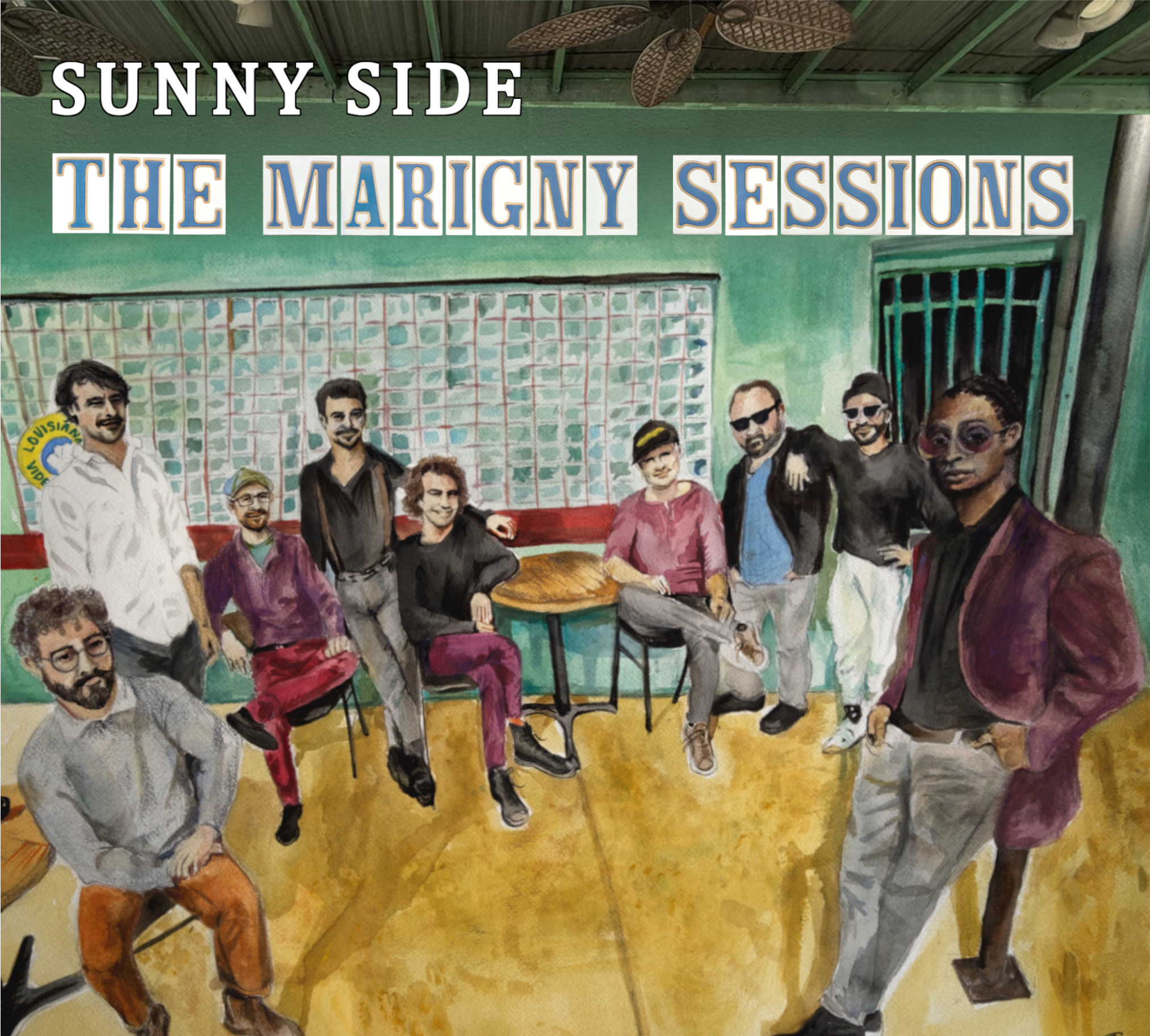
 With The Marigny Sessions, Sunny Side continues its steady evolution from a capable New Orleans traditional jazz band into something broader, warmer, and more broadly inviting, without ever losing their footing in the city’s musical soil. Like its predecessor The Felicity Sessions, this is unmistakably New Orleans music, but it stretches comfortably beyond strict trad-jazz boundaries while remaining anchored in swing, songcraft, and groove. The effect is timeless rather than retro, familiar rather than archival.
There is a mass appeal here that should not be confused with compromise. This is the sort of record that feels immediately welcoming, the way well-loved seasonal music does: easy to return to, rich without being heavy, and familiar even when the titles themselves are not immediately recognizable. Sunny Side keeps things on the sunny side, never dour, never academic, and never precious about its sources.
At the center of the album is vocalist Darold Alexander, who proves to be the ideal frontman for this band. A New Orleans native steeped in the city’s R&B-inflected jazz tradition, Alexander brings classic soul phrasing and showmanship to early jazz and mid-century standards without tipping into pastiche. His singing here is relaxed and confident, marked by clarity of diction and an instinctive sense of groove. He never oversells a lyric, allowing the material to breathe, and that restraint is key to the album’s comfortable groove. Even on songs with deep emotional histories, Alexander favors warmth and forward motion over melodrama.
The repertoire draws largely from songs written or popularized in the 1940s and 1950s, a period that naturally bridges swing, early rhythm-and-blues, and popular song. For a general audience, only a handful of selections, “Moonglow,” “The Song Is Ended,” “Let the Good Times Roll,” and “You’d Be So Nice to Come Home To,” are likely to prompt immediate recognition. Syncopated Times readers, and listeners of a certain age, will recognize far more. What matters is not familiarity but coherence: the song selection shows real breadth and depth, unified by taste and Rob Montgomery’s vision for the band.
Instrumentally, Sunny Side plays like a band that has earned its comfort level on bandstands, in clubs, and on the road. Trumpeter Jack Pritchett is a commanding presence throughout, equally at home leading the ensemble and stepping forward for idiomatic, melodic solos that draw cleanly from New Orleans and swing traditions. Alto saxophonist and clarinetist Andy Page matches him with consistently strong work, offering solos that are fluid, thoughtful, and stylistically grounded while never sounding rote. Together, Pritchett and Page give the front line a bright, flexible voice that carries the album.
The band cuts particularly loose on “You’d Be So Nice to Come Home To,” where the ensemble energy lifts noticeably, and the solo work adds real excitement without tipping into excess. It is a reminder that Sunny Side can “rip” when the moment calls for it, even as the group’s default mode favors balance and flow.
The trombone chair is split between Scotty Yost and Russell Ramirez, likely reflecting two recording sessions, but the transition is seamless. Yost, known for his work in classic hot-jazz settings, brings a clean, supportive approach that reinforces the band’s traditional core. Ramirez, whose background spans both historically oriented ensembles like The Secret Six, and more exploratory small-group work, adds a slightly broader tonal palette. Both fit comfortably within the group sound, reinforcing rather than reshaping it.
The rhythm section provides the album’s steady pulse. Guest pianist Andrew Huot brings a spontaneous, stride and swing informed approach that suits the repertoire perfectly, responding attentively to both singer and soloists. Guitarist Coyote Anderson supplies rhythmic lift and harmonic clarity throughout, anchoring the ensemble while leaving space for others to shine. Anderson also contributes the album’s lone original, “The Fly,” with lyrics from a William Blake poem set to his new music. The band released it as a single earlier in 2025. Rather than a stylistic departure, the tune fits seamlessly into the program, its lyrics and melody aligning naturally with the surrounding standards. I love a band that can add to the repertoire, even as creatively as harnessing a Blake poem, without breaking the vintage spell.
Bassist Steve Walch and drummer Rob Montgomery form a flexible, dance-friendly foundation. Walch’s lines are supportive and grounded, locking in with Montgomery’s groove-centered drumming to keep the music buoyant without rushing. Montgomery, the band’s founder and guiding force, continues to shape Sunny Side’s identity through feel rather than force. His focus on ensemble cohesion and danceable time underpins everything the band does, and The Marigny Sessions benefits directly from that steady leadership.
Recorded at Marigny Studios following an extended tour, the album captures a band comfortable in its identity and confident in its choices. This record offers excellent musicianship, warm and engaging jazz, memorable vocals, and a genuinely good time. For listeners with an interest in New Orleans music in its broadest sense, and for anyone who values swing, songcraft, and ensemble playing, The Marigny Sessions is an easy recommendation. Look up Sunny Side on your next trip to The Crescent City, they play all over town and even recently celebrated the release of this album at the Jazz Museum. Their 5th tour, last summer and fall, took them up the East Coast from Atlanta, to DC, as far as Upstate NY, so they are thinking big, and available for bookings nationally.
Sunny Side
The Marigny Sessions
Joe Bebco is the Associate Editor of The Syncopated Times and Webmaster of SyncopatedTimes.com