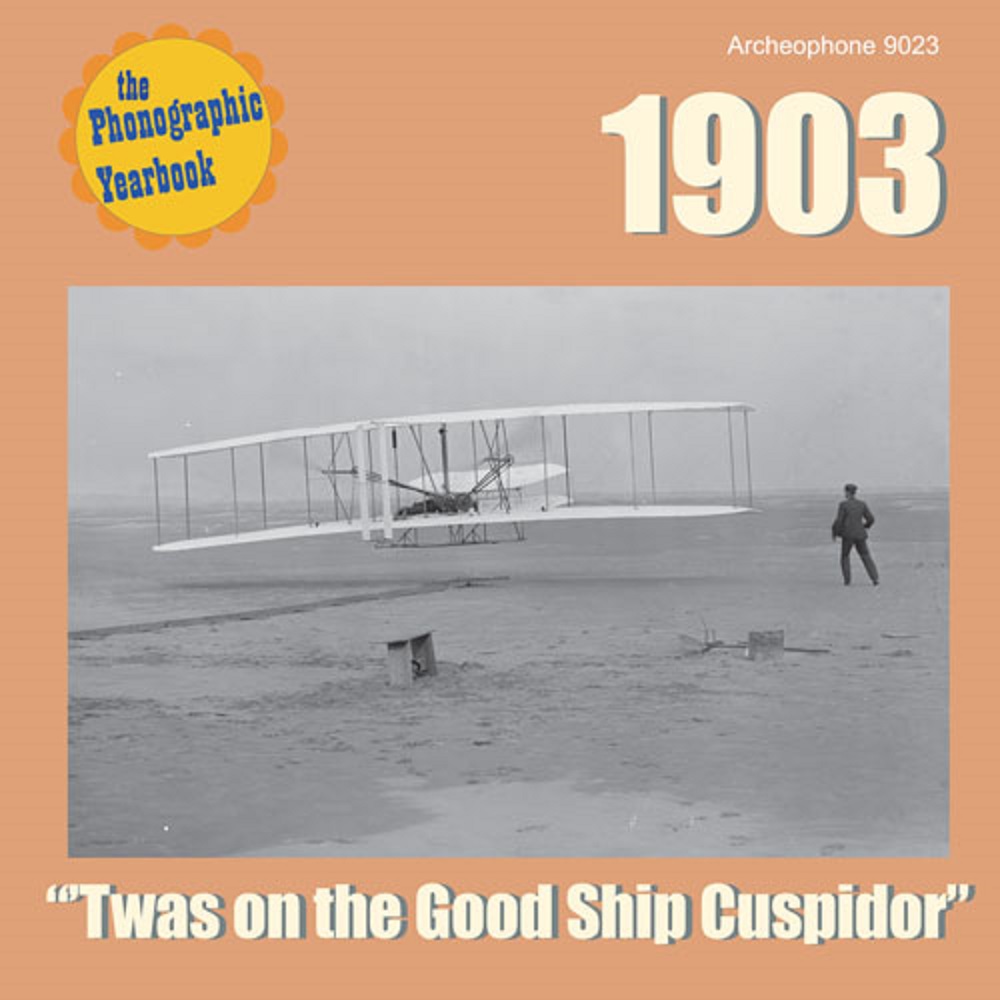
 Archeophone’s Phonographic Yearbook 1903: “’Twas on the Good Ship Cuspidor” benefits enormously from something that might seem incidental but turns out to be liberating: the series has never been issued in strict chronological order. There is no narrative pressure for the music to go anywhere in particular, no implied march toward jazz, modernity, or canon. One volume may jump forward a decade, the next backward even further. As a result, 1903 does not present itself as a stepping stone or a missing link. It exists on its own terms, and that freedom shapes both the listening experience and the way the year is framed.
For collectors already steeped in pre-1920 recordings, a release like this raises an obvious question. Why buy a CD of material that, in many cases, amounts to period hits, songs you may already own, or close cousins of them at least? The first answer is practical and unromantic. Playing 78s is work. It is rewarding work, but it is still a process of handling fragile objects, flipping sides, and digging through shelves in search of a particular performance. The second answer is sound. Even seasoned collectors are rarely hearing copies this clean, transferred with this level of care and judgment. But the most persuasive reason is curation. What Archeophone is selling here is not rarity so much as coherence, and that coherence is driven as much by scholarship as by sound.

That emphasis on coherence is not accidental. A section near the center of the booklet lays out the mission of the Phonographic Yearbook series itself, and it clarifies much about the choices made here. The goal is to present the popular sound of a given year in America, not to assemble obscurities or alternate versions for their own sake. In the absence of formal popularity charts, Archeophone draws on sheet music sales, contemporary reporting, and surviving sales evidence to identify which songs, and which recorded versions of those songs, were actually at the height of their popularity during a specific calendar year. The result is not a strict discographical snapshot, but a cultural one: an attempt to reconstruct what a particular year sounded like to the people living in it.
The 24-page booklet included with 1903 is central to that effort. Rather than foregrounding the music track by track from the outset, the notes open by situating the year itself, adopting the tone of a contemporary magazine rather than an academic paper. Newsworthy developments such as airplanes, Theodore Roosevelt, and the creation of the Departments of Labor and Commerce establish a sense of a society accelerating toward modern systems, convinced that statistics, bureaucracy, and science would tame an otherwise precarious world. One line in particular is well wrought: “The past can’t see the future, and the future blames the past for its myopia.” But rather than being followed by a defense of the past that line is followed by a stinger lobbed into the present.
That framing matters because it changes how the music is heard. These performances are not presented as artifacts awaiting rescue or validation, but as products of a commercial culture that is comic, sentimental, topical, and often sharply written. Many of the selections are overtly lyrical songs, and their appeal does not depend on stylistic nostalgia. Strip away the surface noise and period sound, and what remains is a classic mode of human communication: humor, storytelling, and emotional directness shaped by rhyme and rhythm.

The booklet does eventually settle into detailed track-by-track notes, with recording dates, artist information, and roughly 200 words per selection. It is plenty for a casual listener and more than enough to guide deeper exploration. As usual with Archeophone, the research, packaging, and most of the restoration work are credited to Richard Martin and Meagan Hennessey, with additional restoration assistance from David Giovannoni. The restorations themselves aim squarely at listenability. Nothing is scrubbed into sterility, nothing hyped for effect. These records sound like records, only heard at their best.
One potential point of confusion is addressed directly in the notes and deserves mention. Although this is labeled 1903, not every track was recorded in that calendar year. A small number date from as late as 1905 and therefore could not have been heard by audiences in 1903. Rather than undermining the concept, these inclusions reflect the series’ guiding principle. Songs often peaked in popularity months or even years after their initial release. In that sense, a later recording can sometimes better represent the sound of a given year than a battered original pressing from an earlier session. Arthur Collins’s “Any Rags!” is a clear example. Written in 1902 and republished in 1903, the song was first recorded that year, but the surviving 1903 discs have suffered from both heavy play and recording limitations. Collins returned to the piece in 1905, and the version included here, previously unissued, arguably captures how the song actually functioned at the height of its popularity.
Arthur Collins becomes the album’s gravitational center. His voice appears repeatedly, alone and in partnership, until it begins to function as a reference point. Any title he recorded feels definitive, not because of novelty but because of delivery. The opening phrase alone often signals something immediately recognizable, even more than a century later. His vocal manner is so durable that it is easy to imagine it resurfacing decades later in animation, novelty records, or contemporary Americana. It sounds retro only because so much later popular culture has quietly borrowed from it. Collins was to me a unique talent. One of those timeless artists that anyone, regardless of musical preferences, could learn to recognize as a generational talent. There were many capable performers working at his level of popularity in that era. But he was among the earliest to have that level of artistry captured by the recording horn.
“Goodbye Eliza Jane” is perfect Collins, instantly memorable, sharply delivered, and a concise argument for why this repertoire endured. His collaborations with Byron G. Harlan reinforce that impression. Collins and Harlan together represent the pinnacle of this style’s appeal: comic, direct, catchy without being disposable. Harlan’s lone solo appearance provides useful contrast, a reminder why their partnership was uniquely commercially successful, bringing out the best in both.
Taken as a whole, the disc is substantial without feeling crowded. The program runs to 26 tracks over 62 minutes, and the distribution of artists reinforces the series’ stated aim of capturing the popular sound of the year rather than assembling a sampler of curiosities. Arthur Collins appears most frequently, with three solo performances and two additional collaborations with Byron G. Harlan, while Harlan also has a single solo track of his own. Other major figures of the period are represented more sparingly but meaningfully: Henry Burr appears twice, as do Billy Murray, Mina Hickman, and J. W. Myers. That balance allows familiar voices to recur often enough to anchor the 1903 listening experience, while still leaving room for contrast and variety across the program. Other notables include Harry Macdonough, Dan W. Quinn, and of course popular quartets and orchestras.

One of the quieter pleasures of the collection is encountering performers whose voices feel familiar even when modern listening habits have not reinforced their names. J. W. Myers fits that description. Contemporary sources did advertise and credit singers more consistently than later collectors sometimes assume, but the way these records are encountered today, loose in bins and stripped of their original marketing context, can obscure that lineage. One of the benefits of buying Archeophone’s CDs and reading the notes is precisely this act of reconnection. By restoring sound and surrounding it with careful scholarship, they help fill in knowledge gaps that even experienced collectors accumulate over time, allowing a voice long known by ear to snap into historical focus.
The notes identify Myers as something of an old timer, a reminder of how compressed musical time already was by 1903. In an industry barely a decade into mass recording, singers who had been active in the 1890s could already be framed as veterans, even as they continued to record alongside equally seasoned contemporaries. That sense of continuity rather than obsolescence comes through clearly here. Myers does not sound out of date. He sounds embedded in a professional culture that was already recycling, refining, and renewing itself at remarkable speed.
Elsewhere, the program balances immediate appeal with quieter rewards. Mina Hickman’s performances, including “Congo Love Song,” lean toward a concert stage vocal style where tone and delivery outweigh lyrical comprehension. Even when the words are clear, the effect is closer to listening to a foreign language record appreciated primarily for its beauty. These are the kinds of selections many collectors instinctively skip in the bins, only to discover later, often by accident, that they resonate deeply when given time and attention.
There is only one extended comedy sketch included, a Cal Stewart “Uncle Josh” routine. Its presence feels deliberate rather than obligatory. Anyone who has spent time digging through 78 bins already owns more Cal Stewart records than they can count. Including just one acknowledges his ubiquity without allowing novelty to dominate the program. The focus remains firmly on songs, voices, and delivery.
The album is carefully paced. It opens with broadly appealing material that eases the listener in before gradually spacing more introspective or easily overlooked performances toward the latter half. The structure mirrors the experience of crate digging itself. What initially seems slight or skippable sometimes becomes the material you return to most. The penultimate track, “The Good Old Summertime,” mirrors the album opener, first heard from the Haydn Quartet and later from Sousa’s Band, functioning as a deliberate bookend rather than an invitation to comparison. A popular song in 1903 would have been heard from multiple sources during the year.
The closing track, Arthur Collins’s “I’m a Jonah Man,” lands as more than a period curiosity. The song originated in In Dahomey, the 1903 Bert Williams and George Walker musical that marked a watershed moment on Broadway, and Collins recorded it during a brief window when its creators were largely absent from the studio. That theatrical origin helps explain why the song still feels so alive. Blues, if not in form, it carries a dramatic clarity and rhythmic ease that would not sound out of place in a modern Americana setting. It is easy to imagine contemporary performers taking it up again, not as a novelty, but revived as a living piece of American popular song.
This volume does not argue that 1903 secretly contains the future of American music, nor that it should be heard as proto anything. It presents the year as it was lived: optimistic, uneven, commercially minded, lyrically sharp, and often funny. For seasoned collectors, the value lies in hearing familiar material made newly legible through sound, pacing, and scholarship. For newer listeners, it functions as an invitation that is welcoming.
That balance remains Archeophone’s specialty. Phonographic Yearbook 1903: “‘Twas on the Good Ship Cuspidor” reinforces why this series still matters in 2026, twenty three releases and twenty six years after they kicked off with 1920 back in 1999. Not because this music is unavailable elsewhere, but because no one else is presenting it with this combination of care, context, and respect.
The Phonographic Yearbook
1903: “‘Twas on the Good Ship Cuspidor”
www.archeophone.com
Joe Bebco is the Associate Editor of The Syncopated Times and Webmaster of SyncopatedTimes.com