Eventually, the National Endowment for the Arts entitled Joe Wilder as their Jazz Master, but first he was called “’Little Louis” because he was playing a cornet, but not because he played like the great Mr. Armstrong. His talent did, however, get him a weekly spot on a local Sunday morning children’s radio show. There the kids were backed by traveling bands performing at the local Black theater. So, years before he was career-ready, “Little Louis” played with Fletcher Henderson, Duke Ellington, and many more.
That list eventually did include Louis Armstrong’s band, and when he learned of “Little Louis,” Armstrong sought him out, encouraged him and, “he gave me a pass and said, ‘Any day you want to come to the theater to hear the band, you just show it and they will let you in for nothing.’ He was such a nice, heart-warming kind of a person. I went that afternoon and never went again. I knew he was a famous musician, and I was very flattered, but I was too young even to know to keep the pass.”

Over the years, when Wilder did see him, Armstrong “would say something like, ‘I remember you playing on the children’s radio program,’ Unfortunately, I was very shy so I never had the relationship that I could have had with no problem. I just didn’t have the sense to go and try to speak to him, but I admired him, and I played on the recording session that he did when he recorded ‘What a Wonderful World.’ I was in the orchestra.”
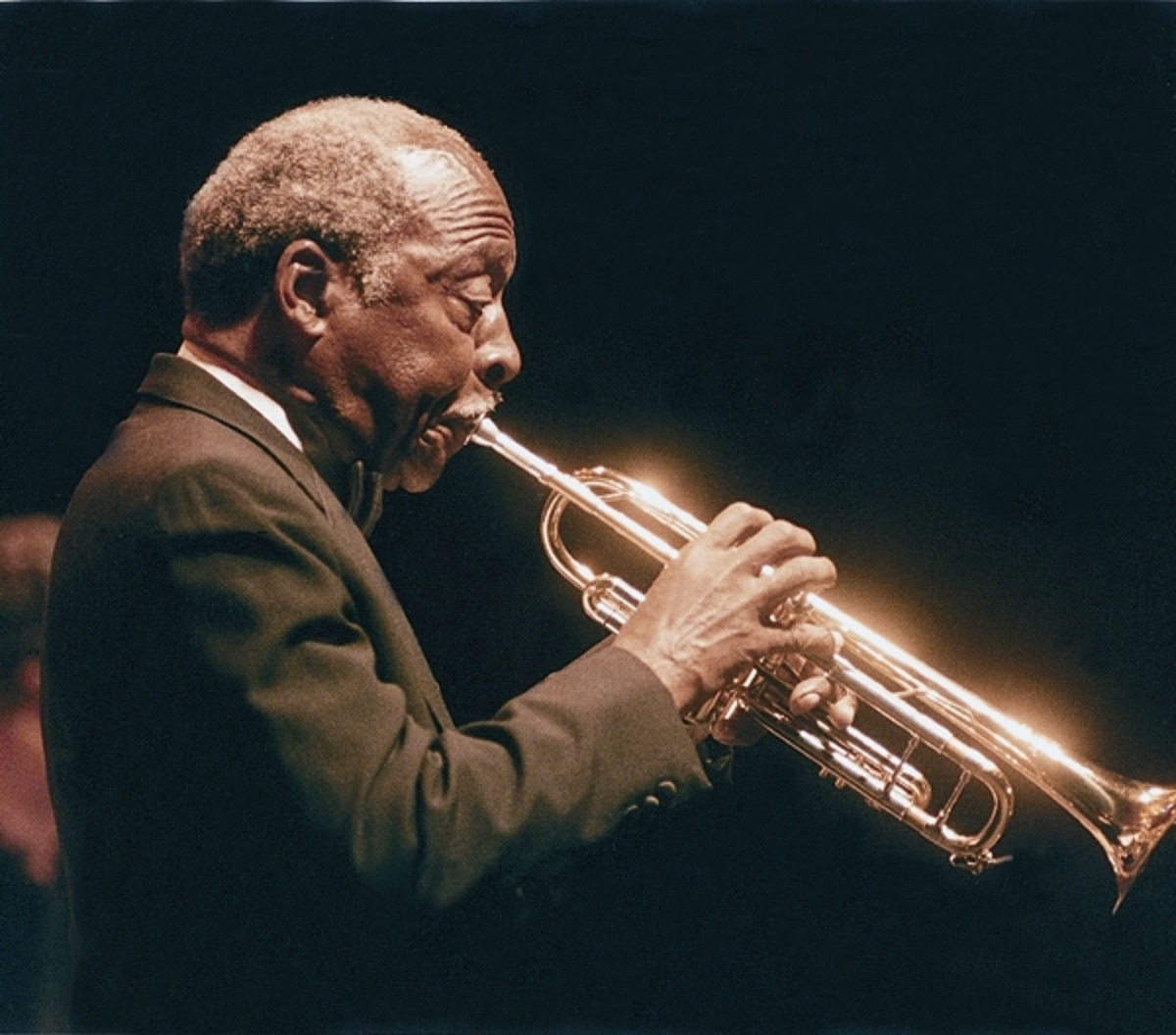
(Photograph by Hugh Talman, courtesy americanhistory.si.edu)
At age 19, Wilder first experienced “the road” with the Les Hite band. He was awed by Hite and being in the band, but not the traveling. Racism kept them out of most hotels, and the ones they could use were often filthy and bug-ridden. Getting food was also problematic as was traveling hundreds of miles between jobs on rented buses, “and the companies weren’t giving us plush transportation.” Eventually he left and next joined Lionel Hampton’s band.
That was an exciting band, filled with top players, such as Illinois Jacquet and Marshal Royal, and arrangers like Milt Buckner and Jimmy Mundy, but Wilder wasn’t happy with the leader. Hamp famously loved to play and at times he would call a full rehearsal after the band had just finished an uncomfortable, hours-long bus trip. And, at the end of gigs, he’d often make them play overtime without compensation. Complaints were answered with a reminder that jobs for black musicians were rare, and there were hundreds of men eager to replace them.
Soon World War II intervened and Wilder was recruited into the Marine Corps. “In boot camp I made sharpshooter, and they took me to be a sniper in Special Weapons, but I wasn’t in it for long. Bobby Troup was a morale officer where they trained all the Black Marines. He knew I had played with Lionel Hampton and Les Hite. He talked to the general and had me transferred to the headquarters’ band. Eventually, I was made the assistant bandmaster. I had a lot of friends in that Special Weapons unit who were killed in the Pacific.
“Bobby Troup, and a few other officer friends of his, started a campaign against segregation on the base. They would have a dance there and we would play. Bobby Troup, this was a dangerous thing he did, brought his wife and had her dance with a couple of the African-American sergeants just to set a precedent. This was North Carolina and they vilified him and a couple of other officers for doing it. They were brought up on charges and given a warning—don’t do it again.”
“Troup kept it up, he and the guys that were with him, brought about some changes on the base. The general assigned all of them to the next combat unit going to the Pacific to fight in the hope that none of them would come back. They had to go into combat—but they all managed to come back. That is a horrific true story. They were almost treated like outcasts for championing the cause of some Black Marines. He was a wonderful person, very likeable and very intelligent. I stayed in close touch with him.”
After the war, Wilder soon joined the Jimmy Lunceford band and had a very different experience. “He was a fine leader and a brilliant man. He was very proud to be an African-American, and he was very serious about the deportment of his orchestra. He was always concerned about the image of Black musicians with the public. We had a couple of guys who were alcoholics, and we would be playing someplace and it would be apparent that they had been drinking because they would be nodding or staggering. Jimmy would go over to them while we were playing and say to the guy, ‘This one is on you.’ That meant you weren’t going to get paid for that night.
“Maybe a couple of months later, he’d say, ‘Tonight, guys, after we finish, we are going to a restaurant for dinner.’ So, we would thank Jimmy, and Jimmy would say, ‘Don’t thank me.’ He would point to the guys who had been drunk and say, ‘Thank so and so and so and so,’ because he had docked them their salary for that night and that money he used to pay for the meal. He set a great example. He was very intelligent. People respected him. As a leader, you couldn’t have a better one.

“If we went someplace and had some racial problems, he dealt with it very strongly. The Eddie Vincent band would check in to a hotel, play the engagement then pack up and leave the hotel without paying the bill. We were playing at the Indiana raceway and we were trying to get into a white hotel. The manager didn’t want to rent rooms to us because Eddie Vincent had been there. He said, ‘These guys left and didn’t pay.’ He didn’t want black bands staying there. Jimmy said, ‘Look, this is Jimmy Lunceford’s orchestra, a world-renowned orchestra. We’re not people like that and we are just trying to find a place to stay overnight. We’ll pay and you won’t have any problems. I guarantee it.’ So, the guy let us stay. Of course, we took care of the rent and everything else we had to do. But that was the kind of thing we ran into quite frequently.”
Wilder remembered Lunceford’s death. “We were in Seattle, Washington, the night before he died playing at this very famous ballroom. The next morning, we went to Seaside, Oregon. We got there early and somebody asked Jimmy if he would come to a record store and sign some autographs for people. While he was signing, he got dizzy and fell to the floor. Some people helped him up. They didn’t have a hospital in Seaside, so they ordered an ambulance to take him back to a hospital in Seattle. The manager of the band went with him. We milled around until it was time to play that night.
“The people who owned the ballroom didn’t want Blacks to come in. They propositioned the band boy and said they would give him $50 if he stood in front of the entrance and when Black people came to buy tickets he would go over to them and say, ‘Look, they don’t want people like us to come in there. If I were you, I wouldn’t buy tickets to the thing.’ We found out and said we weren’t going to play.
“Our road manager, in the meantime, had come back after being with Jimmy. He finally persuaded us. We played, then packed up and that was it. I was infuriated that we did play. I felt, and so did other people in the band, that we should have just said, ‘We just won’t play; the heck with the money.’ We weren’t in Mississippi; we were in Oregon.”
“Then after we played, he told us that Jimmy had died. Some of the guys wanted to shoot him, they were so angry. It was a very disturbing thing. Then the manager said, ‘We have a few more engagements to play.’ Instead of cancelling them and coming back to New York immediately, we played two or three more. By the time we got back to New York, Jimmy’s funeral was over and we never got a chance to pay our respects.”
Wilder soon was working with Nobel Sissle and found that Sissle, like Lunceford, was also socially conscious. The trumpeter was offered a Broadway pit job, but it started in a week, and he was required to give two weeks’ notice if leaving. “I spoke to Mr. Sissle and he said, ‘There are no Negroes playing in the Broadway pits. This might be the chance for us to get an opening in the pit orchestras. It might be a start. I’ll let you go without the two weeks’ notice.’”
That happened again, and Sissle again bent the rule, but the second show was the years-long lasting hit Guys and Dolls. “Actually, it was one of the things that led to integrating some of the pit orchestras.” Wilder’s third incident was Cole Porter’s Silk Stockings, and another step forward. “That was the first time they were hiring a Black trumpet player to play principal chair with a Broadway show.” The producers, cautious of perhaps offending the legendary composer, asked his permission. The legend’s legendary reply was, ‘Can he play my music? That is all that matters. Hire him.’”
Wilder had one regret. “I thanked him, but I didn’t get to talk to him on the level that I should have; but again, I was just too shy to do it. This was one of the greatest composers in the world. Who was I to go up and pat him on the shoulder? But he was aware of it through the people that hired me. They knew I appreciated it, and they were happy, too. He was a nice and brilliant man.”
Typically, the Jazz Master added, “Think of how fortunate I was to be dealing with people like that.” His career lasted decades more, and expanded into classical orchestras including the New York Philharmonic and Symphony of the New World. He famously spent years in the Basie band and seemed to be first call for every major singer plus a good number of others. Yet he always seemed unaware of his great achievements. How fortunate we were to have someone like that.