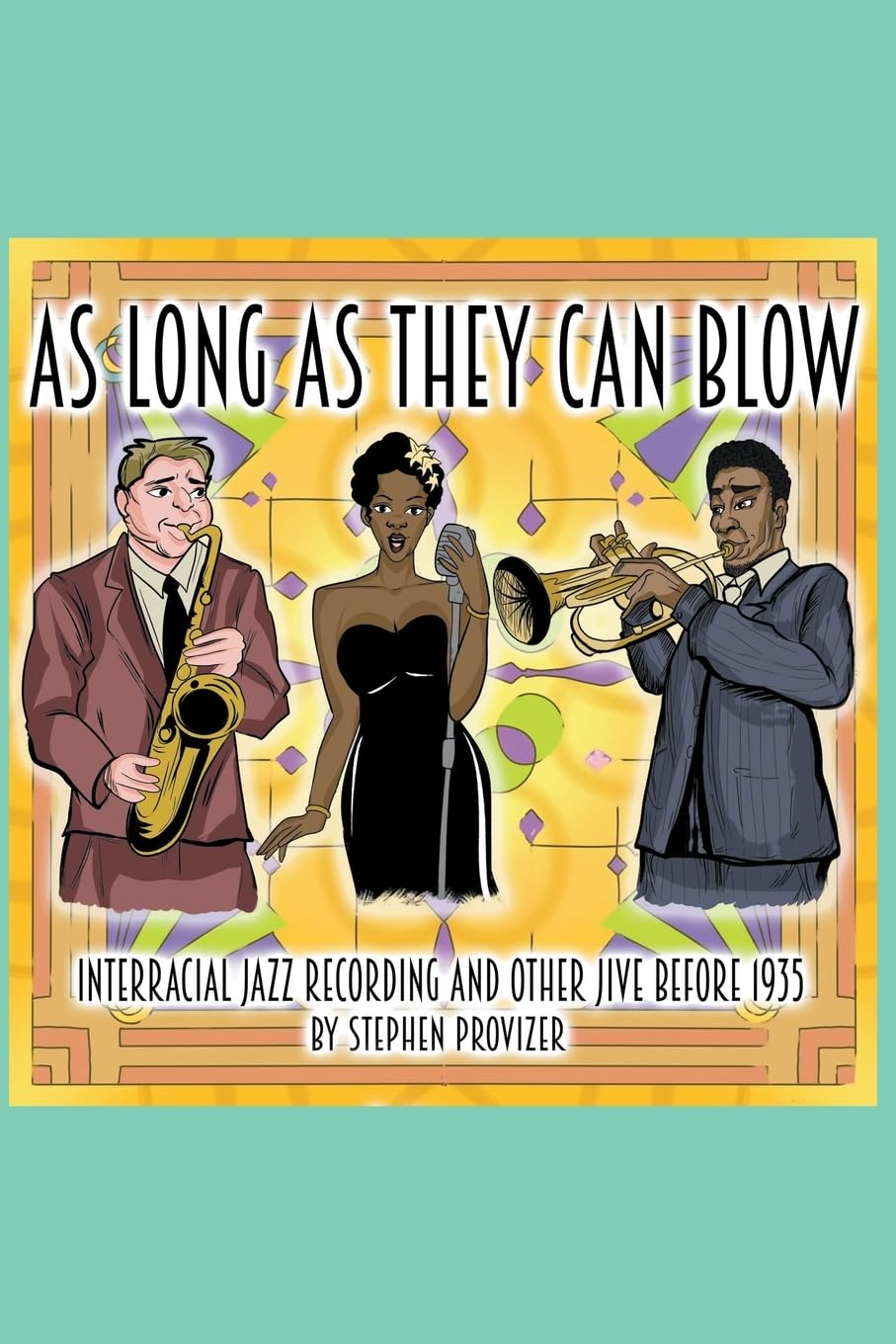
 Sometime in my mid-teens as my interests in jazz began to take shape, I become aware of the story that racial integration in jazz began when Benny Goodman formed a trio that included Black pianist Teddy Wilson. A few years later I noticed that a recording of the New Orleans Rhythm Kings, a white group, included Jelly Roll Morton. It occurred to me that perhaps only a small part of the record-buying public would be aware of the performers’ races and that opposition to racial integration in jazz focused on live and staged performances. I’ve long wondered casually about these issues, but never bothered to take a close look at the actual history. With As Long as They Can Blow, Stephen Provizer has done the footwork for me.
The book comes in two formats: paperback, with 172 pages, and PDF, which shows no page numbers but reports 103 pages. I asked the author about the discrepancy; he said that both formats have identical content. I’m reading the PDF and my remarks reflect that edition.

This is an unconventional book. It has sections of narrative, long listings of recordings, and selections from two books that tell of key moments in interracial jazz recording history. The table of contents shows not only the seven chapters and a bibliography, but also a description and justification for each chapter. The first chapter, Preface (a mere two pages), speaks of how mixed-race staged performances were rare in public prior to 1936, but after-hours jam sessions and private parties provided locales where Black and white musicians got to know and appreciate each other.
Chapter 2, Prelude and Pathway (six pages), discusses the advent and development of recordings, from Edison’s cylinders and Berliner’s lateral discs to the later emergence of diverse record companies. The general rule until the 1920s was that Black artists who recorded were accompanied by white staff musicians. This was the case, for example, with clarinetist Wilbur Sweatman’s almost-jazzy 1916 recording of his Down Home Rag with an ensemble of white studio musicians.Mamie Smith’s Crazy Blues recording with Black musician accompaniment on Okeh in 1920 demonstrated that there was a large, profitable audience for “race records.” Throughout the 1920s, the number of racially integrated recording sessions increased; some musicians, when performing with an ensemble of a different race, disguised their identities with pseudonyms. White guitarist Eddie Lang, for example, sometimes used the alias Blind Willie Dunn when recording with Blacks.
Chapters 3 (Interracial Recording List, eight pages) and 4 (Interracial Discography, fifty-five pages) constitute the evidence for the author’s thesis. They show such events as the Duke Ellington orchestra recording with the Rhythm Boys vocal trio of Bing Crosby, Harry Barris and Al Rinker in 1930. I had wondered how Benny Goodman, Gene Krupa, and Teddy Wilson had gotten together for their groundbreaking public appearance as an interracial trio in 1936. These two chapters show that Goodman and Wilson had already recorded together twice in 1934 and twice in 1935. In 1934, Goodman had also recorded with such Black artists as Coleman Hawkins, Doc Cheatham, and Benny Carter, and in 1930 with Bubber Miley in an ensemble led by Hoagy Carmichael. It’s abundantly clear that for many leading jazz artists, musical values were of far greater importance than the racial encumbrances common at that time.

Chapter 5, Episodes of Intermingling (six pages), has a brief, one-page narrative reporting that Black musicians were harassed by the police and the F.B.I., that J. Edgar Hoover sent antisemitic propaganda to regional F.B.I. offices, asserting that Jews controlled jazz and, as part of a Communist conspiracy, were intent on having Jewish/Black jazz replace American music. This narrative is followed by five pages of disparate and unconnected quotations showing that jazz musicians of both races appreciated and valued the art of the other.
Chapters 7 and 8 (21 pages) are each based on memoirs by two white jazz musicians who promoted racial integration in recordings and live performances: Really the Blues (1946), by Mezz Mezzrow (Milton Mesirow), and We Called It Music (1948), by Eddie Condon. Selecting passages from the two memoirs, Provizer creates narratives that highlight the passion with which these two musicians brought together jazz artists regardless of race. Such racial mixing had already occurred among many jazz musicians, and would continue to occur even without the efforts of Mezzrow and Condon, but the narratives also reveal the opposition to such integration and the efforts by Mezzrow, Condon, and others required to continue the process of ignoring race.
This is a self-published book and it clearly could have been helped with editing. For example, in the Interracial Discography entry for The Big Aces, I had to read these words several times to make sure I was not misreading (spacing as in the original): “Frank Teschemacher (cl,ts) [aka Frank Teschemacher
(cl, ts) ]”.
In other places I noticed lines that appear to be left-over notes the author had intended for himself, such as “July 13, 1935- B.G. trio w Wilson.” This abbreviated phrase will not cause problems for jazz scholars or for almost any jazz fan, but it detracts from what we expect in a quality book.
The book suffers from a few missteps, but they fade into insignificance when compared with what it accomplishes. It succeeds eminently well in demonstrating that jazz musicians, placing musical values above other considerations, had integrated racially long before American society as a whole was ready for that step. I highly recommend As Long as They Can Blow to anyone curious about the subject.

As Long as They Can Blow:
Interracial Jazz Recordings and Other Jive Before 1935
by Stephen Provizer
Re-Balance Publishing, Gloucester, Mass.
172 pages; paperback $23.23; kindle ed. $5
ISBN: 979-8892923729
Ed Berlin is author of King of Ragtime: Scott Joplin and His Era, now in its second edition, and many other writings on ragtime and various musical topics.