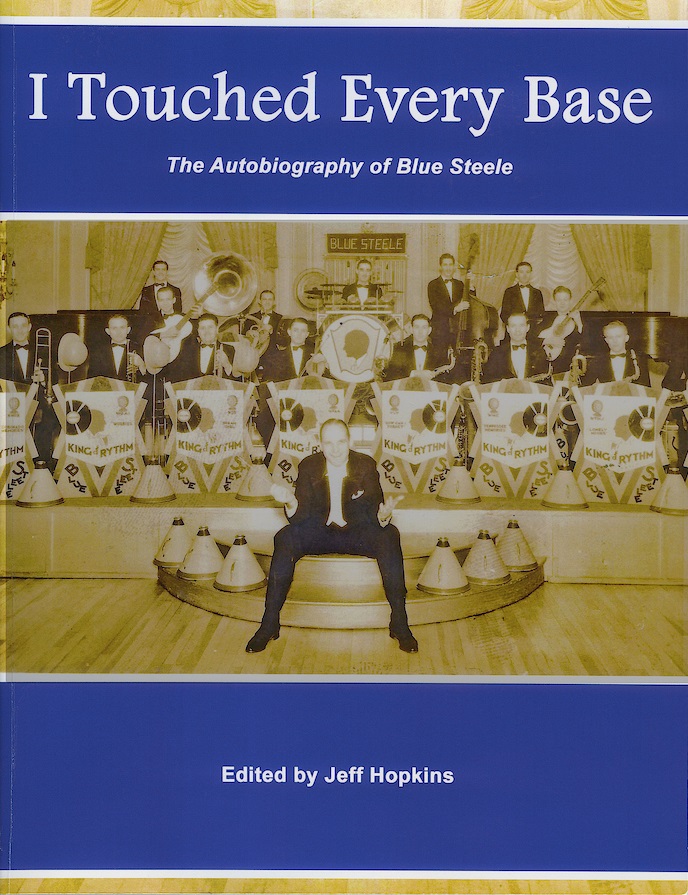
 Blue Steele and His Orchestra recorded for the Victor Talking Machine Company between August 26, 1927, and May 16, 1930, resulting in 16 discs. His recordings, which sold fairly well, ranged from hot jazz to waltzes. Steele’s band played some of the best hotel venues, such as the Peabody in Memphis, the Muehlebach in Kansas City, the St. Anthony in San Antonio, and the Coronado in St. Louis, as well as the prestigious Graystone and Trianon Ballrooms. During his time in the music business he received many accolades. But that time, like his earlier years, was also cluttered with frequent fistfights and jail time.
In the 1960s, Blue decided to write an autobiography for publication or to produce it as a movie. Jeff Hopkins was confronted by 19 drafts, several versions of the same story, and a large number of missing pages. The missing pages do affect the flow and detail of the narrative. Jeff has done a remarkable job of piecing it together with an introduction to each of the 39 chapters and with the use of almost 500 footnotes to clarify and expand Steele’s commentary. (Jeff also wrote the liner notes for the Vintage Music Productions CD Blue Steele & His Orchestra: The King of Rhythm, VMP 0101.) All in all, Blue Steele was a fairly good writer.

The usual autobiography/biography of a musician has a single chapter devoted to their formative years. Mainly, the discussion is about the musicians, musical events, and orchestras with which they were associated. Steele’s approach is different. The first 29 chapters (222 pages) focus on his early years. Chapter One brings the reader back to 1682 for a discussion of Blue’s heritage. But as Jeff points out, the future events in Steele’s life are more comprehensible with a reading of this chapter. Subsequent chapters reveal more about his philosophy of life: fight for what you get; men with guts should stand up for their rights and beliefs. The reader finally meets the orchestra leader of the 1920s in the last ten chapters.
His real name was Eugene Charles P. Staples, born on March 11, 1897, on a ranch in Pleasant Ridge Township, Arkansas. The location is Fulton County in the Ozarks. Its county seat is Salem. His mother called him “Little Boy Blue.” It was used by him as a sign-off on his recordings and radio shows. His use of “Steele” was adopted from a bronco buster by the same name, which Jeff indicates may have been a fabricated story. Blue claims to have legally changed his name to Robert E. Steele, Jr., after being adopted by the Steele family. Later, he indicates that he used the name “Blue Steele” because he was a good blues singer. But he also has other explanations.
Blue was the youngest of two brothers and two sisters. When he was four, his father, mother, and youngest sister died of typhoid fever. He then moved to the home of his grandparents in a nearby ranch with his precious horse Cajun. This time period was idyllic for Gene. His grandfather taught him to shoot and gave him instructions for self-reliance and a direction in life. But it ended in 1907 with the death of his grandmother and his beloved horse, Cajun.
From around 1907 to 1919, Blue had a wanderlust spirit that ended with a stint in the US Calvary, eight months in Alcatraz, and a wound in France during World War I. His time on the Rock was due to the suicide of his sergeant which he claimed stressed him so much that he went AWOL. This time period included a trip from Arkansas down the Black and White and Mississippi Rivers to New Orleans, where he recounts a meeting with the legendary trombonist Zue Robertson. The city’s jazz traditions were influential on him. In late 1912, he ended up in the Nebraska State Industrial School for Boys because of a trumped up charge of horse stealing. Nevertheless, the Judge lectured him that the school would be a way to stop his wanderlust and find a home. This is where he learned the rudiments of music and became director of the school band.
Throughout this time, other than learning to play a number of musical instruments from the tuba to the trombone, Blue also became quite proficient as a baseball pitcher and player, gun marksman, horse trainer and rider, and boxer. He also met many personalities that included Will Rogers, Lyle Talbot, Jack London, and President Franklin D. Roosevelt.
His musical adventures begin in Chapter 30. During this period, he married Helyn Broadhurst in Tampa on December 22, 1924. They had two children. The first died in 1925. The second, born in 1926, was honored in one of Steele’s recordings, “Betty Jean.” His big start in the music business was over WGBU radio in Miami in September 1926 for the real estate venture named Fulford-By-The-Sea. It turned out to be a land swindle. Then came Tybrisia Pavilion on Tybee Island, Georgia, in the Spring of 1927, where his band became the highest paid orchestra to play that venue. While there, he wrote Victor announcing that they should record his high-end band. At first they weren’t interested, then sent Ralph Peer to organize a session. This resulted in his first recording made in Savannah on August 26, 1927. Soon afterward, they were at the Peabody Hotel, Memphis, where he played long-term engagements for a couple years and made more recordings for Victor at Memphis’ Ellis Auditorium.
In subsequent chapters, Blue discusses various places his band played, his association with aviatrix Bettie Lund, the time several of his band members joined the Casa Loma Orchestra, and his fight with trumpeter Frankie Martinez. There is a sense that Steele’s temper affected his relationship with fellow band members. Jeff cites an interview with drummer Johnny Blowers, who said, “Just about everybody that worked for him was afraid of him.” Nevertheless, Blue warmly describes the superlative voice of Bob Nolan, the genius of Sidney Arodin, the incredible virtuosity of Snoozer Quinn, and other sidemen.
Then the final straw to anyone’s career. In 1940, Blue had a fight with a belligerent IRS agent. Although admitting he did owe taxes, Blue thought they went overboard in confiscating his orchestra’s band instruments. Once again, his temper got the best of him. He spent April 1941 through December 1942 in federal prison in Atlanta. It shook up his attitudes and philosophy. He felt that all the good things he had done in the entertainment field were ignored. He was left to sit in a small jail cell and lead the prison orchestra.

I Touched Every Base is a worth-while read. It shows the complicated personality of Blue Steele, a trombonist, vocalist, lyricist, songwriter, and director of a popular and excellent orchestra of the 1920s and 1930s, who called his band “The King of Rhythm.” Little Boy Blue talked his last on July 1, 1971, aged 74.
I Touched Every Base: The Autobiography of Blue Steele
Edited by Jeff Hopkins
Transatlantic Radio, Atlanta, Georgia, 2025
available on Amazon.com
288 pages with Index; 8 1/2 x 11in; 3 photos
Paper, ISBN 9798218452223; $35
Richard M. Raichelson
Richard M. Raichelson received his doctorate in folklore from the University of Pennsylvania and gospel music and has taught in the Department of Anthropology at Memphis State University.