Drummer Lewis Nash is noted for his adaptability to a wide range of musical genres and having one of the largest discographies in jazz to his credit. He’s played on over 600 recordings (including 10 Grammy Award winners and numerous Grammy nominees) throughout his 45-year career. He has the distinction of being the only musician in jazz history featured on albums honored in both the “Best Jazz Vocal” and “Best Jazz Instrumental” album categories in two separate years: the 2004 Grammys with Nancy Wilson and McCoy Tyner, and again in 2010 with DeeDee Bridgewater and James Moody.
It’s earned him the well-deserved title of “Jazz’s Most Valuable Player,” bestowed on him by a drumming magazine. Further, he’s had a jazz club in his home town of Phoenix, Arizona and an academic scholarship at his alma mater (Arizona State University) named after him.
Nash has performed with contemporary stars and historical trailblazers alike. Among the masters he has recorded with since the early 1980s are Betty Carter (his New York gig debut), Clark Terry, Joe Henderson, Dizzy Gillespie, Benny Carter, J. J. Johnson, Tommy Flanagan (as a 10-year member of his trio), Joe Lovana, Oscar Peterson, Sonny Rollins, Milt Jackson, Ron Carter, Jackie McLean, Wynton Marsalis, Garry Burton, McCoy Tyner, Toshiko Akiyoshi and Diana Krall.
When the rhythm is swinging, chances are Lewis is providing the pulse.
A typical itinerary from his busy schedule would find him recording an album with country legend Willie Nelson, a week’s engagement at New York City’s Village Vanguard, a tour of Japan with his own all-star sextet, and recording a CD with his quintet for his Happy Beat label.
Lewis Nash is in great demand for his educational expertise as well as his drumming skills, and presents clinics, masterclasses and workshops at institutions worldwide. He was a member of the first Jazz Studies faculty at The Juilliard School and has also served as a music director for Lincoln Center and Carnegie Hall and as an instructor and artist-in-residence at the Vail Jazz Workshop, the Thelonious Monk (now Herbie Hancock) Institute of Jazz and the Generations Jazz Workshop in Switzerland.
His Drumming Philosophy
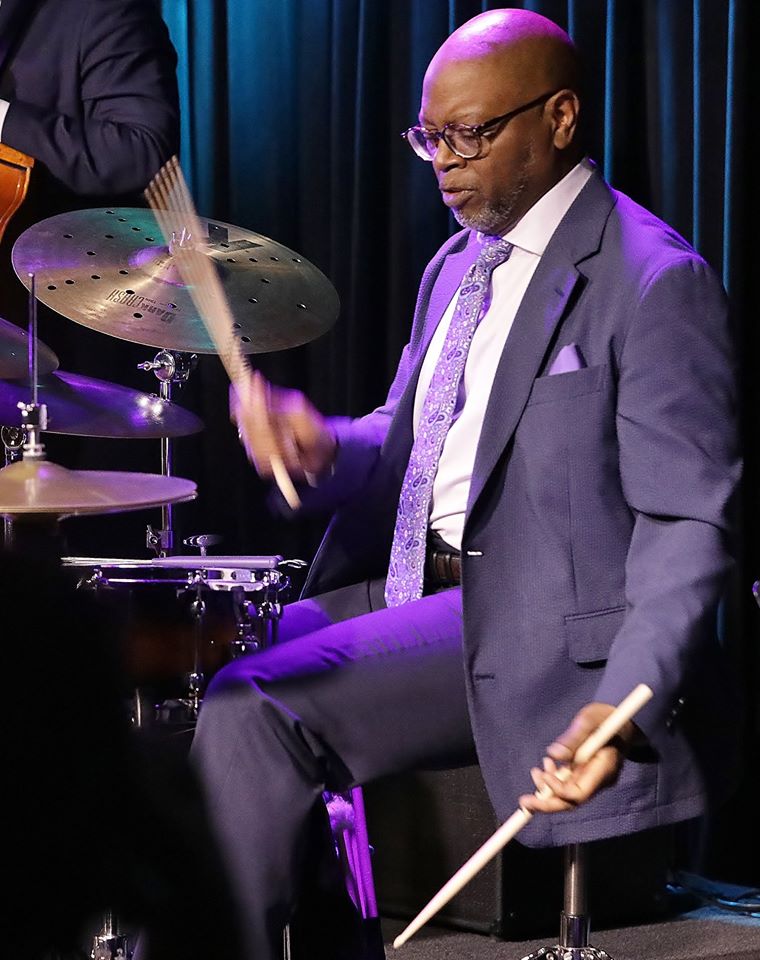
Whether he’s playing live or teaching a class about the essentials of rhythm, this avid sports fan always keeps his eye on the ball. Where some see a complicated chart, he hears the music in spheres. Where some mean to express themselves, he means to express the music. He has always been known for his urbane, polished-swing feel and great attention to detail. There is a dichotomy in his playing of which many drummers may not be aware.
“It’s all about context,” he has been quoted as saying. “The musical environment, the other players, the music itself. Considering all of that, I always look at what’s required to make the music work. I adjust to playing different styles pf music while maintaining my identity. I have learned as a musician to be a chameleon. You do that by thinking music first. You don’t have to search for something new to create great drumming and great jazz.”

“I’m not trying to sound like different people when I play. My goal is to keep a consistent thread of musicality. I come to the gig as prepared as I can be: I’ve practiced; I’ve worked on my technique; I immerse myself in the situation at hand; and I have a lot of experience from which to draw.’
“When I play with McCoy Tyner, there are certain things I have to do to make his thing work. When I play with Hank Jones, I can’t play the same way I play with McCoy. I’m looking for the threads that run trough their music and give it a certain essence.”
Known for his unhurried pacing, he points out “I’m striving for a certain kind of relaxation that is a part of the best swinging jazz. That’s a big goal. A lot of it is experience, and a lot of it is playing with the kind of musicians who bring that sensibility to the stage. I’m always gauging the musicians with whom I play. That’s a big, big thing. If you’re going to make them sound like the best version of themselves, then you’re going to have to check out what they do and how they do it.”
Shares His Experience
Discussing his teaching experience, he states, “When I do drum clinics, I have a theme I call the ‘MVP mind-set.’ The MVP on a team isn’t necessarily the one who scores the most points or is the most exciting on the floor, but rather is the one who is the glue that makes everything else work more smoothly.”
“I try to bring that MVP mind-set to the drum set. I hear different things going on around me from the musicians on the bandstand, and I try to enhance that- which in turn, helps the whole band and the soloists shine even more. You can’t be selfish; it’s a team concept. I want to be that person who makes the team click on all cylinders.”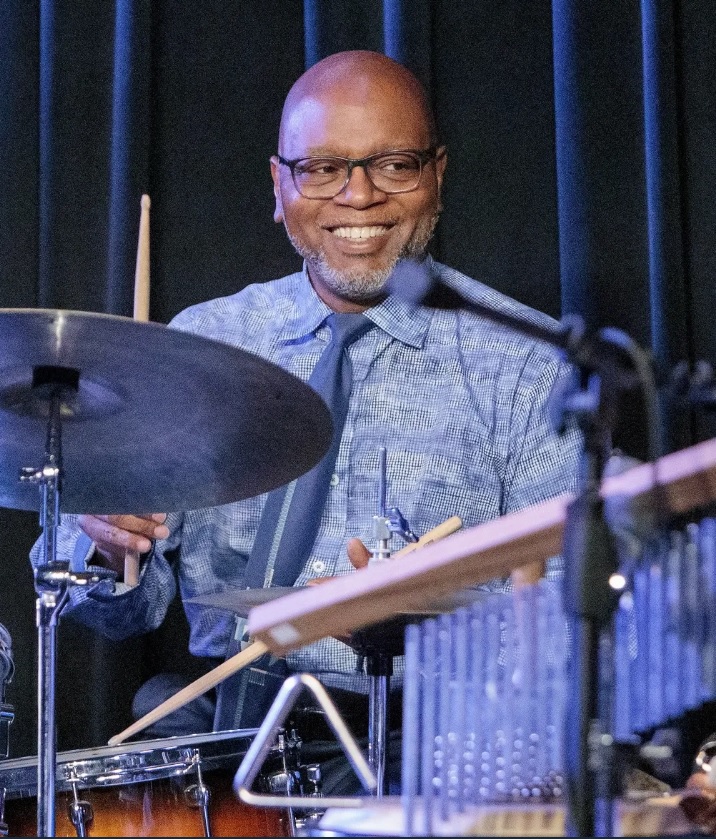
Lewis Nash got his start in a South Phoenix home which permeated with the sounds of spirituals, blues and gospel music. Pots, pans and cardboard boxes provided a primitive drumming surface for young Lewis, which he beat with small tree ranches for sticks. He got his first real drum set at age 10: a Sears Special, and he played in his first organized band at the Percy I. Julian School, followed by concert and jazz bands at East High School in Phoenix.
He enrolled at Arzona State University, majoring in broadcasting and music. But a call in his senior year from the manager for vocalist Betty Carter sent him off to the Big Apple in 1981 where he became a member of Carter’s trio to travel the world over the next four years, gaining international recognition and engaging with his many of his musical peers. In the years that followed, Nash toured, recorded and performed with many of jazz’s most celebrated icons, all of whom he says contributed to his unique style. “I feel like all these people are on stage with me when I perform.”
Teaches at Arizona State
In 2017, Nash joined the Jazz Studies faculty at Arizona State University where he was named the Bob and Gretchen Ravenscroft Professor of Practice in Jazz. In early 2021, the Lewis Nash Scholarship Endowment was created by the University to be awarded annually to a deserving ASU undergraduate or graduate performance student.
In 2012, the Nash Jazz Club opened in downtown Phoenix, dedicated to live performances and programs that promote jazz education. Recognized by Downbeat Magazine as one of the “Great Jazz Venues in the World,” The Nash does much more than preserve an original American art form. The music room and education facility create a community of jazz enthusiasts and musicians who build on the past to create a modern musical experience. The facility sponsors a summer camp and recently expanded its educational programming with the opening of the John Dawson Jazz Education Center at The Nash.
Lew Shaw started writing about music as the publicist for the famous Berkshire Music Barn in the 1960s. He joined the West Coast Rag in 1989 and has been a guiding light to this paper through the two name changes since then as we grew to become The Syncopated Times. 47 of his profiles of today's top musicians are collected in Jazz Beat: Notes on Classic Jazz.Volume two, Jazz Beat Encore: More Notes on Classic Jazz contains 43 more! Lew taps his extensive network of connections and friends throughout the traditional jazz world to bring us his Jazz Jottings column every month.