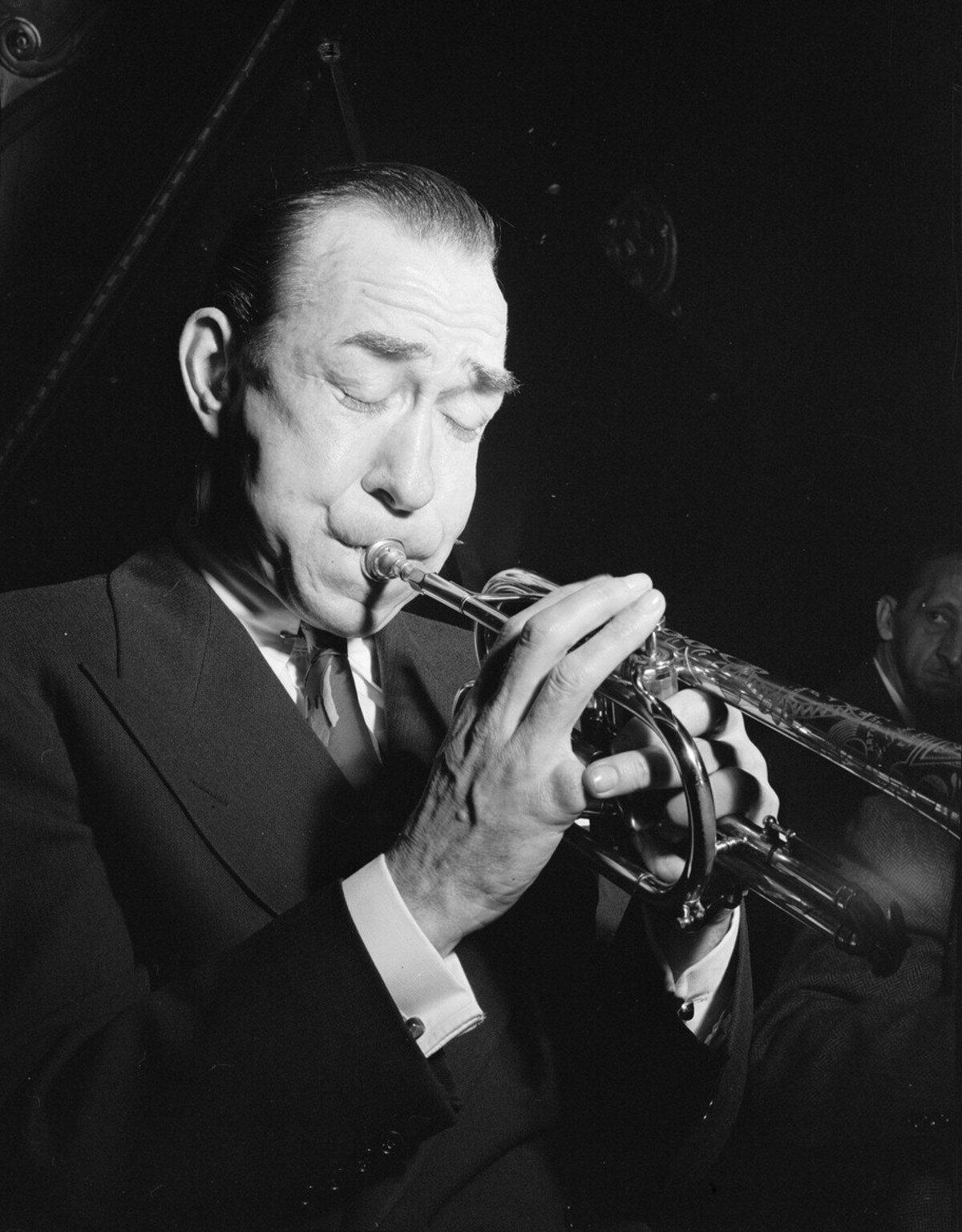
Cornetist Muggsy Spanier always had a distinctive sound, was consistently enthusiastic in his playing, and was very reliable whether leading a Dixieland ensemble or taking solos. In fact, he was so reliable that one could say that his playing was quite predictable but predictably exciting. Even though one knew what to expect when he was on the bandstand, his presence always raised the temperature in memorable fashion.
Francis “Muggsy” Spanier was born Nov. 9, 1901, in Chicago. Since he was a lifelong baseball fan and an admirer of New York Giants’ manager John “Muggsy” McGraw’s intense no-nonsense style, he adopted the name of Muggsy as a teenager.
Spanier briefly played drums before taking up the cornet when he was 13. It only took him two years to be skilled enough to become a professional. He was born in the right city to play jazz, becoming an important part of the Chicago jazz scene. Early on, Spanier worked with Elmer Schoebel (1921), Sig Meyers (1922-24), and Charlie Straight. Seeing King Oliver play at the Lincoln Gardens made a major impression on him. He adopted aspects of Oliver’s style, playing melodically, making each passionate note count, and driving a band rhythmically. He and Oliver became friends and throughout his life, Spanier was always happy to show off the mute that the older cornetist gave him. He also became a big fan of Louis Armstrong’s playing at that early stage. Oliver and Armstrong would always be Muggsy’s main inspirations. He also enjoyed seeing the New Orleans Rhythm Kings, becoming close friends with its trombonist, George Brunies.
Muggsy Spanier had his own sound by the time he made his recording debut in 1924 with the Bucktown Five, playing hot jazz with the quintet. He also appeared on two numbers with a pickup group in 1925 called the Stomp Six. Spanier worked with Floyd Town during 1925-28, a group that unfortunately never recorded. However in 1928 Muggsy, whose style was now fully formed, made a series of memorable recordings with Charles Pierce (a nine-piece group that included clarinetist Frank Teschemacher), the Chicago Rhythm Kings (which also had Teschemacher in addition to Mezz Mezzrow on tenor, Joe Sullivan, Eddie Condon and Gene Krupa), the identical personnel of the Jungle Kings, altoist Danny Altier, and Ray Miller. Many of the songs that he played during the era such as “China Boy,” “Nobody’s Sweetheart,” “Jazz Me Blues,” “I’ve Found A New Baby,” and most notably “I Wish I Could Shimmy Like My Sister Kate” would always be in his repertoire.
Spanier was the star of Ray Miller’s orchestra for a few months but by the spring of 1929, he was offered a lucrative job with Ted Lewis, as was George Brunies. He would spend seven years with Lewis, giving the cornballish clarinetist some jazz credibility. Spanier’s timing was perfect. The job saw him through the worst years of the Depression when many of his contemporaries were struggling. While the Lewis association was a fulltime job, Spanier did find time to guest on sessions by Annette Hanshaw, Spike Hughes, Seger Ellis, the Mound City Blue Blowers (next to Jimmy Dorsey and Coleman Hawkins in 1931), Chick Bullock, and a pickup band in 1935 that went under the name of the New Orleans Rhythm Kings.
In 1936 when Harry James left the Ben Pollack Orchestra to join Benny Goodman, Spanier took his place. He recorded with Pollack in small groups (the Rhythm Wreckers and his Pick-A-Rib Boys) in addition to a few numbers with the big band. While none of the dates resulted in any hits for Ben Pollack, these underrated recordings include plenty of enjoyable moments. But during a tour of New Orleans in Jan. 1938, Spanier became seriously ill with a perforated ulcer. He was hospitalized at the Touro Infirmary and was completely out of action for a year.
After recovering and returning to Chicago in 1939, Spanier decided to form his own band and play the freewheeling music that he loved most. His Ragtimers, a four-horn seven-piece Dixieland group, recorded 16 selections that were later on dubbed “The Great 16.” His group consisted of Spanier, trombonist Brunies, clarinetist Rod Cless, Ray McKinstry, Bernie Billings or Nick Caiazza on tenor, George Zack or Joe Bushkin as the pianist, bassist Pat Pattison, and Marty Greenberg, Don Carter or Al Sidell on drums with rhythm guitarist Bob Casey just on their first session. The 16, which with the later release of ten alternate takes could be called “The Great 26,” is filled with exciting performances. Among the highpoints are “Big Butter And Egg Man” (with Spanier quoting Louis Armstrong’s solo), a famous version of “I Wish I Could Shimmy Like My Sister Kate” that includes a Brunies vocal, “Mandy Make Up Your Mind,” “Lonesome Road,” and the blues “Relaxin’ At The Touro” that the cornetist gratefully named after the doctors who saved his life.
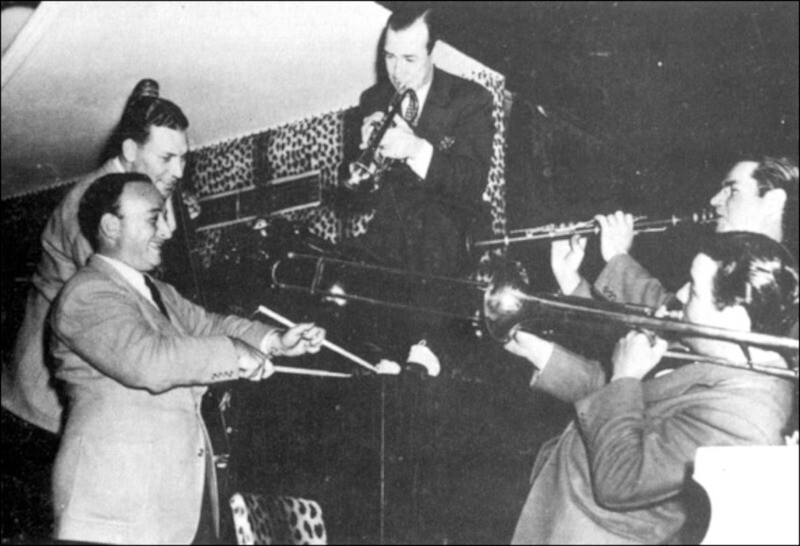
The music of the Ragtimers would be one of the main inspirations for the upcoming Dixieland revival movement, but unfortunately the band was formed a little too early. Swing was king, big bands were very much the rage in 1939, and Spanier could not find enough work for the Ragtimers to survive. They broke up after just seven months.
However Spanier was not out of work for long. On Mar. 28 and Apr. 6, 1940, he recorded eight songs with Sidney Bechet in a quartet with guitarist Carmen Mastren and bassist Wellman Braud. The magical interplay between the two horns makes one wish that they had formed a permanent group. Spanier’s solid lead made it easy for Bechet to weave lines around him.
Next, Muggsy Spanier joined Bob Crosby’s orchestra. While he loved the experience, ironically this was during a period when Crosby and his musical director Gil Rodin thought that their big band Dixieland style was becoming old hat and they sought instead to compete with the more swing-oriented orchestras. Although Spanier had his moments when the band played live, the recordings that he appeared on during 1940-41 tended to be commercial; even the sides by the Bobcats were saddled with vocals. The underutilized Spanier never had the exposure with the orchestra that his predecessors Yank Lawson and Billy Butterfield had enjoyed. In fact, his best playing on record during his year with Crosby was on two songs (“Sugar” and “Down To Steamboat, Tennessee”) on which he and pianist Jess Stacy played with Lee Wiley.

However the cornetist so enjoyed the overall experience with Bob Crosby that he put together a similarly-styled big band of his own that lasted for two years. Due to the musicians’ strike, the Muggsy Spanier Orchestra only recorded seven songs before breaking up in 1943 (although some radio broadcasts have since been released), highlighted by “Chicago,” “Little David, Play Your Harp,” and “American Patrol.” While lacking the great soloists of the Crosby band, there was an appealing team spirit in Spanier’s band along with enthusiastic ensembles and the leader’s cornet.
1944 was a particularly busy year for the 42-year old cornetist. Dixieland had become quite popular and Spanier was in demand. He was a regular at Eddie Condon’s Town Hall concerts, led four exciting sessions for Commodore, made V-discs and radio transcriptions, and worked regularly with Condon and for a few months with trombonist Miff Mole.
Other than occasional record dates as a sideman and appearing at all-star concerts, from then on Spanier was mostly featured as a leader. He headed stirring three-horn sextets and played regularly at Nick’s in Greenwich Village. Spanier was also on most of Rudy Blesh’s This Is Jazz radio concerts in 1947, playing next to clarinetist Albert Nicholas and his old friend George Brunies.
Muggsy Spanier successfully ignored bebop and other forms of modern jazz throughout his career, sticking mostly to the Dixieland standards that he loved. As the 1950s progressed, he continued playing in a style that was unchanged from 20 years earlier. While he occasionally added new songs to his repertoire, they were usually based on the blues or a vintage standard. Back in Chicago, he recorded a few songs for Mercury during 1950-52 and made a series of radio transcriptions.
His band (with clarinetist Darnell Howard) played at San Francisco’s Hangover Club in 1953 and he teamed up with pianist Earl Hines for a Chicago date the following year that was released by the Storyville label. In 1956, Spanier moved out West to join Earl Hines’ band which included Howard and trombonist Jimmy Archey. While East Coast critics have since either ignored or been a bit critical about Hines playing Dixieland during this era, the five live albums that have been released by this group (four led by Hines and one put out under Spanier’s name) are quite stirring.
Although Muggsy Spanier was only 57 as 1958 ended, his gradually declining health resulted in him keeping a lower profile from then on even though he remained active. His last album as a leader is a bit unusual. In 1962 he headed a 16-piece big band that included clarinetist Matty Matlock and tenor-saxophonist Eddie Miller from the Bob Crosby days. The group plays the type of music that his short-lived big band of the 1940s might have performed. On such numbers as “Royal Garden Blues,” “The Lonesome Road,” the recent Kenny Ball hit “Midnight In Moscow,” and a hot version of “Columbia, The Gem Of The Ocean” Spanier sounds very much in prime form.
For his last hurrah, Spanier led a group at the 1964 Newport Jazz Festival that included Brunies and either Peanuts Hucko or Edmond Hall on clarinet. Three songs (“Sister Kate,” “Royal Garden Blues,” and a final version of “Relaxin’ At The Touro”) were released on a multi-artist album by RCA Victor.
Shortly after that appearance, bad health forced Muggsy Spanier to retire. He passed away on Feb. 12, 1967 at the age of 65.
Fortunately there are many worthy Muggsy Spanier recordings that today’s listeners can enjoy if they search a bit. 1924-1928 (Retrieval) includes his best early sessions, The Ragtime Band Sessions (Bluebird) has “The Great 16” plus the alternates that make this “The Great 26.” 1944 and 1944-1946 (Classics) reissue the Commodore dates. From his later years, Hot Horn (Storyville), Relaxin’ At The Touro (Jazzology), Chicago Jazz (Jazz Crusade) and Columbia, The Gem Of The Ocean (Mobile Fidelity) are all easily recommended. In addition The Lonesome Road (Jazzology Press) is a definitive biography of Muggsy Spanier that includes a CD of rarities. Finally, in 1963 the cornetist was featured on Ralph Gleason’s half-hour television program Jazz Casual (which was released on a DVD), playing several songs, talking about his career, and proudly showing off King Oliver’s mute which he had been given 40 years earlier.

Since 1975 Scott Yanow has been a regular reviewer of albums in many jazz styles. He has written for many jazz and arts magazines, including JazzTimes, Jazziz, Down Beat, Cadence, CODA, and the Los Angeles Jazz Scene, and was the jazz editor for Record Review. He has written an in-depth biography on Dizzy Gillespie for AllMusic.com. He has authored 11 books on jazz, over 900 liner notes for CDs and over 20,000 reviews of jazz recordings. Yanow was a contributor to and co-editor of the third edition of the All Music Guide to Jazz. He continues to write for Downbeat, Jazziz, the Los Angeles Jazz Scene, the Jazz Rag, the New York City Jazz Record and other publications.