 What does it mean to be underappreciated in jazz? Most of us can name several musicians we think might not be getting their due. I might say that Jabbo Smith, Miff Mole, or Red Allen are less appreciated than they should be. We base such evaluations on the musician’s recorded history, even though the vagaries of the record industry or of the person can easily skew our judgment: Some players may not be much of a hand at “blowing their own horns.” Their recordings may come from the pre-electric era, or their earliest efforts may not have been recorded at all.
These factors may help to explain why the pianist and composer James P. Johnson’s place in the jazz pantheon seems both entirely secure and yet may be honored more in the breach than the observance. Although this may not be the most scientific statistical analysis, take for example the fact that on YouTube the first recording listed for Fats Waller playing “Ain’t Misbehavin’” has 2.2 million views, while Johnson’s performance of “Caroline Shout” has 117 thousand.

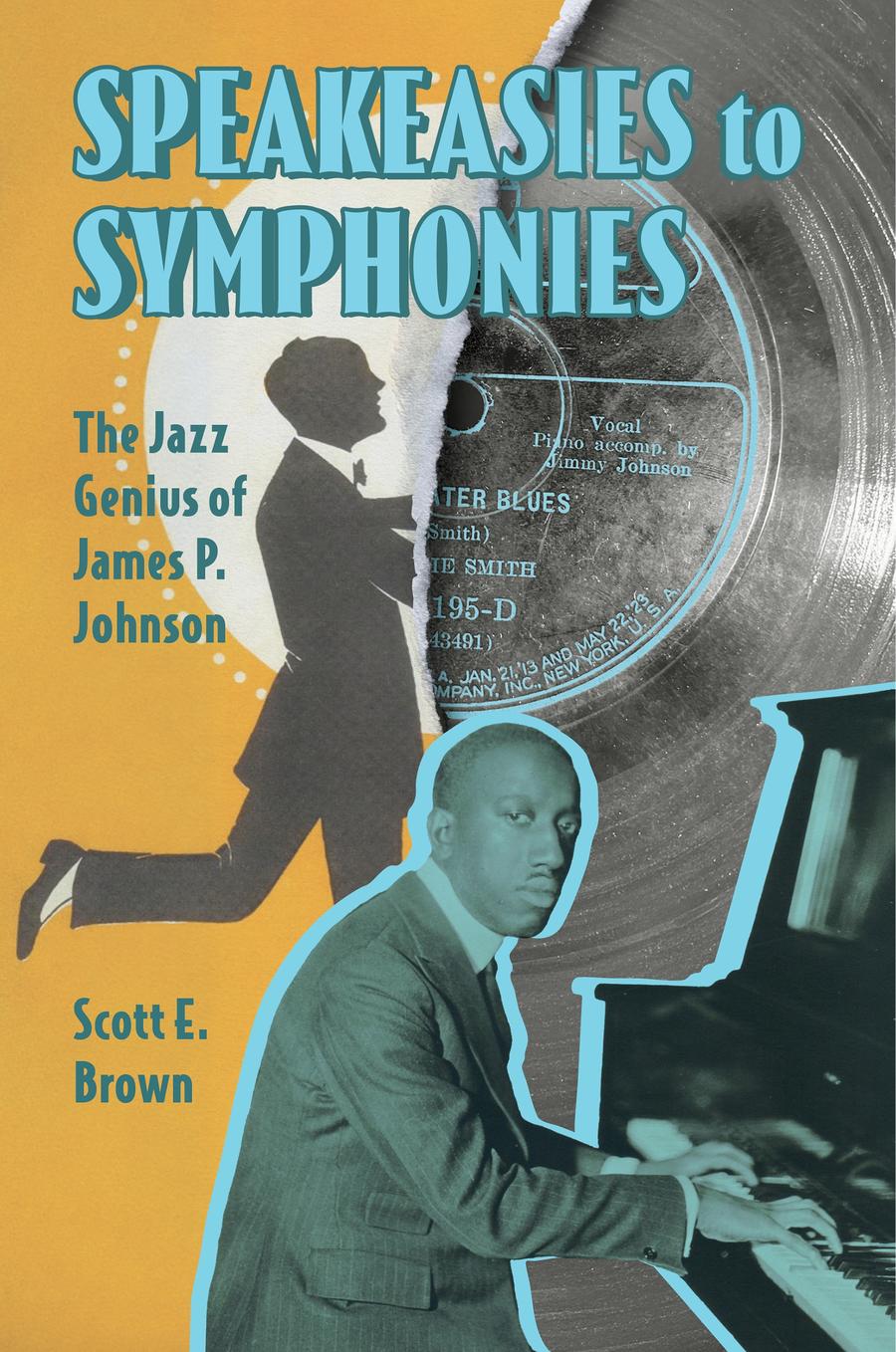
In 1987 Scott Brown wrote James P. Johnson: A Case of Mistaken Identity and he has continued to research and analyze Johnson’s life. It seems reasonable to mark his new book Speakeasies to Symphonies: The Genius of James P. Johnson as the culmination of his efforts. The book aims to make sure that Johnson’s contribution gets full due and for this reader it succeeds.
The outlines of Johnson’s life may be familiar to readers of Syncopated Times. Briefly told, he was born in 1894 and spent eight years in Brunswick, New Jersey, where his Southern ancestors had settled. His mother sang in the Methodist church, taught herself piano and passed on some knowledge to her son. James had a strong voice and sang on the street for change when he was six.
He had the chance to hear many local brass bands and the famous Jenkins Orphanage band from Charleston, S.C., which occasionally came to town. Family and other visitors from the south to their home brought their music and dances, including ring shouts—important musical influences on young James. Within a few years, he would write arrangements of dances like the “Mule Walk” and “Gut Stomp” and compose multiple versions of what would become his most famous song, “Charleston.”
When he was eight the Johnson family moved to Jersey City. There were 26 saloons near his house and he would sit outside, playing guitar, singing, dancing, learning tunes and admiring the pianists, then called “piano ticklers.”
At age 14, the family moved to San Juan Hill in Manhattan, the “Negro section of Hell’s Kitchen.” In 1912, he got his first job, at a rough cabaret. With his books stashed in a coal bin, he played until late, slept a bit then went to school. He was already writing songs, although he didn’t yet know how to notate them. He began to work around more steadily, playing for films, vaudeville, gumbo suppers, fish fries, egg nog parties, and “dance classes” (a way for black owners to avoid the difficult task of trying to get a dance hall license). Johnson didn’t start formal piano studies until he was 15.
There were a number of black pianists around: Sam Gordon, Frederick Bryan, Fats Harris, Kitchen Tom, One Leg Willie Joseph, Bob Hawkins, Richard “Abba Labba” Maclean, Eubie Blake, and Lucketh (Lucky) Roberts, who was the first to have a rag published in 1913: “Junk Man Rag.” Many pianists of the day studied with Alberta Simmons, the rare woman who played and taught many others, including, later on, Thelonius Monk. Willie “The Lion” Smith was on the scene and it was through him that Johnson met his future lifetime partner Lily Mae Wright.
At age 18 or 19, Johnson began to study with Bruto Giannini, which was the beginning of Johnson’s life long studies with conservatory-trained musicians. Johnson was part of the James Reese Europe’s Clef Club stable and in 1917, Bill Farrell of the Clef Club taught Johnson how to notate music. For the next couple of years, they wrote songs together for social clubs, reviews, industrial and convention shows.
I’d wager that one of the least known facts about Johnson’s life is the degree to which he was associated with shows, musicals and reviews. He started early and continued until not long before he died. Something else the book revealed, at least to me, was how early the form of what came to be called stride piano was developed and how quickly Johnson rose to the top of the heap. No one seriously challenged Johnson until his student Fats Waller and then, in a famous cutting contest in 1932, Art Tatum made his dramatic entrance onto the New York scene.

It’s difficult to trace the evolution of the stride style because during the nineteen-teens, only a handful of black musicians and bands were being recorded. Stride piano only began to be documented in the late teens, through piano rolls. (There’s an interesting parallel between the lack of coverage of the early history of Bebop because of the recording strike). The author says: “Johnson expanded the expressive possibilities of the piano by introducing the blues feeling and rhythmic vitality of the Ring Shout into his music.”
Johnson made rolls for several companies and became the first black staff pianist for QRS. The rolls were hugely influential with other pianists. Duke Ellington, for example, slowed the rolls down so he could learn “Carolina Shout.” Ethel Waters, frustrated with Fletcher Henderson’s accompaniment, got him some Johnson rolls, which he learned. Fats Waller, too, learned from the rolls. He met Johnson, who became his teacher and mentor. Eventually, they became running buddies and Waller’s famous appetite for food and drink was one that Johnson shared.
The pattern of Johnson’s musical life had pretty much taken shape by the late 1920s. He functioned in several popular spheres. He played with small groups, was a piano soloist, a musical theater composer and pianist and an accompanist to singers. Each of these called for sightly different skills and, in fact, no one else really comes to mind who was able to carry them all off.
Johnson also wrote longer form pieces, influenced by his study of “classical” music—a desire that arose early on. The first, most well known and most successful of these is “Yamekraw: Negro Rhapsody,” written in 1927. William Grant Still orchestrated its combination of Jazz, ragtime, spirituals, blues and stride that comprises the piece. In 1930, a film based on it was released and widely shown and may be viewed at this link: tinyurl.com/yamekraw1930.
As documented in this book, Johnson’s struggle for recognition with Yamekraw and other works like Harlem Symphony and Jazzamine Concerto was frustrating. Throughout his life, attempts to get his serous works played were mostly rebuffed or ignored, as symbolized by the fact that he was never able to get a Guggenheim or other Fellowship.
For his popular work, he called himself Jimmie Johnson. For his longer work, James P. Johnson. The author believes that the fact that he worked in so many spheres, using different names, is an important reason he’s not better known than he is. Although Brown never uses this word, he’s talking about what we now called “branding.” That is, broad public recognition requires that when we hear a name, we associate it with something very specific. Otherwise, to continue with current jargon, our brand becomes “diluted.”
The book limns all of the aspects of his career in detail, showing us he was constantly involved in musical theater efforts, recording, writing, studying, playing concerts, clubs and benefits. Also, he was doing a fair amount of carousing with his mates. I wish there had been more testimony from Johnson’s family about him but we do get a sense of his personality. He seems to have been a fairly quiet man, quick to make friends and slow to make enemies. Clearly devoted to music, he also seems, for the most part, to have been a good father and not a philanderer.
The book and the Notes are thorough, with a fair amount of non-biographical information brought in to provide wider cultural context. There is no discography. I do have an issue with the author’s approach to chronology, which is always a key question for biographers. There is a natural expectation by the reader to see events unfold pretty much as they did in the protagonist’s life. There can be reasons not to do it this way, but they have to be good. They would have to illuminate some aspect of the protagonist’s life. Diverging from chronology might also make sense if it would break up what would otherwise be tedious stretches of the narrative. However, there seems to be no good reason that Brown sometimes starts a story and interrupts or delays it. We will hear facts we’ve already read and have them expanded later on, for no apparent reason.
That aside, Speakeasies to Symphonies: The Genius of James P. Johnson seems pretty definitive. James P. Johnson fans will be happy to have this book as a reference. Also, anyone interested in the development of Stride piano and the history of black theatre/cabaret/reviews will also find much of interest.
Speakeasies to Symphonies:
The Genius of James P. Johnson
by Scott E. Brown
University Press of Mississippi
upress.state.ms.us
Hardcover: 480 pages, 52 b&w illustrations; $110
ISBN: 9781496857521
Paperback: 480 pages, 52 b&w illustrations; $35
ISBN: 9781496857538
Steve Provizer is a brass player, arranger and writer. He has written about jazz for a number of print and online publications and has blogged for a number of years at: brilliantcornersabostonjazzblog.blogspot.com. He is also a proud member of the Screen Actors Guild.