My title comes from a Thirties phrase for “I really like that,” found in a wonderful Frank Loesser left-handed love song (“Your fuzzy hair, your vacant stare / I go for that”) deftly sung by Dawn Lambeth at the Redwood Coast Music Festival, Eureka, California.
The RCMF is a deluge: 120 sets of hour-long music from Thursday to Sunday, often simultaneously in eight venues, most with dance floors. It offers an expansive stylistic menu of traditional jazz, Mainstream, blues both acoustic and electric, rockabilly, zydeco, and variations within variations. With the help of my technological Chief of Staff, Mark Voitenko, I saw and heard about 190 performances, some in person, some on video. But I estimate that there were more than 1200 songs played, sung, and danced to during this weekend.
To give you an idea of this all-you-can-experience menu, here are the artists my wife and I enjoyed. Singers: Dawn Lambeth, Alice Spencer, Valerie Kirchhoff, Jess King, Naomi Uyama, Katie Cavera, Paige Herschell, Jenna Colombet, Natalie Hanna Mendoza, Duke Robillard, Dave Stuckey; brass: Marc Caparone, Dave Kosmyna, Andy Schumm, Colin Hancock, Mike Davis, Clint Baker, Riley Baker, Dan Barrett, Charlie Halloran; reeds, Jonathan Doyle, Jacob Zimmerman, Dennis Lichtman, Ryan Calloway, Nate Ketner, Dave Bennett; piano: Carl Sonny Leyland, Chris Dawson, Kris Tokarski, Dalton Ridenhour, Ethan Leinwand, Brian Holland; guitar: Mikiya Matsuda, Jake Sanders, T.J. Muller, Dani Vargas, Jonathan Stout; bass: Steve Pikal, Matt Weiner; Sam Rocha, Sean Cronin, Alex Fernandez, drums: Hal Smith, Josh Collazo, Benny Amon, Alex Hall, Danny Coots. A dozen of these musicians double and triple, but this list is sufficiently long. “More stars than there are in heaven,” and I do not mean Metro-Goldwyn-Mayer.
To describe every musical experience of that weekend that moved me would take up this month’s issue, but many performances left me in tears or speechless-awestruck. Others had me wanting to leap out of my chair and cheer, impossible when one is sitting behind a camera and tripod. But the impulse was strong.
Thursday night had Valerie Kirchhoff with Carl Sonny Leyland’s Boogie Woogie Boys getting the musicians and crowd to, and I quote, “Shout the Boogie.” Valerie can get a group to do whatever legal thing she suggests, and Sonny is a whole percussive band in himself, piano and vocals A Clint Baker New Orleans-flavored group with Halloran began its set with “Weary Blues” which was exultant, not tired, then an earthy “We Shall Walk Through the Streets of the City” (which I know as “Red River Valley”) sung by Ryan Calloway. Dave Stuckey sang a few, including a funny improvised blues about pillows and blankets. Finally, there was Josh Collazo’s new group, Jazzboree, featuring Caparone, Doyle, and Riley Baker, living up to its name stylishly. Their “Thou Swell” was aptly titled, and Marc Caparone shone on “On Treasure Island.”
On Friday the music marathon began in earnest, and at a peak, with Alice Spencer and Hal Smith’s Overland Swing Express, offering an affectionate look at rare Swing Era repertoire: Fats Waller’s “How Can I? (With You in My Heart),” Hoagy Carmichael’s “Sing It ‘Way Down Low,” and “Say it Simple.” The band glided, and Alice was, as ever, both soulful and sly.
Naomi Uyama and her Handsome Devils followed and had the crowd dancing to equally unhackneyed repertoire from an opening instrumental “Shivers” to “Oh, That Kiss.” She charmed the room with enthusiasm and energy, and the Devils (Riley Baker, Sanders, Zimmerman, Halloran, Davis, Ridenhour, and Pikal) were a superb swing-dance orchestra.
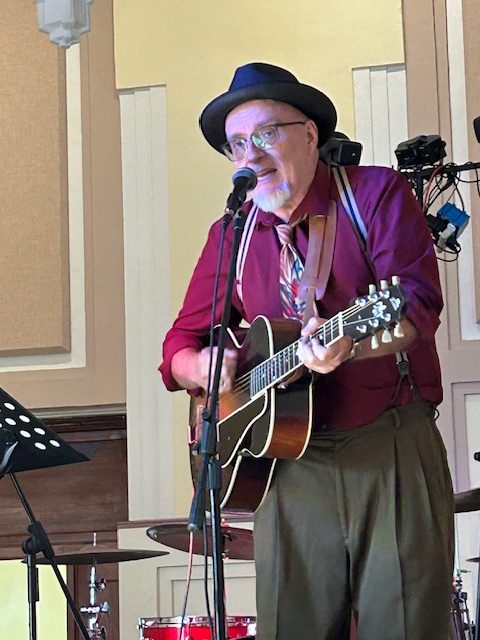
Dave Stuckey and the Hot House Gang are perennial favorites, for good reason. Beautifully-played swing can be entertaining to a wide audience without diluting its effect. He offered three originals (with hilarious lyrics) as well as songs that would be jazz classics if more groups learned them, the intricate “No One Else but You” and Alex Hill’s “Baby Brown.” Dawn Lambeth sang “I Go for That,” mentioned above, and the Dietz-Schwartz “Thief in the Night,” in understated warm style. Once again, she showed herself as the uncrowned successor to Becky Kilgore in graceful swing.
A rocking set by a New Orleans-flavored Clint Baker group followed, with lovely singing by Jess King, making “I’m Confessin’,” a song perhaps overly familiar, sound emotionally genuine. When a band plays an extended “Bye and Bye,” at a tempo that exhorts the audience, returning to ensemble choruses in the middle of the performance, I know I am in the right place. A delightful surprise was the solid bass playing of Alex Fernandez, unadorned and compelling.
A dozen songs – really, blues arias—by the seismic Valerie Kirchhoff were a history lesson too powerful for any classroom: the Smith girls, Mary Johnson, Victoria Spivey, Ma Rainey, Bertha Henderson, and others. Valerie is a force of nature, and her band moaned and shouted appropriately. Thanks to a front line of Colin Hancock, T.J. Muller, Andy Schumm, and Mike Davis, and a rhythm section of Ethan Leinwand, Mikiya Matsuda, and Hal Smith, the room levitated. A truly idiomatic highlight was an instrumental duet on Ma Rainey’s “Travelin’ Blues,” scored for Andy on comb and Colin on kazoo.

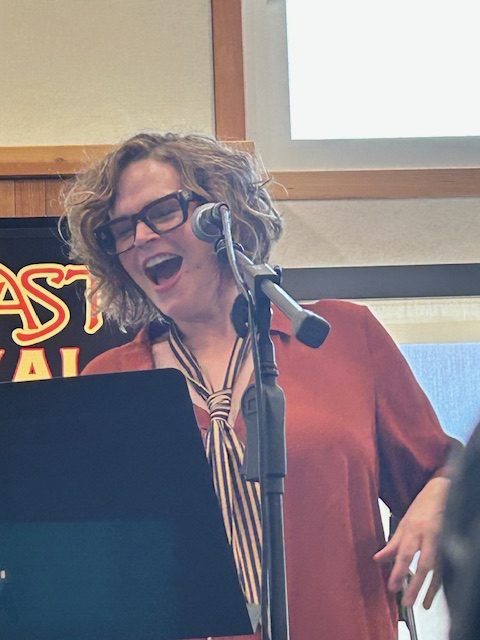
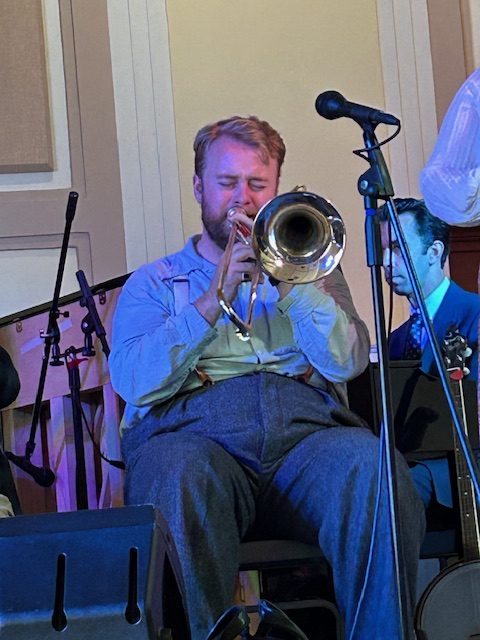
(photo by Michael Steinman)
While all this was going on, Mark Voitenko was documenting four sets at the cozy Morris Graves Museum: the first a delightful hour with Kris Tokarski’s deeply-grounded Riverside Jazz Collective, featuring a trio romp on “Oriental Man” for Schumm, clarinet; Kris, and Benny Amon, and leisurely but spirited readings of “Aunt Hagar’s Blues” and “Wabash Blues.” The Lovestruck Balladeers – Dalton Ridenhour, Dennis Lichtman, Jake Sanders, and Sean Cronin—displaying remarkable virtuosity and a broad repertoire (rags, stomps, waltzes, and Italian serenades) held the room rapt, particularly with a delicate ensemble reading of “In a Mist.” With the Holland and Coots Jazz Band, its front line Caparone and Schumm, clarinet, Alice Spencer offered four songs, among them a cheerful “Somebody Loves Me,” and a dark-blue “Ghost of a Chance.” Finally, Charlie Halloran and the Tropicales rocked the room, no cliché, with dance music from the islands played with hot-jazz ardor. He and this band offer new pleasures, because the songs are new and exhilarating.
After some sleep, we began Saturday with a charming set by San Lyon, featuring Thirties Swing classics, French pop tunes, and originals. Four musicians – Katie Cavera, Dani Vargas, Jenna Colombet, and Paige Herschell – gave us an orchestra’s worth of brightly-colored music, including voices singular and in harmony, Django Reinhardt-virtuosity on guitar, rocking banjo, double bass, violin, kazoo, and snare drum. They are a rewarding show, virtuosic, witty, light-hearted. And their originals, particularly “Starry Eyes” and “Chickadee,” are far from ephemeral.
From sweetly hot gypsy jazz, we moved on to Dave Kosmyna’s (aptly named) Incendiary Seven Plus Two, which could also have been named the Ferocious Nine. Dave’s opening “Down in Honky Tonk Town” closely followed the 1940 Louis Armstrong Decca classic with Dave and the band (Halloran, Schumm, Lichtman, Tokarski, Rocha, Amon, Cavera) raising the room temperature in the best way. (I’ve posted it on YouTube: see for yourselves.) Dave offered splendid tributes to Wingy Manone and Henry “Red” Allen and explored the intersection of hot jazz and opera with “My Heart at Thy Sweet Voice.” Keeping the festival’s budget balanced, Valerie Kirchhoff sternly warned anyone trying to sneak in without paying with “There’ll Be No Freebies at Miss Jenny’s Ball.”
That afternoon, at Morris Graves, Dawn Lambeth and her Daybreakers (Caparone, Dan Barrett, Jacob Zimmerman, Chris Dawson, Sam Rocha, and Amon) sweetly brought Fifty-Second Street back to life without making the room full of cigarette smoke. Dawn nimbly made her way through the treacherous lyrics of “I’ll Never Say ‘Never Again’ Again,” won hearts with a passionate “I Get Ideas,” and preached an Alex Hill sermon with “Get Rhythm in Your Feet.” A particularly moving interlude, quietly intense, was Chris Dawson’s solo “Body and Soul.”
Mike Davis’ New Wonders kept the Twenties front and center, evoking Red Nichols, Miff Mole, Vic Berton, and Fud Livingston. They offered a fiercely mobile “Stomp Off, Let’s Go!” then a pastoral trio reading of “For No Reason at all in C,” with Schumm at the piano, Muller on guitar, and Zimmerman on alto saxophone.
What could follow those two effusions? Another set by Charlie Halloran and the Tropicales that not only had the audience but the band members wriggling rhythmically. Not only is Charlie a world-class trombonist; he’s an engaging comic singer, which he proved on “Take Her to Jamaica” and the hilarious “Fifty Cents.”
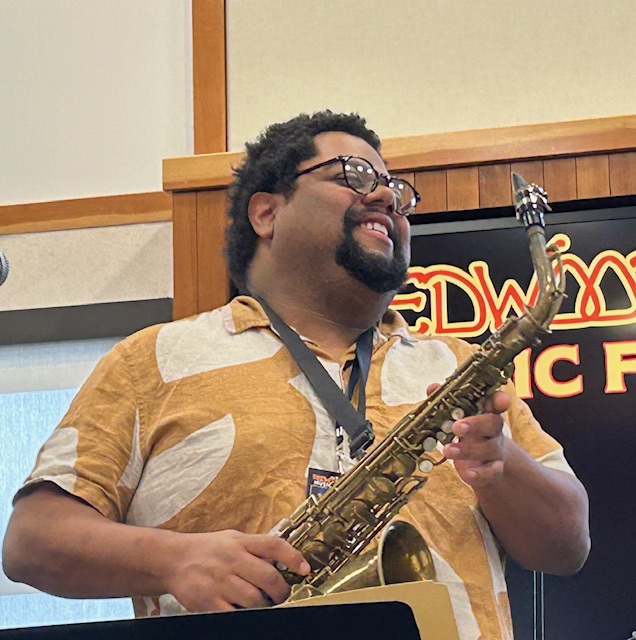
When the sounds of ocean liners and the aroma of rum had dissipated, Katie Cavera came on with her Lost Boys (a nod to J.M. Barrie and to the gender I was born to). Katie and Jess King stood, without preening, as the completely-not-lost Girls. Highlights were a storming “Wolverine Blues,” featuring Colin Hancock (I note that Hancock-conversions were happening around me all weekend), a sweet “Whispering” for Ryan Calloway on Albert-system clarinet, a frolicsome “Sister Kate” by the leader and Jess King’s exhortation to all to “Shake That Thing.” At the end, “Tiger Rag” was the only song that could be played, and it closed the hour memorably.
Saturday evening brought a meeting I had long been anticipating, of two musical partners and friends from Austin, Texas, Alice Spencer and Jonathan Doyle. I have been a Doyle-ian since I saw his work with Hal Smith in Austin on YouTube nearly a dozen years ago. I encountered Alice on record some years later and in person only last year. Their set presented Jonathan’s engaging originals that I was familiar with as instrumentals, with two, “I’ve Never Been to New York,” and “You Never Knew Me at All,” with evocative lyrics by Jonathan’s wife, Corinne Elysee Adams, sung fetchingly by Alice.
Alice also sang a few standards associated with Billie Holiday, with neat Doyle arrangements that would have fit on a ten-inch 78, but one of the peaks of the whole weekend was her somber, quietly grieving reading of “When Your Lover Has Gone.” Fortunately for posterity, I was able to wipe my eyes and make sure my camera was running. You can experience that five minutes of emotional transcendence on YouTube. And that band! Doyle, Kosmyna, Barrett, Zimmerman, Tokarski, Matt Weiner, and Alex Hall, brilliant soloists and ensemble heroes expertly reading charts new to them.
Nothing could follow that except a visit to our hotel and sleep. And then it was Sunday morning. After breakfast, a set of crossover music of the best kind: Hawaiian hot jazz (think Andy Iona and Sol Hoopli) 1929-30, deeply inspired by Bix Beiderbecke and Frank Trumbauer. Mikiya Matsuda consistently delivers lyricism and swing, no matter what stringed instrument he is playing, and the band was stellar: Schumm on cornet, Doyle on bass saxophone, Hancock on alto, Muller on guitar, Zimmerman on clarinet, and Mikiya gently guiding them all. There were Hawaiian pop tunes: “Hula Girl,” “Keiko,” and “Hana Hana Hawaii,” as well as enduring standards, “Reaching for Someone,” “I Surrender, Dear,” a tender quartet version of “More Than You Know,” and of course, “Singin’ the Blues.” Wondrous, and at ten-thirty a.m., no less.
Noon brought a rousing hour by T.J. Muller’s Jazz-O-Maniacs. The emotional temperature of the set can be assessed by the first song, T.J. singing “I’m Gonna Stomp Mr. Henry Lee,” and the two closing ones, a New Orleans rhythm Kings version of “Shim-Me-Sha-Wabble,” and a final “Arkansas Shout.” In the intervals between stomping, shimmying, and shouting, Valerie Kirchhoff made two musical requests, “Daddy, Won’t You Please Come Home,” and “Gimme A Pigfoot,” The front line of Kosmyna, Halloran, and Schumm (now on alto saxophone) was matched by a rhythm section of Muller, Tokarski, Calloway, bass saxophone, and the indispensable Hal Smith.
The Sunday afternoon set by Brian Holland, Danny Coots, Steve Pikal, Caparone, Zimmerman, and Alice Spencer, was notable for Marc’s ominously growling “Gee, Baby, Ain’t I Good to You?” Alice’s perky “When My Sugar Walks Down the Street,” and deeply moving “I’m Thru with Love,” and “Stardust,” with the verse. An unexpected highlight was Jacob Zimmerman’s musical elegy for the late clarinetist Bob Draga, a slow, hymnlike reading of “Dinah.”
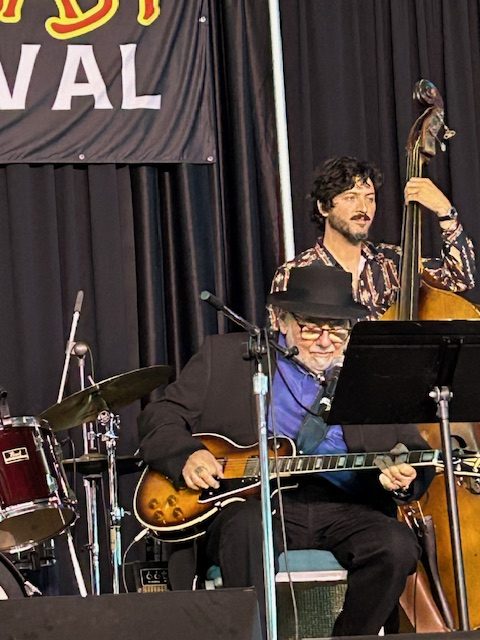
What I thought would have been the last set for us was a quiet extravaganza, featuring Duke Robillard, guitar and vocal, and “the Ladies of Song”: Dawn Lambeth, Valerie Kirchhoff, and Alice Spencer, with a compact swing band of Caparone, Riley Baker, Zimmerman, Sanders, Dawson, Rocha, and Collazo. Each of the “Ladies” had two features: Dawn’s sweet “If I Had You,” making that venerable song come alive, and a mournful “I Got it Bad,” Valerie’s rowdy “Do Your Duty” and “Don’t You Feel My Leg,” and Alice’s explosive “Don’t You Know,” making Ray Charles welcome here, and caressing “A Sunday Kind of Love.” In addition to epigrammatic solos, Duke brought his own majesty to three vocal features: “Jumpin’ the Blues,” “I’ll Always Be in Love with You,” and a closing “Exactly Like You,” which he dedicated to his wife Laurene, gazing directly in her eyes as he played and sang. Watching Duke thoughtfully make a musical line completely his own, I feel the way I do when observing Louis Armstrong in his late years: the unaffected deep mastery that can only come from decades of devotion to one’s craft.
That would have been enough. My wife and I went to dinner [the fine restaurant’s name on request] and were ready to retire to the quiet of our eccentric hotel. But she, who does not want to sit for five sets in a row, urged, “I don’t want to go back to that room. Let’s go to the Eagle House.” So we did, for a gleeful set by Dennis Lichtman and his Mona’s All-Stars, including Davis, Halloran, Ridenhour, Sanders, Cronin, Collazo. They played a rocking “Once in a While,” an even more unfettered “Royal Garden Blues,” with Colin Hancock and Riley Baker joining in, and an ecstatic speed-of-light “Dinah” with Naomi Uyama reminding the crowd of the name of the song. I had packed away my video equipment and it would have been useless in the crowd, but I held up my iPhone and caught these three performances. Imperfect video, joyous sounds.
It was done.
When we went to the bite-sized airport (Arcata has two gates) on Monday morning, I was sad that the weekend was all over but I couldn’t believe all the extraordinary music I had experienced. And the friendship.
It isn’t an overstatement to write that joy is the defining feature of this festival. If readers have been waiting (im)patiently for complaints, I don’t have them. I am no longer 50, and hustling from one venue to another is not easy. But there are several RCMF shuttles circling the venues, and having so many venues means that more music can be seen and heard in a day. And those who have heard enough music can visit the redwoods, or the lovely towns of Eureka, Arcata, and Trinidad. One that I have not visited is enticingly named Samoa: perhaps we will detour there in 2006.
I attended my first jazz weekend in September 2004, and although the music has usually been uplifting, sometimes both audiences and musicians can be heard complaining, and for good reason. Sometimes the seating plan is unfair, the acoustics poor, the management invisible or unsympathetic, the sets monotonous, there’s no room to dance. None of these things apply here. Mark Jansen, who runs things with the help of an energetic board, is a hands-on presence, grinning as he rushes from venue to venue. If someone has a problem, musician or audience member, Mark fixes it if it can be fixed.
Happily, the RCMF is particularly welcoming to swing dancers, for two good reasons. The musicians are inspired by the dancers’ energy, and the dancers, in the main, are a younger audience, helping to assure an audience in future for this music in performance. Yes, they would rather listen and be uplifted by live musicians instead of some erudite person at a Mac laptop. And rightly so.
At Redwood Coast, the musicians may be exhausted, but they grin at each other when someone’s memorable chorus is over, and applaud each other at the end of a set. The dancers swing and twirl and laugh. The audience looks transported and they come up to the musicians, their faces gleaming, when the set ends.
This festival is frankly overwhelming in the best way: my chronicle leaves out five-sixths of the music performed that weekend. The 2026 Redwood Coast Music Festival will take place from October 1-4, and there will be more of what I have described here, plus surprises. Details at rcmfest.org, and videos from the festival at www.jazzlives.wordpress.com.
We’ll go for that.
Michael Steinman has been published in many jazz periodicals, has written the liner notes for dozens of CDs, and was the New York correspondent for The Mississippi Rag. Since 1982, Michael has been Professor of English at Nassau Community College in Garden City, New York. This story was originally published on Michael Steinman’s excellent blog Jazz Lives (jazzlives.wordpress.com), and is reprinted here with Michael’s permission. Write to Michael at swingyoucats@gmail.com. May your happiness increase!