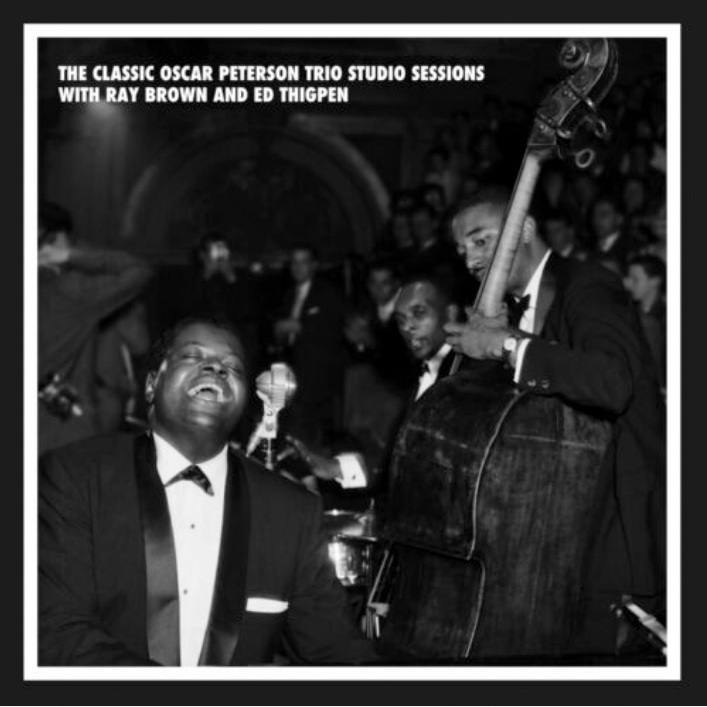
 A reasonable guess is that Oscar Peterson made over 200 recordings under his own name—we’re talking albums here, not singles—but the number goes up to over 500 when you include the sessions at which he was merely (merely!) a sideman. Hence the challenge of narrowing the selection process. Mosaic Records has dipped into the Peterson well a couple of times before, but their newest release covers 1959 to 1965, when he was busier than ever with concerts and recordings. Therefore, it’s hardly exhaustive, but its focus brings us Oscar at his most creative and versatile. He thrived in a trio setting, and the musicians he worked with thrived as well.
“Peterson’s greatest impact was as a leader of a piano trio,” writes Bob Blumenthal in his thoughtful, thorough program notes to Mosaic’s eight-CD Classic Oscar Peterson Trio Studio Sessions with Ray Brown and Ed Thigpen. “Neither more intimate encounters nor grand orchestral settings threw him off his game, but his sustained work in two distinct three-piece iterations defined what the classic modern jazz piano trio was all about.”
Peterson won a talent contest in his native Montreal in 1940, when he was 15; like so many budding pianists during that era, he idolized Art Tatum’s harmonic and technical virtuosity. Unlike so many, Peterson developed the chops to make the most of his hero’s precedent. Tatum’s recorded output remains comparatively small, much of what’s there thanks to producer Norman Granz’z insistence on sitting Art down and capturing him extensively in solo and small-group settings. Granz also produced a number of Oscar’s sessions, including those that start off this set.
Their relationship began in 1949, when Granz put him into the “Jazz at the Philharmonic” lineup at Carnegie Hall that year. Oscar was such a success that Granz kept him on the JATP roster, at first playing duos with Ray Brown, then, as you can hear on Mosaic’s ten-CD Classic Jazz at the Philharmonic Sessions 1950-57 set, placing the pianist in a wide variety of contexts with many different stellar artists (a set that’s now, but only recently, out of print).
Fresh off those first forays with the JATP bunch, Oscar returned to the trio format that he’d enjoyed in Montreal, with Ray Brown at his side alongside guitarist Barney Kessel, whose studio work was also issued by Mosaic on the seven-disc set of the Complete Clef/Mercury Studio Recordings of the Oscar Peterson Trio 1951-53 (a set that’s now very much out of print).

Picking up the story again in 1959 makes a lot of sense for Mosaic. Fans of the label probably have the earlier O.P. sets and can enjoy continuing to trace the pianist’s development, but even if not, this is as good a place as any to enter his staggeringly impressive piano world. Note that the set’s title bears the term “classic,” which means it was cherry-picked. That’s because the trio also recorded ten installments of Granz’s Songbook series at this time, none of which (I’m assuming for rights reasons) is included. But eleven other terrific sessions (and then some) are offered here, variously themed.
First off is A Jazz Portrait of Frank Sinatra, twelve tracks recorded on a single day in May 1959. As Blumenthal points out, focusing on the singer invited material by a variety of songwriters (Sammy Cahn and Jimmy Van Heusen, for example) who weren’t included in the Songbook series. Tying this album to Sinatra probably also added some crossover appeal. The session starts off with a declamatory “You Make Me Feel So Young” that sets a pattern for the remainder, each a fairly medium-tempo track running just under three minutes. In fact, “Just in Time” runs just under two minutes, but it’s a succinct evoking of a charmingly tuneful piece. And it reinforces my belief that Peterson played the lyrics as well as the melody. All twelve selections are brief and take an easy tempo, a way, perhaps, to sneak jazz concepts into the ears of the more casual listener.
Even while recording the ensuing Songbooks sessions, the trio stretched out in a half-dozen numbers collected as The Jazz Soul of Oscar Peterson. A scorching “Liza” takes us into the set; especially pleasing here is an eight-minute “Maidens of Cadiz,” an art song by Léo Delibes that has been recorded by Jeanette MacDonald, Deanna Durban, Miles Davis, and Scott Hamilton, among many others, here taken as an easy ballad and displaying the partnership with Brown at its best.
Three of the numbers—Dizzy’s “Con Alma” and “Woody’n You,” along with “Close Your Eyes”—were recorded again a couple of months later during a marathon session that delivered ten songs from “Porgy and Bess” along with seven others, including the aforementioned three. Comparing them reminds us that, as much as a working trio would be inclined to routine its approach to oft-played songs, Peterson & Co. always found fresh things to say.
Porgy and Bess got the jazz treatment frequently, which only underscores its worth. Here we have ten numbers of very varying length, ranging from a minute-long “Oh, Dey’s So Fresh and Fine” to over seven minutes of “There’s a Boat Dat’s Leavin’ Soon for New York.” The selections are nicely sequenced, offering ear-happy contrasts from song to song. “I Got Plenty o’ Nuttin’” is the opener; a whimsical “It Ain’t Necessarily So” serves the nature of the song well, and it wraps up with “Bess, You Is My Woman Now.”

Back when Broadway shows were still a source for hits, the labels put their artists to work covering those songs. The two musicals included here couldn’t have been more different in outcome. Fiorello!, with a score by Jerry Bock and Sheldon Harnick, ought to have thus endured, but the nine songs the trio recorded require you to enjoy them without the baggage of hit-parade fame. “On the Side of the Angels,” which opens the show, is a standout.
West Side Story was next, about which I have little to add. Thigpen and Brown drive the jittery opening of “Something’s Coming,” before Oscar throws in a more contemplative contrast. And this approach holds true for the ensuing five numbers. You’d think “Somewhere,” with Ray’s bowed bass stating the melody, would be the winner here, but I find the eight-minute “Jet Song” to be most captivating as it reharmonizes Leonard Bernstein’s already harmonically complex song. Putting a bow on the proceedings is a concluding “Reprise” that does as the title suggests, a deft touch I don’t expect from a jazz ensemble.
Two CDs that follow give us three sessions, beginning with another marathon: the December 1962 recordings released on the album Night Train. Ellington’s title song leads it off, sounding kinda Dukish; also from his pen are “C-Jam Blues,” “I Got it Bad and That Ain’t Good,” and “Band Call,” nestled with Mercer’s “Things Ain’t What They Used to Be.” Otherwise it’s a mixed bag of standards old and newer, with a cameo by “Volare.” There’s a similar pattern to the next two albums, Affinity and The Oscar Peterson Trio Plays, with shrewd programming (nice to hear Oscar on “Waltz for Debbie”) that mixes tempos and styles behind so much virtuoso playing.

Oscar made his debut as songwriter with Canadiana Suite, an album of eight movements taking us across the country, heading west. It’s material the trio honed for a year in the clubs before committing it to record. We start with “Ballad to the East,” with its suggestion of expansiveness, before heading through the Laurentides to Montreal and the up-tempo, whimsical “Place St. Henri.” By the time we reach “Blues of the Prairies,” we’re thinking of wagon wheels and loping livestock in this medium-tempo number. Then it’s “Wheatland,” with an extended Ray Brown solo before the spirited “March Past,” opening in the piano’s high register with thumb cymbals before filling out its merry soundscape.
“My One and Only Love,” from the album We Get Requests, exemplifies Oscar’s skill with a melody. You know the tune; he know you know it. He opens in Tatum mode, adding runs and other embellishments. He pivots to the bridge with a plagal cadence, the hymn-finishing “A-men” sequence. He repeats the tune with tender octaves before re-chording it. Then he takes the melody apart some more, revealing unexpected connections among the notes. He lays back to let Brown solo, all the while being propelled by Thigpen’s brushwork. And then he finishes it with Bach’s “Jesu, Joy of Man’s Desiring.
“Have You Met Miss Jones?” takes the cautious tempo of one whose declaration of interest is tempered with apprehension, making it amusingly surprising even as it climbs to a majestic two-chord sequence.

The trio made several trips to Villingen, Germany, in the 1960s, where Hans Georg Bruner-Schwer recorded pianists for his label MPS. Action sports six longish cuts of standards, including two by Gershwin. But beyond that, and rounding out this set, are the results of two more sessions released here as The Lost Tapes. They come from 1963 and 1965. Gordon Jenkins’s “Goodbye” is a centerpiece here, meditative and poignant; I’m also partial to the very easygoing pace of “Li’l Darlin’.” At the very end of Disc Eight, as if signaling the finish of this incarnation of the trio, Oscar takes to the studio alone with “Autumn Leaves.”
A pianist friend of mine is a Peterson fanatic, and he scorned the need to acquire this set. “I have all those albums,” he boasted—and then I played him some of this Mosaic set. “I can’t believe they sound this good,” he said. You know that Mosaic searches out the best possible source material and applies the most appropriate remastering tools, but there’s nothing like the ears of a pianist to attest to such quality. It’s that good.
Classic Oscar Peterson Trio Studio Sessions
with Ray Brown and Ed Thigpen
Mosaic Records