 Although he is rarely listed as one of the top prebop tenor-saxophonists along with Coleman Hawkins, Lester Young, Ben Webster, and Bud Freeman, Eddie Miller (1911-91) deserves to be ranked at that high level. While he had a tone similar to Freeman’s (they often could be mistaken for each other), Miller did not play the quirky phrases that Freeman often put in his solos and he had a smoother and generally warmer tone.
Most famous for his association with the Bob Crosby Orchestra during 1934-42, taking tenor or clarinet solos on nearly all of the best recordings by the orchestra and Crosby’s Bobcats, Miller also led his own worthy if short-lived big band, worked on the staff of 20th Century Fox for nine years (playing on many soundtracks), recorded numerous sessions for the Capitol label in different settings, was part of a variety of Dixieland and swing recording bands, participated in many Bob Crosby reunions, and worked in later years in New Orleans with Pete Fountain (who he influenced on both tenor and clarinet). Always reliable and a class act, Miller was an asset on hundreds of record dates during 1930-87.
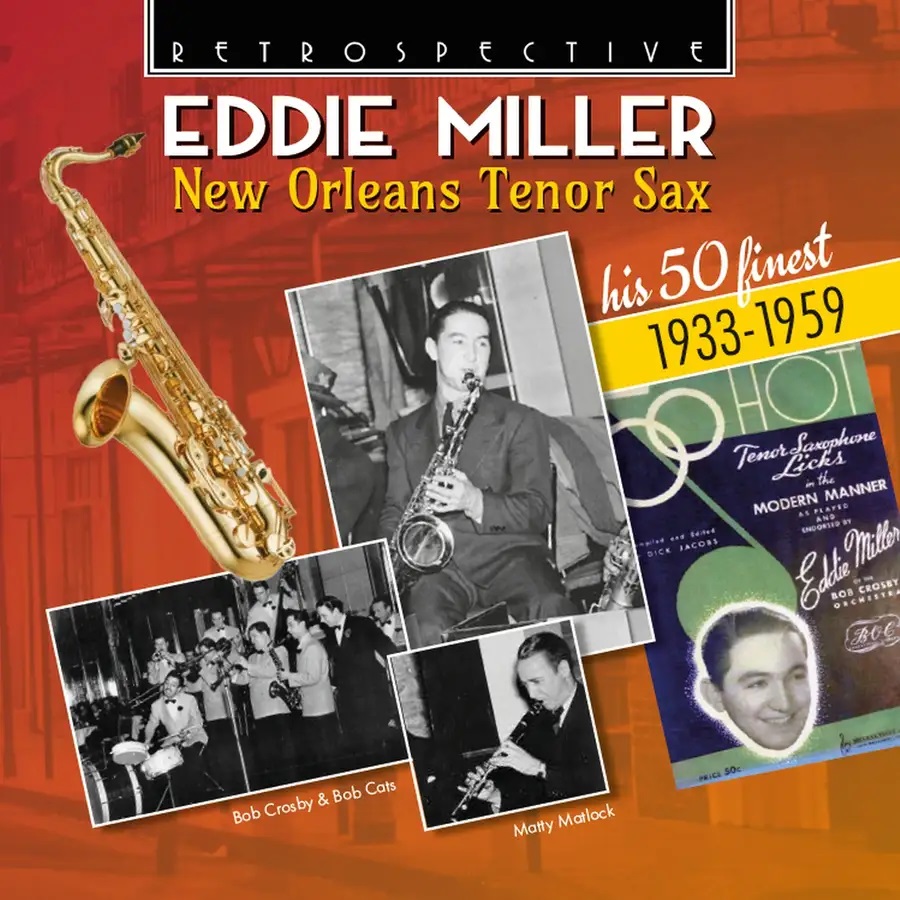
The two-CD set New Orleans Tenor Sax put out by the Retrospectives label has 50 of Miller’s finest recordings from 1933-59. It starts out with Miller’s most famous composition, “Slow Mood” (later given Johnny Mercer lyrics and retitled “Lazy Mood”) from 1937. After that memorable showcase for Miller’s tenor, he is heard as a sideman with Ben Pollack (1933’s “Two Tickets To Georgia”), on “Shine” with Wingy Manone and the Four Bales Of Cotton, three other numbers with Manone (including his hit “The Isle Of Capri”), a song apiece with Louis Prima, Glenn Miller (“Solo Hop”), and the Mound City Blue Blowers, three numbers with Bunny Berigan, and “Swingin’ At The Hickory House” with Wingy Manone. In addition to his emerging style on tenor, these early performances remind one how talented a clarinetist Miller was when he switched instruments; he really tears into “High Society” with the Mound City Blue Blowers.
Following those excursions, Miller is heard on 11 songs with the Bob Crosby Orchestra and the Bobcats including taking his famous clarinet solo on “South Rampart Street Parade” and having two showcases on tenor (“I Hear You Talking” and “Call Me A Taxi”) with Crosby’s rhythm section. The four numbers that he recorded with his big band in 1944 are here along with one number with Martha Tilton. After that, the emphasis is on Dixieland-oriented pickup groups including the Rampart Street Paraders, the Pete Kelly Seven, and the Kings Of Dixieland plus occasional ballad features. Such notables as trumpeters Pete Daily, Clyde Hurley (a great if often overlooked soloist) and Dick Cathcart, trombonist Abe Lincoln, clarinetist Matty Matlock, and guitarist George Van Eps all play prominent roles as part of the illustrious cast. New Orleans Tenor Sax easily succeeds as a definitive and well-conceived tribute to the masterful Eddie Miller.
Eddie Miller • New Orleans Tenor Sax
Retrospective RTS 4444
www.retrospetive-records.co.uk


Since 1975 Scott Yanow has been a regular reviewer of albums in many jazz styles. He has written for many jazz and arts magazines, including JazzTimes, Jazziz, Down Beat, Cadence, CODA, and the Los Angeles Jazz Scene, and was the jazz editor for Record Review. He has written an in-depth biography on Dizzy Gillespie for AllMusic.com. He has authored 11 books on jazz, over 900 liner notes for CDs and over 20,000 reviews of jazz recordings. Yanow was a contributor to and co-editor of the third edition of the All Music Guide to Jazz. He continues to write for Downbeat, Jazziz, the Los Angeles Jazz Scene, the Jazz Rag, the New York City Jazz Record and other publications.