 Few great musicians, either popular or “classical,” have been so historically “hard done by” as Gertrude “Ma” Rainey. Until the release of this album, there has been no re-release of her work which enabled modern listeners to truly evaluate her greatness as both a singer and performer without the distraction of surface noise. But those days are, fortunately, over.
Rainey, like jazz cornetist Freddie Keppard, started recording late in her career, but (also like Keppard) her skill and musicality nonetheless shine through in all her recordings.

In my previous article about “Ma” Rainey for the Syncopated Times (“Why are Ma Rainey’s recordings so important to the history of music?” TST, Oct. 2022) I discussed the importance of Rainey’s musicianship to the history of music, so that topic will not be discussed herein. Instead, I wish to discuss why this album is important to the history of music.
First of all, the original 1920s recordings needed to be effectively restored using modern audio engineering software (such as Pro Tools) so that your average listener might be able to hear the performers more clearly. Because we are all accustomed to modern recording equipment and software, most listeners are not going to tolerate listening to the type of surface noise found on Rainey’s original recordings.
Towards the end of the last century, and the beginning of this, the leading restorer or early jazz recordings was John R. T. Davies. A credit to Davies on a compact disc re-issue has always been seen as a sign of quality. His motto was, “Add nothing, take nothing away.” Davies died in 2004, and in my opinion, the man who is perhaps the torchbearer for this skill (or better yet, artistry), is sound engineer Doug Benson.

I have followed Doug Benson’s career as a specialist in sound restoration with interest for some years, and his accomplishments are awesome. His work is to be found on the Archeophone Records label, Frog Records, and Rivermont Records. On his own label, Off The Record, he re-released the Wolverine Orchestra records from 1924-28, King Oliver’s Jazz Band complete 1923 recordings, and the collection of 1920s New Orleans jazz musicians, Cabaret Echoes. Rivermont released his well-received restorations of the New Orleans Rhythm Kings Complete Recordings 1922-1925 in 2018.
Every time Benson is involved with a re-release project, our expectations are very high. And this album does not disappoint. Firstly, I asked Doug Benson a few questions regarding this new release.
Davidson: How long had you been thinking about creating this new Ma Rainey album?
Benson: The inception was not mine; I was approached by the [George] Buck Foundation.
D.: How long did it take to complete the album?
B.: The whole process was around seven years from start to finish. Just locating the sources took about five of those.
D.: What is your process of renovating early sound recordings? Do you remove or change one type of noise at a time?
B.: Yes, I’m generally not a fan of the “auto-cleanup” software. I always start out removing clicks, since that’s the least likely step to cause artifacts; and allows you to listen to the remaining audio more carefully without all those spikes assaulting your eardrums! At that point, each record has its own sonic personality. Even different copies of the same disc can perform quite differently! Steady-state noise is the most difficult to remove since it often takes some music out with it. Enhancing the audio with selective EQ is also an important part of the process.

D.: I notice that your sound restorations never completely remove the “scratch” or surface noise. It sort of reduces the noise to the level of tape hiss of analog tape recordings of the 1960s in my opinion. It sort of “puts it in the background.” How did you arrive at the decision to do this?
B.: Good question! It would be very easy to remove every bit of noise, but as stated earlier, it would also remove some of the sound we want to keep. Also, especially in the case of acoustic records, a little bit of “hiss” above the upper frequency limit of the recorded sound will stimulate the listener’s ear, and actually breathe life into the track.

D.: In the Biograph LP re-releases of the 1960s and 1970s, they often used reverb, particularly in the LPs of the California Ramblers. Why do you think Biograph did this?
B.: That was a trend that started in the 1950s and survived through the 1960s. RCA Victor used to drown their Big Band reissues in reverb, though to my ear it masked a lot of the detail in the sound. Decca was another culprit, sometimes using reverb and EQ to create a crude stereo image from a mono master. It’s not surprising that Biograph would have tried it as well, as “that was what everybody was doing” at the time. I’m glad they don’t do it anymore!
D.: In “Army Camp Harmony Blues” the clarity is so great, that I believe that I can hear a bit of “echo” of the studio itself, and can clearly discern the piano playing. How in your opinion did you achieve this? (to be honest, being able to hear that absolutely blew my mind!)
B.: The recording horn will pick up whatever is in front of it, including studio ambiance. With many of these Paramounts it was a matter of carefully scrubbing away the unwanted noise occupying the same frequency zone as the ambiance… and sometimes getting luckier than other times!
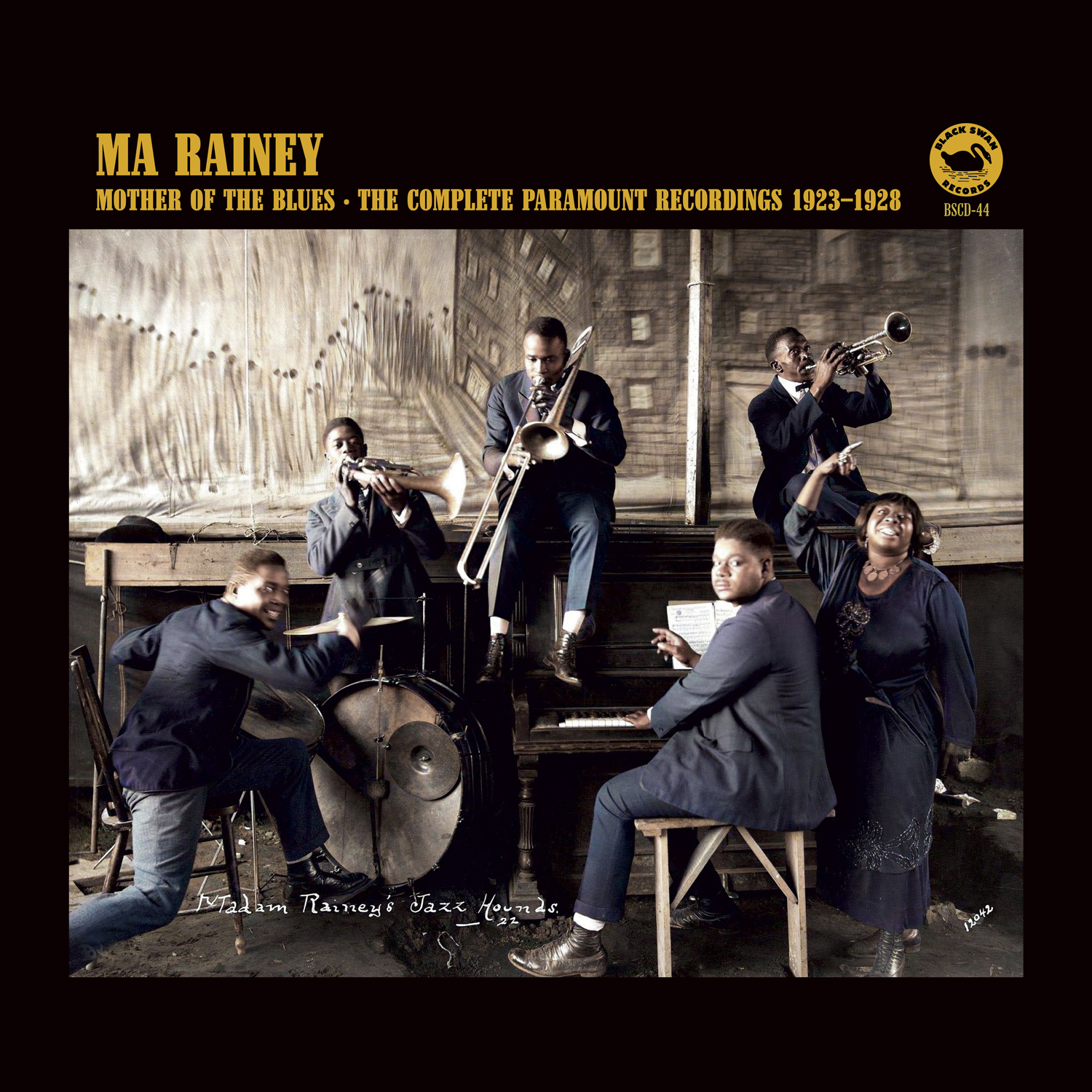
To continue with my assessment of this album, Jazzology has clearly not spared any expense with this re-release. This beautifully packaged collection comes in a huge square container that you’d expect from a Vinyl LP set, but in fact it contains 5 compact discs, and an enormous 11” x 11” phenomenal full-color booklet, complete with copious historical notes by David Sager, photos of record labels, historic places, and individuals important to the Ma Rainey story.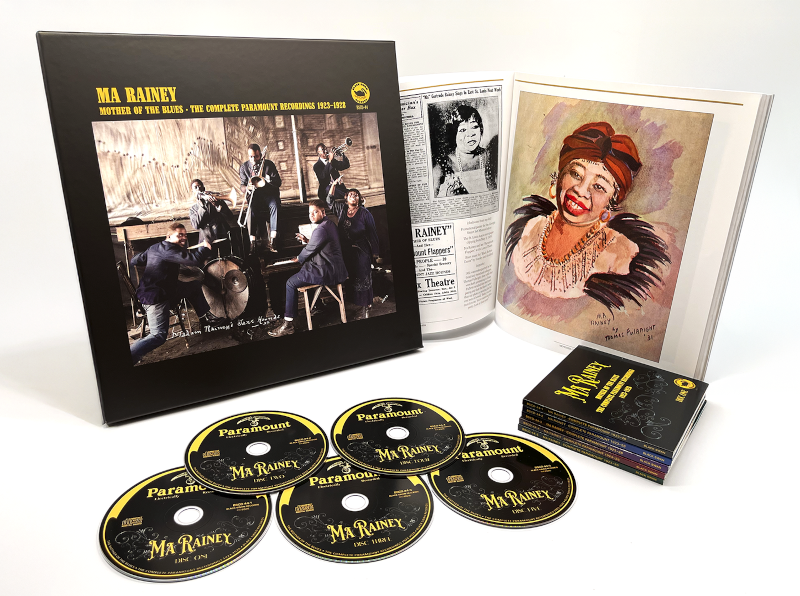
There is too much music on this collection to discuss every track, so I’m only going to write about one or two tracks per disc.
“Lost Wandering Blues” (on the first disc) is an excellent place to start. It is not just one of her earliest recordings, it displays her vocal skills in plain relief, being accompanied by the Pruitt Twins who play on guitar and banjo, which was an unusual accompanying group for a theatrical performer. It gives us a clear idea of how pre-1917 blues singers would have sounded.
In this version, we can clearly hear the string instruments change harmonies under Rainey’s powerful voice, which sails over the top of the string players. Around the 1 minute 10 second mark, the instrumentalists play on the second and fourth beat of the bar, but leave beats one and three silent. This gives us full opportunity to hear the nuances of Rainey’s style which uses a lot of glissandi (sliding from one note to another). She emphasizes phrases by sometimes shouting out individual words (such as “Lawd!”) which has an indeterminate pitch. Her techniques don’t sound terribly unusual to us now, but would have been quite striking at the time. In terms of the sound restoration, nothing is added nor taken away. The surface noise is moved to the background. And you have to listen hard to hear what’s left of the surface noise!
“Lawd Send Me a Man Blues” (also on disc one) is a better example of how audiences would have heard Rainey on stage or in her tent shows. Once again, the surface noise is barely audible, and the high and middle frequencies are made more audible than in the original recordings. We can also clearly hear the counterpoint of the clarinet, cornet, weaving in and out of the vocal line, quietly complimenting rather than overpowering the singer. Thanks to the sound restoration, during the chorus, we can hear Rainey’s powerful voice leading the other musicians. It becomes particularly overwhelming when she literally shouts, “Oh Lawd!”—she creates a gravelly sound in her voice which we would probably call multiphonics nowadays.
“Army Camp Harmony Blues” (on disc two) might not be everyone’s favourite on this set, but for me it definitely stands out as you can not only hear all George Tilford’s saxophone playing multiphonics and the unknown kazoo player doing quick tremolos and comical wa-wa effects. On top of these theatrical gestures, Rainey delicately rests her vocal stylings. What really stands out for me, is that not only can you hear the piano accompaniment clearly for the first time ever, but you can hear a little bit of natural reverb which was occurring in the studio. It is quite a revelation to hear. It’s almost like being in the studio with the musicians.
“See-See Rider Blues” (track four on disc two) is justifiably a jazz classic, boasting sensitive and thoughtful accompaniment by Fletcher Henderson’s group: Louis Armstrong on cornet (not trumpet), Charlie Green on Trombone, Buster Bailey on clarinet, Charlie Dixon on banjo, and Henderson on piano.
It’s quite remarkable to hear Armstrong in harmony but still rhythmically on the same notes as Rainey at first/ Then, in the chorus, he plays very quietly underneath Rainey, supporting but never overpowering her. Bailey also does quick and quiet tremolos underneath her singing, and Green does slow glissandi as an accompaniment as well. The call and response pattern is on display here, with Rainey shouting a phrase, and the instrumentalists getting louder in response to her singing when she stops for a short phrase. This track is closer to what we would have heard her do on stage, and it is remarkable to hear all these great instrumentalists with such remarkable clarity for once.
“Broken Hearted Blues” (disc three, take two, track nine), despite Armstrong’s obvious absence, and the fact we don’t know who some of the instrumentalists are, is truly a tight performance, and a very slick arrangement indeed. The muted wa-wa trumpet is delightful, and we get a complete solo accompanied at the end by a banjo doing a tremolo before Rainey joins in. It is also faster and more driving than some of her earlier recordings. There is an engaging saxophone solo (by either Percy Glascoe or Lucian Brown, we are not sure). We even get to hear the piano do a delightful little break in bare octaves towards the end. Once again, the clarity of the sound restoration is astonishing.
While track one on disc four (“Little Low Mama”) is certainly intriguing to hear with Blind Blake’s guitar accompaniment, I much prefer “Don’t Fish in My Sea” (track four, disc four). On the latter we can clearly hear the legendary blues pianist Jimmy Blythe, filling out the accompaniment as if he were a whole jazz band.
His musical figures are sometimes simplistic, sometimes complicated, sometimes in the high register, sometimes mid-range, sometimes playing in rhythmic unison, sometimes not, sometimes he “double times” (a device used by “Jelly Roll” Morton), sometimes he slides off the black note octaves onto the white notes (as Eubie Blake was wont to do), sometimes we hear a trill followed by rapid passage work from the top down to the middle range. It is just as interesting to listen to him as to Rainey, and they make an exceptional performing duo. And it all ends very suddenly on a minor 7th chord. All remarkable stuff, and made clear through the subtle reduction of the surface noise and bringing out the (delightfully out of tune) piano part.
On disc five, track eight, “Deep Moaning Blues” starts with a vocal chorus, and continues with jug playing, kazoo playing, and other unusual sounds. It gives the listener a good idea of what her earliest performances would have sounded like, as earlier in her career, she was often accompanied by a jug band. “Daddy Goodbye Blues” has Georgia Tom Dorsey providing a gutsy piano accompaniment with guitar legend Tampa Red also giving contrapuntal accompaniment.
Her final two recordings include “Ma and Pa Poorhouse Blues” (track 19, disc five) with Charlie Jackson on banjo solo accompanying Rainey. This is perhaps my favorite on this disc, because it provides excellent evidence of the “banter” you probably would have heard in Rainey’s vaudeville routines. It also shows Rainey, once again, in plain relief, with just one instrumentalist accompanying, and there is singing and talking back and forth between Jackson and Rainey, as well as singing delightfully in harmony. It is both joyful and sad. Joyful to hear these two musicians delight in each other’s exceptional skill; sad for us to recognize that this was the end of Rainey’s recording career forever.
Writing a conclusion for this five-disc set is daunting. However, in my opinion, this is a five-disc album set that is designed for everyone—everyone who enjoys music, full stop. Perhaps some individuals might not appreciate the many nuances. But that is not important. What is important is that here, for the first time in the history of recorded sound, are almost all of Ma Rainey’s known recordings, presented with a gorgeous, large, easy-to-read book, and with sound restoration better than anything before it.
Doug Benson’s career has been leading towards this moment, and he and his colleagues have created a CD set of monumental historical importance to the world. While it is true that Ma Rainey, like poet Emily Dickinson, possessed a “narrow palette,” she plumbed extraordinary depths.
To compliment Doug Benson on his extraordinary achievement here is not to diminish all the other people involved in this exceptional product:
1. Producer Lars Edegran who had the foresight and vision to realize that no expense should be spared on this production;
2. Historian David Sager for his very thorough and thoughtful notes and analyses;
3. Researchers Paul Swinton, Dick Spottswood, and Sager; and…
4. graphic designer David Stocker who brought together all the historic materials and made them “pop” out at the viewer and bring even greater pleasure to the person reading the booklet.
This album is, in all respects, a unique technical and musical masterpiece, of great historical importance, one which finally presents some of America’s greatest music in a manner that can be appreciated by all.
Mother of the Blues: The Complete Paramount Recordings, 1923-1928
Ma Rainey
Black Swan Records BSCD-44
(www.jazzology.com)
Matthew de Lacey Davidson is a pianist and composer currently resident in Nova Scotia, Canada. His first CD,Space Shuffle and Other Futuristic Rags(Stomp Off Records), contained the first commercial recordings of the rags of Robin Frost. Hisnew Rivermont 2-CDset,The Graceful Ghost:Contemporary Piano Rags 1960-2021,is available atrivermontrecords.com.A 3-CD set of Matthew’s compositions,Stolen Music: Acoustic and Electronic Works,isavailable through The Sousa Archives and Center for American Music University of Illinois (Champaign/Urbana),sousa@illinois.edu.