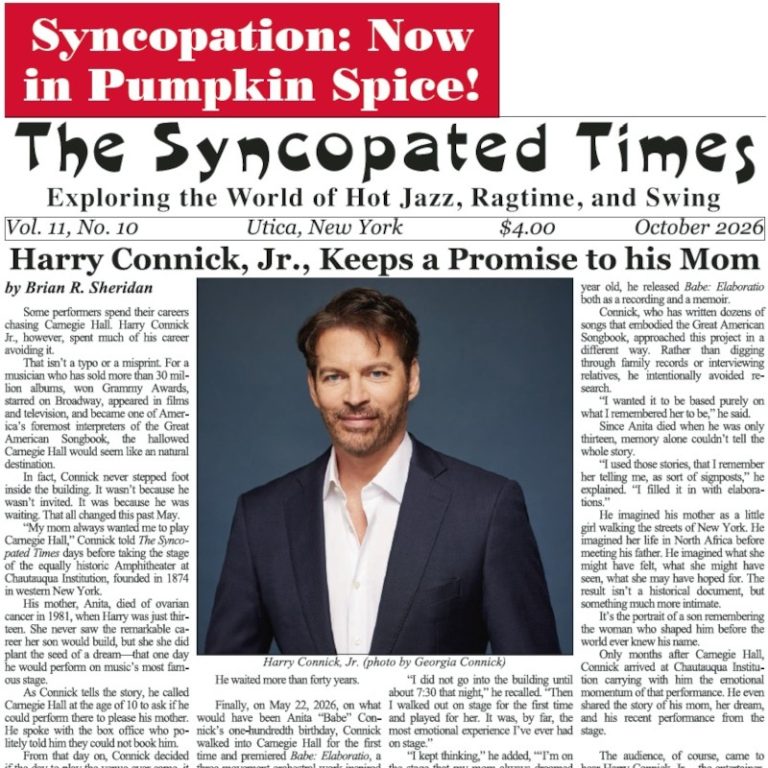
Some performers spend their careers chasing Carnegie Hall. Harry Connick Jr., however, spent much of his career avoiding it.
That isn’t a typo or a misprint. For a musician who has sold more than 30 million albums, won Grammy Awards, starred on Broadway, appeared in films and television, and became one of America’s foremost interpreters of the Great American Songbook, the hallowed Carnegie Hall would seem like a natural destination.

In fact, Connick never stepped foot inside the building. It wasn’t because he wasn’t invited. It was because he was waiting. That all changed this past May.
“My mom always wanted me to play Carnegie Hall,” Connick told The Syncopated Times days before taking the stage of the equally historic Amphitheater at Chautauqua Institution, founded in 1874 in western New York.
His mother, Anita, died of ovarian cancer in 1981, when Harry was just thirteen. She never saw the remarkable career her son would build, but she she did plant the seed of a dream—that one day he would perform on music’s most famous stage.

As Connick tells the story, he called Carnegie Hall at the age of 10 to ask if he could perform there to please his mother. He spoke with the box office who politely told him they could not book him.
From that day on, Connick decided if the day to play the venue ever came, it would belong to her.
“I never went into Carnegie Hall,” he said. “I never saw a show there. I never performed there because I wanted it to be a special thing.”
He waited more than forty years.
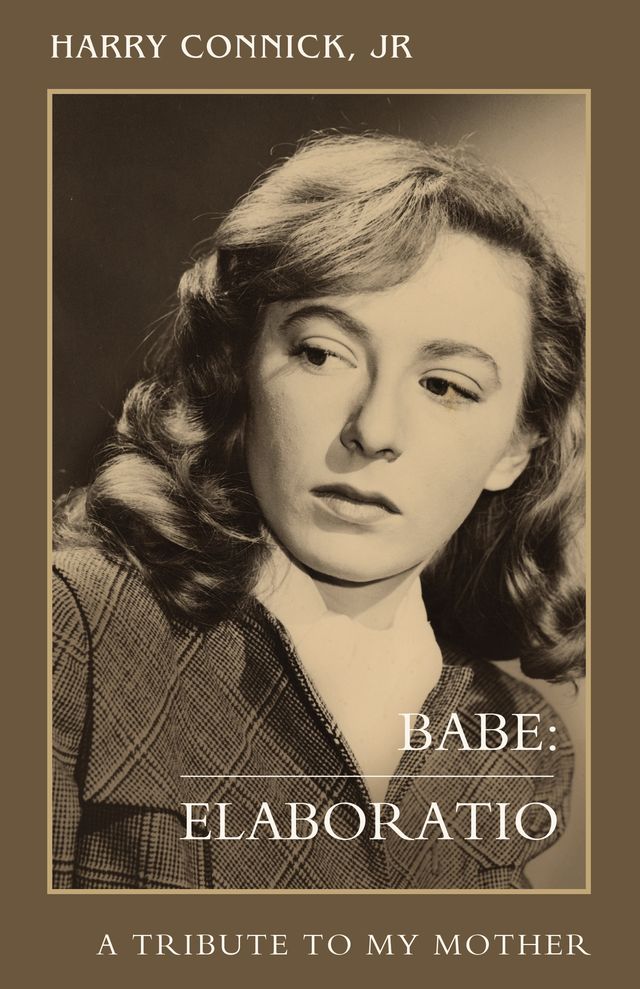
Finally, on May 22, 2026, on what would have been Anita “Babe” Connick’s one-hundredth birthday, Connick walked into Carnegie Hall for the first time and premiered Babe: Elaboratio, a three-movement orchestral work inspired by his mother’s life. He played the piano, accompanied by the Orchestra Victoria from Australia. Connick even made sure the opening notes of the piece were B-A-B-E.

“I did not go into the building until about 7:30 that night,” he recalled. “Then I walked out on stage for the first time and played for her. It was, by far, the most emotional experience I’ve ever had on stage.”
“I kept thinking,” he added, “‘I’m on the stage that my mom always dreamed of me being on.’”

The Carnegie Hall concert is only the beginning of what promises to be one of the most personal chapters of Connick’s career. In September, month he turned 59 year old, he released Babe: Elaboratio both as a recording and a memoir.

Connick, who has written dozens of songs that embodied the Great American Songbook, approached this project in a different way. Rather than digging through family records or interviewing relatives, he intentionally avoided research.
“I wanted it to be based purely on what I remembered her to be,” he said.
Since Anita died when he was only thirteen, memory alone couldn’t tell the whole story.

“I used those stories, that I remember her telling me, as sort of signposts,” he explained. “I filled it in with elaborations.”
He imagined his mother as a little girl walking the streets of New York. He imagined her life in North Africa before meeting his father. He imagined what she might have felt, what she might have seen, what she may have hoped for. The result isn’t a historical document, but something much more intimate.
It’s the portrait of a son remembering the woman who shaped him before the world ever knew his name.
Only months after Carnegie Hall, Connick arrived at Chautauqua Institution carrying with him the emotional momentum of that performance. He even shared the story of his mom, her dream, and his recent performance from the stage.
The audience, of course, came to hear Harry Connick, Jr.—the entertainer, the showman, the New Orleans performer. They were not disappointed by a performance some Chautauqua residents called the best show they ever saw at the Amphitheater.
Backed by an exceptional eight-piece band, he opened with “That Old Black Magic,” before revisiting “It Had to Be You,” the song forever associated with When Harry Met Sally… (1989), the soundtrack that introduced millions of listeners to his effortless blend of jazz, swing, and American standards.
Connick is far from that youngster who reminded music fans of a young Frank Sinatra. Like later Sinatra, his voice has a little more gravel and gravitas in it. However, neither his ability to swing or play a mean stride piano has diminished with age.
With “The Way You Look Tonight,” from Your Songs (2009), he reminded listeners how comfortably he inhabits the Great American Songbook, while Cole Porter’s “I Love Paris,” from True Love: A Celebration of Cole Porter (2019), reflected Connick’s admiration for the composer he calls his favorite.
Throughout the night, Connick worked the stage, not only singing and playing, but joking with the audience, and leading the band with the confidence of someone who has spent nearly four decades entertaining crowds.
When he sat down at the grand piano, he reminded everyone why musicians have always considered him far more than a vocalist.
At one point he paused, looked around the Amphitheater, smiled, and said, “This place feels like a church to me.” For anyone who has spent time at Chautauqua, the comment made perfect sense since the Amphitheater doubles as a place of worship on Sunday mornings during the summer season.
Connick followed the comment with “How Great Thou Art” from his COVID-19 era record of spirituals “Faith…” He gradually expanded the song into a soulful improvisation before the audience began singing along and his band crept in musically.
Moments later, he was tapping rhythms on the piano itself, turning the instrument into a percussion section before breaking into an impromptu tap dance. It was vintage Harry Connick, Jr.—part jazz musician, part vaudevillian, part New Orleans showman.
The evening also traced the arc of his own recording career.
He reached back to “City Beneath the Sea,” from Star Turtle (1996), one of his most imaginative original compositions, before bringing the audience to its feet with “Come By Me,” the title song from his 1999 album.
Throughout the evening, his hometown of New Orleans was never far away.
Whether recalling Mardi Gras traditions, celebrating the city’s music, or closing with an encore that invited everyone to “drive down to New Orleans,” Connick continually returned to the place that formed him.
Connick is a man who honors not only his mother but his past mentors, giants of jazz like Ellis Marsalis, James Booker, and Dr. John.
Today, Connick is roughly the age those men were when they were guiding him. Has that changed the way he thinks about his own place in jazz?
“I never think about my role within jazz,” he stated. “I don’t think they did either.”
Instead, he offered what may be the simplest explanation for his remarkable career.
“You’re given whatever you’re given and you develop it and try to do with it what you can,” he said.
And Connick as done quite a lot. In addition to his career successes, he has a strong 32-year marriage to former model Jill Goodacre and together they raised three, successful daughters. Through it all, he remains humble and grounded.
He is not especially interested in discussing legacy. Connick isn’t looking backward though much of the music he plays comes from America’s past. He’d rather talk enthusiastically about his family, about continuing to write, perform, compose, and explore whatever creative avenue interests him next. There was no sense that he has arrived but only that he intends to keep going.
Please visit Harry Connick, Jr.’s official website, www.harryconnickjr.com, where Babe: Elaboratio is now available for purchase.
Brian R. Sheridan, MA, is the chair of the Communication Department at Mercyhurst University in Erie, PA (hometown of Ish Kabibble) and a longtime journalist in broadcast and print. He also co-authored the book America in the Thirties published by Syracuse University Press. Sheridan can be reached at bsheridan@mercyhurst.edu. Find him on Twitter @briansheridan and Instagram at brianrsheridan.