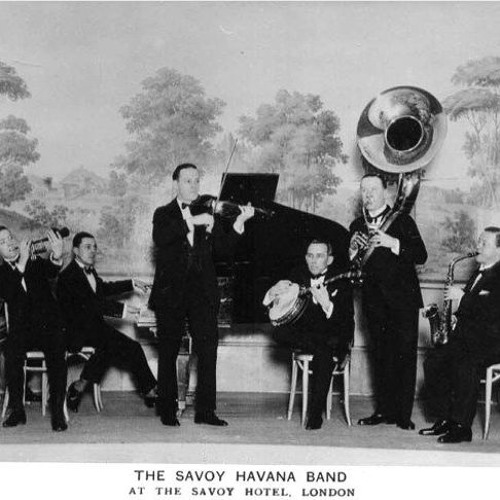
A century ago, they were undoubtedly one of the biggest names in broadcasting in the UK, Europe, and large parts of the world. The Savoy Orpheans and Savoy Havana Band, both resident at the Savoy Hotel, London, were on the air at least twice a week to audiences of millions. Now, their story is being explored in detail for the first time on BBC Radio 3, in a documentary series entitled A Foxtrot Too Far, presented by yours truly.
I have long been fascinated by what I call that distinctive “Savoy sound.” As early as 1923, they were recording pioneering blues songs with a mixed American/English band, with records like “Farewell Blues,” “Blue Hoosier Blues,” “Henpecked Blues,” and “Downhearted Blues” among them. These have stood the test of time, and I’d rate them on the same level as anything coming out of America that year.
London musician, and Savoy Havana Band fan Nicholas Ball recreated the band a few years ago for Mike Durham’s International Classic Jazz Party. He told me: “They’re playing the blues long before a lot of the more famous American jazz musicians that we would have all heard of had recorded or even started working professionally.
“The idea that jazz and blues music is something that the British have always been kind of second best at, whilst of course that is true to a degree, it’s amazing to find that there were British musicians recording and performing this music at such an early date, long before perhaps the mainstream awareness of jazz in Britain would have thought that was possible.”
By 1925 they had achieved a strong, driving rhythm section, and were able to hire the finest musicians thanks to the huge sums of cash that the hotel was willing to spend on entertainment. Several of their recordings from the 1925-27 period have become the definitive versions for many record collectors.

A brief list of my favorites follows: “The Charleston,” “Masculine Women, Feminine Men,” “Static Strut,” “Jig Walk,” “I’m A Little Blackbird Looking For A Bluebird,” “Ain’t That Too Bad,” “Vladivostok,” “Stomp Off Let’s Go,” “When My Sugar Walks Down The Street,” “Everybody Stomp,” “Blue Evening Blues” (featuring the first jazz guitar solo recorded in the UK by Eddie Lang who was visiting at the time), “Copenhagen,” “Oh That Sweet in Suite 16”—I really could go on.
Suffice to say I love the bands. The hotel is unique among similar London establishments in that it maintains a comprehensive archive containing letters, photographs and memos dating back to the earliest days of its operation.
Unlike other prestigious hotels, the Savoy wasn’t sold from its original ownership until well into the late 20th century. This has meant the survival of so many fascinating documents which might have otherwise been discarded if the building changed hands.
Every letter leaving the building was copied onto thin tracing paper and filed away into huge leather-bound ledgers, so entire conversations can be read, albeit just one side of them. What this means is we have an invaluable insight into the inner workings of dance bands in 1920s London.
It’s these letters which first led to the documentary. My good friend, and expert on the Savoy bands, Nick Dellow, suggested to me that we might like to write up their entire story for Memory Lane magazine. Several years ago, he was able to access these letter books, and diligently photocopied or transcribed every memo relating to the bands.
What followed was a 24,500 word essay telling the story, which is still being serialized. A few months later, I had a chance encounter at work with a former BBC Radio 4 producer, Beaty Reubens. Beaty now works for an independent radio company, and I was interviewing her about an exhibition she was putting on in Oxford about radio in the 1920s.
I mentioned this article I had written, and she thought it interesting enough to pitch to her bosses, and later to Radio 3. This was all done in time for Christmas 2025, and by the start of February I had lost hope that the story was to be rejected. Instead, I got an email saying that they had purchased the idea, and that they wanted me to front a 5 x 15 minute series over the course of a week. Beaty has since guided me to produce the documentary broadcast in December.
The story of music at the Savoy really centres around one individual: William De Mornys. In the words of Nick Dellow, he was a gigolo, a good-looking dancer from Belgium who came over looking to make his money after World War One.
De Mornys realised there was a huge dancing craze, and that this was his ticket to the top. One night at Rector’s, where the Original Dixieland Jazz Band were playing, he approached the owners and asked why the place was so busy.
“He said to the owners of the club what the bloody hell is all this row about? And they said it means 500 pounds a week—that’s how much they were making in sheer profit,” said Dellow.
Polite society in London in 1919 was quite horrified by jazz. The Tatler Magazine wrote “London’s such a wicked place since the Americans landed.” Press coverage was often condescending, rude or outright racist.

But De Mornys realised this was where the money lie. So he charmed his way up to the hotel’s publicity manager at the Henley Regatta and promised he could make them similar levels of profit to Rector’s.
Though he was largely given free reign to arrange and manage the bands at the hotel, his boss—and the other key character in the story—Miles Thornewill, was not so impressed with De Mornys.
The Savoy’s archivist Susan Scott told me that Thornewill had a real reputation for strict discipline. He would run his finger along the top of mantelpieces to inspect for dust, and terrorized the hotel’s florists if he thought their displays were too loud. The two clashing personalities eventually led to the demise of the groups, but more on that later.
 In early 1921, De Mornys sent talent scouts over to America to hire the finest jazz musicians to bring them to the UK. His first star signing was Bert Ralton, who had been playing with Art Hickman. Apparently his party trick was to smoke a cigarette at the same time as playing his clarinet. He also brought with him a letter of recommendation from the American arm of the Columbia Gramophone Company. Ralton was to lead the new Savoy Havana Band.
Right from the start, De Mornys realized the power of new technology to get his band heard by the masses. If you wanted to see the bands at the Savoy live, you had to pay large sums of money to dine and dance—it was, and remains, a five-star establishment.
Gramophone records meant that fans could hear the group across the country, and this had a huge effect. Even greater was the advent of radio. Literally across the road from the hotel was Savoy Hill, the home of the fledgling BBC. De Mornys realized if the BBC could run cables across the road to the ballroom, then his bands would have an audience in the tens of thousands overnight.
The BBC were also keen to have a prestigious band on the air, not some underground jazz joint, and were persuaded to broadcast from the Savoy regularly.
In March 1923, the Paul Whiteman Orchestra came to the UK for the Brighter London revue. This caused a stir—the horde of 15 Americans was unlike anything the British had then seen, and De Mornys realised he needed another band to keep up with the latest American trends.
The result was the Savoy Orpheans, initially a mixed group of Americans and British. The Americans treated it like a paid holiday, though some were reprimanded for throwing bread rolls at each other in the dining room!
Just two weeks after the Savoy Orpheans’ radio debut on 11th December 1923, they were being heard worldwide via relay broadcasts, as far away as New Zealand and Australia, and Cape Town in South Africa.
Marconi, the inventor of radio, had a suite at the hotel, and received messages that both sides in the Rif War were listening to the Savoy bands, leading newspapers to print headlines “The bands that stopped the war.”
Their fame led De Mornys to arrange a sell-out series of concerts at Queen’s Hall in London at the start of 1924, followed by a pioneering broadcast to America. I believe the Orpheans were the first British band to broadcast a concert across the Atlantic.
The Orpheans were also the backing band for the premiere of George Gershwin’s Rhapsody in Blue, with the composer at the piano, which was broadcast across the nation on the BBC on 15th June 1925.
In August that year, they left London for the first time for a little under 40 hours to a gig in Amsterdam. De Mornys charted trains, cars, and a yacht to get the band to and from London in time for their regular gigs.
De Mornys also arranged for the first band concert from an aeroplane, which took place on October 10th 1925. By all accounts the broadcast wasn’t successful, and barely any music could be heard above the roar of the plane’s engines. The pilot also helped himself to a bit too much beer which was also smuggled on board and nearly overshot the runway on landing.
De Mornys was an early pioneer of what we would now call public relations. He fed the press some quite absurd stories, who eagerly lapped them all up. At concerts he arranged for records to be on sale – what we’d now call merchandise. He realised there were ways to link the separate strands of the music industry together in a way which hadn’t been thought of before.
Some of his wilder stories he orchestrated included tales of the Orpheans taking up fencing lessons on the hotel roof to keep fit; how he conducted band auditions over the telephone from Paris; how he personally travelled to New York to track down a trumpey player who had decided to leave the band; how a canary from America pined so much for its master playing in the UK that he had the bird shipped to London to sit on the bandstand, and so much more.
In 1926, he took the bands out of the hotel on tour around the country. The response from the public was huge—every concert was a sell-out, there were civic receptions wherever they went, and De Mornys wanted to repeat this with planned concerts in America. While on tour, some of the American musicians got drunk and rampaged round the Adelphi Hotel in Liverpool firing a shotgun in the air— not exactly what was expected from musicians playing at London’s most prestigious hotel!
Sadly for De Mornys, Miles Thornewill was not enamored with the idea of a tour. After all, the bands were intended for the hotel’s well-heeled guests, and they had no desire to let them leave for several months at a time.
Beginning in 1926, the letter books reveal some pretty confrontational memos between De Mornys, Miles Thornewill and the hotel. Initially it’s about them playing too many tangos, evidenced in this letter dated November 20th:
“Mr Thornewill has just shown me the dance programme from last night. I cannot think of anything more ridiculous than the playing of the Tango four times successively unless of course the desire is to kill the Tango.”
As the bands entered 1927, the memos continued and the hotel’s management became more hands-on, trying to micro-manage everything.
Here’s one example from September 1927:
“It seems the height of absurdity to me that after all the talks we had as to the desirability of not playing one kind of dance for say, three quarters of an hour or an hour, I find the first time I come here thirty or forty foxtrots played consecutively. We have to pay the bands, and it seems to me that the bands ought to play the kind of music we think our visitors will like. It is really distressing to me to think that such a simple matter of management cannot be enforced. The matter has been discussed over and over again for now, I shall think, eighteen months past, and, it would see, without the least effect. P.S. – Is anybody in charge of the bands from 9:30 pm until 1:00 am?”
The management began to explore ways to cut De Mornys out of the picture, but since the bands were under contract to him, this created big difficulties for them. De Mornys remained defiant, and his contract lapsed at the end of 1927, and that’s where our documentary story ends.
While the above is a summary, there’s so many more wonderful details in the program, which I could have easily extended to two hours! In a way the Savoy story encapsulates so many of the social changes that happened in the 1920s, and a revolution in popular music which would repeat itself later with rock and roll, and it’s a story which I’ve had so much fun exploring.
A Foxtrot Too Far will be broadcast w/c 14th December on The Essay, BBC Radio 3, at 9:45pm GMT, 4:45pm EST. The programme will be available to listen to via the BBC Sounds website for listeners worldwide for free, you just create a free account to listen in. It will also stay online indefinitely under The Essay strand on the BBC Sounds website.
Jonathan Holmes has been a jazz fan since the age of 17, when his English teacher turned him onto the Great Gatsby. Now aged 28, his love of jazz and dance band music has exploded into a record collection that numbers a few thousand discs.
He can be found doing transfers of British jazz & dance band 78s at www.youtube.com/jonathanholmesjazz