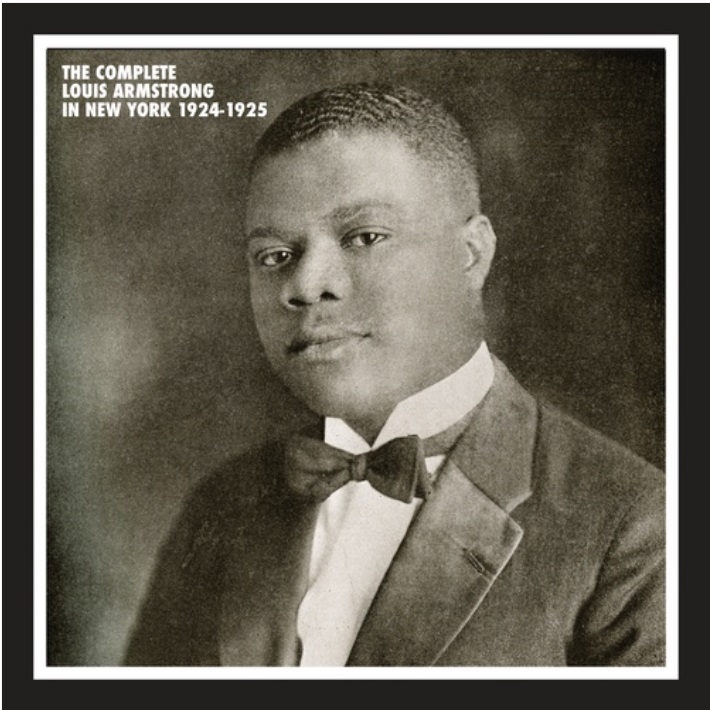
 By the time the 23-year-old Louis Armstrong arrived in New York in 1924, that city had become a vital proving ground for jazz musicians—and a crucible for jazz innovation. It had recording studios and clubs galore; it had radio stations, although dance-band remotes were just getting started. News of this sensational young cornet player had reached Fletcher Henderson, an enterprising pianist who had started his own orchestra at the beginning of that year, and he persuaded Louis to leave King Oliver’s band in Chicago and join him. In so doing, Armstrong become that city’s, and the jazz world’s, most potent innovative force.
We know this thanks to the 134 recorded sides he laid down between October 7, 1924, and November 2, 1925. And they’re featured, with new remasterings, in the new Mosaic Records six-CD set The Complete Louis Armstrong in New York 1924-25. For any fan of this artist—for any fan of jazz history—this is reverential territory. But let’s look at the packaging first. Like all Mosaic sets, it’s housed in a 12-by-12 box. Breaking with tradition, however, this one sports a glossy 108-page hardcover book.

Fresh audio improvement techniques were brought to bear on each of the sides, and restoration expert Doug Benson points out in his notes to this set that one of the biggest challenges lay in effecting aural consistency. “Hearing a well-recorded Columbia session,” he writes, “followed by an inferior dime-store session may be jarring at first and require a slight recalibration of one’s ears to compensate for differences in tone. Toward the end of the set, we also have a mixture of electrical and acoustical sides, which is equally challenging. We have done our best to make the various sessions ‘play nice’ with each other.” (You can find an informative video featuring Benson and co-producer David Sager showing part of the restoration process linked on the Mosaic Records web page for this collection.)
Louis would spend 13 months in the band, relegated to the third-trumpet seat but taking the hot solos (same as Bix’s placement in the Goldkette band two years later). And those hot solos are the backbone of our interest in the recordings. As Sager points out, “Armstrong’s influence would soon grow exponentially, beginning with the musicians in the Henderson band and spreading to the arrangements for Henderson by Don Redman, which eventually gave the band a style bearing Louis’ rhythmic and harmonic edge.”
This is Louis coming into his own after his apprenticeship with his idol, King Oliver. But not all of his talent is on evidence in this set: he takes no vocal refrains, leaving that to the array of singers he backed during recording sessions of this period. “So, it is of prime importance,” Sager writes, “to remember that he was first and foremost a singer and could play anything he sang. However, even moire significant, Louis could accurately sing anything he heard.”

Louis might have remained happy snuggled fairly anonymously in Oliver’s band had he not married the band’s pianist, Lil Hardin. She recognized Armstrong’s talent and steered him away with the promise of better gigs. A few frustrating freelance months followed, but in September 1924 came that telegram from Henderson.
Armstrong arrived and found himsef playing alongside Coleman Hawkins, Big Green, Buster Bailey, and Don Redman, among others, including trumpeters Howard Scott and Elmer Chambers. As Sager notes, Armstrong brought a unique, looser and freer approach to the music. “Whereas Scott, etc. applied jazz effects to their playing, Louis simply played music organically, drawing from his various influences and his inner resources.”
This is why we’re listening to this collection. Armstrong’s unique tone and impulsive approach is heard right from the start, squeezed into 8- and 16-bar solo moments, often blooming into complete choruses, and many times in counterpoint to the vocals of blues shouters.
The eleven surviving tracks cut with Bessie Smith are among the gold of this collection. There’s a five-song session from January 14, 1925, that includes “The St. Louis Blues” and “You’ve Been a Good Ole Wagon,” an astonishing display of packing so much genius into a single day.
We were still in those first weeks of October 1924 when Armstrong joined Ma Rainey and Her Georgia Jazz Band for a single session. It’s a small group drawn from the Henderson lineup, with Fletcher himself at the piano, and Louis is here as a solid ensemble player until the third song, “Countin’ the Blues,” where he solos in elegant rotation with Buster Bailey and Big Green.
Ten sessions with pianist-songwriter-publisher Clarence Williams mostly featured vocalist Eva Taylor (Williams’s wife), but on their first date the singer was Virginia Liston, and even then she missed or sat out the first number, “Texas Moaner Blues,” which lets us hear the sinuous work of Louis and his old buddy Sidney Bechet, their musical sensibilities obviously in sync—but soon to unravel later in this collection.
A month later, the mature Louis comes peeking through his solos on “Everybody Loves My Baby,” with plunger work that took the jazz world—or at least the trumpet division—by storm. By contrast, an Alberta Hunter version of the song follows immediately—it was recorded the same day!—showing a more bluesy approach driven by Lil Hardin Armstrong’s piano.
Both Taylor and Hunter recorded “Cake Walking Babies” with ensembles bringing back the duo of Armstrong and Bechet, whose long-standing rivalry crackles during Hunter’s session, to Bechet’s advantage, but re-erupts two weeks later when Taylor waxed the song and Satch, much-provoked, showed Sidney the future of jazz.

Most of the accompanying ensembles comprised some number of Fletcher’s players, although the pianist might be Clarence or Lil. But the impressive range of singers who took to the studio also included Margaret Johnson, Sippie Wallace, Clara Smith, and Trixie Smith. Three sessions with Maggie Jones feature only Armstrong and Henderson accompanying her, and check out Louis’s lively work throughout “Good Time Flat Blues.” French critic Hughes Panassie wrote of this record, “No lover of jazz worthy of the name should be able to live without it.”
Armstrong’s first recording session with Henderson took place on October 6, 1924. Sissle and Blake wrote “Manda” for their 1924 Broadway show “The Chocolate Dandies,” a show that got mixed reviews, “with many white critics complaining that it wasn’t black enough,” according to the session notes for this set by Ricky Riccardi, who goes on to quote one of the critics as writing, “There is too much so-called politeness, too much platitudinous refinement and not enough of the racy and razor-edged.” Aligning the sentiments of the white Roseland clientele with those of the critic, Riccardi speculates that Henderson had this is in mind when he hired Louis, reckoning that that clientele “secretly craved something hotter, something ‘blacker.’ They didn’t know it yet, but they craved Louis Armstrong.”
Which sets us up for Louis’ 16-bar solo that comes near the end of the song. It’s remarkable not only in the context of this band but also when compared to his recorded solo work with King Oliver, of which only one, “Chimes Blues,” has a Satch solo—but it’s a jolt of electricity. “Manda” picks up where that one left off, spreading the excitement even further.

By the time you get to “Words,” in Armstrong’s third Henderson session, you’ll easily distinguish Louis’s solo at the top of the song from trumpeter Elmer Chambers’s more clichéd work at the finish. And don’t forget, as we analyze these solos, that we’re also hearing the even younger Coleman Hawkins come into his own.
As mentioned, Louis takes no vocal refrains in this collection—Henderson was foolishly insistent on that point—but we get at least an aural glimpse at the end of Take 1 of “Everybody Loves My Baby” as Satch encourages the band calls like, “Aw, now you’re comin’ to it!” And by the time you get to that cut, you’ll already have heard Eva Taylor and Alberta Hunter sing contrasting versions of the song.
Two Henderson versions of the novelty “Shanghai Shuffle,” recorded a month apart, show that Armstrong already was routining his solos, as they’re nearly identical, although he’s capable of refining what he has to say as the solos on three takes of “Alabamy Bound” go to show. And there’s a sense of something else being nurtured here as well when you listen to him on a Red Onion Jazz Babies recording of “Of All the Wrongs You’ve Done to Me,” taking a stop-time solo foreshadowing his groundbreaking “Potato Head Blues” from 1927.
Louis seems to have been born with the kind of advanced harmonic sense later heard in Art Tatum’s playing, and it’s on evidence here on numbers like “One of These Days,” from a November 1924 session. As Riccardi observes, “Armstrong enters from another planet for one of his greatest transformations; right from his opening pickup phrase, he is swinging as hard as humanly possible.”
By April 1925, Armstrong was glorying in his hot-trumpet role, as evidenced by a swinging full-chorus solo in “When You Do What You Do.” Then compare that to “Money Blues,” recorded one month and a quantum technology leap later. Columbia was among the first labels to switch to electrical recordings, and Louis’s solo on this one (both takes) will be manna to your ears, as will Hawkins’s contribution.
Then came Armstrong’s own “Sugar Foot Stomp,” co-credited to King Oliver and twice recorded by Oliver’s ensemble as “Dipper Mouth Blues” when Louis was there. Here the re-named number is re-worked by Redman, but Satch gets what once was Oliver’s solo spot and glories in it even as he pays subtle tribute to the King. The record was Henderson’s biggest seller and should have cemented Armstrong’s position with the band, but the young cornet star had become increasingly unhappy with New York and set his sights on returning to Chicago. A few valedictory sessions towards the end of 1925—including a final hot side for Henderson, Elmer Schoebel’s “TNT”—and he was gone. And ten days later, he recorded the first of the Hot Five sessions.
Mosaic has served Armstrong well over the years, issuing his complete Decca All-Stars studio recordings in 1993, the complete Decca pre-All Stars sessions from 1935-46, the Columbia and RCA Victor live All-Stars sessions from 1947-58, and, just five years ago, his Columbia and RCA Victor Studio Recordings from 1946-66. All of those sets were limited editions (such is the case with Mosaic’s licensing agreements), and all are out of print. This newest set has a limited run of 2,500 copies. Just sayin’.
The Complete Louis Armstrong
in New York 1924-1925
Mosaic Records, MD6-286
mosaicrecords.com
B.A. Nilsson is a freelance writer and actor who lives in rural New York. His interest in vintage jazz long predates his marriage to a Paul Whiteman relative, and greatly helped in winning her affections.