Jeff Barnhart: Dear listeners of Le Music Hot, I’ve got a surprise for you this month! My erstwhile collaborator Hal Smith is wending his way across the country to play at the Redwood Coast festival in Eureka CA (since he lives in Arkansas and drives to his gigs, I think he left in mid-September to get there!) so he’s asked me to look elsewhere for a topic, and I’ve found a terrific one!
A few months ago, Hal and I discussed the great St. Louis Ragtimers in this column. I should point out that they were not the only Ragtime Quartet playing during the second half of the 20th century. Another great group hailed from Denver, CO. They were a subunit of the Queen City Jazz Band called the Queen City Ragtime Ensemble (the final word pronounced so as to rhyme with “aplomb”). While I never heard that quartet perform live, I had the opportunity to several times witness the topic of this month’s column in action. I first performed at the Scott Joplin International Ragtime Festival in 1996, and while I enjoyed all the wonderful pianists I heard that weekend, I was completely blown out of my chair by a Midwest group called the Elite Syncopators.
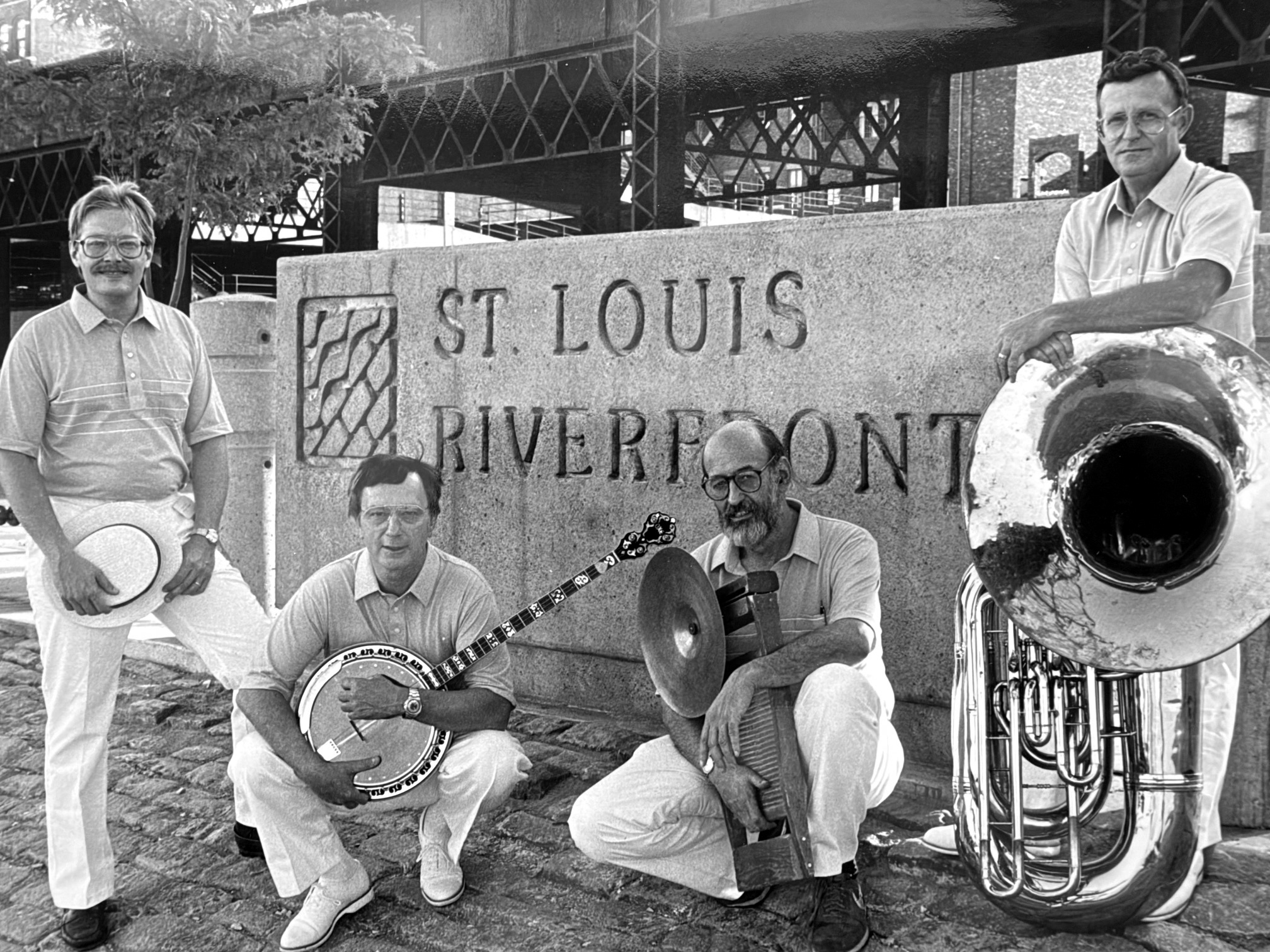
By the time Hal and I had gotten around to discussing the St. Louis Ragtimers, three of the four original members had passed. Happily, the reverse is true regarding the Elite Syncopators (forthwith herein the “ES”): while we recently lost washboardist/vocalist/compère Mike Schwimmer, pianist and Musical Director Terry Parrish, banjoist Jim Marshall, and tubist Steve Ley are still taking nourishment, and will enrich us with the story of how the group came together, as well as share some of their favorite tunes in the band’s repertoire. While the group is no longer actively performing live, there are still ample opportunities online to experience their hot, authentic renditions of Classic Ragtime selections, Cakewalks, and Early Jazztunes. Gentlemen, welcome!!
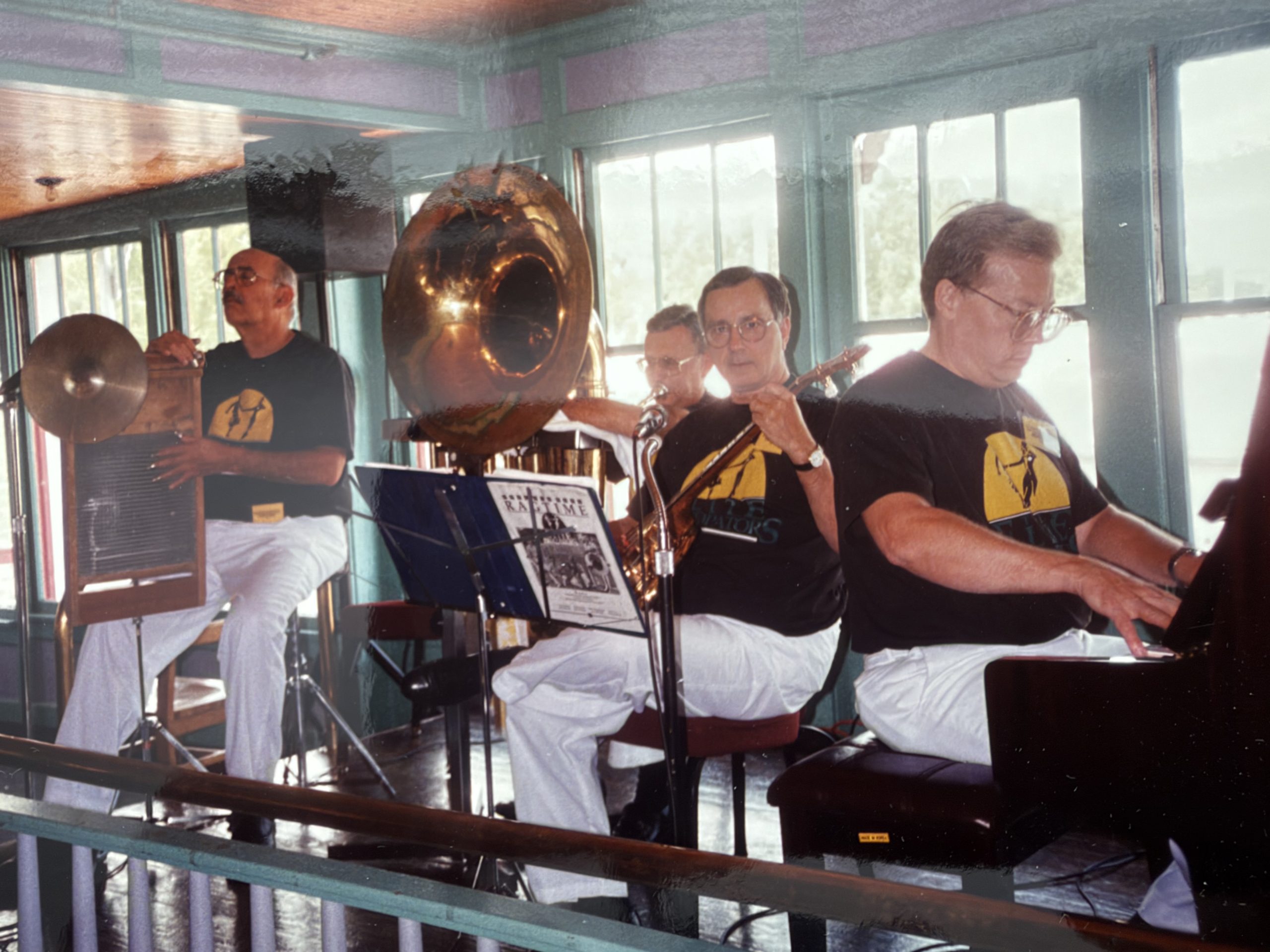
My first question is the most obvious one. When and how did the ES come to be formed? Was the personnel always the quartet I first heard live in 1996?
Terry Parrish: Our group’s story is a serendipitous blending of four individuals with disparate backgrounds: Jim Marshall, a busy publisher, Steve Ley, an attorney with the IRS, our dear departed friend Mike Schwimmer, a well-known washboardist, raconteur, radio broadcaster and collector of everything from piano rolls to cigar boxes, and me, of all things, a psychiatrist! Let me have our legal authority Steve tell you more of how the Syncopators got started.

Steve Ley: In the early 1980s, before we knew one another, the three of us each had developed a lasting appreciation of the music of the St. Louis Ragtimers—the unifying factor. Jim had been following them since their early days in Gaslight Square; I was driving to St. Louis often to hear and sit in with the band on the Goldenrod Showboat, and Terry and Trebor Tichenor shared their love of sheet music collecting. We subsequently met at a meeting of the Classic Ragtime Society in Indianapolis and learned of our mutual interest in the Ragtimers. Learning that Jim played banjo, I invited him to join an informal gathering of musicians. Dr. Terry subsequently joined the group, and blew us away—not only with his playing ability—but also with his knowledge of so many beautiful (yet obscure) rags. We three then began to seriously play as a band. Our first major gig was in 1984 at the Boggstown Inn & Cabaret—a venue as remote as it’s name suggests—where another budding young high school pianist, named Brian Holland, was first drawing attention.
JB: I’ll interrupt here for a moment, Steve. Brian was actually TWELVE when you first played at Boggstown!
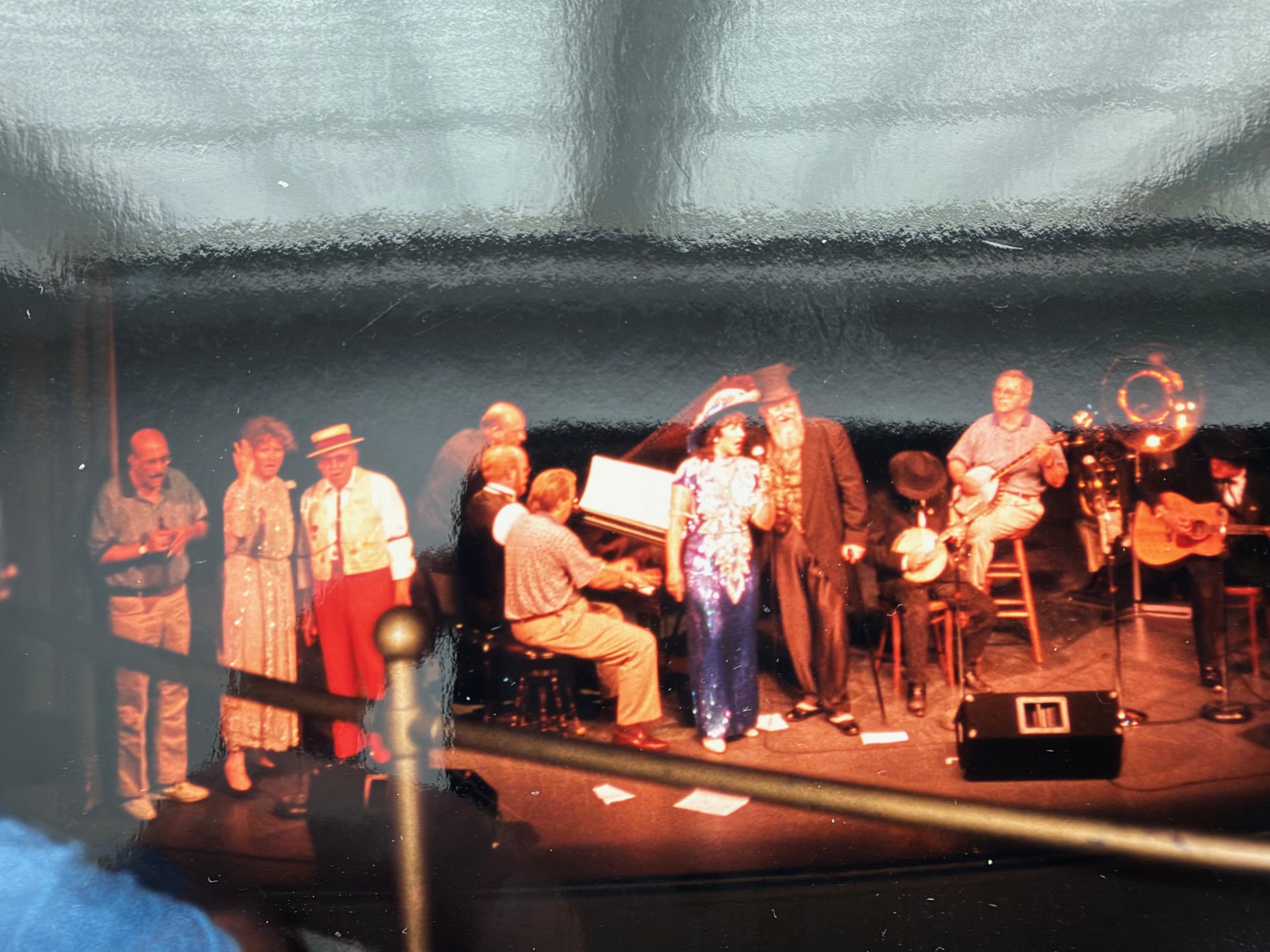
SL: Wow! Well, as our reputation grew, in 1985 we were invited to perform at the annual traditional jazz and ragtime festival on the Goldenrod Showboat in St. Louis. It was there that we met Mike Schwimmer, a percussionist (washboard), and fellow sheet music collector from Chicago, who asked to sit in. Mike was immediately accepted into the band, thus rounding out the rhythm section and serving as MC and vocalist for the duration.
JB: How long was the band active?
TP: We were active as a group from 1985 up to 2021, about when COVID hit. We were fortunate over the years to have been asked to play in Sedalia multiple times, as well as Sacramento, St. Louis (aboard the Goldenrod), Indiana Classic Rag Festival, and many other venues. It was a busy time, but we loved it!
JB: How often were you able to get together to rehearse and how did you choose repertoire?
TP: Interesting you asked that. With all of our busy schedules we would have infrequent practices but as the festival or concert approached we would all get serious and usually practice weekly or several times a week at Jim’s home in Zionsville. These practices were particularly important as we were continually learning new rags and early jazz tunes and had to get used to the melodies and when needed, work on tuba and banjo solos.
In terms of choosing our repertoire, that responsibility was largely relegated to me, which I loved doing! I’ve been a collector or rag sheet music, piano rolls and recordings for fifty years plus, and a lot of the tunes we played were first brought to a practice and, if ’’approved’’ by Jim and Steve, we would work out the chords and arrangements. I loved digging up rare rags like “Meteor Rag” by Arthur Morse, “French Onion Rag” by Les Copeland and “Rapid Transit” by Joe Lamb. Great discoveries!

As far as music director for the group, we actually never had that formally assigned to anyone but it pretty much fell to me. However, the four of us would work out programs selecting different approaches to rags and jazz tunes, play thru it and if it felt balanced and with a variety, it would be a go!
Jim Marshall: Rather than play the tired old war horses, Terry—with his vast knowledge of early sheet music and piano rolls—would pick out little-known rags that had a good melody. Nothing went into the book until it got three thumbs up. And if a tune needed a little help, Terry had the piano magic to make it shine and give it a fresh rebirth. This was particularly effective with the folk rags, which became a popular part of our repertoire.
Terry never stopped digging. At almost every rehearsal he walked in with two or three new pieces, some going back to the 1890s. Over the years we worked up easily 200 tunes, and most of what we recorded had not been recorded in the better part of a century, if ever. I would bet there are another fifty good ones we played for a while and never got onto a record, and I still have tapes of some we never released. People who didn’t want to hear “Tiger Rag” one more time got a chance to discover something different. The credit for that belongs to Terry, and before him to Trebor Tichenor, who was the first to really dig this material out.

One irony: I’m the one who named the band after Joplin’s 1902 rag “Elite Syncopations.” We never recorded it, and I think we only played it once or twice.
SL: I echo Terry and Jim here. It was decided early on that rather than compete with the technical prowess of numerous other ragtime performers, we would let the music speak for itself. At rehearsals Terry would play a selection from his large sheet music collection and Jim and I would give it a thumb’s up or down depending on whether it passed our melodic test. Nor did we limit our repertoire to any particular style. We, of course, relied heavily on the works of the Big Three of Joplin, Lamb, & Scott, and were fortunate even to meet and play for Joe Lamb’s daughter. [E.B. Patricia Conn Lamb, who this author knew as well]
We also loved the folk rags of Brun Campbell. Terry added several originals to our repertoire, such as his beautiful “Yellow Tulips” and “That Old Nashville Rag.” Mike would add variety with vocals on Tin Pan Ally tunes such as “Masculine Women and Feminine Men” and “Doing the Subway Glide.”
JB: I’ll add that I learned one of my very favorite rag songs, “When Ragtime Rosie Ragged the Rosary,” from Mike’s singing it with the ES on that first concert I saw you live in 1996!
SL: Oh yeah, that was a BIG hit for us!
In summary, our tune list varied from the likes of the melodic “Crimson Rambler” to the finger buster “Stompin’ ’Em On Down.” Turk Murphy once said “I play one for the crowd, and then I play one I think they should hear.” We agree.
JB: Steve, that’s a great quote from Turk, and one I feel we should ALL agree with! Before we move on, I’ll share that Brian Holland and I both learned “Stompin’ ’Em Down” from the ES and it remains one of our most requested tunes as a piano duo. THANK YOU!
Would any of you care to share the reaction your particular sound had on listeners and how you came to cultivate it?
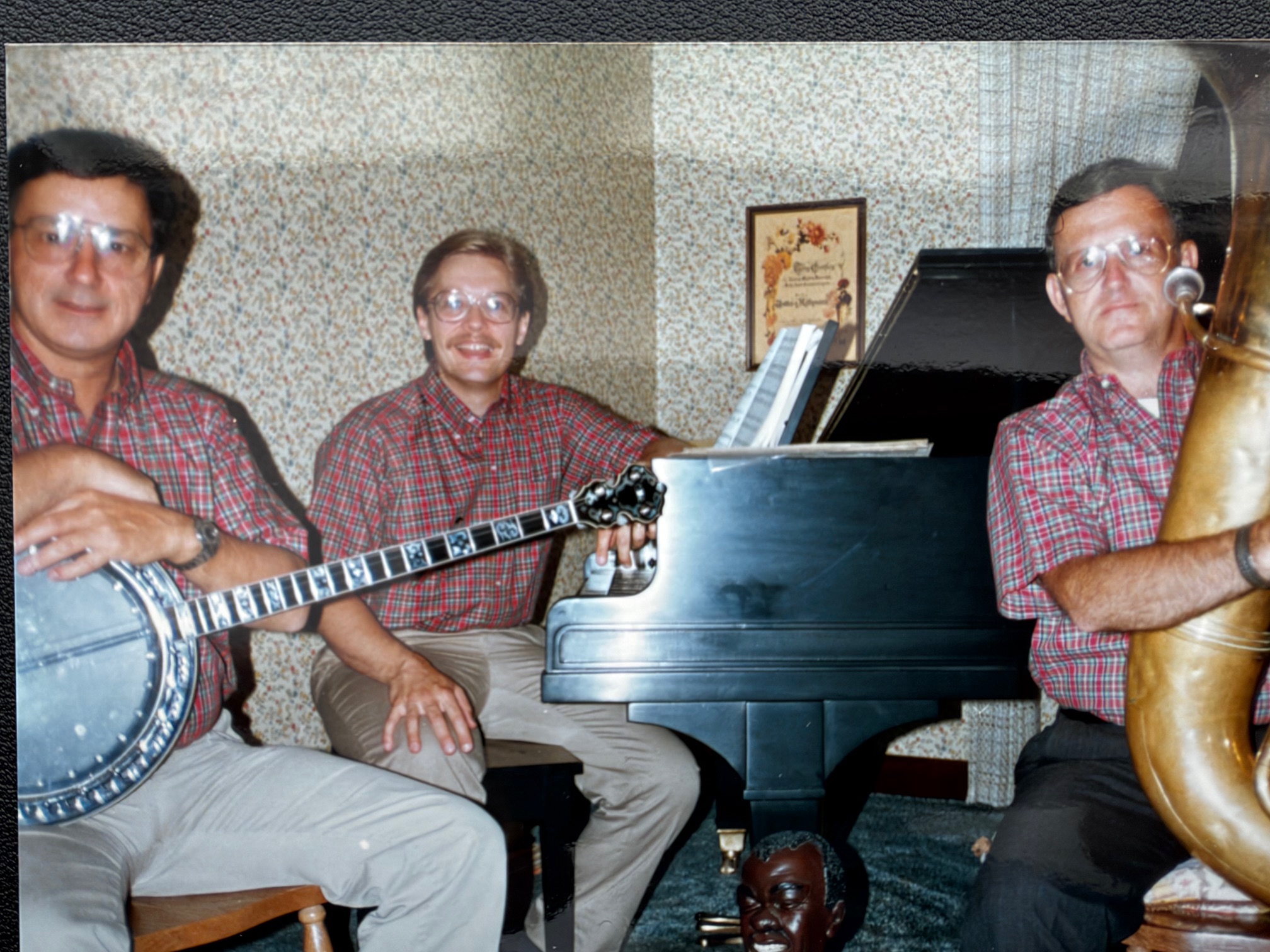
JM: You might even call it style development. Many people have commented on it. Wally Rose, the original pianist with the Yerba Buena Jazz Band, came up to me on the Goldenrod Showboat and told me that when he first saw us, he wondered how a pianist like Terry would ever work with a traditional jazz rhythm section. He said he was stunned at how good it sounded, and that we had a unique, very listenable style. When I asked Trebor Tichenor how we could improve as a group, he said, “Don’t change a thing.” And Bob O’Friel, who had the radio program Jazz Lives, wrote in the liner notes for our Stomp Off CD that the combination of Jim Marshall and Steve Ley “fit Terry like a glove.”
We didn’t necessarily plan that; it just happened. The formula, if there ever was one: a full, blended bass and a smooth banjo, nothing bombastic or choppy, just enough to support and not disrupt Terry’s golden-tone piano. We didn’t call him Dr. Chimes for nothing.
JB: Nice thoughts, Jim. At the height of the band’s activity, how many gigs were you playing annually, and in what kind of places?
TP: Guys, wouldn’t you say this was highly variable? Though when we were busiest we were asked to play a on an annual basis in Sedalia, as we were about the only small ragtime group in attendance. I think in all we would play about four to five or more performances annually. Not a lot, but enough to keep us going!
SL: Most of our jobs over the years were concerts and ragtime festivals, the most prominent of which were the annual aforementioned St. Louis Goldenrod festival, the Scott Joplin festival in Sedalia, and of course our own Classic Ragtime Society festival in Indianapolis. Although we didn’t rehearse often, when we did, it was a hoot. Mike would regale us with his humorous (though often long) stories, while Terry would entertain with his Donald Duck impersonations.
JB: I sincerely would’ve liked to have been there!
JM: Since you bring up venues and playing live, we were careful regarding how we were being presented. Once you have a sound, you have to keep monitoring it. Whether you’re playing a gig or recording, don’t assume the engineer has the same ears you do. They don’t. Moving a microphone just six inches can make a major difference. A showboat, a concert hall, and a studio are all different rooms, so we always did a sound check. The three of us had a shared ear for what the band should sound like, and we made sure that’s what came out.
JB: Are there any favorite concerts you each have? Conversely, are there any disasters you’d like to share?
TP: I remember our very first appearance in Sedalia when Dick Zimmerman came to us asking us to fill in for another player who didn’t show, which was about 1985. We were all nervous, but we played really well and the audience loved our sound. As far as things not going well (i.e., disasters), we all remember being asked to play at a church festival fund raiser, but upon getting there found no piano except for a miniature play-a-tune toy. Oh boy, anybody have a spare upright?
SL: Terry, that would actually happen more than once. Infrequently we would arrive at a gig to find no piano (“I thought you would bring your own”), or just a small laptop keyboard.
JM: Here is my favorite anecdote. Terry got to talking records with George Foreman, who ran the Great American Brass Band Festival in Danville, Kentucky. George wasn’t sure ragtime belonged at a brass band festival, but he asked for a tape. A week later he called back and said he’d been listening to it for two days and really liked it. “Let’s try it once.”
I figured we were headed to a little small-town concert and didn’t even bother to practice. Then I pulled into Danville and onto the Centre College campus and saw television cameras and 12,000 to 15,000 people. The Canadian Brass was on the bill. The first band up was full of University of Kentucky music school people, and they were awfully good. Then the Jack Daniel’s Silver Cornet Band came on with “Entry of the Gladiators,” and they were incredible. We had to follow them, three guys with a piano, banjo and tuba, the complete opposite of everything the crowd had just heard. When we finished our first number, the members of the JD band stood up and applauded us. We were invited back the next year.
SL: Terry, that would actually happen more than once. Infrequently we would arrive at a gig to find no piano (“I thought you would bring your own”), or just a small laptop keyboard.
JB: I know in addition to live performances, the band occasionally recorded. Can you share some highlights?
SL: Sure! Our first major recording was made without advance notice while appearing at the St. Louis festival in 1986. It was issued on the Jazzology label as a cassette only. Then in 1988 we recorded our first CD for the Stomp Off label (Ragtime Special—SOCD 1286). Our second CD for Stomp Off was recorded in 2000 (American Sampler Rag—SOCD 1358). The band also produced a self-recorded commercial cassette release with John Otto joining us on reeds (Ragtime and a Bit More).
JB: Although the band is no longer together, are any of you still playing and/or performing?
TP: Alas, our performing days are over. I know Jim is still keeping up with his banjo-istics, and I play for good friends at birthday get togethers. We miss those days when we were active and being asked to perform with a bit more regularity.
JB: Terry, don’t you still play solo engagements?
TP: I rarely play solos at festivals now, the most recent being several years ago in Frankenmuth, Michigan with Bob Milne (and you!} and Sedalia for the Joplin rag fest. Since the group is no longer active, I am pretty much only playing solos for my own amusement at home! ’Course, I would not be opposed to being asked to play at some future festival!
SL: The band was active until about the onset of the Covid epidemic and my Parkinson’s diagnosis. Although we no longer play professionally as a group, and recently lost Mike Schwimmer, the remaining three amigos still get together often to reminisce and talk about coming out of retirement.
JM: It’s worth remembering that none of us did this for a living. Terry was a child psychologist, Steve was an attorney for the IRS, and I owned a marketing consulting firm. We were never a heavy touring band, and nobody makes money at this. When I look at the list of what we recorded, I’m a little overwhelmed that we managed it at all. What kept it going was a shared passion for the music and a friendship that has lasted more than forty years.
We were also lucky in the company we kept. Mike Schwimmer was with us for a good stretch and is on our recordings; with his radio announcer’s voice, he gave audiences the stories behind tunes they had never heard. Friends from the St. Louis Ragtimers and the Salty Dogs sat in with us along the way.
JB: You all most likely had favorite tunes from the repertoire.
TP: As for me, there are so many rags I love it’s just not possible to single out one. I love James Scott and Joe Lamb’s rags, and there are a number of them on our Stomp-Off CDs we recorded over ten years ago.
SL: I am with Terry on this one. Because our repertoire was so large and varied it is impossible to single out favorites. It is to Dr. Terry’s credit that he was able to play so many different styles. I personally enjoyed playing the folk rags of Brun Campbell, and in particular Terry’s own “That Old Nashville Rag.” Actually we mostly ignored Turk’s advice and only played tunes that we thought the audience should hear. I hope they enjoyed them.
JB: The longevity of the group proves that they did! Well, I’ll share some of my favorites and see what memories these awake in you all! Readers, links can be found in the online version.
I’m starting with a video of a trio performance (Mike Schwimmer is not in this vid) from 1987 aboard the historic Goldenrod Showboat at the famous Ragtime Festival in St. Louis, Missouri in 1987. The video incorrectly lists this piece as Joplin’s “Elite Syncopations.” Terry, can you please provide the correct title? I love the groove, the bouyancy, Jim’s occasional single-string interpolations, and especially the final chorus of the reprise of the B strain!
TP: That obscure tune is “Easy Pickins” by Egbert Van Alstyne from 1902. We liked this rag because of its lively, strutting sound. We frequently would start cakewalking around Jim’s house! LOL!
JB: Next up is a fun ride on a very obscure tune,”Oh Willie, Play That Thing.” I love how well this is recorded, Steve’s sonorous loooowww notes on the tuba, the bouncy banjo, Mike’s rhythm, the tempo, Terry’s novelty piano breaks, the breaks for banjo and tuba, and the band calling out the title twice during the side. Guys, this one is HOT!
TP: Bill Krenz was a wonderful pianist who wrote not only novelty pianos in the 1920-1930s style but later in the ’50s composed some ragtime revival pieces that were pianistic knock-outs. This one, plus his “Poodle Rag,” were two of our favorites.
JB: My next choice is a piano solo, an original by you, Terry! Could you tell our readers the meaning of the title “Billy Meets Zez on 12th Street?” and share what inspired you to create such an incredible piece?
TP: I have long admired the American pianist Zez Confrey and British genius Billy Mayerl. I thought well, if these two fellows got together on a rag everyone played but with each contributing some of their own styles, what might it become? This pastiche of breaks and other fancy pianistics was sincerely dedicated to these two chaps! I sometimes wonder how on earth I could play this thing!
JB: Back to the quartet and some earthy rag-blues with “Texas Blues.” A totally different sound from the group with some soulful harmonic changes. Any thoughts about this one?
TP: Another of my personal favorite ragtime composer-pianists was Leslie C. Copeland, a true oddity among eccentrics! This version is quite different from Les’ own piano roll version, ours being in a more plaintive, perhaps melancholy blues setting.
JB: The only music I can find on YouTube from the group is from your release The American Sampler. Are there any additional titles from that album you’d like to share?
TP: Among my very favorite classic rags we recorded were “Honeymoon Rag” and “Sunburst Rag”: immortal rags! I enjoyed “Bow Wow” too, a great one step that features my take on a Charley Straight break mid-tune!
JB: Since there are no Mike Schwimmer vocals on that release, as a lagniappe I’ve included a fun video of Mike Schwimmer in vocal action! I’m sure you miss him as much as do I!
TP: We were all saddened with the news of Mikey’s passing. He was the ultimate vocalist and raconteur who always made things fun for us! I had know him since the early 70’s when he and his brother had frequent piano roll auctions. Ah, those were the days…
SL: WOW! It’s great to see Mike performing his signature vocal, “Red Rose Rag.” His infectious personality entertained us for so many years.
JB: Before we part company, have you any final thoughts?
JM: Well, Jeff, as you brought them up at the beginning of our conversation, I’ll emphasize that like the St. Louis Ragtimers, who stayed together for over forty years, we did the same, because we all liked each other. We haven’t played in quite some time, and we each have our share of things to cope with these days. I’ve also heard too many bands try to come back and not sound nearly as good. But we still get together regularly for lunch in Indianapolis, trade CDs, and reminisce about the good times. We talk about a comeback now and then. The odds aren’t great, but I won’t shut the door. Who knows?
JB: Guys, I’ve really enjoyed sharing the story and sounds of your great group, The Elite Syncopators! Even though the group has packed it in, the many recordings and memories will keep the band alive! Thanks for joining me!
TP: Thank you, Jeff! This has been a great trip down ragtime memory lane!
JM: Thanks for taking an interest in the band, Jeff.
JB: Next month, I’ll welcome Hal Smith back and we’ll discuss some of our favorite recordings by the great pianist Joe Sullivan!
Jeff Barnhart is an internationally renowned pianist, vocalist, arranger, bandleader, recording artist, ASCAP composer, educator and entertainer. Visit him online atwww.jeffbarnhart.com. Email: Mysticrag@aol.com