We’ve all heard many of the jazz history’s more accomplished musicians resist explaining the creative process behind their composing or playing, preferring instead to let the music “speak for itself.” After all, an artist of any kind would want a new creation to express in some way the thoughts and feelings that went into it.
But some of history’s best-known and respected jazz musicians, despite their popularity—or perhaps because of it—have remained somewhat enigmatic to their fans, and were not overly eager to discuss their art in a straightforward manner such as an interview with a journalist. It wasn’t always common to hear the top musicians of the day speak for a recorded conversation, but there are a number of recordings from the mid-20th century that have allowed devotees to catch just a glimpse of our legendary musicians’ thoughts, feelings, and opinions covering a wide range of topics within the jazz world—which makes those interviews all the more fascinating today.

A prime example is that of Lester Young, regarded as one of the greatest tenor saxophonists of all time (hence his nickname “Prez,” as in “President of the Tenor Saxophone”).
Prez had been known as somewhat eccentric; when he spoke, he peppered his speech with jazz slang and, when he wasn’t being guarded on radio—a preponderance of four-letter words, as well as his invented phrases, such as “having eyes” for a piece of music or an individual (that is, enjoying or meeting his approval). As the surviving recordings demonstrate, he was softspoken, never rushed himself, and could be upbeat, cordial, and talkative. But wandering into certain topics could change the mood abruptly. Most of the surviving interviews took place in the 1950s, when it has been said he went through a period of decline, brought on to a great degree by his alcoholism and emotional scars from traumatic periods of his life, such as his harrowing 15 months in the army.
Prez’s illustrious career has been documented for decades, with details of his life as a musician available from many sources. So, this piece is not meant to be a full retrospective by any means. Rather, it’s meant to put his own words front and center. So, let’s hear more from Lester Young himself.

The oldest surviving recording of Prez being interviewed dates to late May-early June of 1947, when he spoke with WMEX in Boston. Unfortunately, the recording is badly deteriorated, and virtually all of his comments are inaudible, with his softspoken answers drowned out by static and crackling. This was just two years after being dishonorably discharged from in the Army, where he was denied the opportunity to serve as a musician in an army band, and confronted with harsh racism and a particularly sadistic drill sergeant.
In 1951, jazz critic Leonard Feather interviewed Prez, with part of their talk consisting of Feather’s Blindfold Test, during which a musician would be asked to comment on random recordings without knowing who was playing.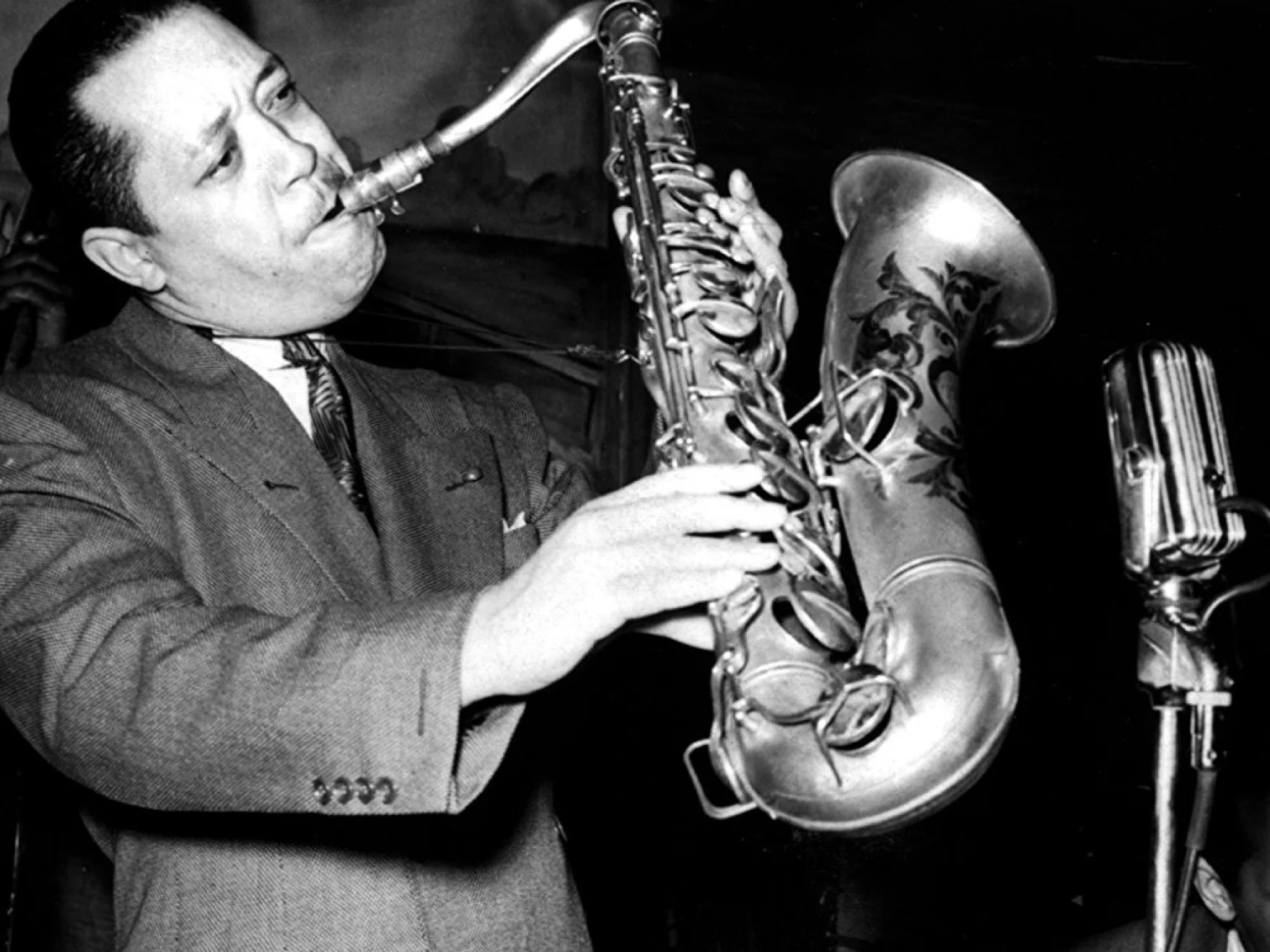
At one point in their discussion, Feather asked Prez his view of the up and coming generation of tenor sax players, such as the Four Brothers in Woody Herman’s band, and the school of tenors whom he had inspired.
“Everybody wants to ask me that,” he replied. “Well, I’ll tell you, well they just fascinate me you know, because I hear little things that I’ve played and it just knocks me out, things like that, you like the way tenor is going down. Sure, I mean I always liked it like that, you know what I mean, because when I first came to New York you know I got bruised because I didn’t play like Coleman Hawkins. So I used to do a lot of teardrops behind that, but I mean, I say well you know some people just don’t have eyes for certain things. So just listen the way you feel and I hear the little people playing like that. I’ll go and buy their records too and things, and sit up and listen and knock me out you know.”
He explained that his record-buying habits were quite simple and straightforward.
“If I hear one I like it or something, or they play one over the radio or something, I’ll go and get it. I like to be—mostly like a variety, you know, I wouldn’t like to get hung up with one thing, so that’s why I speak like that. Yeah, I play quite a wide variety of things…just all music and all day and all night, music and things you know it’s just like that… Woody Herman, if you keep jumping like that that’s me yeah all the
time so that’s straight.”
Europe’s appeal to many jazz musicians grew stronger in the post-War era, but he claimed not to notice any real pattern of enthusiasm among American audiences in the Mid-west or West coast.

He also addressed the issue of segregated audiences in the South: “…it’s just a job though, but the people like music that’s what comes you know, even some of them places where they play—they have them ropes and things like that, the people are there, so you know they must love music, ’cause I wouldn’t make no ropes to go hear nobody myself. If it was like that…the way they do them ropes, white on that side colored on this side…well they still do that at many places, very few… but there’ll be one or two on the tour, you know, like Texas, that’s usually the way it happens… I don’t try to dig them you know, that hard, but I know some place they segregated I know that you dig. We went to New Orleans, that’s right there, the rope’s there. That’s what I mean. Them ropes, you dig, but you don’t want to talk about that, make everybody feel bad, but it’s true, what I mean. And it’s hard for me ’cause I’m standing out there playing with gray boys, you know. All I have to lean on is what is it, me and Sweets and Ray and Hank, you dig, but they’re sitting down mostly but me and Flip and Bill Harris, you dig what I mean? It’s Sweets, we’re out there, and then people love them, you know…”
He continued, “I feel the same way, the white on that side the colored on that side you
know, both sides but one thing is half and half, 50/50 you know what I mean, they’re all

enthusiastic. They seem to be enjoying it…I mean I’m like that I feel real sorry for them, why they don’t leave in come up New York where they could just go somewhere for themselves…”
On August 24, 1958, Chris Albertson of WCAU in Philadelphia caught up with the Prez for an on-air conversation.
Lester spoke of how difficult it was for him personally to replace the great Coleman Hawkins in Fletcher Henderson’s band.
“Yeah, well I had a lot of trouble in those days, because the people couldn’t understand the way I sound, and they wanted me to play like Coleman Hawkins, you know? But to each his own… I caught all kinds of trouble, because most of the people came out to see him, and see me up there, and listen to the way I sound, but they’re looking for him. I think he was in Switzerland or Sweden, something like that.”
He seemed happier to talk about his close friend and collaborator, Billie Holiday. He first met her “when I came to New York in 1934. I used to live at her house with her mother, ’cause I didn’t know my way around. She taught me a lot of things, got me little record dates, you know, played behind her with little solos…”
Holiday had called him her favorite soloist, to which he replied, “She’s mine, too! So that’s a draw!”
She indeed gave him the nickname Prez. “Yes, she did. And I gave her the name of Lady Day.”
Albertson noted that Holiday had said her style of singing was formed on Lester’s style on tenor sax. “Well, I think you can hear that on some of the old records,” he replied. “Sometimes I sit down and listen to them myself and they sound like two of the same voices if you don’t be careful—of the same mind, or something like that.”
He then briefly offered his memories of her and Basie band: “I just know we were all happy, always waiting to go to work.”
Albertson then asked about Basie’s comments concerning recording in the old days, with only one mic in the studio, as opposed to modern techniques using several mics placed throughout the studio to get each section of the band. “I don’t think I’d go for that,” Prez replied, “ ’cause if you only have one mic you gotta run up to it and play and sit down…”I still don’t buy that—to each his own. I don’t think like that.”
As any interviewer would ask, the subject of Lester’s favorite records came up, if he had any at all. “I really couldn’t say…when I get by myself, I just play ’em and enjoy them all…My favorite singer today is Jo Stafford. I’d go there. And Lady Day, and I’m through.”
Albertson pointed out that Jo Stafford wasn’t really considered a jazz singer. “No, but I hear her voice, and the sounds, and the way she puts the songs out…”
Prez also addressed whether he preferred to play as he did years earlier, or if was more interesting change things up. His answer revealed a musician who was still striving to evolve and grow. “I think it was nice doing those days, I feel like I had a lot of trouble on the bandstand when they’d say, “how come you don’t play like you played with Count Basie?” But that’s not progressive, you know? If I’m gonna stay there and play the same stuff year after year, well, Jesus, I’d be an old man, you know? So I don’t think like that. So I have to think of little new tricks and new sounds and things like that.”
He didn’t have a problem with or feel threatened by the younger generation of musicians at that time, either. “Well, I’d have to say I like them all. They all sound the same to me because most of them went to Julliard, and whoever that teacher was taught them all the same thing—this one will stop playing it, this one will pick it up…in my mind whereas the individual is gonna come out and play it for himself—like if you have 13 people and the teacher teaches all 13 of them, you mean to tell me out of 13 he can’t get one individual? So that’s the way I think. But I like them all.”
What about Coleman Hawkins’ style?
“Well, the way I look at him, he’s the first person to play tenor saxophone who woke you up and let you know there was a tenor saxophone, so I see all the kiddies copying his style and think like that. That’s about all I can say on that.”
He also acknowledged the re-issues of the old Basie records.
“I have some in my room, I listen and try to dig little mistakes, things that are a little better.”
As to his health issues, which had been steadily worsening throughout the 1950s, “I’ve been off, I was a little sick, had to go to the hospital, I haven’t worked since the 5th of July, this is the first week I’ve had—taking a little time to build your chops, you know?”
On February 6, 1959, Prez talked with French writer Francois Postif in a Paris hotel suite, where he sounded upbeat for the most part, but his answers often came a little more slowly—perhaps more thoughtfully. Regarding his freewheeling use of curse words, he conceded to Postif early on, “I talk nasty! Can you cut out the nasty?”
He did begin on a playful note with his answer to the first question regarding where he was born. Many observers cited New Orleans as his birthplace.
“Should I really tell you? I could tell you a lie!” he said with a chuckle before setting the record straight. “I was born in Woodville, Mississippi.” His family moved to New Orleans, where the music bug first bit him. “In New Orleans, they had those trucks going around town to advertise for a dance, and this excited me, you know? So they gave me handbills and I loved that music. I was running all over the city until my tongue was hanging out. I still didn’t know my father was a musician.”
Postif inquired about Lester’s earliest influences on saxophone. “I had a decision to make, between Frankie Trumbauer and Jimmy Dorsey, and I wasn’t sure which way I wanted to go. I’d buy me all those records and I’d play one by Jimmy and one by Trumbauer, you dig? I didn’t know nothing about Hawkins then, and they’re the only ones telling a story I liked to hear. I had both of them made.”
Later, the subject of Coleman Hawkins inevitably entered the conversation. As he told Chris Alberson the year before, being compared with Hawkins so often, especially in the early days, wasn’t always easy for Prez to take. But in this discussion, he paid due reverence to his fellow tenor virtuoso. “As far as I’m concerned, I think Coleman Hawkins was the ‘President’ first, right? When I first heard him I thought that was some great jazz I was listening to. As far as myself, I think I’m the second one. Not braggadocious, you know I don’t talk like that. There’s only one way to go. If a guy plays tenor, he’s got to sound like Hawk or like Lester. If he plays alto, he’s got to be Bird or Johnny Hodges. There’s another way, the way I hear all the guys playing in New York, running all over the place…”
He also again addressed the issue of playing old favorites versus forging ahead with new ideas for his style. “In my mind when I play, I try not to be a repeater pencil, you dig? Always leave some spaces—lay out. You won’t catch me playing like ‘Lester Leaps In’ and that sh-t, but I always to back.”
He noted that he had been hearing the rumors about his health and a link to his supposed drug use, which he denied, to some extent.
“Man, they say ’he’s an old junkie, he’s old and funky, and all that sh-t, that’s not nice. Whatever they do, let them do that and enjoy themselves, and you get your kicks yourself. All I do is smoke some New Orleans cigarettes [marijuana], don’t sniff nothing in my nose, nothing. I drink and I smoke and that’s all. But a lot of people think I’m this way and I don’t like that, I resent that. My business is the musical thing, all the way.”
Prez made his final studio recordings and live performances with a small group the following month. His planned European tour was abbreviated, as he reportedly was eating very little and drinking heavily. On a flight to New York City, he suffered from internal bleeding determined to be due to alcoholism, and died on March 15. He was only 49 years old.
Leonard Feather accompanied Billie Holiday to Lester’s funeral, and claimed that she said afterwards, “I’ll be the next one to go.” She died four months later on July 17, 1959, at age 44.
Lester Young may not have revealed all of his feelings or secrets in his interviews—such as how he produced such magic from his tenor sax—but it’s fascinating nonetheless to hear this jazz giant doing at least some of the talking about himself and his music, in harmony with his beloved instrument.

For over twenty years, Garry Berman has written books and articles related to pop culture and entertainment history. He has contributed articles to Beatlefan magazine, Nostalgia Digest, and History magazine. In addition to his non-fiction work, he also writes comic novels and screenplays.He is also co-administrator of the Facebook group page Friends of Sant Andreu Jazz Band. Visit him online at www.GarryBerman.com.