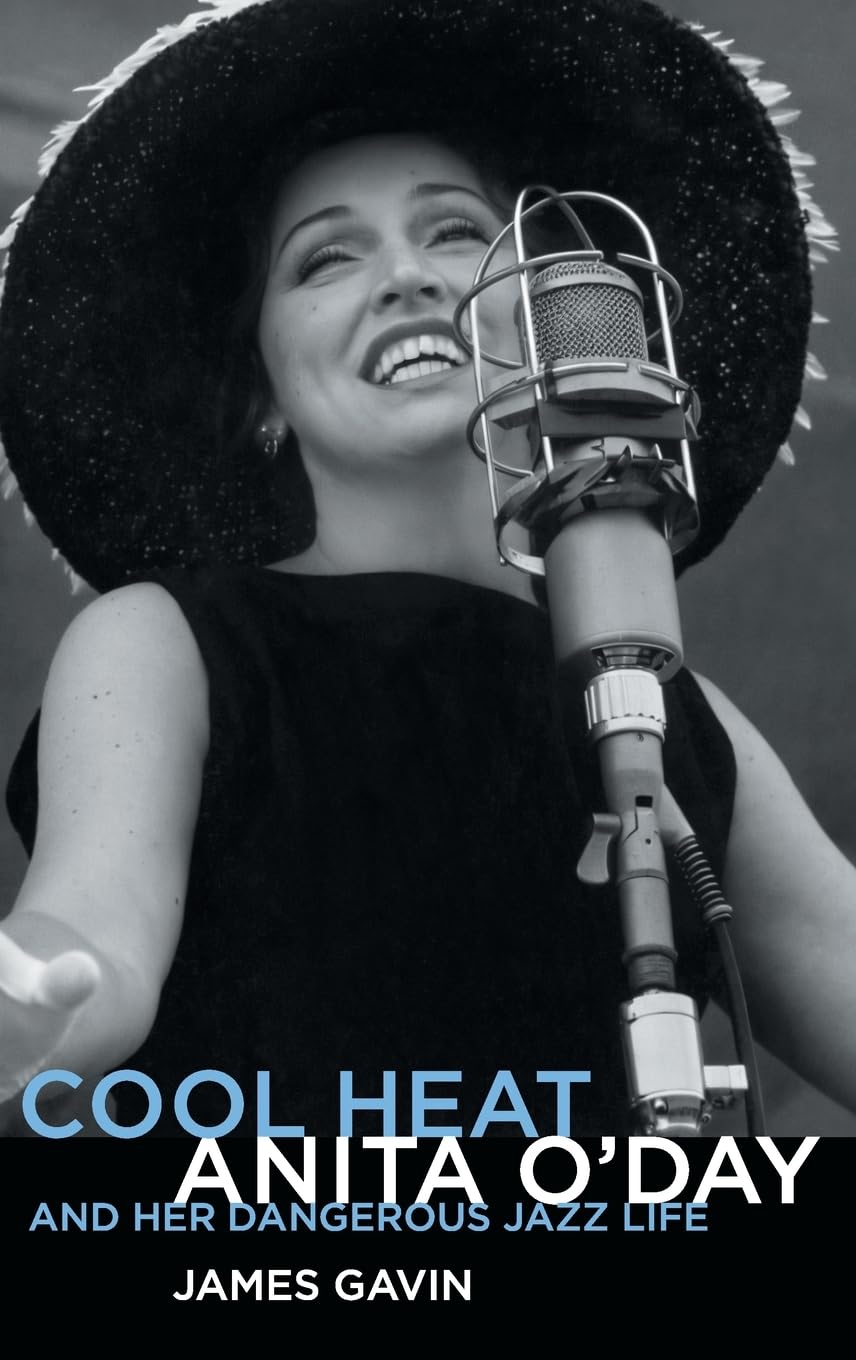
 The word “love” shows up in many a song, the standards especially, offering emotional reinforcement whatever your situation when your favorite singer sings that word. Songs question it, regret it, disparage it, and above all celebrate it, and when your singer is hip to those complexities you can glory in the comfort coming from one who understands.
Listen to Anita O’Day sing one of them. In her hands, which is to say in her vocal equipment, the word enjoys a forensic dissection. The opening “L” often eases from its most common sound into a more back-of-the-palate dark L, followed by the vowel sound signified by “O.” It’s typically pronounced (according to the International Phonetic Alphabet) as an open-mid back unrounded vowel, symbolized with “ʌ” (unsurprisingly known as “upside-down V”).
O’Day makes it more than that. She travels along that sound as if it’s a stretch of emotionally fraught highway, giving it tension and nuance no other singer offers—even her many imitators, like Chris Conner and June Christy. “It’s a complicated, unpredictable subject, this ‘love’ stuff” Anita is in effect saying, “and I’m not sure I can take it very seriously.” When you read her new biography, James Gavin’s Cool Heat, you’ll understand why.
The world of jazz singers is relatively small—relative when compared to the mass of crooners and other such stylists—and demands a facility with the voice on a par with an instrumentalist’s on an instrument. The words don’t necessarily matter as much as the note-choices and rhythm, and whatever melody the songwriter labored to craft is typically discarded in favor of a re-styled and possibly re-harmonized variation. That was Billie Holiday’s specialty. Ella Fitzgerald, on the other hand, honored the melody before taking it into stratospheric scat segments. But Ella never sounds entirely sure of the meaning of the lyrics, while Billie, especially in her later years, made it all about suffering.
Anita O’Day was in a category all her own. She knew what those lyrics meant. No matter what else she may have been doing with them, scooting them ahead of the beat or scooping them through blue notes, she told the story. She had a limited vocal range and only in-the-field training, but hers was an instrument as imaginative as any good horn in the band. As her life story reveals, it was an ability gained through pain, and Gavin skillfully takes us through her struggles and triumphs.

He has tough competition. O’Day and George Eells wrote the story in 1981, under the title High Times Hard Times. She was candid about her drug addictions but elusive about her emotional life, and fairly dismissive about why she sang the way she sang even as she emphasized that singing was what she lived to do, taking precedent over all else. But as you read Gavin’s book, which uncovers much that was hidden from the autobiography, you begin to understand how the strong affections in her life—for family, for musicians, for boyfriends and husbands, and particularly for herself—colored that complicated “love” in her singing.
She was born Anita Colton in Chicago in 1919, an event that persuaded her parents to get married. But it was an ill-starred match, and her father, an alcoholic womanizer, left when Anita was seven. Her mother wasn’t much better, constantly belittling the youngster. But, writes Anita, “Like a turtle, I developed a hard shell to protect myself.” That shell became a shield that helped her survive through decades of performing in a male-dominated industry. As a child, she had no interest in school but pursued an interest in dancing, beginning with a Lindy Hop contest she entered at the insistence of a boy she liked, whose influence was still greater: “On the night of their first competition,” writes Gavin, “He handed the adolescent Anita a joint, claiming it would make her dance better. They won the contest, which paid a cash prize. She kept smoking and loved the effects; fear and stress vanished in a puff of smoke.”
A popular Depression-era gawk-at-it sport were the dance marathon and the walkathon, both of which were endurance contests that could go on for days. Anita parlayed her ability to dance for hours into recognition from both types of contest, along with plenty of travel and her first attempts at singing in public.
Throughout 1935 and 1936, she did six marathons. She boasted of having once danced for 2,328 hours, or 97 days. But the highest she ever ranked was second place. It forever irked her. During the marathons she decided that singing—like all of life—was a race to the finish line under daredevil conditions. You either wound up a winner or in second place. Persistence was key.
This was also when she came up with new last name. Pig Latin was in vogue among kids fashioning themselves as hip, and Anita decided that what she most wanted in life was money—dough. Thus: O’Day. What would prove ironic is that she would go on to make plenty of dough but found a variety of ways to stay broke.

None of which was apparent in 1937, as she doggedly continued her climb. Gavin charts her progress much more efficiently than O’Day does in her own book, listing a staggering
sequence of Chicago clubs that included the Celebrity Club (a hook shop, although Anita wasn’t selling), Vanity Fair, the Tavern, the Ball of Fire, the Sun Dodger, the Pink Poodle, and Planet Mars, a former speakeasy once run by Texas Guinan.
It was there that she began imitating Martha Raye, whom she admired for both singing and comedy, and where guitarist Al Lyons noticed an anatomical anomaly:

(He) peered into her mouth and announced that she had no uvula (the piece of epiglottis that hangs above the entrance to the throat). When O’Day was seven, her tonsils had been removed and her uvula was accidentally snipped off; she went on to blame the mishap for her supposed inability to sing sustained tones or use vibrato.
Neither of which actually characterizes her singing, nor is it true that a missing uvula would have any such effect: “The uvulas secretes saliva and keeps food and liquids from entering the nostrils; in no way does it influence vibrato or vocal control,” Gavin explains, adding that “O’Day did have a modicum of vibrato, but tremolo meant emotion, and the only feeling she wanted to show was bright, upbeat command.”
She auditioned for Benny Goodman, and “started improvising after the first chorus. He stopped her. ‘Don’t you sing melody?’ ‘I try not to.’ ‘In my band, the girl singer sings the melody.’” But, while singing at Chicago’s Off-Beat Club, she impressed a visiting Gene Krupa, in an encounter that would change both of their lives. He promised to hire her should his regular singer leave the band, and, although it took over a year, Krupa eventually hired her. She was 22.

This is when the Anita O’Day story usually begins for jazz fans, with her recordings of hits like “Boogie Blues,” “Georgia on My Mind,” and especially “Let Me Off Uptown,” a duet with trumpeter Roy Eldridge that you can find as a Soundie (a kind of music video) on YouTube.
Both O’Day and Krupa were enthusiastic pot users, a substance that had been legal until 1933; by 1943, the Federal Bureau of Narcotics began an all-out campaign against it, spreading the kind of misinformation made famous in the cult classic movie Reefer Madness. Early in 1943, Krupa was arrested after being set up by a plant he’d hired as a gofer. It was a national headlines case. The drummer served 90 days, but his band broke up in the meantime.
O’Day didn’t stay unemployed for long. She was hired by rising young bandleader Stan Kenton. Although she didn’t want to go back on the road, her manager convinced her to do it for a year. Kenton biographer Carol Easton wrote that this was “the truly marvelous mismatching of supersquare Stanley, who could barely bring himself to say damn, and superswinger O’Day, whose favorite adjective was fucking.” Despite a growing chorus of awards and accolades, she didn’t even last the year with Kenton, but the singer O’Day recommended as a replacement settled in for an impressive career once she changed her name from Shirley Luster to June Christy.
There’s no question that O’Day sounded great with a big band, as many of her later Verve recordings prove. Norman Granz began recording her in small-group settings in 1952, four sides apiece led by Ralph Burns and Roy Kral, but at the end of that year she went into the studio with Larry Russell’s Orchestra for a session that included the unknown “Vaya con Dios.” These were issued on Granz’s Clef label, but later would be collected on Verve reissues and, ultimately, a nine-CD box set from Mosaic Records that covers the entirety of her Granz-related output.
O’Day recalled Granz as “honest but vicious”—a hard-nosed businessman who worked any situation to his advantage. “He could be charming or heartless depending on which would get him further,” she recalled. Noting all the hardcore junkies he signed—including Charlie Parker, Billie Holiday, and Stan Getz—O’Day added, “He was shrewd about waiting until the people he had under contract were strung out to begin negotiating.”
Her first collaboration with arranger Buddy Bregman came at the end of 1955, resulting in the acclaimed album Anita, which racked up enough sales and good reviews to keep those recording sessions coming, sessions that included work with Billy May, Russ Garcia, Marty Paich, Bill Holman, and even Krupa again. And her small-group sides boasted players like Oscar Peterson, Barney Kessel, Jimmy Giuffre, and Ben Webster.
Granz continued recording her through 1962, but by then jazz sales had fallen well behind other kinds of music. She would record for other labels, including her own, with mixed results—but the Verve catalogue is her monument.
Yet her biggest career boost came at a time when her life was in more disarray than usual, which is saying something. She was slated to perform among a roster of top talent at the Newport Jazz Festival in 1958. Impresario and Festival founder George Wein gave her a terrible Sunday afternoon slot, so she fought back by buying a black cocktail dress and ostrich feather-trimmed hat to perform in, not knowing that the Festival concerts would be filmed and a finished product titled “Jazz on a Summer’s Day” would be released in 1960. Despite the presence of such talent as Louis Armstrong, Thelonious Monk, George Shearing, Chuck Berry, and Mahalia Jackson, O’Day stole the show. As Gavin writes:
O’Day would later claim that she didn’t know she was being filmed—an absurdity, for there were multiple cameras in view. But she couldn’t quibble with the results, Onscreen she radiated cool control—the antithesis of junkiedom—and offers poured in. “Next thing I know I got a car. I got new makeup. Two pairs of shoes. I’m movin.’” (Quote from a 1985 radio interview with Ron Della Chiesa.)
O’Day’s autobiography starts with her 1966 heroin overdose that proved fatal—at least for a brief while, until she was resuscitated. This prompted her to hock enough belongings to buy a plane ticket to Hawaii, where she spent the next several months kicking her heroin habit. Although that incident is well documented, there’s a “you’re not going to believe this, but listen” quality to much of what follows as she takes us through her life. As it turns out, there’s good reason not to believe a lot of it.
Gavin’s task has been to set the record straight while telling what’s still a compelling story. Along with many interviews and published articles as sources, he had access to George Eells’s papers, which include much that didn’t go into the autobiography.
And he takes us beyond the close of that book, on through the 1980s and to her death at 87 in 2006. Incredibly, she kept working almost to the very end, her quality remaining impressively high through most of that period. Her fame and fees continued to grow, yet she continued to live with a sincere disregard of it all. Beginning with a 1979 Dick Cavett Show appearance, she became the bane of interviewers (Harry Reasoner, Johnny Carson, most odiously Tom Snyder) who only wanted to pursue all the lurid aspects of her life—drugs, abortions, arrests—questions she parried with admirable disdain. You can find most of those interviews on YouTube, too, for what it’s worth.
In 2000, a young graphic designer and ardent fan named Robbie Cavolina took over as her manager, founding a record label for her in the process. These were her twilight years, of course, but the association gave her a needed boost on which to finish this tumultuous life and career. Cavolina and filmmaker Ian McCrudden produced a 2007 documentary titled Anita O’Day: The Life of a Jazz Singer that does a good job telling the story of who she was and who she became, even if the film is marred by jarring graphic design and too many intrusive technical events. It’s also on You Tube, and James Gavin numbers among the many fans and associates with on-camera interviews. Which brings us full circle to his book. It’s well researched, conversationally written, and should help keep this important singer in the highest pantheon of jazz artists.
Cool Heat—Anita O’Day
and Her Dangerous Jazz Life
by James Gavin
Hardcover, 214 pages, $40
ISBN: 978-1800503090
Equinox (www.equinoxpub.com)