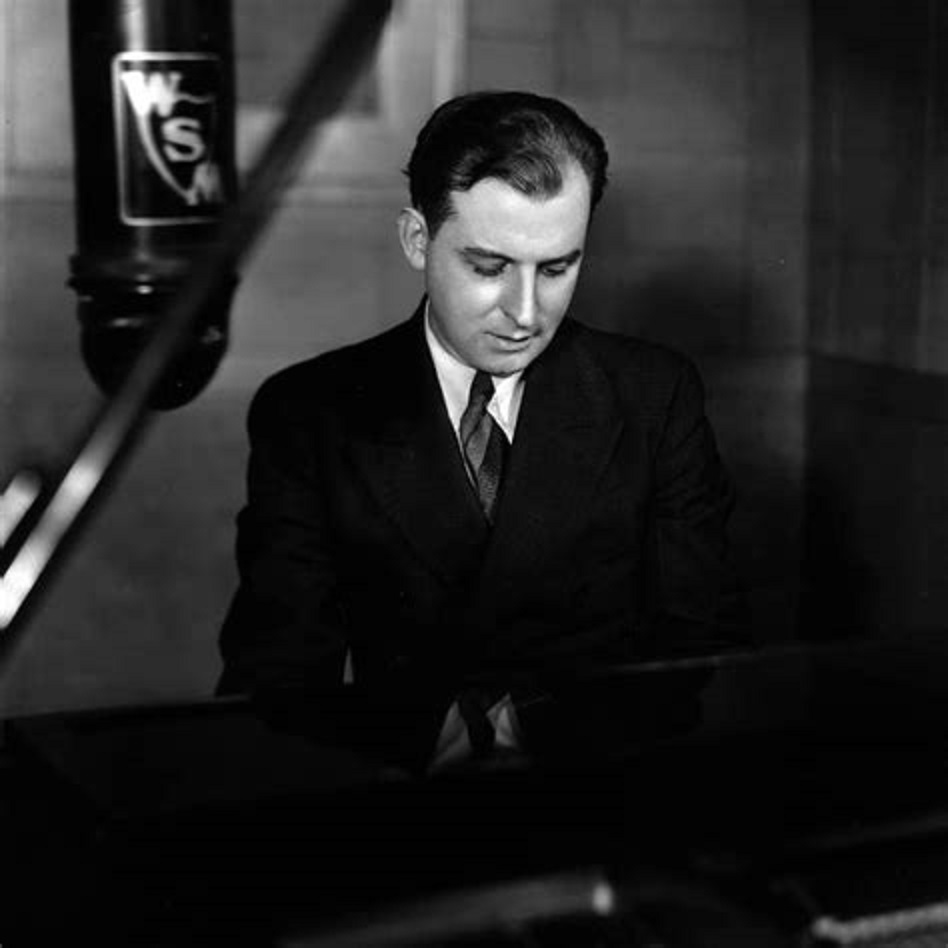
Jeff Barnhart: Hal, we’ve received some great feedback regarding Clancy Hayes Trilogy in this column and I believe that pattern will continue with the figure you suggested for this month’s offering: the great musician/composer/producer Fred Rose. While Clancy is today more widely known than Fred, the tunes Mr. Rose composed during the Jazz Age and beyond have provided a century of pleasure and repertoire for listener and performer alike. By the mid-1930s, he became a well-known tunesmith in the western-cum-country style, with songs of his being picked up by the likes of cowboy-vocalist superstar Gene Autry (at least 17 songs penned by Rose are included in Autry’s films), Tex Ritter, the Sons of the Pioneers, and even Bing Crosby. In 1942 he founded Nashville’s first major country music publishing house with Roy Acuff. Called Acuff-Rose Music, the publishing house served as a base for many country music composers and stars, most notably Hank Williams, Jr. along with Don Gibson, Boudleaux Bryant and Marty Robbins. In 1961, Rose was posthumously inducted as one of the first three members into the Country Music Hall of Fame.
While these are formidable accomplishments, our readers will likely be much more interested in the music Fred Rose was creating in the 1920s, as am I! Hal, do you have some info to share about Rose’s early life and then a particular tune you’d like to start with?
Hal Smith: Fred Rose was born in the “Jazz State of Indiana”—Evansville to be exact—in 1897. He was raised in St. Louis, when ragtime was still popular in the city. He taught himself to play piano as a youngster and began playing and singing for tips in St. Louis saloons. He moved to Chicago in 1917 and continued to play in bars. He also cut piano rolls and played for silent movies. All of those experiences must have been invaluable when Fred Rose started to compose popular songs! One of his earliest efforts was “Sweet Mamma (Papa’s Getting Mad)” which was recorded by the Original Dixieland Jazz Band in 1920. (Note Creamer and Layton’s “Strut, Miss Lizzie” was also “introduced” on this side—a typical device on records from this period).
JB: What a great side! The addition of Benny Kreuger on alto sax gives this recording an extra richness, and the duet between him and clarinetist Larry Shields on the “Strut” interpolation gives the tune an unusually poignant feel. The group vocal on the title phrase when “Sweet Papa” returns will be a nice surprise to anyone who’s never heard this before. My two concluding observations about this record are how wonderful for Fred Rose his early tune was picked up by (then) jazz superstars right out of the gate, and how far the ODJB had come from their hokum “Livery Stable Blues” days. This is real jazz music!
HS: There is also a neat piano roll of the song from the early 1920s, played by Pete Wendling, as well as a 1928 recording by Duke Ellington & his Washingtonians with some wonderful plunger mute work by Bubber Miley.

JB: I LOVE Pete Wendling (and had to laugh that the QRS roll misspelled his first name by leaving out the “t!”). It’s a terrific arrangement that carefully balances between what a great pianist soloist could do while adding some judicious “third or fourth” hand flourishes only possible at that time on piano rolls. I hope one day we can explore Wendling’s catalogue of hot tunes. Like Fred Rose, he was one of our most gifted musicians and composers and deserves more attention!
For me, Ellington’s recording is a tad strange. Incredible playing and arranging of course (albeit with a couple of uncharacteristically corny solos), but why are they recording a song that was eight years old? Was it actually that popular that it continued to have a presence through the 1920’s? Twenty days prior to that session, the band had waxed “East St. Louis Toodle-oo” and ten days later would record “Jubilee Stomp,” two tunes composed by Ellington that sound decades ahead of this side. Ah well, I hope Fred Rose received a nice royalty for it.
My observation above led me to see just what legs “Sweet Papa” has, so I trolled YouTube. From 1941, there’s a gender reversal recorded for Decca by Bon Bon and His Buddies. AND a year later, Joe Marsala and his Chosen Seven (including George Brunies, Dick Carey, and Zutty Singleton—SOME choices!!!) effortlessly swung it.
Finally, I must eat crow over griping that Ellington assayed the tune in 1928, as my last example is by a duo comprised of the celebrated multi-styled trombonist (here on trumpet!) Wycliffe Gordon, backed by guitarist Matt Munisteri, recorded in 2012 for the Chesky Records label on Dreams of New Orleans. It’s gentle and very sweet.
HS: It’s a tribute to Fred Rose’s skills as a composer that this song from the early 1920s was considered worthy of recording for decades to come! Your inclusion of the Wycliffe Gordon/Matt Munisteri recording raises a point we should address: Quite a few of Fred Rose’s songs have been recorded in more recent times by bands such as Jim Dapogny’s Chicago Jazz Band, John Gill’s Novelty Orchestra of New Orleans, Chris Tyle’s Silver Leaf Jazz Band, the West End Jazz Band and many of the groups who recorded for the late Bob Erdos’ Stomp Off label. For space considerations, I suggest we limit further musical analysis to older records. However, if there are newer versions of the songs that we want our readers to hear, let’s mention them.

Moving on, in 1921 Rose co-composed “Underneath Hawaiian Skies” with Ernie Erdman (probably known best as co-composer of “Nobody’s Sweetheart”). It was recorded as a vocal duet by Albert Campbell and Henry Burr.
JB: During the 1910s and into the 1920s as more people traveled, songs proliferated about exotic places (the jungle, the desert, Asia, Hoboken, that sort of thing). I imagine this must be one of the earliest songs about Hawaii, although I remember Ian Whitcomb always sang “They’re Wearing ’Em Higher in Hawaii (1916)” about scandalous women’s fashion. The vocals on this side from 1921 are stentorian but perfectly in tune.
HS: Another recording of the song was made in 1921 by the great composer Isham Jones and his Orchestra. It also has an “introduction” of the pop song “I Never Knew” by Pitts, Eagan and Marsh. (Incidentally, “Pitts” is Thomas Pitts, an African-American composer from San Francisco who wrote the beautiful “Meadow Lark Rag”).

JB: Now THIS is more like it! I love Isham Jones records. I was dancing around the room. Incidentally, both the records you’ve shared of this tune utilize a feature found in a more famous song from another Fred: “Dardanella” (1919), with lyrics by Fred Fisher, has a repetitive figure in the bass as well.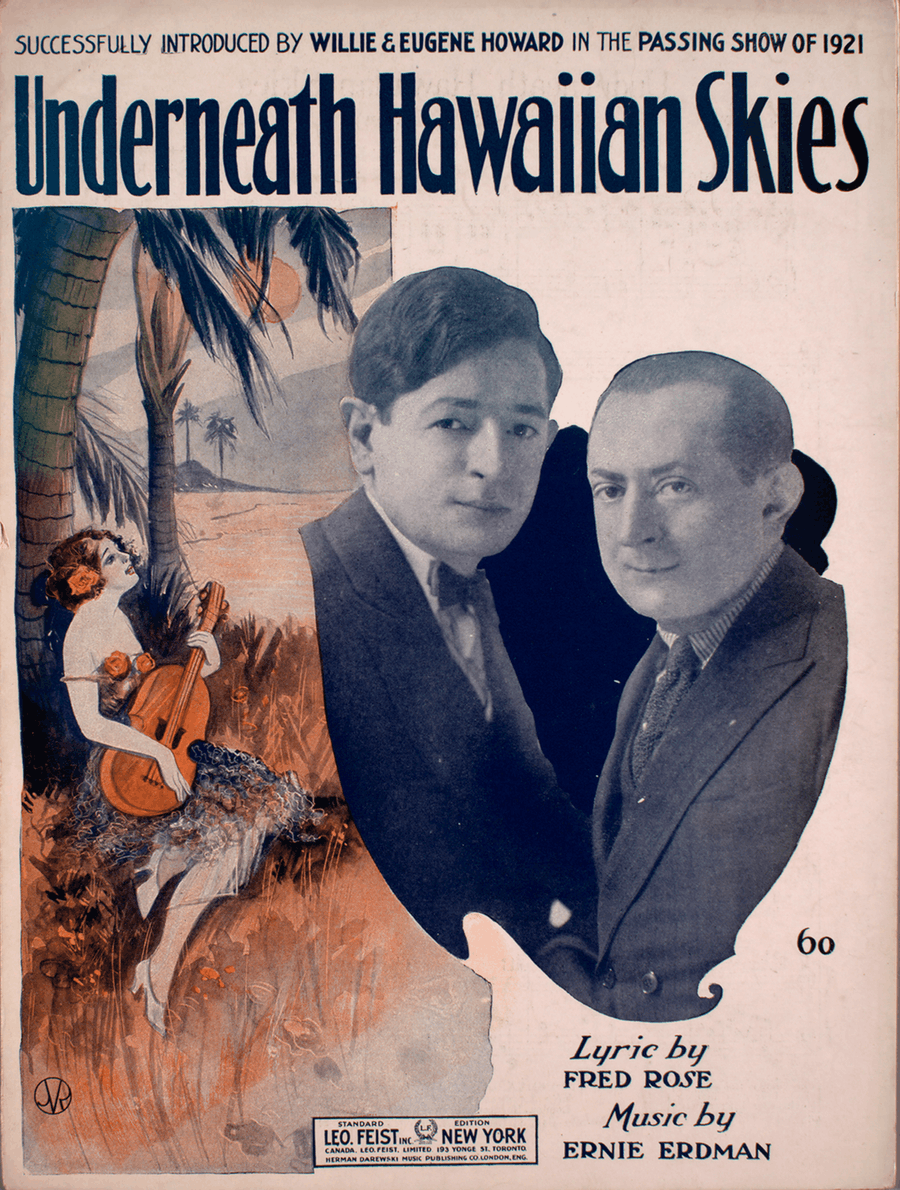
HS: I like hearing the song played as a dance number, but the version I like best is the one played by George Lewis!
JB: Four-Four all the way, baby! The band doesn’t play the verse and changes the harmonies during the second eight bars of the chorus but that doesn’t take away from the excitement of this side. I love how the front line blows through most of this version, with George Lewis and Big Jim Robinson duetting before the climactic final chorus.

Two great songs by Fred Rose so far, Hal. Where do we go now?
HS: Let’s take a listen to Fred Rose’s first big hit (co-written with Gilbert Wells and Bud Cooper) from 1924: “Red Hot Mamma.” There were three excellent recordings of the song made the same year it was composed: The first is by the original “Red Hot Mama” herself: Sophie Tucker. With fantastic ragtime piano accompaniment, Sophie sounds like she could have projected her voice from a block away to the cutting apparatus.
Next, Cliff “Ukelele Ike” Edwards recorded a terrific version (with a manic, pre-Louis Armstrong scat chorus).
Speaking of Louis…Fletcher Henderson’s record was made before Armstrong joined the band. We may disagree, but I think this performance has a very stiff feel.
My favorite record of “Red Hot Mama” was actually recorded three decades after the song was written—by Turk Murphy. The highlights for me are Bob Helm’s vocal, Wally Rose’s raggy piano and Bob Short’s facile tuba solo.
JB: Sophie kicks butt here, as does her music director, pianist Ted Shaprio. What a terrific piano solo! I enjoy the “Tuckerisms” here; Sophie was always willing to change lyrics to “improve” them. At the end, instead of repeating “sweetest girl in town,” she sings “But I’ll have to turn my damper down!” She also adds her own “punchline” leading up to the final four bars: “I could make a Texas farmer forget his hay / I could make the devil throw his fork away.”
Compositionally, this tune is just tops. It’s as much a pleasure to play as it is to listen to. It is no surprise that Cliff “Ukulele Ike” Edwards recorded this number tailor-made for him! He too changed up the punch line found in the sheet music—and Sophie’s first go-round on her record—with “You went to the North Pole; couldn’t stay / You melted all the ice and snow away.” His scatting is simply divine as well.
Fletcher Henderson’s version (here with his 10-piece Club Alabam’ Orchestra) has so many delightful 1920’s tropes: Charleston stops, slap tongued saxophone, choke cymbal accents…ah…pure bliss. This side, although I agree it is stiff as you commented, nevertheless illustrates Fletch’s amazing arranging chops and reveals what a strong tune Fred Rose and Co. wrote, as there is no vocal this time and you don’t miss it.
Up until now every version of “Red Hot Mamma” has been from 1924 (and there are more!) which shows that this tune was a BIG hit for Fred Rose. Turk Murphy’s version from thirty years later is nigh on perfect, as you described above, Hal. The only thing I’d add is how much I enjoyed lusty, gusty trombone melody chorus right out of the gate. THAT is how trombone should be played in the traditional jazz style.
Hal, I’m interested in what you’d label “jazzier” tunes by Fred Rose as this last one is really hot!
HS: One of the all-time hottest Fred Rose compositions is “Mobile Blues,” from 1924. Our friend Andy Schumm wrote an arrangement of it for the Chicago Cellar Boys. We played that same chart with the Oliver-Smith Incomparables at the Scott Joplin Festival this year and I thought we might actually burn the canvas off the John Stark tent!
The recording of “Mobile Stomp” by the wonderful Bucktown Five—made the same year that the song was published—was the red-hot inspiration for Andy’s chart. Cornetist Muggsy Spanier, clarinetist Volly DeFaut and their bandmates set off musical fireworks from beginning to end.
JB: This side puts so much on the table! First, we are treated to terrific sound for 1924, as realized by the wonderful Richmond, Indiana-based Gennett Records (which would be the first to record Bix less than a year later in 1925). Second, what a band. The arrangement is tight, the playing is so hot, and the melodies and harmonies Fred Rose provided on each section are winners throughout. I listened to this one more than once!
HS: Three additional recordings of “Mobile Blues”—all made in 1924—take very different approaches to the song. The first one is by Haring’s Happy Harmonists…
JB: Hmmm, this one is much more square, and I think there must be an uncredited horn playing the trio melody, unless a tenor sax can actually get down that low. Haring’s Harmonists might have been Happy, but I really wasn’t. This side was recorded in New York a day after the Bucktown Five waxed theirs in Indiana! What a difference a day makes.
HS: I agree that this record is a letdown after the blazing-hot version by Muggsy and company.
Let’s listen to another “Five” that brought more heat into the studio: The Original Memphis Five.
JB: Ahhhh….now we’re back on track! Of course how can you miss when two of the five are the legendary Phil Napoleon on trumpet and Frank Signorelli on piano? To my ears this is the exact arrangement played by the Bucktown ensemble, and it’s interesting to hear two different quintets play the same chart so individually. I’m not sure which I prefer, so I’ll simply say both are tops!
HS: It’s different, for sure—but Phil Napoleon and the others came up with a “keeper.”
Now let’s comment on popular reedman Boyd Senter’s record of “Mobile Blues.”
JB: Boyd Senter is an acquired taste, and I’m afraid I’ve never developed a strong appetite for this early Chicago-based stage of his recording career. His long time piano accompanist Jack Russell keeps the tune moving forward with some nice 1920’s piano licks, and Russell Senter (Boyd’s brother) clumps along on the drums, but I’d prefer even Haring’s Happy bunch over this. As an aside, can we assume that the A.E. Short who receives co-credt with Fred Rose for “Mobile Blues” the same fellow who ran the Tivoli Syncopators in Chicago? If so, maybe he got Boyd Senter to record it.
HS: Yes—the “Short” is Albert E., as you said. Boyd Senter’s clarinet playing is a notch or two below Ted Lewis’, especially on this track. Jack Russell’s piano playing is always a bright spot, even on a less-than-stellar performance by his boss. To his credit, Brother Russell seems to be trying to play in the Jasper Taylor style.
Boyd Senter recorded the song again in 1928, with Jack Russell, trumpeter Mickey Bloom, the Dorsey Brothers and Eddie Lang—and better results!
JB: Yes! Much better. I love the riff the band plays—lifted from the ending of “Singin’ The Blues”—behind Senter on his first solo.
HS: With co-composer Charlie (“Copenhagen”) Davis, Fred Rose wrote another hot stomp in 1924: “Jimtown Blues.” There is a fantastic recording of it by the Cotton Pickers. I think you will really like this one:
JB: This one has some nice sections and a great turn around of the beat during one of them. This New York studio group featured musicians I hope are familiar to our readers, including Phil Napoleon (tpt); Miff Mole (tb); Frank Trumbauer (C-mel. sax) and—perhaps less known—Rube Bloom (pno). I shouldn’t leave out one of my two favorite tubaists, Joe Tarto! Everyone is in fine form and does this tune justice!
HS: A recording from the following year by the “Super Syncopators” is a bit of a mystery.
JB: This one is very unusual. I hear cornet, clarinet, banjo, and accordion! This group recorded a total of four sides across two sessions in four months. The highlight is the cornet solo by the only musician named: Bob Pope. I really like the mixture of rural hokum and clever arranging.
HS: Yes, there is some horsing around—but a good, hot spirit! By the way, those cymbal accents were played by Art Layfield, an older percussionist who several “name” Chicago drummers studied with.
Also from 1925, there is a superb record of “Jimtown” by Lanin’s Red Heads featuring some of the top exponents of 1920s hot jazz and one of my drum idols.
JB: Get those flapper dresses out! Mid-twenties white jazz as heard on this side is intricate and sophisticated, with a good amount of heat. The 10-piece band directed by the seemingly ubiquitous Sam Lanin features Red Nichols (tpt), Miff Mole (tb), Joe Tarto (tba), and one of your heroes, Hal, the wonderful Vic Berton! So many devices are used here: breaks, whole-tone ensemble breaks, a clarinet trio on the B strain. Lovely! It seems Fred Rose’s tunes were being picked up by short-lived studio groups: this one only recorded six sides in the span of 7 months and out they went.
HS: In contrast to the short existence of the studio bands that recorded Fred Rose compositions, “Jimtown Blues” was also recorded by established orchestras. Isham Jones made a topnotch version in 1934.
JB: OK, now we’re in that great early swing era. Tight arrangements, superior intonation! This is one HOT side, with great solos from trumpet and trombone and thickly textured harmonized passages for the entire front line! Virtually unrecognizable from the previous versions it at once shows the versatility of a well-written tune and the well-deserved longevity of the Isham Jones outfit. Compare this ride to the orchestra’s 1921 recording of “Underneath Hawaiian Skies” and we have a primer in the changing sounds of jazz between the early ’20s and ’30s. Love it!
HS: Two years later, Fletcher Henderson’s great orchestra recorded a version of “Jimtown” that starts truckin’ on the very first note! Roy Eldridge, Buster Bailey, Chu Berry, Horace Henderson, Israel Crosby and Sid Catlett are present and swinging!
JB: Listening to this right after the Isham Jones recording really shows that Fletch’s band could play real up-tempo material while sounding like they’re just lounging around. Supreme effortlessness.This arrangement is also markedly different from the previous one; Henderson was too gifted an arranger to let stock charts go unimproved!
HS: There is a broadcast version of “Jimtown” from 1937 by Tommy Dorsey and his Orchestra. The sound reminds me of Bob Crosby’s Orchestra—particularly the arrangement (probably by Deane Kincade) and Yank Lawson’s “Southwestern” hot chorus on trumpet.
JB: The reed section plays that intricate chorus as one, and their riffs behind Yank’s second ride add to the excitement, goosing him along. My personal highlight is that wonderful two-fisted piano solo by Howard Smith—who I don’t think I’ve ever heard before now—with the band blasting a surprise two-bar interlude into the second piano chorus!
HS: Speaking of Bob Crosby… Jeff, what do you say we wind up the first part of our conversation about Fred Rose with a recording of “Jimtown Blues” by Crosby himself, from 1942? Ray Bauduc is driving the bus from the drum set, and there is a wonderful extended solo by Eddie Miller and hot clarinet by arranger Matty Matlock. A piano chorus by Jess Stacy would have been icing on the cake, but otherwise this is a fine example of Bob Crosby’s Big Band Dixieland style.
JB: How fitting that we are treated to a third boffo arrangement of Fred Rose’s composition, with a bit more of the Dixie feel. Matlock makes sure this ironically oft-recorded “rarity” receives the full Bob Crosby treatment! It builds wonderfully with all the trademarks one listening to this band is looking for. Eighteen years of “Jimtown Blues” is a good start!Let’s hope for many more! Hal, our space is running out, while the tunes composed by Fred Rose we plan on exploring are not! Let’s continue this discussion next month.
HS: Looking forward to it!

Jeff Barnhart is an internationally renowned pianist, vocalist, arranger, bandleader, recording artist, ASCAP composer, educator and entertainer. Visit him online atwww.jeffbarnhart.com. Email: Mysticrag@aol.com