This July 24-26 marked the 23rd Evergreen Jazz Festival in the Front Range of the Rockies (elevation 7500 ft.) about 30 miles southwest of Denver. But for me it was the first time. I combined this festival with the Bix Beiderbecke festival in Davenport, Iowa the following weekend (you’ll read about that one next month).
Evergreen is a small unincorporated community that appears to be a mix of trendy tourist-oriented businesses and upscale residences that cling to the mountain sides that are accessible by narrow winding roads. Seven-figure housing prices are the norm here.
The festival prides itself on its intimacy—no large venues or crowds. Despite are reported total attendance of 2,000 over its three days, it lived up to that claim. There are five venues, four of which are within walking distance of each other. The fifth, the Evergreen Lake House, was used only on Friday evening. It is about a mile from the other sites and I did not go there. The festival provided a free shuttle between the venues, perhaps because the terrain in Evergreen is decidedly vertical and some attendees have difficulty walking on steep and uneven surfaces. There are no sidewalks and the streets are very narrow and curvy with no nighttime lighting. In addition, the altitude could be an issue for “flatlanders.”
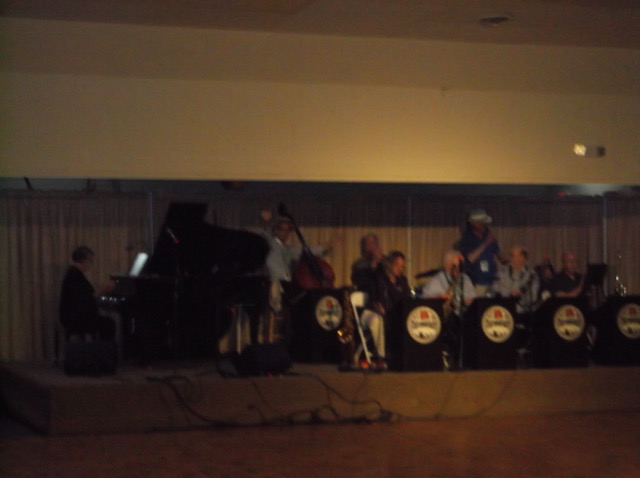
About the venues: two are at the Elks Club—a large ballroom with a raised stage, and a patio just outside that is partially covered. Both of these are set up with round and rectangular tables, respectively, with (unpadded) folding chairs. The others are the Christian Church and a place called Center Stage. I went to several sets in both, neither of which has air-conditioning. Perhaps it is normally not needed here, but the weather over the weekend was on the warm side. Cloud cover provided much relief all three afternoons.
Some ten bands of varying sizes were on the card, along with pianist Carl Sonny Leyland who led a trio. Most groups were scheduled for at least half a dozen sets, save for The Hot Tomatoes Dance Orchestra which had four. Of the ten bands, I could recall only having seen one before—the Queen City Jazz Band, probably at the Arizona Classic Jazz Festival which is no more, unfortunately. The one-hour sets, with a 15-minute break between them, were scheduled in a way that everyone had multiple opportunities to see each band.

From the festival website I was able to lay out a tentative itinerary before leaving home, subject to change based on my impressions of each group. Most of the bands were local, more or less. Those from “away” were the Ear-Regulars (New York), Le Jazz Hot (San Francisco), and Floyd Domino’s Western Swing All-Stars (Austin). The Ear-Regulars, a quartet, was actually only half from New York; the other two members being pianist Chris Dawson and bassist Sam Rocha, both from California. Curiously, there is no pianist when the band plays at its now 19-year regular gig, the Ear Inn, because that venue doesn’t have a piano.
The festival organizers engaged a caterer to provide lunches and dinners at the Elks Lodge which eliminated the need to go into town. The food was good and somewhat less expensive than comparable fare at local restaurants, and there was no tipping. With tables and chairs, one could easily eat and hear the music at the same time—a welcome touch.
Now, about the bands. The Great Scott Quartet, consisting of piano, bass guitar and drums, played old tunes but not in what I thought was trad style. I only saw them once. I’ve referenced the Ear-Regulars above. I have been to the Ear Inn a couple times, and its leader, trumpeter Jon-Erik Kellso, has been a member of Vince Giordano’s Nighthawks for over 35 years. That alone speaks to his stature.
The Poudre (POO-der, not POW-der) River Irregulars (I could not discern anything irregular about them), a 9-piece band from Fort Collins, were very good. Similarly, Floyd Domino’s band was quite good at its forte Western swing, but a little of that goes a long way. They were making their first appearance at Evergreen. They engaged drummer Hal Smith, well known to readers of this paper, who is facile in various genres.
Although I am not a serious devotee of gypsy jazz, I found Le Jazz Hot to be very listenable. They have been in existence for 38 years, but this was their first time here.
The main attraction, to me, of Queen City is its vocalist, Wende Harston, who has been with them 40 years. To my ears, she is probably the best female blues singer today. The band’s final set showcased her talents, as she sang tunes made famous by her predecessors from Ma Rainey to Dinah Washington.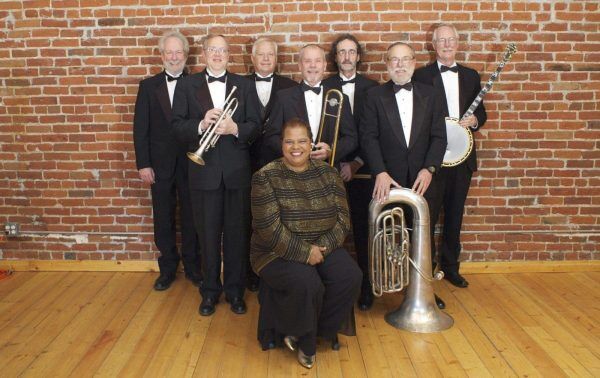
An approximate indication of the bands I preferred can be gleaned from the number of times I saw each one. Here’s the list, in no particular order. Great Scott-1; Ear-Regulars-2; Poudre River-2; Floyd Domino-1; Rocky Mountain Rascals-2; Sonny Leyland Trio-1; After Midnight-1-½; Queen City-3; Le Jazz Hot-2; Hot Tomatoes Dance Orchestra-2-½; Evergreen Footwarmers-1 (their only set; this band was comprised of members of several bands that were here). Since virtually all the bands were new to me, I wanted to give each one a fair hearing, and, fortunately, the schedule allowed me to do that.
If you’re one of my regular readers—yes, there are a few!—you know that I usually use my bicycle for local transportation at festivals. You may be wondering, given what I’ve written above about the local geography, if I did so here. Don’t think I didn’t consider it, but due to several potential issues, months ago I reserved a rental car just in case that I could cancel at the last minute. I’m glad I didn’t. I have to acknowledge that in my 80th year I can no longer do some things that wouldn’t have fazed me even five years ago. I feared that climbing hills at this altitude without acclimation could cause problems, but I had no trouble walking up steep hills.

I came away from my first visit to Evergreen with a good impression. It seemed well organized, with plenty of volunteers, and a large selection of bands. Not all the music I heard could be considered traditional jazz, but I allow that my tastes are somewhat restricted. Still, the quality of the musicians was very good. There were a few limitations with the Elks’ facilities but they were manageable. I felt the acoustics in the ballroom were less than ideal, but I did not hear any complaints from musicians. I’d consider coming again depending on the lineup.
Bill Hoffman is a travel writer, an avid jazz fan and a supporter of musicians keeping traditional jazz alive in performance. He is the concert booker for the Tri-State Jazz Society in greater Philadelphia. Bill lives in Lancaster, PA. He is the author of Going Dutch: A Visitors Guide to the Pennsylvania Dutch Country, Unique and Unusual Places in the Mid-Atlantic Region, and The New York Bicycle Touring Guide. Bill lives in Lancaster, PA.