If the contributions Gary Giddins has made in the last 50 years to the dissemination of Jazz and Jazz history were all listed here, they would take up this entire piece. Here’s a brief sample:
Giddins’ Weatherbird column at the Village Voice set a standard for jazz journalism for 30 years. He and John Lewis co-created the American Jazz Orchestra, active from 1986 to 1993. In 2007, he started teaching and conducting interviews at CUNY and was director of the Leon Levy Center for Biography from 2011 until 2016. He has written for scores of national publications and won multiple awards, including the National Book Critics Circle Award. He’s written 13 books and participated in 31 films as producer, director or consultant.

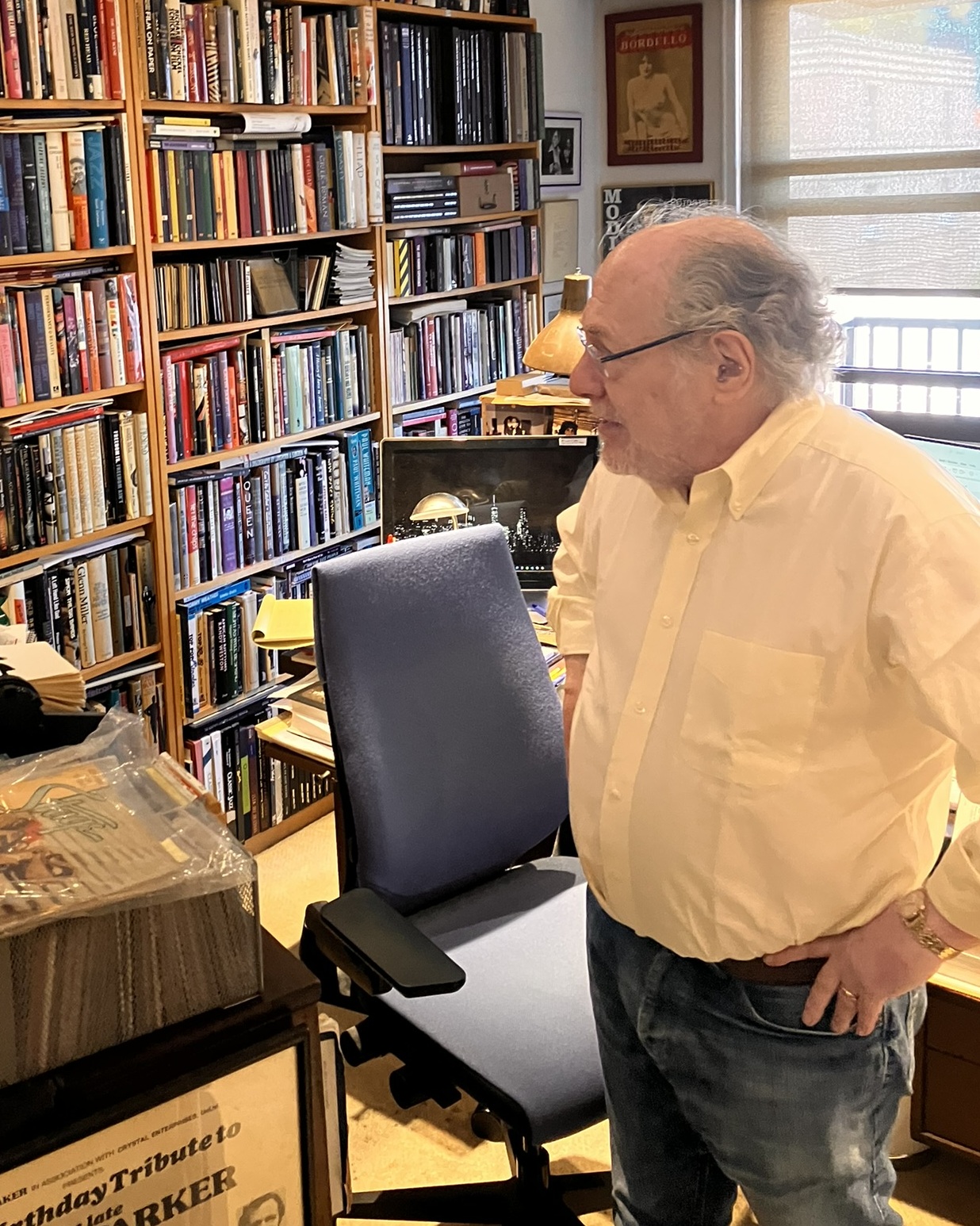
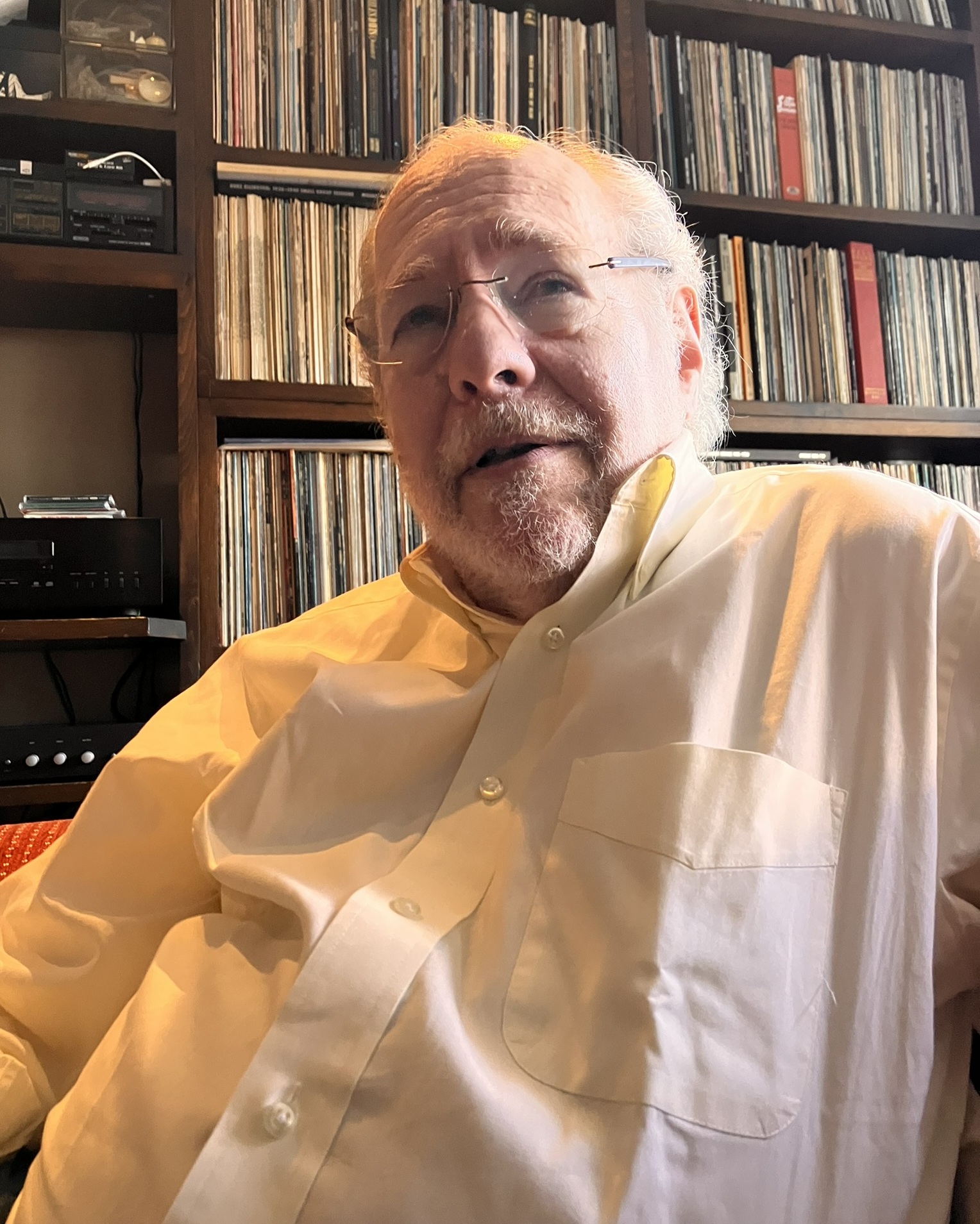
Giddins recently spent a generous amount of time with me in his record and book-lined studio and apartment in New York City, talking about some of the key moments in his career, his musical and literary inspirations and the joys and traps of criticism.
Born in 1948, Giddins lived in Brooklyn until he was four years old when his family moved to East Rockaway, Long Island. His father was president of a trucking business, his mother a homemaker. When his dad died at age 57, his mother became an interior decorator specializing in antiques. His sister, Donna Rothchild, lives with her family three floors above Gary in the same apartment building; her achievements include some two decades as director of development for Friends Seminary.
Just as jazz musicians often emerge at a young age, it was clear early on that some combination of music and writing would dominate Giddins’ life. He loved music and knew he wanted to be a writer when he was 8 years old.

Giddins heard and enjoyed some classical music, but he wasn’t very attracted to the Brill Building-generated pop music of the day. Then, several encounters led him to the music he’d spend his life listening to and writing about. The first exposure happened thanks to the Giddins’ black live-in housekeeper, then named Pearl Hill, who eventually went on to became the Exchequer at the New Yorker. She could see that Gary loved her R&B records and on Thursdays, Hill’s day off, she volunteered to take him to places like the Apollo Theater, the Brooklyn Paramount and the Hillside Theater in Queens. There they saw acts like Jackie Wilson, Shep and The Limelites, Frankie Lymon and the Isley Brothers.
He “got” R&B, but Jazz was harder. Maynard Ferguson played at his synagogue and he didn’t get it. He also heard records by Ray Charles and Cannonball Adderley and still didn’t get it. But his next encounter with the music began to turn the tide. In 1963, age 15, he was on a teen-tour of the country’s border cities that included a stop in New Orleans where he attended a concert at the Royal Orleans Hotel. He recalls that the band included George Lewis, Joe Robichaux, Slow Drag Pavageau, Kid Howard, Joe Watkins and Emmanuel Sales. They were celebrating an upcoming trip to Japan, the first time any of them had toured overseas. Giddins loved the music and he loved the fact that there was a racially mixed audience sitting together, digging the music. His regular record shop, Sam Goody, didn’t have their records so he used mail-order to send away for them.
Giddins describes the third, most fatal encounter: “Cue Magazine had a feature: 20 critics pick the 10 greatest jazz albums. The only two albums that were on just about every list were Ellington’s In a Mellotone compilation on RCA and the Louis Armstrong Story Volume 3, Louis and Earl.”He bought it and played over and over. “It kind of stunned me. I didn’t know Armstrong was a great musician. I thought he was a guy on Ed Sullivan that people liked because of his personality…It was a religious experience.” It’s not surprising he chose “Weatherbird” as the name of his column in the Village Voice.
So, at age 15, he was hooked. He bought his first issue of Downbeat and borrowed draft cards of older kids so he could go to jazz clubs. Although his path to writing about jazz was still not inevitable, the stage was set.
Giddins had always been an avid reader: “One of the first writers who got me excited was Dwight MacDonald, who wrote a movie column for Esquire…I had never read real criticism and it changed my way of thinking…MacDonald encouraged me to step back and trust my own reactions, my own dissent.” He also mentions his interest in Edmund Wilson, Aldous Huxley, Max Beerbohm, and James Huneker.

So, when he picked up Downbeat, unlike most of us, Giddins didn’t just read it, he analyzed the writing to a fare-thee-well. “Criticism brought me deeper into jazz and jazz brought me deeper into criticism…I loved Ira Gitler’s stuff—pithy, argumentative, full of puns and good feeling, and absolutely on the mark when it came to anything related to bop. I bought anything Dan Morgenstern liked.” He also spoke of how important Albert Murray and Martin Williams were as mentors.
Giddins went to Grinnell College and although he was in Iowa, not exactly the Great White Way, he continued his foray into the jazz world. He became “Concert Chair” at Grinnell and had the idea of contacting Associated Booking, which handled many jazz groups; “I knew touring musicians hated a night off, so I called them and said if they ever have a band in Iowa, I’ll make it worthwhile for them to come to Grinnell.” That’s how he managed to bring acts like Duke Ellington, Louis Armstrong, Cecil Taylor and B.B. King to the college.
Giddins says he needed an excuse to bring in a group as big as Ellington’s so he used the fact that there was a prom at the college and they needed a dance band. He also said that during the Ellington gig, one of the students, who played trumpet, engaged in a conversation with Cat Anderson. That night, every time Anderson played anything, he graciously leaned over to show the student the fingering. By the way, to show what “show business” was like in the late 1960s, Ellington charged $4,000, while Big Brother and the Holding Company (even without Janis Joplin) charged $12,000.

As he went through college, Giddins was still not certain that he saw himself as a critic rather than a fiction writer. However, during his senior year in 1970, a teacher and writer named M. M. Lieberman whom he greatly respected told Giddins he had no talent for fiction, but that he had a gift for criticism. This carried a lot of weight and the young boy who had once wanted to be “the Hawthorne of my generation” began to see that he could creatively ply his writing skills as a critic.
He began to shed his residual ambivalence about being a jazz critic: “At first, I didn’t think I was allowed to write about music. I’m not a musicologist, I’m not a player.” But he was immersing himself more and more deeply into the music. He studied every instrument: “Just to see how they worked.” He got Leonard Feather’s New Encyclopedia of Jazz and went through three copies of it. “I was determined to see every single person who was still alive. The only two people who eluded me were Ben Webster, who’d gone to Europe…and Hank Mobley.”
But even then, despite his immersion in jazz, it wasn’t clear that Giddins would write about jazz and not film.

After college, he worked as a copy boy at a newspaper and through a friend, began writing film reviews for the Hollywood Reporter. His relationship with film was no passing fancy. Giddins has continued to love and to write about movies, including the book Warning Shadows: Home Alone With Classic Cinema, published in 2010.
He also freelanced forHifi Stereo Buyer’s Guide and eventually Dan Morgenstern at Downbeat gave him an assignment to review McCoy Tyner at the club called Slugs: “Tyner used a deafening drummer, Alphonse Mouzon, and I couldn’t hear a thing—it was a dreadful set…I loved McCoy Tyner, and didn’t feel comfortable criticizing him on the basis of one set…” So he opted not to write a review, but a couple of weeks later, Morgenstern asked him to write about Mingus’s return to the Village Vanguard—I think that was my first published jazz article other than liner notes.”
At this point, he felt as though he had to choose between film and jazz and the choice was not really difficult.
“To be a critic you have to have a certain amount of…The nasty word is arrogance, but I don’t think it’s inappropriate because you think your opinion is important enough for someone to print it…I was arrogant enough to think I had something to say that no one else was saying…You need a sense of certainty and in jazz I had that.”
At this point, I might interject that Giddins is about the least arrogant person at his level of accomplishment that you’re likely to meet.
He was doing some work for Downbeat and courtesy of record producer Don Schlitten, got work writing liner notes. “My very first liner note was Mike Bloomfield for John Hammond at Columbia; but fortunately, the LP producer—not Hammond—decided to go without notes. God, was I relieved. They were so pompous that when, several years ago, I came across a carbon in my file cabinets, I didn’t tear it up. I set a match to it, like a scene from an old espionage movie.”
His next move was to the Village Voice, which would be his employer for the next 30 years. He had written a review that he hoped would land him in the New York Times, but he’d “jumped the queue” at the Times so it could not be run. He sent it to Diane Fisher, the music editor at the Voice, who ran it and paid what he recalls was $90. He asked Fisher for a column, but she said he had to pay Voice dues and invited him to contribute a Riff [short-form criticism and reviews] each week. “…for the next year, I went out three or four times a week, wrote my ass off, dropping reviews in the Voice mail-slot every Sunday evening.”
After 18 months, he heard from Robert Christgau, who became chief music critic and senior editor at the Voice, and Giddins’ column Weatherbird was born. The column ran every three weeks, while Giddins did Riffs for the other weeks. He credits Christgau with being: “the best line-editor I’ve ever known.”
Giddins is a person who loves and wants to support jazz and grapples with writing negative reviews: “If an artist does something you don’t like, you criticize them in sorrow, not in amusement…or even anger.” I asked him what he had to do in order to convince himself that he was justified in writing a negative review. “Keith Jarrett had just done his first big box of solo piano music. I just couldn’t hear it. But it made me very nervous and I didn’t dig it at all. I don’t think I ever played a record more than that one. I listened and listened and of course I got nothing but complaints when the review came out.” In other words, he has to go beyond due diligence to be certain that he has given complete attention to his evaluation. Later on, he was a big fan of Jarrett’s Standards group with Jack DeJohnette and Gary Peacock.
It became clear early on that his columns would not satisfy all readers, but a few events made him think that he was on the right track: “In 1973, Bob Christgau [his editor] gets a letter from Dave Leibman and Richie Beirach saying ‘Giddins only writes about black people.’ One week later he gets a letter from Rashied Ali and another black musician that said ‘Giddins only writes about white musicians.’”
After Giddins wrote a negative review of the Miles Davis recording Agharta. A box was delivered to the Voice office and since something was rattling inside, it took a whole to decide it was safe to open it. Inside there was a big box of steel wool and a box of q-tips, with a note on cardboard that said “the next time you write about Miles, clean out your head.”
After that, a musician Giddins really respected, Bob Belden, ended up compiling Miles Davis box sets. “By this time, I had heard a lot of late Miles, I’d seen him live and I said “This is a great record. It’s the best Sonny Fortune, it’s the best Pete Cosey that exists anywhere and Miles is playing very little trumpet. He’s mostly playing keyboard, but he’s totally controlling everything. I got very inspired and wrote a piece about what a shmuck I was, but when anyone does something on Miles and they get to Agharta, they quote me attacking him and never the other thing.”
“It’s really a wonderful thing when you change your mind,” Giddins said. “It means you’re alive, you’re still growing.”
Giddins has generated close relationships with jazz musicians through the years, despite advice given him by writer Martin Williams: “[Martin] told me when I started not to get friendly with musicians and for a long time I tried to do that. But being a jazz critic is different. Rock and classical and film critics probably don’t hang out with rock, violin, and film stars, but jazz writers are in small spaces with the people they write about; they often do liner notes and go to recording sessions.”
He describes with pleasure being hugged and kissed by Gerald Wilson, being told by Dizzy Gillespie how much he’s meant to him and to the music and Sarah Vaughn telling him: “Some critics I like. You I love.” Says Giddins: You can’t put a price on that.”
Of course, rough patches are sometimes hit. “Phil Woods tried to take a punch at me at the airport,” Giddins told me, “something about his rhythm section…A year later we ran across each other. He comes up and he gives me a real bear hug and that was that. We were friends from that moment.”
In various ways, his respect for the musicians has grown over time. Musicians know when they’re playing well and when they’re not. In 1976, Giddins went with Ira Gitler to the Half Note to see Sonny Rollins. Rollins was upset about a positive review in the Voice, which surprised Giddins: “We played badly that night,” Rollins said. “If they can’t hear when you’re playing badly, how can you trust them when they say you’re playing well?”
Giddins has critiques of critics. He can’t understand the critical opinions about Paul Gonzalves, Charlie Rouse, and George Coleman. He cites a reviewer who said that all Horace Silver’s records are alike. “I thought to myself: ‘well, you get them free in the mail, you think they’re all alike, but somebody who’s reading this—is it a good record or not a good record?’” He chastised the work of a writer who clearly didn’t understand what it meant to trade fours or eights, but reserved his strongest criticism for those “like Pauline Kael,” Giddins says, “who in a way were just as influential for showing me what not to do, like spending half the review attacking colleagues and the other half establishing yourself as more important than the subject under review.
“I can’t think of any musician who was a dick,” Giddins says. “Critics yes, but not musicians.”
He’s writing a book about George Gershwin and describes how much the critics in the 1920s hated Gershwin because he was a Jew, didn’t have higher education and because he was a genius: “People hate that because you can’t attack it rationally. They fall back on old criteria—he doesn’t know the sonata form, he doesn’t know how to develop ideas—they love the word ‘develop.’ Cecil can’t play what Bud Powell played. They attacked Ornette because he didn’t play changes.”
I wonder whether the sheer number of pieces he’s written through the years makes finding anything new to say more difficult. “Dizzy Gillespie told me that you would think trumpet playing gets easier as you go along, but it gets harder,” Giddins said. “I asked him if he was referring to his embouchure, but he said it had nothing to do with technique; it becomes harder because after you’ve played certain ideas and have exhausted them, you have to find new things. I think about that everyday. You exhaust phrases, you exhaust ideas, you don’t want to keep repeating yourself, so it becomes harder in that sense, but easier in the purely technical sense… Every once in a while I think I have a brilliant idea but then I’ll say ‘this sounds awfully familiar.’ Because I had this brilliant idea 20 years ago and I wrote about it back then…I think most critics, no matter what the field is, stick around too long…When you become a professional it becomes about the records you get in the mail, or the gigs you cover and other things get in the way. You have to remember how you listened when you listened to what you loved.”
I asked Giddins what he thought about the truism that critics often refer to: that an artists does—or should—represent their times. In response, Giddins talked about the difference between Eddie Cantor’s Whoopee, produced a year before Black Tuesday [the 1929 Market crash] and Gershwin’s Girl Crazy, a year after Black Tuesday. He explained that in Whoopee, diva Ruth Etting sings a. downbeat torch song “Love Me Or Leave Me” He compares that to Ethel Merman singing the upbeat “I Got Rhythm” in Girl Crazy in 1932, the height of the Depression. “When times are better,” Giddins said “you might choose to go to a movie so you can cry in your beer. But, when the times are really bad, you don’t want to do that, you just want to be entertained…To reflect that time is not to say ‘oh, there’s a dust bowl.’ It’s to say ‘we’re gonna get through this.’” And he adds that someone like Bing Crosby, who brought everyone together, was necessary.
 Giddins has written that the modern style of American popular singing was originated by four performers: Bessie Smith, Louis Armstrong, Crosby and Ethel Water. Bing Crosby has had no more prolific biographer and no bigger champion than Giddins, whose two books on Crosby are definitive. “A third volume is on hold, as he completes a shorter biography of George Gershwin.
We talk about the sometimes difficult discussions about jazz and race, especially coming from academia: “I think at some point, you just finally have to really try to become color blind and say this guy is saying something and this guy isn’t, and it isn’t a question of race and it isn’t a question of gender…You know there is injustice in history, but you just can’t let it control you. Cause that’s not what this music is about…Jazz is for joy. It’s for euphoria, it’s for emotion, and anguish, and excitement… and if it loses that, then it’s lost everything.”
Gary Giddins’ writing and work in the studio, on television and in film has been the gateway for many into jazz, helping to foster that joy. To converse with him is to stroll through jazz history with a man thoroughly imbued with a love of the music.
In the course of his work, Giddins has generated an important collection of material. There are his papers, a few hundred cassette interviews, research, manuscripts, about 2500 letters, hundreds of sheet music pieces, half a century of press releases, and dozens of notebooks with concert and other notes going back to the 1960s. There are also thousands of LPs, 78s, CDs, and books and jazz magazines. Some possible sites for the archive are put off by the size—there are about 30 boxes or so—and Giddins is concerned about being able to find a home for his archive. I can only hope that someone who reads this will step up and help provide a viable repository for this invaluable collection of jazz and film material.
Visit Gary Giddins online at garygiddins.com.
Steve Provizer is a brass player, arranger and writer. He has written about jazz for a number of print and online publications and has blogged for a number of years at: brilliantcornersabostonjazzblog.blogspot.com. He is also a proud member of the Screen Actors Guild.