After 23 years as co-directors of the Sun Valley Jazz & Music Festival, Carol and Jeff Loehr are handing the reigns over to Steve and Linda Goff. The announcement was made at the 36th annual festival held in the picturesque Sawtooth Mountains of Idaho. The Loehrs will continue to serve on the board of the festival as artistic directors for the next five years, but the Goffs will take over planning and producing the festival.
Carol Loehr is the daughter of Tom Hazzard, who started the festival with Wally Huffman (then general manager of the Sun Valley Company) as the Sun Valley Swing ’n’ Dixie Jazz Jamboree in 1989. Four years later, Tom and his wife, Barbara, asked Carol and Jeff to take over the festival after Tom was diagnosed with cancer. The younger couple agreed and have been running the festival since 2003.
A professional musician, Steve Goff played saxophone with the US Army Band until he retired from the military. The Goffs traveled the world while Steve was in the service and now live in Nampa, Idaho where Steve is the chief technology officer at Northwest Nazarene University.
The Goffs are well acquainted with the Sun Valley Jazz and Music Festival. Steve has played the festival with his High Street Band, for more than 20 years and is also founder of the Northwest Nazarene Jazz Festival held in March. The Loehrs had scaled last year’s festival back as they considered retiring. Then, six months ago, the Goffs stepped up to help produce the 2025 festival and joined its board of directors.
Leadership Transition
Linda Goff said that the Loehrs acknowledged that her husband had the business savvy to run the festival, given his management of the High Street Band. For his part, Steve thinks that Linda will be “a great partner” in their new endeavor, given her experience organizing events. Working on the jazz festival “gives us something to do together that involves music,” he said. The dates for the 2026 Festival are October 15-18.
The two couples formally announced the leadership transition to festivalgoers during the opening ceremony in the Limelight Ballroom at the Sun Valley Inn. The Goffs are already thinking of ways to grow the festival and on collaborations that will get more young people to come. “We’ve got great plans,” said Linda “We’re optimistic about the future of the Festival, pointing out that more people today are reaching senior age and therefore have more time for leisure activities. (The average age of attendees (72) has remained fairly constant over the past few years.)
Called “the Cadilac of Jazz Festivals,” the Sun Valley fest is a smorgasbord of music that delights, refreshes, and entices each and every listener. Four venues (three in The Inn, plus Satchmo’s) with 130 sets over four days, 47 musicians, a 21-member Big Band Bash (led by Terry Myers), a marching band performing in concert, themed sets that ranged from Louis Armstrong to rocker Steely Dan, a taste of the Blues, uplifting Gospels, Banjomanics, tributes to Miles Davis and Jerry Lee Lewis, clarinet clambake, dance lessons, and concluding the music sessions with a 90-minute Grand Finale which ends with a big band on stage playing the Festival’s theme song, Moonlight Serenade. An Afterglow dinner and dance wrapped up the weekend Sunday evening.
♫ ♫ ♫ ♫
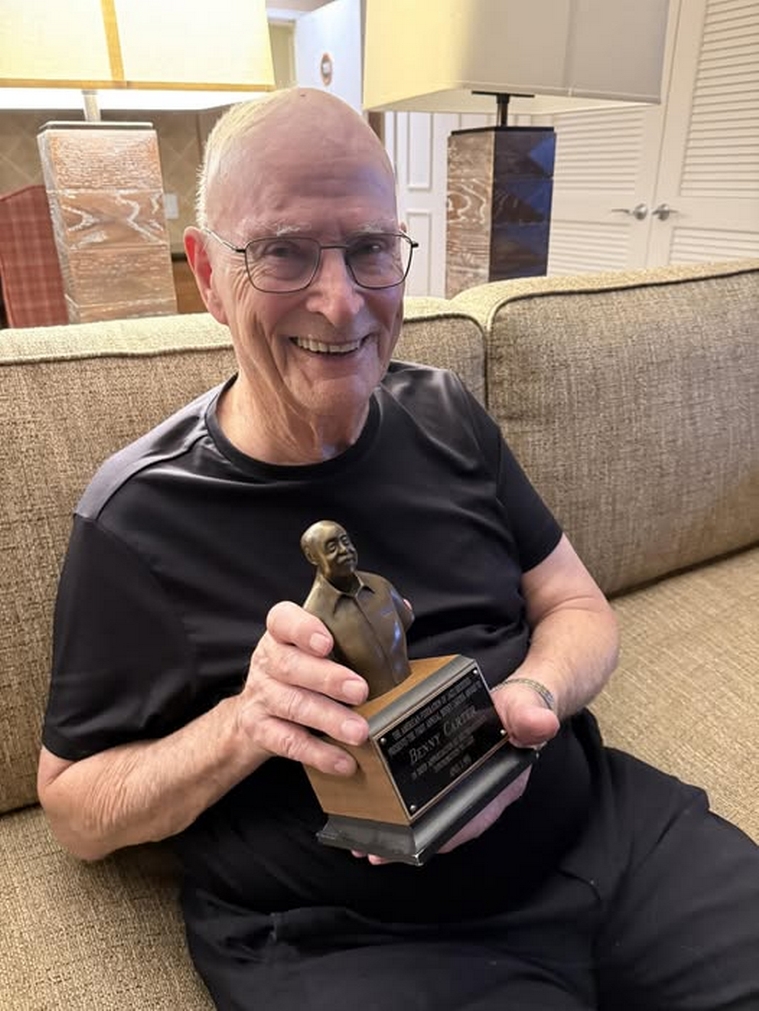
A highlight at the Sun Valley Festival opening ceremonies was the presentation of the Benny Carter Award to veteran reed player Terry Myers in recognition of his long career and many years as a versatile sideman, band leader, and educator. Terry acknowledged he was “totally shocked and surprised, but most appreciative and very honored” to be the recipient.
Fellow musician and former director of the Tommy Dorsey Ortchestra Buddy Morrow is on record, saying “Terry Myers is undoubtedly one of the best all-around reed players in the country today. His versatility and expertise on the saxophone and clarinet are a treat to the ears.” With his smooth, mellow-toned saxophone, he evokes memories of Swing Era stalwarts like Bud Freemen , and when he plays his soprano sax, the thrust and grit of Zoot Sims comes to mind.
11 Years in Education
Terry was born on a farm near Richmond, Iowa and grew up in Des Moines. He received degrees from Drake University and a Master’s from the University of Missouri and went on to hold various teaching and administrative positions for 11 years

In 1972, he moved to Nashville to pursue his great love of music where he worked at Opryland USA and various clubs, followed by time in Orlando, Florida at Disney World and a period in New York City where he played with Vince Giordano’s Nighthawks and Stan Rubin’s big band, In 1983, he returned to Florida to lead a new band at Disney’s EPCOT Center. He also led the band at Rosie O’Grady’s Good Times Jazz Emporium and was an original member of Bill Allred’s Classic Jazz Band. Terry recently retired after more than 10 years as director of the Tommy Dorsey Orchestra.
♫ ♫ ♫ ♫
When Arthur Vint moved back to Tucson to teach at the University of Arizona, he had visions of opening and running a jazz club in his hometown. A chance meeting with the owners of the 107-year-old Hotel Congress led to the creation of the Celebrity Room where jazz can be heard seven nights a week.
Now three-plus years later, Vint extols, “When I founded the Century Room in February 2022, I couldn’t anticipate the amazing community we would build around this little club, including our audiences, our performing musicians and our staff. What we’ve built has been nothing short of amazing, presenting over 500 shows a year, representing everything from student ensembles to Grammy-winning artists and hosting Tucson Jazz Festival events throughout the year.
Expanding Programming
“In 2024, the Century Room forged a partnership with the Tucson Jazz Music Foundation to raise funds for the Century Room Education Program, which has allowed us to provide our musicians with top-of-the-line house instruments, offer discounted and free tickets to music students, and help sponsor lessons and workshops.
“In 2025, I founded the Sonora Arts & Music Initiative to underwrite the Century Room’s community programming, including our Sunday night Century Jazz Jam and Monday night Century Jazz Orchestra. These two events have given opportunities for young musicians to perform and learn during the jam session and the opportunity for students, teachers and professionals to perform together in the CJO.”
In November, a fundraiser to underwrite further programming kicked off with a challenge from an anonymous donor to raise $25,000 in matching funds.
♫ ♫ ♫ ♫
The Bix Beiderbecke Museum & Archives is in the process of relocating from the space it has occupied in the Redstone Building at 129 North Main Street, Davenport since opening in 2017 to larger space in the City Square Building at 112 West Second Street. The move provides the Museum with 30 per cent more space, greater visibility, and is at ground-level right off the street. The Museum is currently closed while construction is underway and is hoping to reopen by the end of the year, with a grand opening planned for early 2026.
A capital campaign to fund the move has been underway and has raised $100,000 in grants and donations to date. Another $20,000 is needed to complete the project. Tax-deductible contributions to reach the $120,000 goal should be sent to Bix Beiderbecke Museum & Archives, 112 West Second Street, Davenport IA 52801 or by contacting director Nathaniel Kraft at 583-293-4046 or by email at director@bixmuseum.org.
The Museum and Archive Collection was established as a non-profit organization for the purpose of collecting, preserving and exhibiting material related to the life and career of the legendary cornetist, pianist and composer, who was a Davenport native and is considered one of the most influential jazz soloists of the 1920s.
Family Memorabilia
The cornerstone of the Museum is a collection of materials from the Beiderbecke family obtained from Elizabeth Beiderbecke Hart and her brother Chis that include photos of Bix as a youth (some of which had never been seen by the public before), letters written to his family, and documents pertaining to his early years in Davenport. The collections compiled by Philip R. Evans, co-author of Bix: Man & Legend, and George Johnsion, tenor saxophonist with the Original Wolverines, are other valuable additions.
Among the major exhibits on display at the Museum are Bix’s horn, the last piano he owned, a replica of the Hudson Lake Resort stage in New Carlisle, Indiana where Bix played in the summer of 1926, and instruments owned by Frank Trumbauer, Bill Rank, Eddie Condon, PeeWee Russell, Chauncey Morehouse and Spiegle Willcox, all of whom had some association with Bix.
Dr. Albert Haim, a retired college educator and noted Bixophile, was responsible for locating the piano that Bix purchased for his apartment in Queens, New York, just prior to his death at the age of 28 in August of 1931. With the help of Christopher Barry, an assignment editor for ABC News Radio, Dr. Haim was able to track the piano (which is in excellent condition) through five different owners before purchasing it in 2012. It is now on loan to the Museum where it is on display.
Lew Shaw started writing about music as the publicist for the famous Berkshire Music Barn in the 1960s. He joined the West Coast Rag in 1989 and has been a guiding light to this paper through the two name changes since then as we grew to become The Syncopated Times. 47 of his profiles of today's top musicians are collected in Jazz Beat: Notes on Classic Jazz.Volume two, Jazz Beat Encore: More Notes on Classic Jazz contains 43 more! Lew taps his extensive network of connections and friends throughout the traditional jazz world to bring us his Jazz Jottings column every month.